The most obvious address. Most cities have municipal clubs and sections attached to sports schools that take adults too - often free or for a token fee. They also run rated tournaments.
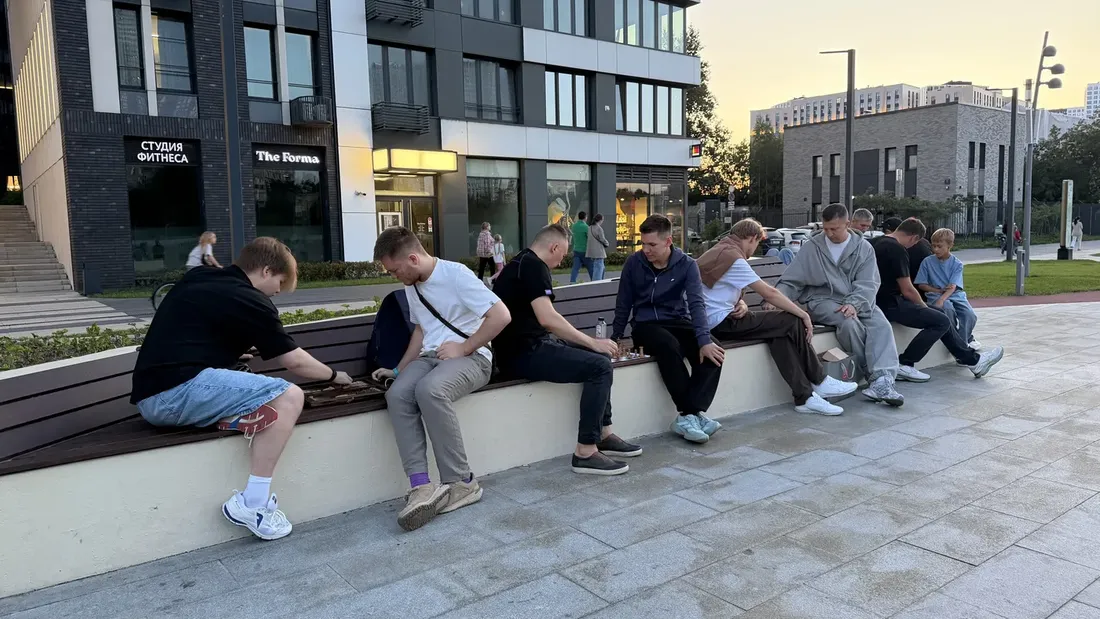
Bigger cities have spots with fixed chess tables, where people play almost every day in summer. The bonus: you can simply walk up and ask for a game, which is the done thing.
A format that has grown over the last few years: an evening at the board instead of talking shop. It is how we play ourselves - chess meetups and tournaments in bars and anti-cafes.
Free venues that have an interest in hosting events themselves. They often have the equipment and a free room already - how that works is in the piece on a tournament in a library.
The fastest way to play a lot of games against different opponents in a single day. There are official rated ones and amateur ones open to everybody - no rating needed.
Your opponents are often sitting in the next room. All you have to do is bring a board: a tournament at the office, a student tournament, a school club.
You do not have to go anywhere. A neighbourhood tournament, at home, at the dacha or a chess party.
If you want to understand the game as well as play it: lessons usually come with practice, and playing partners turn up by themselves.
We have collected real addresses city by city: chess schools and clubs, free municipal sections, federations, a guide to lesson prices. Pick your city and get a concrete list of places you can walk into.
If your city is not on the list, the universal method works: search the maps for “chess club” and “chess section”, look at the schedule of the nearest sports school and at what the city library has on. And almost every city has a local chat of enthusiasts in Telegram - that is the fastest way to arrange a game.
A common situation: the club is far away, there is nobody in the park, and you want to play. Then it is easier not to look for a group but to create one - it takes one evening and needs neither a hall nor a budget.
The whole process is covered step by step in the guide to how to organise a chess tournament. If there are more than ten of you, go straight for Swiss system - it fits even 30 players into one evening.
The main reason people do not go and play in person is the fear of looking weak. A few rules that remove that barrier:
That is exactly what our format is built on: evenings in cafes and bars, where people turn up who last played at school. For companies there is a separate option - a corporate tournament, fully run for you.
Once more than eight people have gathered, the main problem with playing offline is not finding opponents but doing the arithmetic: who plays whom in the next round, who has how many points, who finishes first. That can be handed to the bot.
Vibe Chess Bot pairs the rounds by the Swiss system, sends the players their pairings with board numbers, collects the results and keeps the standings with the Buchholz score. What that is and how to use it - an overview of the Vibe Chess Bot and the organiser's guide. Not having Telegram is no obstacle - they are added as a guest by name.
Start with informal places: evenings in cafes and bars, tournaments in the yard or at home. Nobody asks about your rating there, and a short time control makes losing painless. Leave clubs and official tournaments for later, when you want the competitive side of it.
No. Municipal clubs and amateur tournaments let everyone in; a rating is only needed for official rated events. The easiest way to check the schedule is to phone: many clubs keep no social media.
Often nothing: municipal clubs, parks, libraries and youth centres charge nothing. In a cafe or an anti-cafe you pay only for your order or for your time. Tournaments sometimes have an entry fee - usually it goes into the prize fund.
Put a game together yourself - it is easier than it sounds. Six to eight people you know is already enough for a proper tournament, and any place will do: a kitchen, a meeting room, a cafe, a bench in the yard. The bot will take on the pairing and the scoring.
At a Swiss tournament it happens by itself: after the first round or two you are playing people on the same score. That is why even a random group of mixed strength sorts itself out quickly.
Not for a friendly game, but it is more fun with one: the game does not drag on and you get to play many times in an evening. You do not have to buy a set - a free online timer in your phone's browser will do.
Yes, at places with fixed chess tables that is the normal thing to do: you walk up and ask whether the table is free. In summer, in the bigger cities, people play there almost every day, and beginners are usually welcome.
The Vibe Chess app is built for an evening over the board, not for online play: it keeps the sign-up list, the pairings and the table while you deal with people and the venue. All of it free.
The bot is constantly improved based on real tournaments. If you need a feature that isn't there yet, message the developers right inside the bot with the /support command. Many features appeared exactly because organizers asked for them, and useful ideas get added quickly.
Our own format is chess meetups in cafes and bars. Organising one yourself - a step-by-step guide. About the bot - what the Vibe Chess Bot is. Clocks for the games - an online chess clock.

At the board since childhood: hazy about his rating, precise about every rook he has blundered. Counts an evening as a good one if the opponent stayed to talk afterwards instead of rushing off to check with an engine. Message →