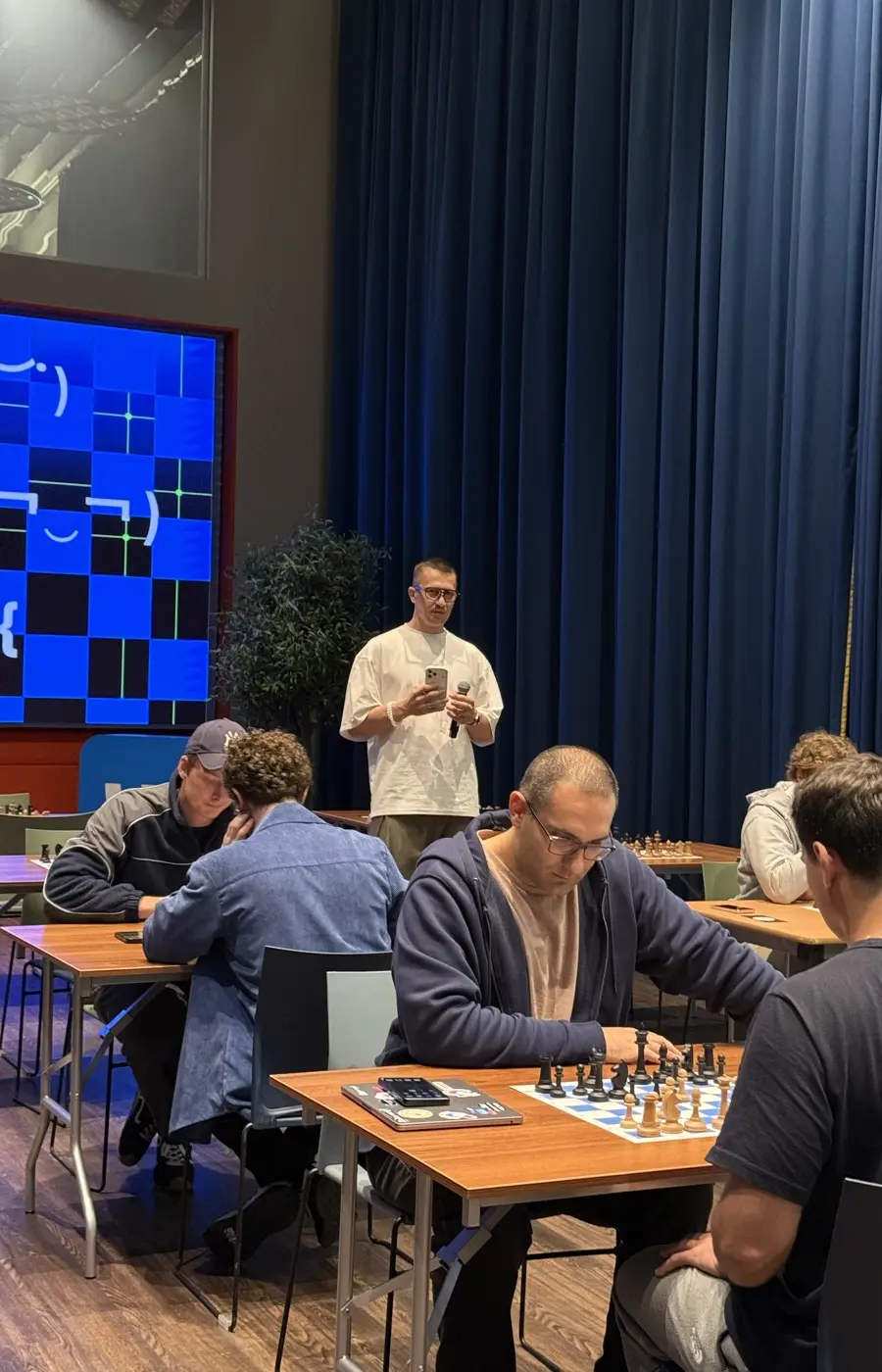
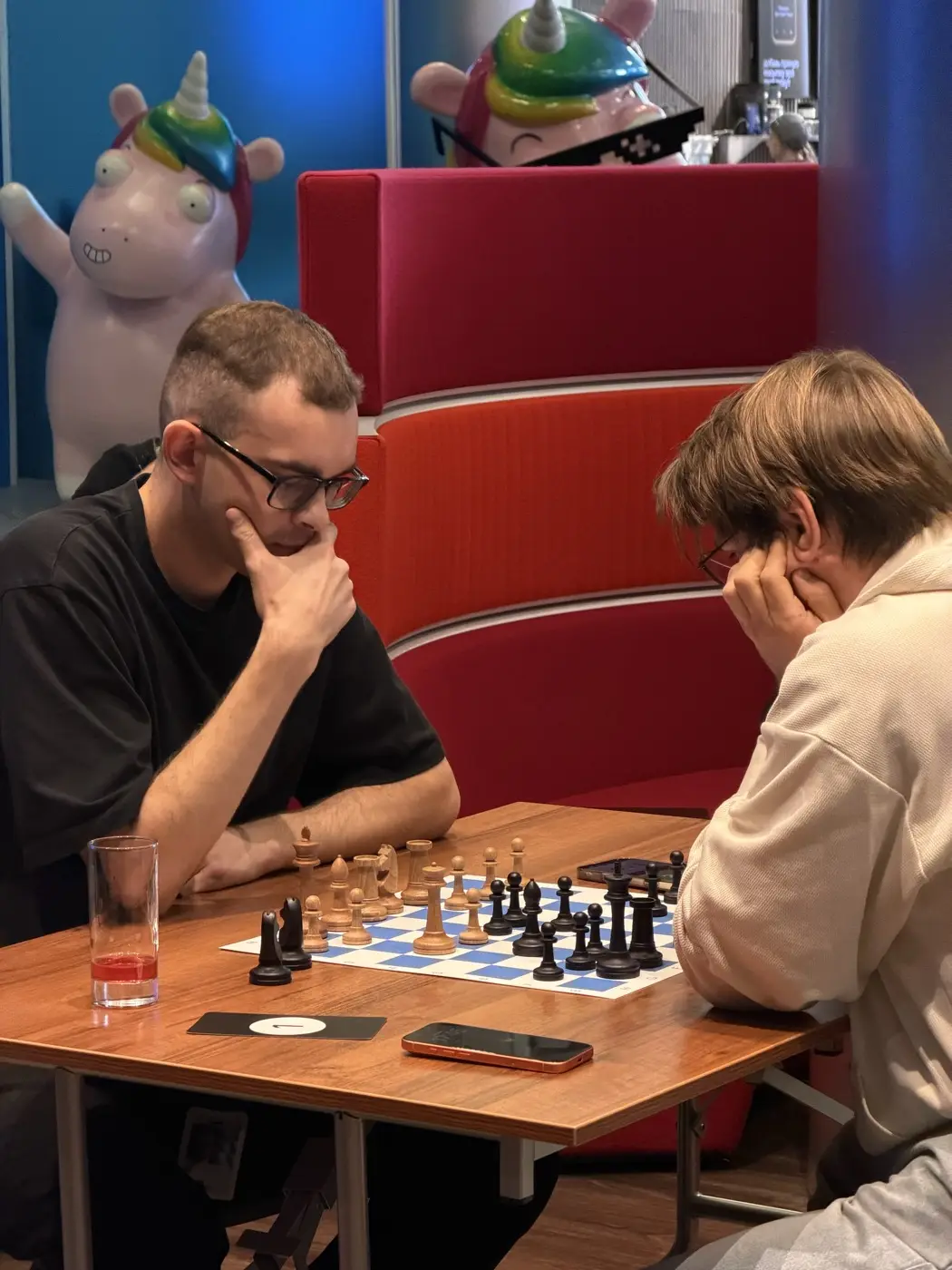
A tournament is a competition with a beginning, an end and a winner. An activity is something you can join at any moment and leave whenever you like. At a corporate event the difference is fundamental: the guests have food, conversations, their bosses and the urge to step out for a smoke, and an event that requires attendance at all seven rounds breaks at the very first break.
Hence three requirements for the format, worth checking before you agree to any activity at all:
Next come the formats that meet these requirements. You can run them one at a time or combine them into an evening's programme.
The format that in our experience involves the most people per unit of time. Everyone opens the app on their own phone and solves chess puzzles against the clock, from easy to hard. You start with five minutes; a correct solution adds ten seconds and a mistake takes away five. There are twenty puzzles, each harder than the last: the run ends either when the time runs out or when the puzzles do.
The results go to a shared screen. A projector in the room shows the table in real time: who has scored what, who is leading now, whose result has just pushed a colleague down. That changes everything - it is no longer twenty people solving separately but a room watching the screen and commenting.
Besides the points, every run earns a category: “sniper” for not a single mistake, “marathon runner” for reaching the furthest puzzle, “ice man” for thinking longest and solving first time, “kamikaze” for the most attempts but still getting to the end. The point is that more than just the winner comes off the screen: the person who solved the fewest but never once slipped gets their line too.
A practical detail, and the reason the format was built this way: a run happens entirely on the phone and does not depend on the internet. The Wi-Fi at a venue goes down at exactly the moment fifty people press “start” at once - so the puzzles are loaded in advance and the result travels to the server when the connection returns. For the venue that means the quality of the network stops being a risk to the evening.
How long it takes: one run is about five minutes, and the whole activity, with explaining the rules and going over the results, from twenty minutes to an hour, depending on how many rounds you want. It suits a room of any size: a hundred people solve just as easily as ten.
The classic format, and the one that looks most impressive: a strong player goes round the tables and plays ten to twenty people at once. The guests sit, the player walks the circle, and each of them makes their move in the few seconds while he is coming over.
Why it works at a corporate event: a player does not need to know how to play - they just need to move the pieces; losing to a professional is no disgrace by definition, while a draw or a win against a master turns into a story someone tells for years. There is a separate bonus in the spectacle: the people who did not sit down to play gather round the display.
How long it takes: an hour and a half to two hours for twenty boards. What you need: tables around the perimeter, sets of pieces and room for the player to walk between the rows.
Short games of three to five minutes, a new opponent every round and a table calculated automatically. The sporting part of the evening for those who really do play - but in a format that fits into an hour rather than half a day.
The key to stopping the blitz turning into a closed club for the strong: Swiss-system pairing. It puts a beginner up against another beginner as early as round two, and instead of a thrashing the person gets an even game - how the Swiss system works.
How long it takes: five rounds at 5+3 is about an hour with the moves between tables. What you need: tables, boards and clocks or a timer on a phone - a free chess clock opens right in the browser, and there is no equipment to buy.
Sales against development, accounting against marketing. Each team puts out four to six boards and the points add up to a combined score. It works where ordinary team building fails: people do not have to perform togetherness, they simply support their own side.
A useful detail: put on board one not the strongest player but the one who is more interesting to watch. Board one is always the centre of attention, and the mood of the whole team depends on it.
How long it takes: an hour to an hour and a half. There is more on the format in a team chess tournament.
A master plays without looking at the board: the moves are announced aloud and the position is shown on a screen for the room. This is not so much an activity as a turn - five to ten minutes of pure astonishment, well placed between the food and the dancing, when the room's attention needs gathering into a single point.
A stronger version: the opponent is not one person but the whole room, with the moves chosen by a vote. The spectators then stop being spectators.
Metre-high pieces on a floor board. They are awkward to play on, and that is fine: their job is to gather people and photographs, not games. They go in the welcome area, work all evening with no host and need no explaining.
A practical tip: it is worth putting an ordinary board next to the giant one. People come over for a photograph and stay to play - but at a normal table.
A background activity: a position goes up on the screen with the question “mate in two”, and answers are taken all evening. It needs neither a host nor its own slot in the programme - it runs alongside everything else.
It covers the gaps well: while the tables are being laid or the equipment changed, the room has something to occupy its mind. The prize at the end of the evening is a formality; what matters is going through the solution in public.
Two teams play a single game, discussing every move out loud. Inside a team people argue, suggest and talk each other round - and that is the whole point: over the board you can see who in a department listens, who pushes through and who has the best idea but keeps quiet.
A format for small groups - up to eight people a team. Beyond that the discussion turns into a din and the game sinks.
Three activities in an evening is the ceiling. More will not fit: a corporate event also has food, speeches and the informal part that most people came for in the first place.
Working out the timing for your number of guests is in the tournament schedule, and the costing in what organising one costs.
The equipment - boards, pieces and clocks - is usually brought by the organiser. What exactly you need and how much of it is in boards and pieces for a tournament.
Vibe Chess puts on a turnkey corporate chess party- from choosing the formats to suit your room and your number of guests to the host, the equipment, the arbiting and the prizegiving. We run chess evenings in bars and cafes in dozens of cities, and a corporate event is built from the same parts, only shaped to the company's brief.
The puzzle sprint with the results on a shared screen is our own development: the app hands puzzles out to the players' phones, counts the points and the categories and keeps the room's table in real time. There is nothing to install - a player opens a link and plays.
The tournament part is run in Vibe Chess app: players sign up by QR code, the pairing follows FIDE rules and the live table goes on the screen. The organiser needs neither Excel nor a separate arbiter with a laptop.
The puzzle sprint and giant chess. In the sprint you do not need to be able to play a game - you need to find one strong move in a ready position, and the hints and the analysis go straight up on the screen. Giant chess works as a photo spot and draws in the people who never sit down at a board at all.
The sprint has almost no limit: everyone plays from their own phone, and a hundred players work just as well as ten. A simultaneous display takes up to twenty boards against one player, and a blitz tournament as many as fit at the tables.
The sprint is ready for that: the puzzles are loaded in advance and solved on the device, and the result goes to the server when the connection comes back. The tournament part survives a dropout too - the pairing and the table stay with the organiser.
The sprint is about five minutes a run, and the whole activity twenty to sixty minutes. A simultaneous display takes an hour and a half to two hours, a five-round blitz tournament about an hour, and blindfold chess five to ten minutes. It is not worth putting more than three activities into one evening.
No. A player opens a link or scans a QR code and plays straight away - the app works in the browser and in Telegram.
Yes, and that is a common choice: a meeting room or an open-plan office after six in the evening works perfectly. You need tables, light and a screen - the organiser brings the rest.
No arbiter skills required. The app takes over the part that usually stops people from running tournaments at all: who plays whom in each round and who finishes first.
The bot is constantly improved based on real tournaments. If you need a feature that isn't there yet, message the developers right inside the bot with the /support command. Many features appeared exactly because organizers asked for them, and useful ideas get added quickly.
Related - turnkey corporate tournaments, chess team building, a family day tournament. Venues - a hotel and a festival. Documents - a proposal.
At the board since childhood: hazy about his rating, precise about every rook he has blundered. Counts an evening as a good one if the opponent stayed to talk afterwards instead of rushing off to check with an engine. Message →