This is a blank tournament table: the grid, the header and the final columns are already ruled, and the names and results are written in by hand. It is free to download with no registration, and the file is ready to print on A4.
All three forms are made the same way and differ only in the size of the grid. The fewer the players, the larger the cells - choose by the number of players who will realistically turn up.
The largest cells - easy to fill in by hand and to pin on the wall. A good choice for a school club or a family or office tournament.
A full round robin: 45 games, 9 rounds.
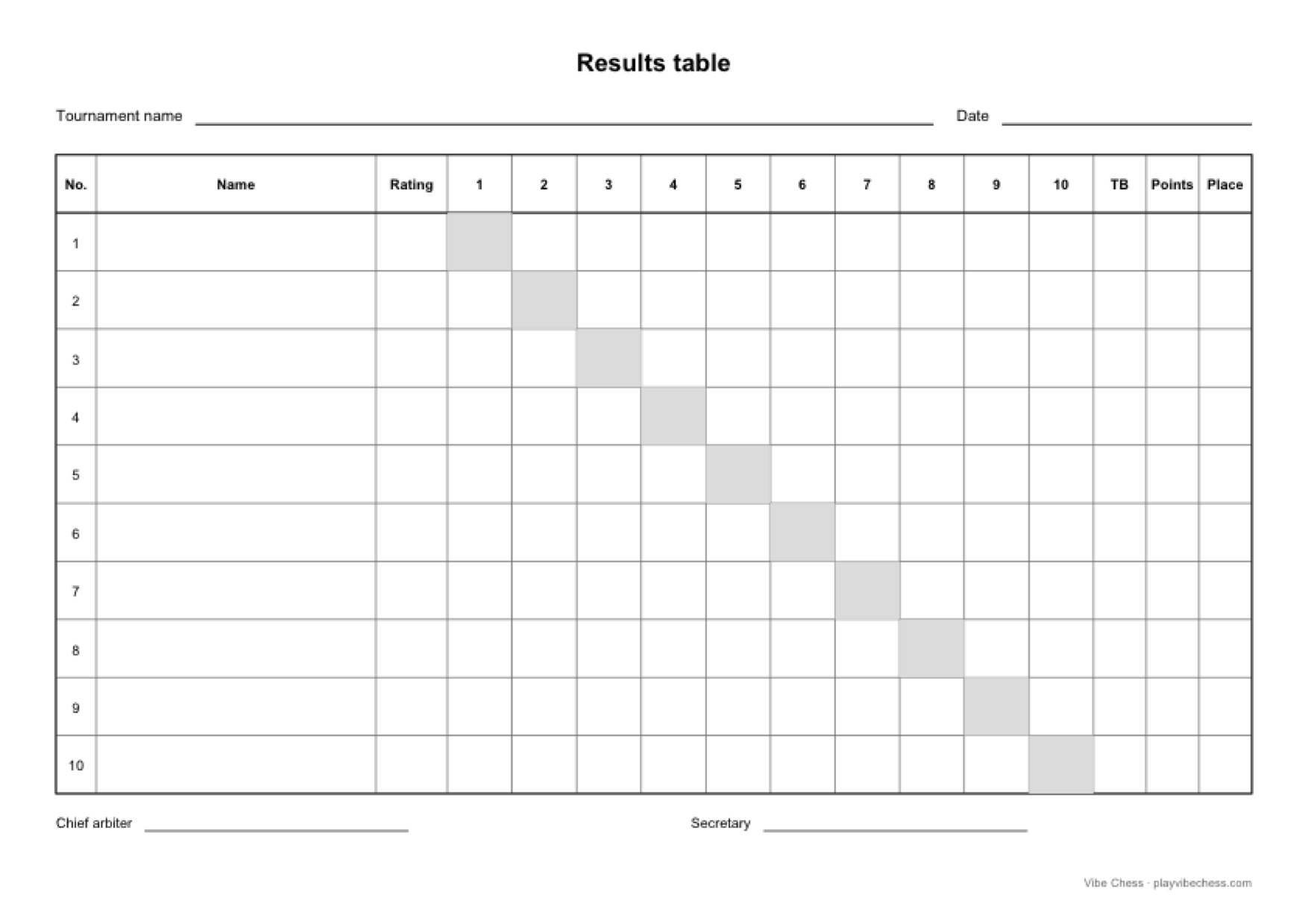
The classic size for a club round robin. The number of players is odd, so one player is free in every round.
A full round robin: 105 games, 15 rounds.
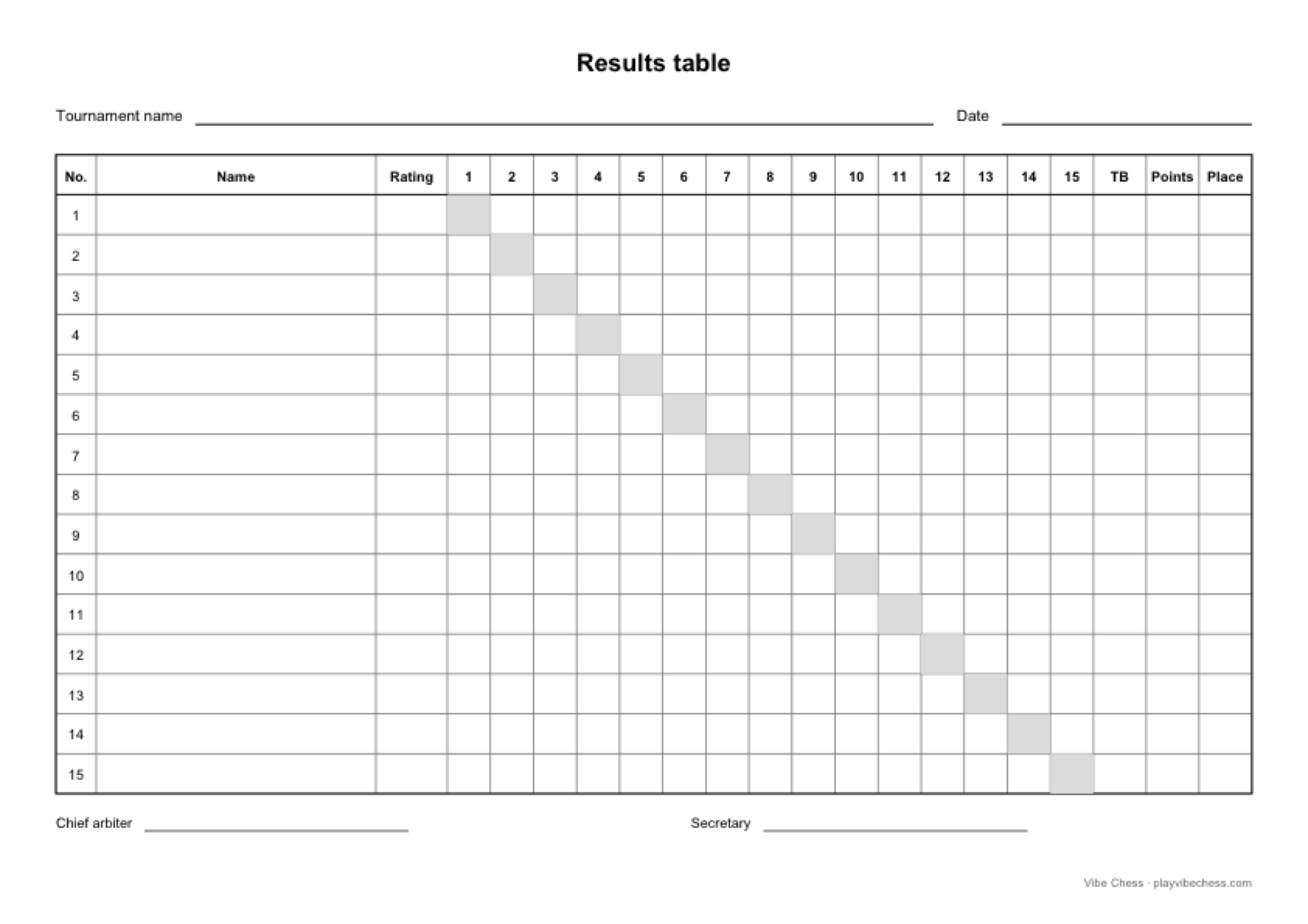
The most that fits on A4 without becoming unreadable. The cells are smaller - for a tournament this size it is better to print on A3 or keep the table in the bot.
A full round robin: 190 games, 19 rounds.
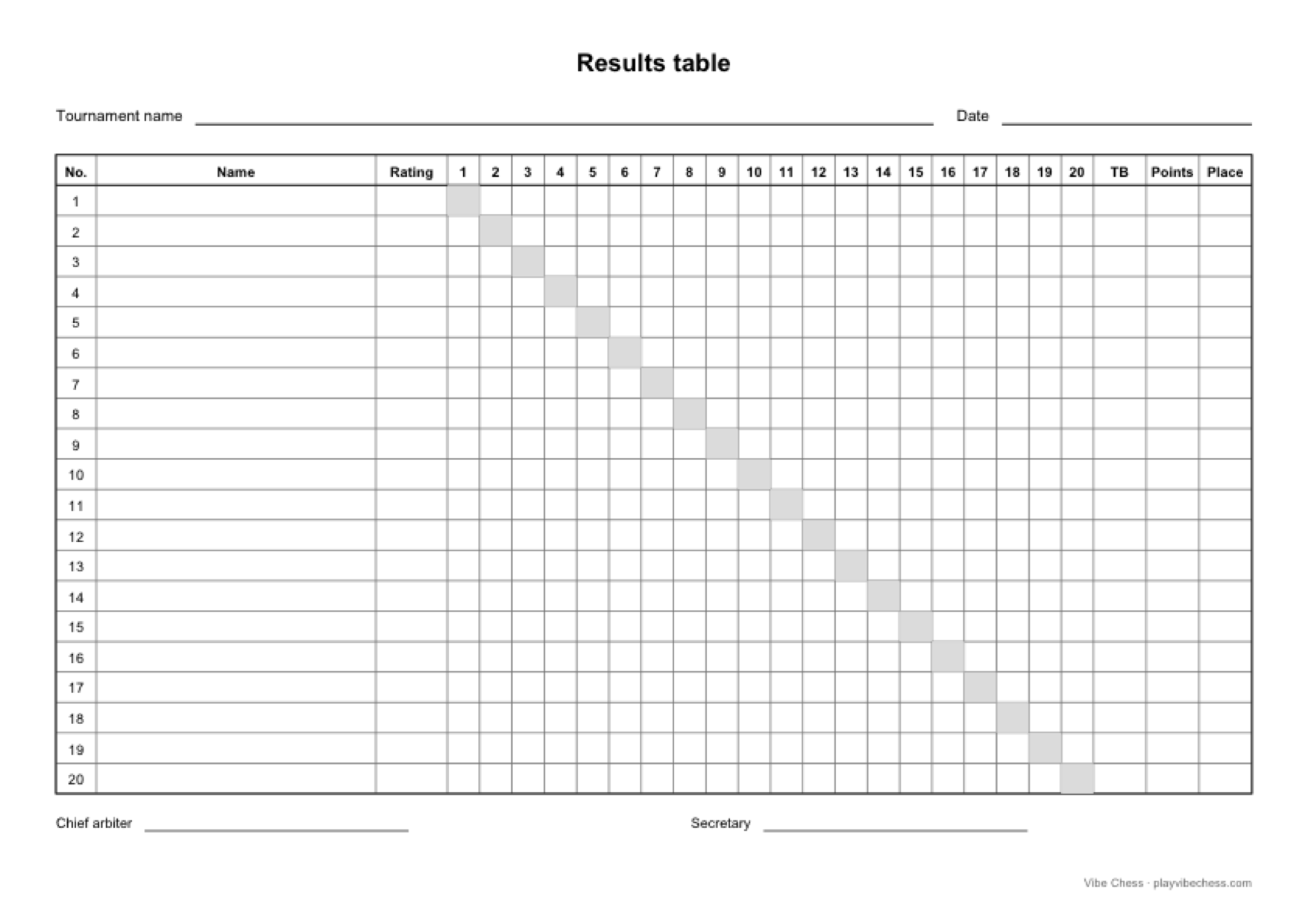
This is a round-robin table(also called a crosstable): every player plays every other. On the left are the player's number and surname, and beyond them the columns with the opponents' numbers. The result of a game is written in the cell where they cross. The grey diagonal is the “against yourself” cells, and they stay empty.
On the right are three final columns: TB (the tie-break that separates equal scores), Points and Place. The “Rank” column is for official tournaments - in a friendly event you can leave it empty.
Here is the same 10-player form, but filled in to the end - the tournament has been played and the placings decided. Let us use it to go through what goes where.
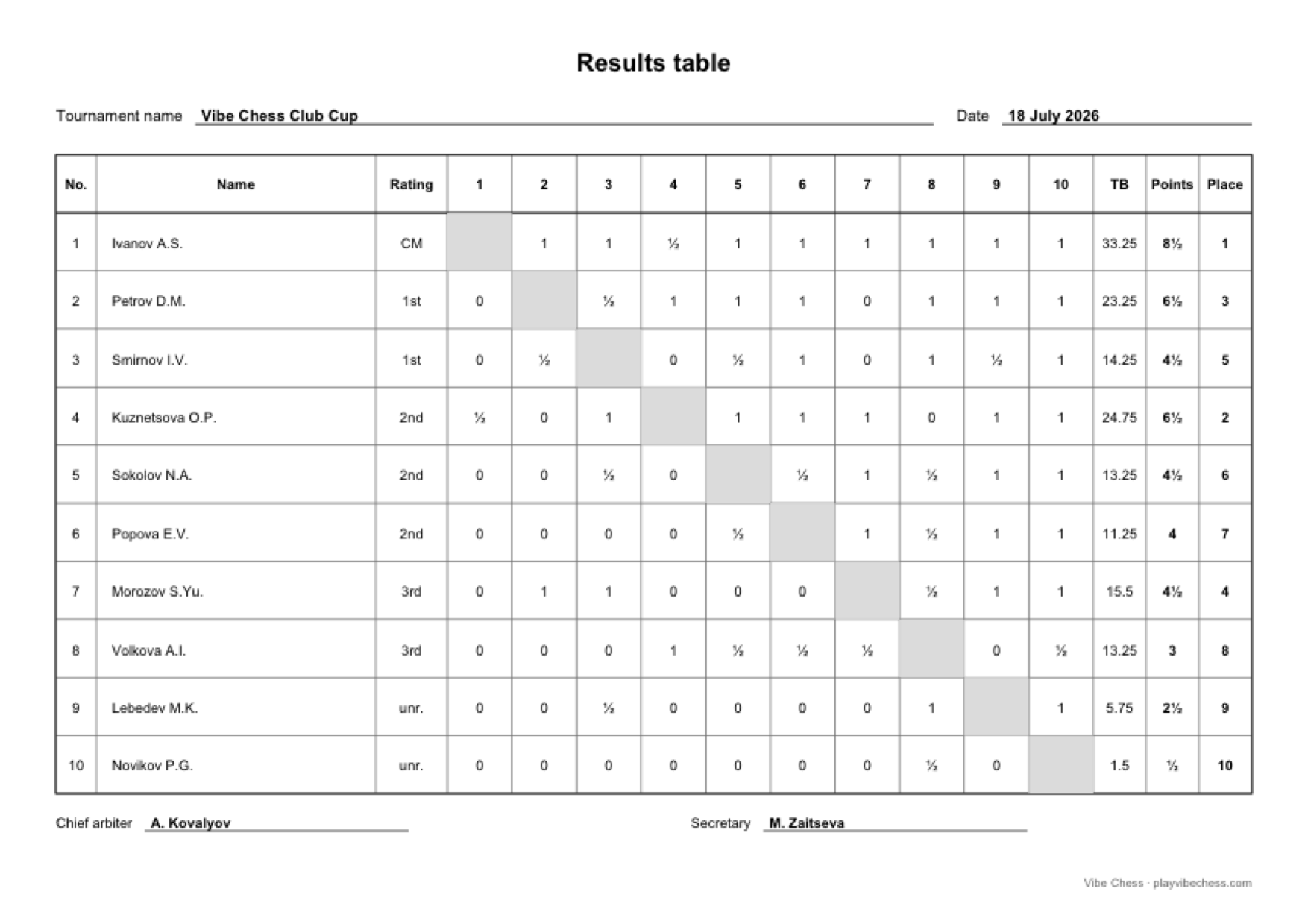
A common beginner's mistake is to fill in only “your” half of the table. The row totals then fail to add up and the standings have to be worked out all over again. Enter both cells straight after the game, while the result is still fresh.
Add up everyone's points. The total must match the number of games played - every game hands out exactly one point between two players (1+0 or ½+½). In the example above: 8½ + 6½ + 4½ + 6½ + 4½ + 4 + 4½ + 3 + 2½ + ½ = 45, and that is exactly the 45 games of a 10-player round robin. If it does not add up, a cell has been missed somewhere or a result has been entered on one side only.
A few more rules that save the arbiter's nerves:
In round-robin tournaments ties on points are broken by the Sonneborn-Berger score It is worked out like this: the sum of the points of all the opponents the player beat, plus half the sum of the points of those they drew with. Games lost do not count towards it.
The logic is simple: beating a strong player who scored a lot weighs more than beating an also-ran. Whoever has the higher score stands higher in the table. In the example above that is exactly how second and third place were separated.
The main thing about the round robin: the number of games grows as the square. Double the players and the number of games goes up fourfold. So if you have a lot of people, or the tournament has to be finished in one evening, a round robin will not do - take the Swiss system: there a 16-player tournament fits into 5 rounds instead of 15.
These are two different ways of deciding who plays whom. The round-robin table above is for the first. The difference is fundamental, and it decides whether the tournament fits into one evening or stretches over a month.
| A tournament for 16 | Round robin | Swiss |
|---|---|---|
| Rounds | 15 | 5 |
| Games in total | 120 | 40 |
| Games per player | 15 | 5 |
| Tie-break | Sonneborn-Berger score | Buchholz score |
| Fits into one evening | No | Yes |
Hence a simple rule: up to 8-10 people with time to spare - a round robin, it is fairer. More people, or a single evening - a Swiss. There is more on the number of rounds in how many rounds in a Swiss system.
The main practical difference for the organiser: a round-robin grid can be ruled up in advance and kept on paper, and a Swiss one cannot. Before every round you have to sort everyone by points again, keep apart those who have already played and keep track of the colours. At 20 players that is already beyond doing by hand - which is why Swiss tournaments are run in software.
A printed form is a perfectly good solution for a small round robin: nothing breaks, runs out of battery or loses signal. But paper has a limit, and it arrives sooner than you would think:
All of this was automated long ago, free of charge and in two ways to choose from - through a Telegram bot or right through the site. Below is how to start a tournament in each.
It suits the case where the players are on their phones anyway: everyone registers themselves, gets their own pairs and records their own result. The organiser needs neither a computer nor paper.
/my_pairing and /standings.The full version with a walkthrough of every screen is in the organiser's guide. What a player does is in how to play without Telegram.
It happens that Telegram will not open for most of the players and people have already turned up to play. For that case the site has an online tournament section - a web version that works in an ordinary browser, with nothing to install and no messenger needed.
The web version has fewer features than the bot: it does not send the pairs to each player privately and it does not collect results from the players themselves - the organiser does all of that. Its job is a different one: to stop a tournament falling through when people have already gathered for it. If Telegram is working, run it through the bot, where there is more to work with.
Both ways are free and score the tournament by the same rules. And one does not get in the way of the other: many organisers run the tournament in the bot and hang a printed form on the wall so that everyone can see. There is more on the features in tournament software.
It is convenient to play the games with an online chess clock- the timer works right in your phone's browser, and there is nothing to download there either.
Only in the size of the grid: the forms are made for 10, 15 and 20 players. The structure is the same - number, surname, rank, opponent cells, tie-break, points and placing. The fewer the players, the larger the cells and the easier it is to write by hand.
Take one with room to spare: the extra rows and columns simply stay empty, and it makes no difference to the scoring. For an expected 12-14 people, for instance, it makes sense to take the form for 15.
A win is 1, a loss is 0 and a draw is ½ (or 0.5). The result of every game goes straight into two cells: the row of one player and the mirror cell in their opponent's row.
The Sonneborn-Berger score: the sum of the points of the opponents you beat, plus half the points of those you drew with. It is only needed to separate players on the same number of points - if nobody is level, you can leave the column empty.
Count by the number of rounds: 9 rounds for 10 players, 15 for 15 and 19 for 20. In a single evening you can realistically only play blitz, and only in a small group. The round robin is a format for a club that meets regularly.
For official tournaments: it holds the player's sporting rank or rating. In a friendly tournament you can leave the column empty or use it for something of your own - a school class, a department or a team name, for instance.
No, all three templates are free. Download them, print as many as you like and use them at your tournaments - no registration needed.
Yes. The files are made in A4, but when printing you can choose to scale them to A3 and the cells get larger. For the 20-player form this is particularly handy if the table hangs on the wall and several people fill it in.
No, this is a round-robin table, where everyone plays everyone. In the Swiss system opponents are decided afresh each round, so you need a different form: a list of players and the results by round. That kind of tournament is easier to keep in the bot than on paper.
In a round robin everyone plays everyone, so the number of rounds is tied to the number of players: for 16 people that is 15 rounds and 120 games. In a Swiss the opponent is picked before each round from the players on the same score, and you set the number of rounds yourself: the same 16 people play 5 rounds and 40 games. The round robin is more objective; the Swiss fits into one evening.
Add up everyone's points: the total must match the number of games played, because every game hands out exactly one point between two players. For a round robin of 10 that is 45, for 15 it is 105 and for 20 it is 190. If it does not add up, a cell has been missed somewhere or a result has been entered on one side only.
As a loss: 1 to the opponent, 0 to the absentee. If neither player turns up, both get 0 - that game then hands out no point at all rather than one, and the check total has to be reduced by one.
Yes. The main tool is the @vibechessbot bot on Telegram: it does the pairing, sends out the pairs, collects results from the players themselves and recalculates the table with the Buchholz score. If Telegram is not working for your players, there is a fallback web version on the site - it has fewer features and the organiser enters the results, but it will get the tournament played. Both are free.
No. If the tournament runs through the bot, the organiser adds such a player as a guest by name and they play in the general pairing - the organiser enters their results. And if you run the tournament through the section on the site, the organiser types in the whole player list on the spot.
Everything people usually keep in a spreadsheet is already in the app: pairings, points, tie-breaks, round order. Free, with no subscriptions and no cap on the number of players.
many players, one evening: four or five rounds are enough
the fairest format for six to ten players
not a tournament, just an evening of chess - who is free and who is playing is visible in the app
The bot is constantly improved based on real tournaments. If you need a feature that isn't there yet, message the developers right inside the bot with the /support command. Many features appeared exactly because organizers asked for them, and useful ideas get added quickly.
With no paper at all - an online tournament table. Getting ready to start - the organiser's checklist. From scratch, step by step - how to run a tournament. Clocks for the games - an online chess clock.

At the board since childhood: hazy about his rating, precise about every rook he has blundered. Counts an evening as a good one if the opponent stayed to talk afterwards instead of rushing off to check with an engine. Message →