Running a tournament is easier than it looks: you need an hour of preparation, one page of regulations and a tool for the pairing. Below are seven steps from the idea to the final standings: the format, the time control, the regulations, the equipment, Swiss pairing and the Buchholz calculation. The guide suits a club, a school, an office or a tournament in the yard.
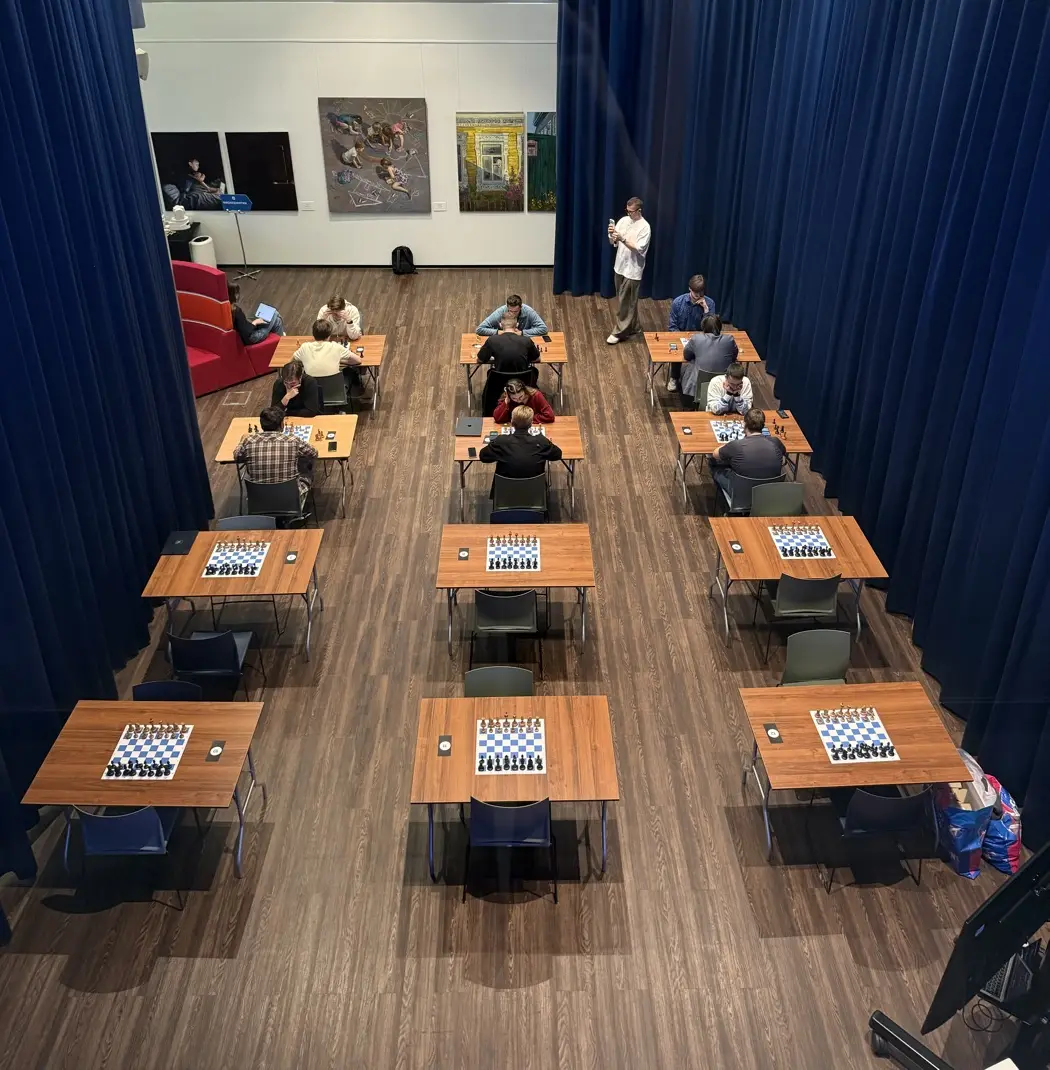
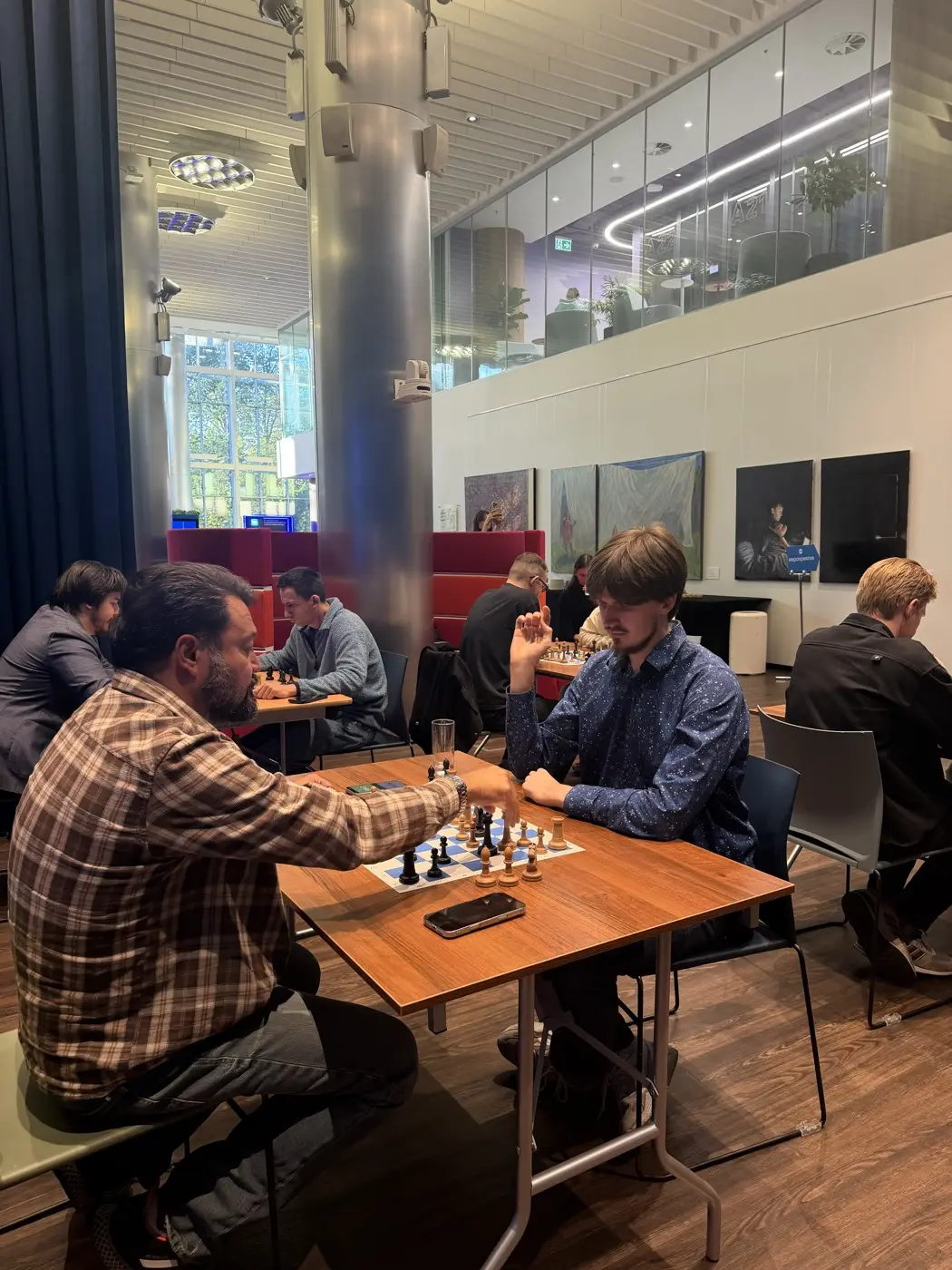
Up to 8-10 players, a convenient choice is the round robin: everyone plays everyone and the outcome is as fair as it gets. From 10 players choose Swiss system - everyone plays the same number of rounds, nobody is knocked out after a loss, and pairings are made by current score: leaders meet leaders.
| Players | Format | Rounds |
|---|---|---|
| up to 8-10 | the round robin | N−1 (everyone plays everyone) |
| 8-16 | Swiss | 5 |
| 17-32 | Swiss | 6 |
| 33-64 | Swiss | 7 |
| 65-128 | Swiss | 8-9 |
For an evening event at a club or an office, a good choice is blitz 3+2 or 5+0: seven Swiss rounds fit into 2-3 hours. Rapid 10+5 or 15+10 - the happy medium for a weekend event. Leave classical controls of 60 minutes and up to multi-day official competitions.
“3+2” means: 3 minutes for the game each, plus 2 seconds added for every move made.
The regulations are the main document: they settle 90% of the disputes before round one. A checklist of what to include:
We have a separate detailed walk-through of tie-breaks - the Buchholz score: formulas and examples.
You need as many boards and clocks as there are pairs: the field ÷ 2, plus a spare set. Clocks are usually the first thing to run short - the tables without them get a chess clock in the browser: everyone has a phone, and as far as the time control goes such a table is no different from the one next to it. For classical play add scoresheets for recording the moves. Set aside a table for the arbiter and a place where everyone can see the pairings and the standings - a printout on the wall or a screen from a phone.
Pairing a Swiss by hand turns into a puzzle at 10 players already: you may not repeat a pairing, you have to alternate the colours and take the scores into account. That is why the pairing is left to software - a review of the options is in the article on chess tournament software.
The quickest route is the free the Vibe Chess app: you create the tournament, players join by a link, the bot pairs the Swiss rounds itself, works out the points and Buchholz after each round and shows live standings. There is also a browser organiser app - with nothing to install.
Before round one, announce the rules: how many minutes late a player may be, what to do in a dispute (stop the clock and call the arbiter), phones put away. Enter the results right after each game - then the pairing for the next round is ready a minute after the last board finishes.
Among players on equal points the places are decided by the tie-breaks from your regulations - how to calculate them is in the walk-through of Buchholz. Publish the final standings where the players gather and announce the next tournament straight away - the best moment for that comes a minute after the prize-giving.
If you want the event counted towards an official national or FIDE rating, you will need a licensed arbiter and an application to the federation filed in advance, before the start.
The Vibe Chess bot pairs the Swiss rounds for free, works out the points and Buchholz after every round and shows live standings to all the players. Creating a tournament takes a minute.
Organising is easier to start not with a table in a notebook but with an event in the Vibe Chess app. Creating one is free, and the format is chosen to fit your group:
From there everything follows one script: you open the entry list and send out the link, tap “Start tournament” - the app announces the pairings, you enter the results - and the table with the points and Buchholz recalculates itself. At the end all that is left is to show the final standings and, if you need to, export a TRF report.
Step-by-step instructions for a specific task - from your first tournament to the finer points of the mechanics.
A practical guide: 8-16 players - 5 rounds, 17-32 - 6 rounds, 33-64 - 7 rounds, 65-128 - 8-9 rounds. The logic is simple: there have to be enough rounds to produce a single winner, so the number grows like the binary logarithm of the field plus a margin for shared points.
Create a tournament in the Vibe Chess Telegram bot: players join by a link, the bot pairs every round by the Swiss system, keeps an eye on colour alternation and repeat pairings, and works out the points and Buchholz. There is also a browser organiser app - free as well, and with nothing to install.
Yes, if it is a round robin of up to 8 players: the everyone-plays-everyone table is drawn on a sheet of paper and the order of games is taken from the Berger tables. A Swiss can be paired by hand too, but at 10-12 players the pairing already takes longer than the games themselves, and mistakes creep in almost every time.
For a club or corporate event an organiser who knows the basic rules and has announced in advance how disputes will be settled is enough. A licensed arbiter is mandatory only where the tournament counts towards an official national or FIDE rating.
It is the sum of all your opponents' scores - the main tie-break of the Swiss system: among players on equal points, the one who faced stronger opposition finishes higher. There is a detailed walk-through with formulas and a step-by-step worked example on our site.
The minimum kit: sets of boards and clocks to match the number of pairs (the field halved), printed regulations of five to seven points, a phone with the bot for the pairing and the standings, an hour and a half for 5 rounds of blitz 3+2 and a small prize - a chocolate medal will do. That is enough for a proper tournament for 8-20 people.
A walk-through of tie-breaks with examples - the Buchholz score in chess. A comparison of software for arbiters - chess tournament software. Newcomers will find useful rules of chess and the correct starting position. Individual situations - emergencies at a tournament and an odd number of players.