Vibe ChessVibe ChessApp

Vibe Chess for chess federations and associations

Alexey Mudry · updated November 1, 2026
Federations and associations run dozens of tournaments a year: city stages, championships, qualifiers, junior and senior events, rated tournaments. All of them can be run in the Vibe Chess app: the app does the pairings under FIDE rules by itself, the arbiter settles disputes right on the phone, and after the tournament gets a TRF report - the file submitted for rating. Below is how the pairings, arbiting and the report work, what players need to provide for a fully automatic tournament, and how to work with us.

What a federation gets

🎲

Pairings under FIDE rules

Swiss system under the Dutch rules, round robin by Berger tables. The app works out pairings and colours.
⚖️

An arbiter in the app

Forfeits, double forfeits, withdrawals, reinstatements, score corrections and disputed games - all from the arbiter's panel.
📊

Tie-breaks

Buchholz in a Swiss, Berger in a round robin - both are in the table, and places on equal points are split automatically.
📄

A ready TRF file

A report in the FIDE format with player data and every round - ready to submit for rating.
📱

No arbiter laptop

Pairings, tables and standings are on every player's phone. The arbiter works from a phone too.
📺

Broadcasting

Games from a phone camera streamed live on live.playvibechess.com - no electronic boards.

Pairings under FIDE rules

Swiss tournaments are paired by the bbpPairings engine under the rules of the FIDE Dutch system - the same system used by most official Swiss events. Round robins follow Berger tables. Neither the organiser nor the arbiter makes the pairings - the app calculates them, and every player sees their table, opponent and colour.
The rules behind the pairings

Score groups

Each round, pairs are made within groups of players on the same score; if a group is odd, one player moves to the neighbouring group.

No repeat games

Two players who have already met do not meet again in the same tournament.

Colour balance

Colours are assigned so that everyone has an equal number of whites and blacks and never three games in a row with the same colour.

Bye

With an odd number of players, one gets a bye worth a point - and no more than once per tournament.

Late arrivals

A player who arrives late joins the pairings from the next round and scores zero for the rounds missed.

Withdrawn players

A player withdrawn from the tournament is no longer paired; their earlier games stay in the record and count for their opponents.
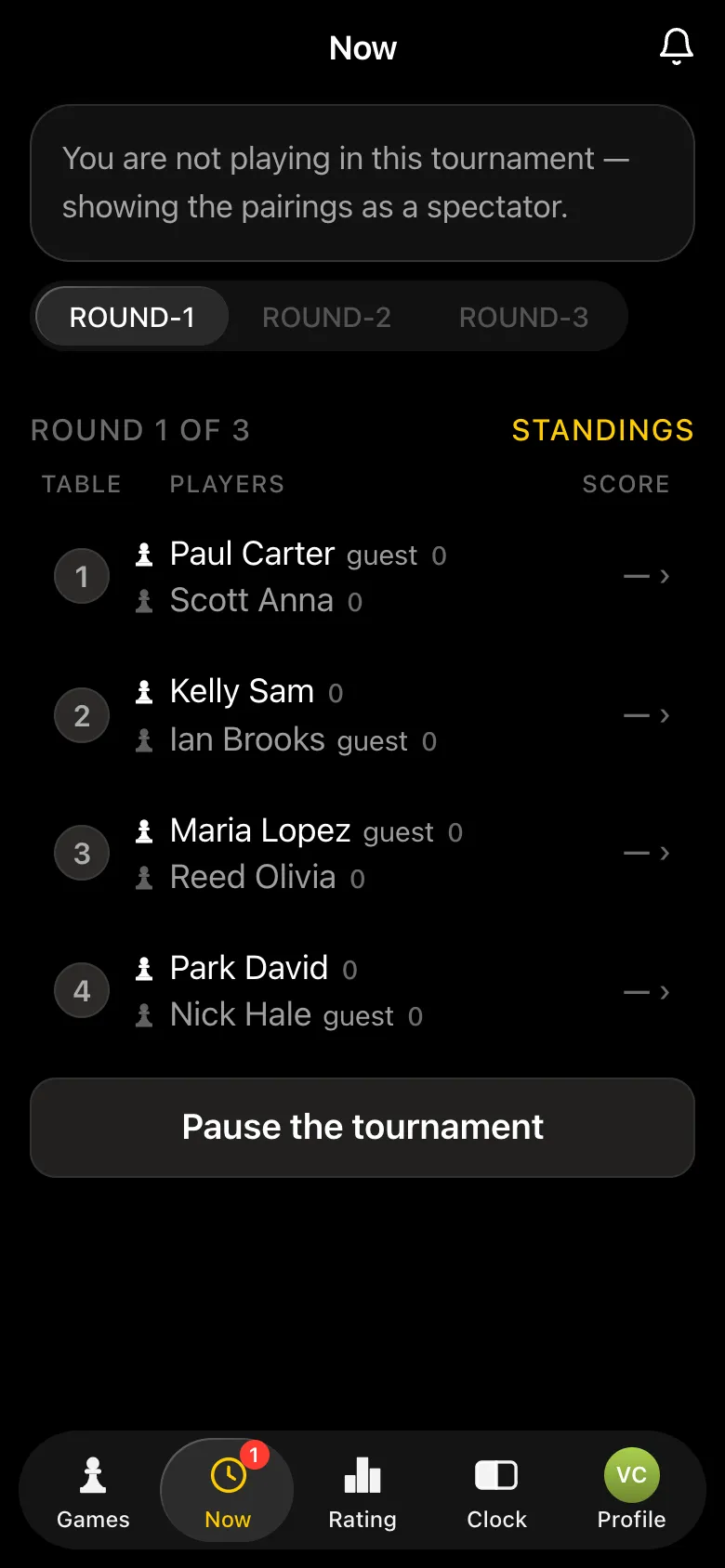
Round one of a Swiss tournament: four tables, each player with White or Black
The app calculates the pairings for each round.
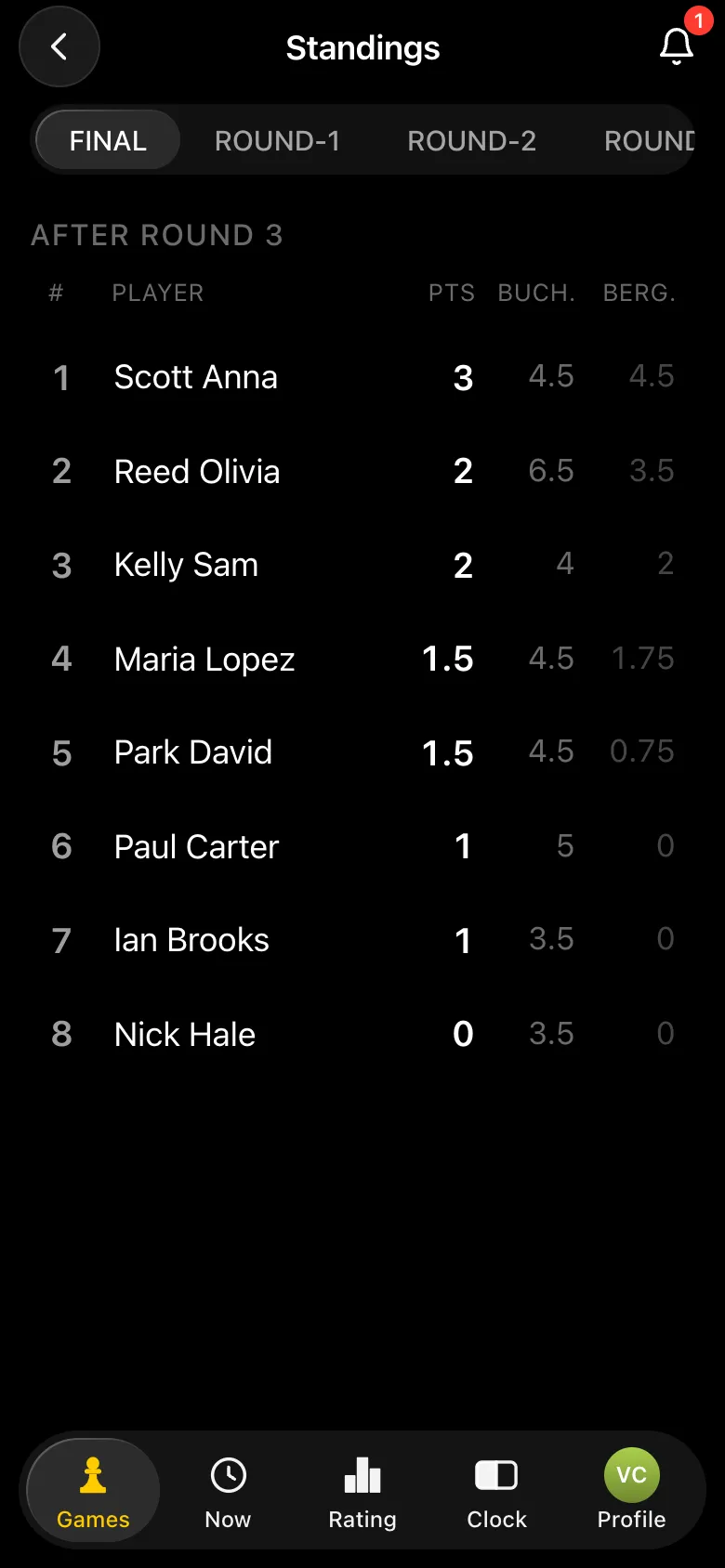
Final standings: places, points, Buchholz and Berger
Standings with tie-breaks.

More on the engine - bbpPairings, on pairings - online chess tournament pairing, on round robins - Berger tables.

Tie-breaks: places on equal points

When points are equal, places are decided by a tie-break, and it differs between a Swiss and a round robin - this matters, and the app takes it into account:

  • • Swiss system - Buchholz: the sum of the opponents' points shows how hard the path was.
  • • Round robin - Berger: everyone plays everyone, so Buchholz is turned upside down - which is why Berger is the main tie-break there.
  • • Both in the table: if the first one is equal, the second decides - and the arbiter can explain the order.

In detail - tie-breaks in chess, FIDE tie-break regulations.

The arbiter in the app: forfeits, disputes and incidents

The tournament organiser has an arbiter's panel in the app. Everything an arbiter decides in the playing hall is decided right from the phone, and the app immediately reflects it in the standings, the pairings and the report:
White wins / Black wins / draw

The arbiter enters the score on the players' behalf. The arbiter's score is final: there is no window for objections.

One side forfeits

The player who turned up gets the win, the absent one is withdrawn. If the arbiter made a mistake, they correct the score and the withdrawn player is reinstated automatically.

Double forfeit

If neither player turns up, both score zero, not a draw. Both are withdrawn; in the TRF both get a minus.

Correcting a recorded score

A result from an earlier round can be fixed without shifting the current round or creating doubled rounds.

Disputed game

One player reports a score, the other disagrees and disputes it - the arbiter settles it with their own score.

Withdrawing and reinstating a player

Withdraw a player before the start or during the tournament, and bring them back.

Attendance

Only players the arbiter has marked as present are paired.

Players without a phone

The arbiter adds them as guests - they get pairings, points and a place in the standings.
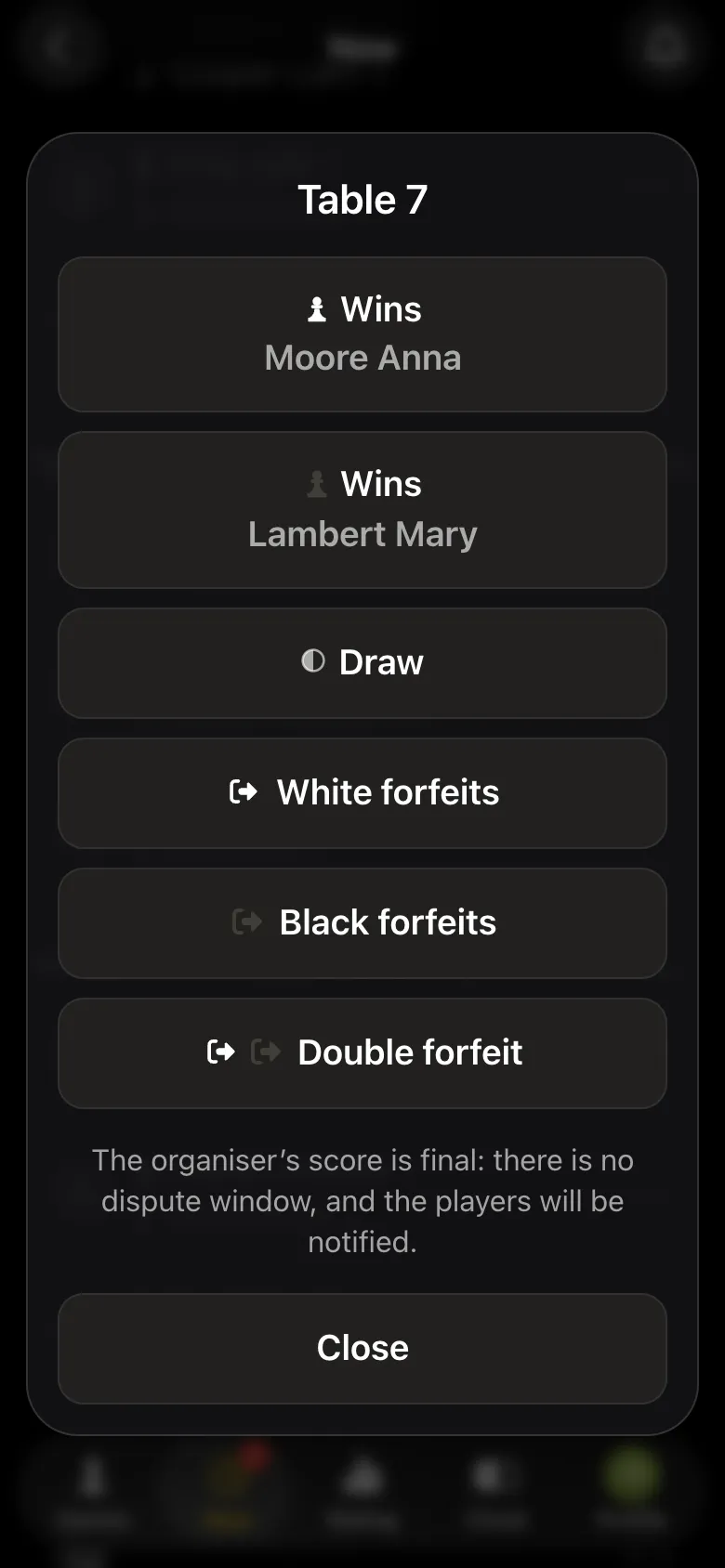
The arbiter's score window: White wins, Black wins, draw, White no-show, Black no-show, double forfeit; the organiser's score is final
The arbiter's score: every outcome, including a double forfeit.
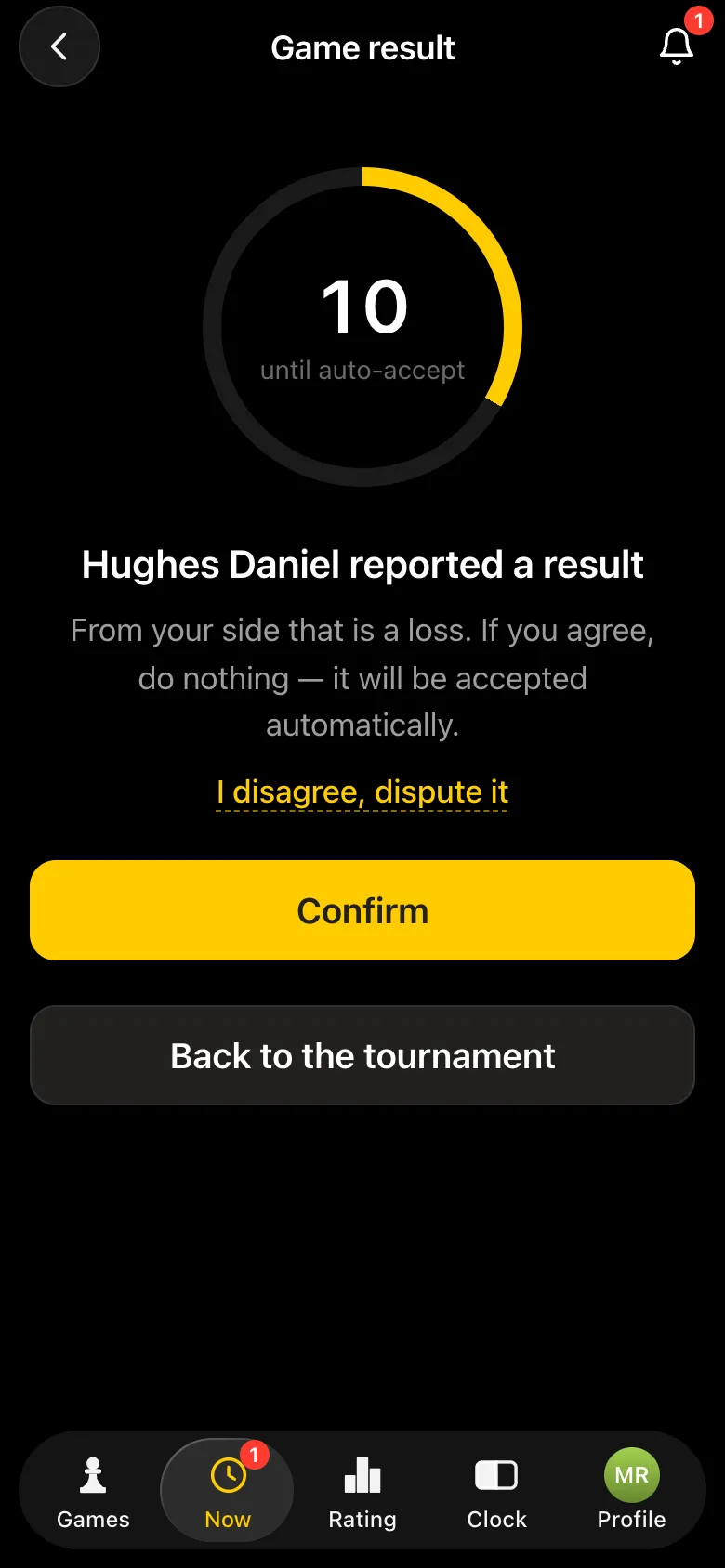
The player's window: the opponent marked the result, buttons Confirm and I disagree, dispute it
A player can dispute - the arbiter decides.
Why a double forfeit is a separate outcome. Recording it as a draw would hand out half a point each for a game that never happened, and there is nobody to award a win to. So in the app both score zero, both are withdrawn, and in the TRF both get a minus - as it should be. In detail - double forfeit in chess.

More on the arbiter's work - arbiting a chess tournament, on withdrawals - removing a player from a tournament, on byes - a bye in a Swiss tournament.

A player profile to FIDE and RCF standards

An official report needs more than names. The Vibe Chess player profile has a section called FIDE and RCF standards (RCF is the Russian Chess Federation), and everything in it goes into the TRF:

  • • First name and surname - in Latin letters in the report, as the format requires.
  • • Sex - a mark in the player line.
  • • Date of birth.
  • • FIDE ID and RCF code - the federation identifies the player by these, not by the spelling of the surname.
  • • Federation - from the player's country, as a three-letter FIDE code.
  • • Title and rating.

A full profile means a fully automatic tournament

If every player has a complete profile, the tournament runs fully automatically: the arbiter admits players by marking attendance, the app handles the pairings, rounds and standings, and at the end the arbiter gets a TRF with every field filled in - ready to submit to the federation or association. Nothing has to be retyped by hand.

Ask players to fill in their profile in advance - in the tournament announcement. The arbiter then only has to check the list before the start and admit those whose details are complete.

The TRF report: a file for rating

TRF (the Krause format) is the standard FIDE format for exchanging tournament data, and it is usually what federations accept for rating. After the tournament the arbiter taps Export TRF report on the event card, and the file arrives as a document in their Telegram.
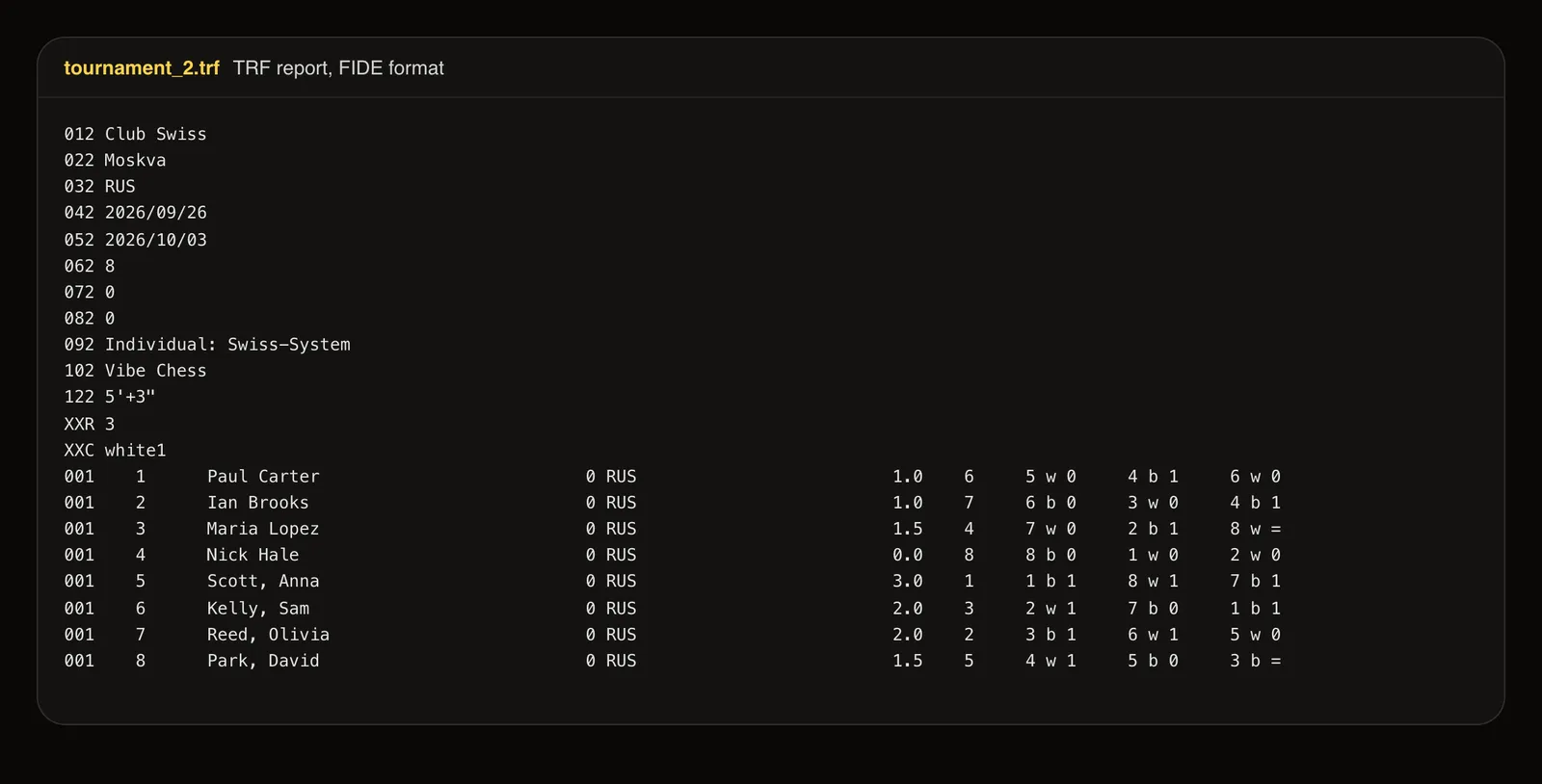
  • • Tournament header: name, city, country, dates, number of players, system, time control.
  • • A line for each player: starting number, sex, title, name, rating, federation, FIDE ID, date of birth, points and place.
  • • Every round: opponent, colour and result, including forfeits, double forfeits and byes.
  • • Groups - if the tournament is split into groups, each is exported as a separate file: for the federation these are separate tournaments.
An example TRF report of a Swiss tournament: header, player lines and round results
The TRF report: the tournament header and player lines with rounds.

Alongside the TRF there are results as a PDF sheet for printing and the prize-giving. The requirements for rating itself (registering the tournament in advance, a qualified arbiter, the time control) should be checked with the federation - a Russian Chess Federation rated tournament, a FIDE-rated tournament, the TRF format.
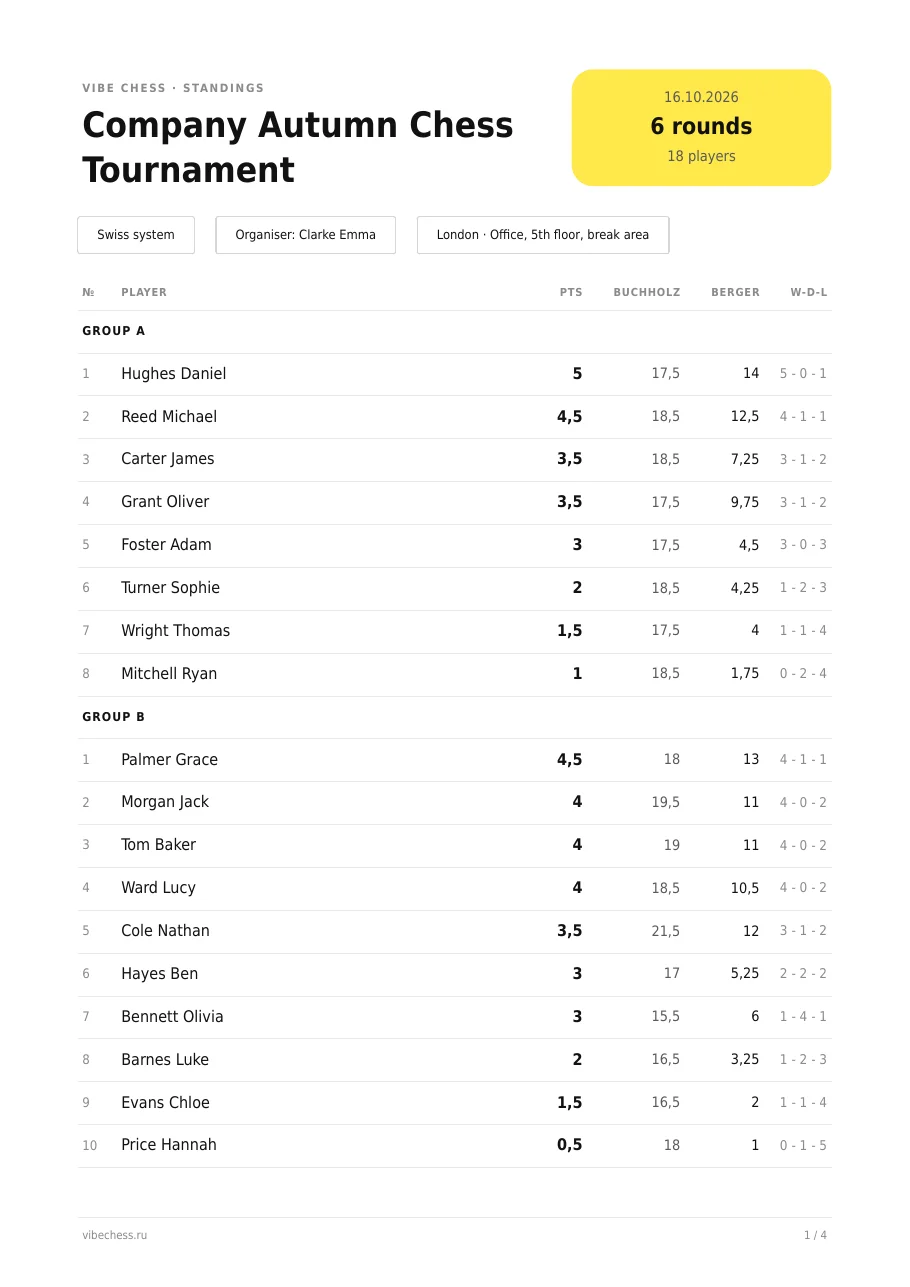
Tournament results as a PDF sheet: places, points, Buchholz, Berger
Results as a PDF sheet.

Reports sent straight to the federation

If your federation or association would like to receive reports of tournaments run in Vibe Chess directly - without arbiters forwarding files - write to us. We can send you the TRF files of tournaments for official rating in the order and format you need. We will discuss the terms and technical details.
What else a federation will find useful

  • • Groups within a tournament - by age and by sex, with separate tables - a tournament for several age groups.
  • • Team tournaments - a team Swiss with team and individual standings.
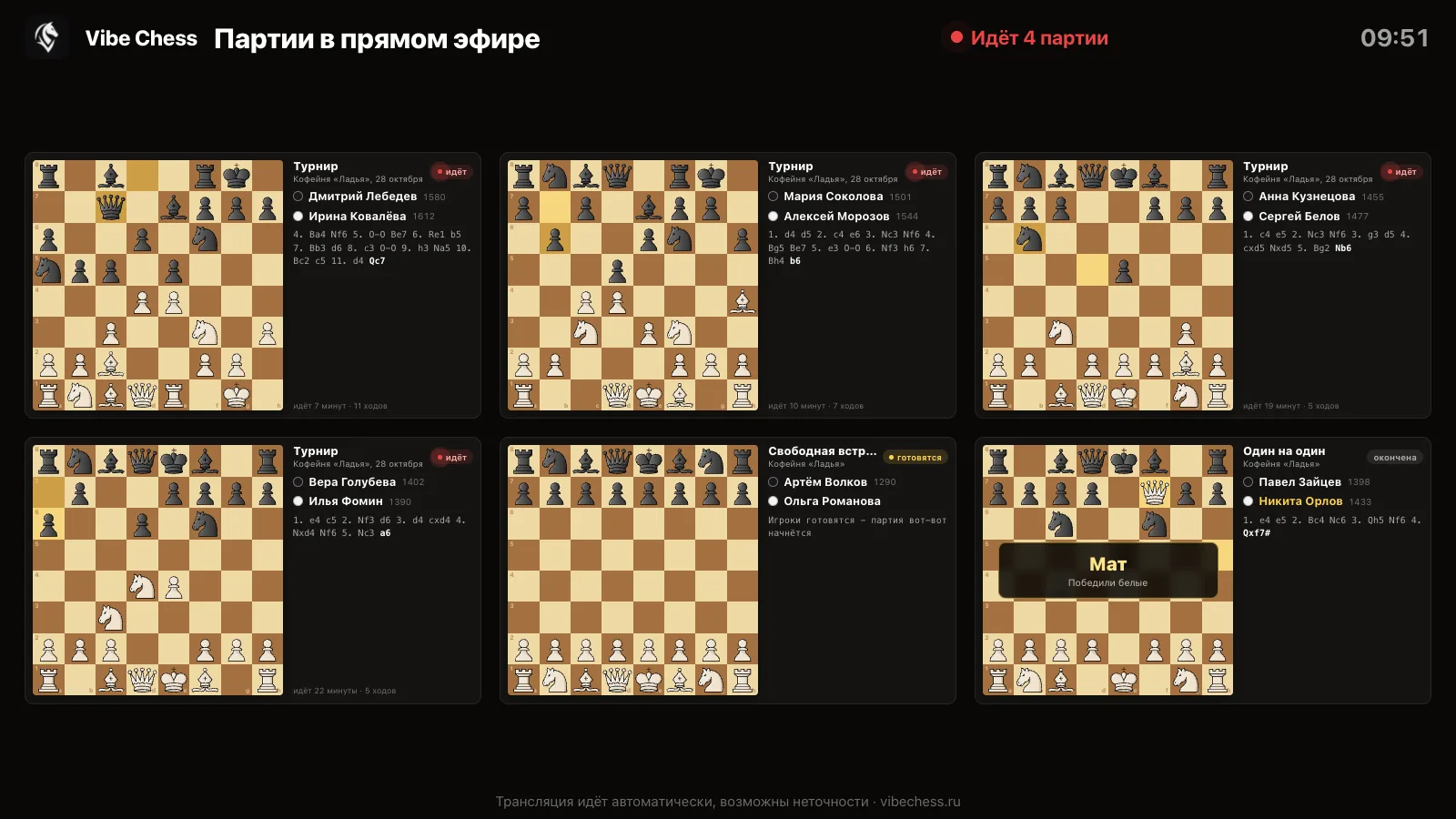
  • • Broadcasting games from a phone camera - no electronic boards - a platform for broadcasting chess games.
  • • Game recording with a camera - for the archive and for checking disputes.
  • • Leagues with their own rating and a season table - for a series of stages.
  • • A screen for the hall - pairings and standings on a projector.
Tournament games broadcast on the live games platform
Broadcasting a federation tournament without electronic boards.

We are open to working together

We build the Vibe Chess app ourselves and want it to be convenient for federations, associations and arbiters. Write to us and share your ideas - we are open to:

  • • sending TRF reports straight to the federation for rating;
  • • supporting your regulations, tie-breaks and reporting forms;
  • • running stages and championships end to end, with a broadcast;
  • • training arbiters and organisers to work in the app;
  • • any ideas of yours - we will discuss them and build them.
Write to us on Telegram

Run your federation tournament in Vibe Chess

Open @vibechessbot, create a tournament and get the TRF after the last round. For cooperation and ideas - write to us on Telegram.

Frequently asked questions from federations and arbiters

Does the app pair under FIDE rules?

Yes. Swiss tournaments are paired by the bbpPairings engine under the rules of the FIDE Dutch system, and round robins follow Berger tables. The engine is not on FIDE's official list of endorsed programs, but the rules of the system are followed.

What can the arbiter do in the app?

Enter the score on the players' behalf, record a forfeit by one side or a double forfeit, correct a recorded result, settle a disputed game, withdraw and reinstate a player, mark attendance and add players without a phone.

What is a double forfeit and how is it counted?

It is when neither player sits down at the board. In the app both score zero, not a draw; both are withdrawn from the tournament, and in the TRF both get a minus.

How do I get the TRF report?

After the tournament, tap Export TRF report on the event card - the file arrives as a document in the arbiter's Telegram. It contains the tournament header, player data and the results of every round.

What is needed for the TRF to be complete?

Players need to fill in their profile: name, sex, date of birth, FIDE ID and RCF code. Then the tournament runs fully automatically and the arbiter gets a file ready to submit.

Will federations accept this report?

TRF is the standard FIDE format, and it is usually what is accepted for rating. The requirements for the tournament itself (registration, arbiter, time control) should be checked with the federation in advance. If you want to receive reports directly, write to us.

How much does it cost?

The app is free. Terms of working with a federation - sending reports, turnkey tournaments, custom features - we will discuss separately.

Free

How to run a tournament without being an arbiter

No arbiter skills required. The app takes over the part that usually stops people from running tournaments at all: who plays whom in each round and who finishes first.

  1. 1Creating the event takes a minute
  2. 2Open registration and drop the link into the chat
  3. 3Pairings follow FIDE rules (Dutch system, the bbpPairings engine)
  4. 4Results go in with two taps and the table recalculates instantly
  • Swiss system. works for ten players and for fifty
  • Round robin. for a small group that wants to play everyone
  • Free meetup. for those who do not need a bracket at all

More than a bot: the app, FIDE rules and a TRF report

  • The app. Besides the bot there is an app - inside Telegram and simply at playvibechess.com/app: what is on in your city, the player list, a live table, the current round, your profile and game history - everything that is awkward to read as chat messages.
  • Pairings by FIDE rules. Pairings are computed by bbpPairings, an open-source engine implementing the Dutch system: score groups, floats on an odd field, colour alternation, no rematches, and no player gets a bye twice.
  • A TRF report. A finished tournament exports as a single file in the FIDE data exchange format - the one arbiter software and federations accept. Your profile stores the FIDE ID, national federation code, title, sex and date of birth for it.
  • Free. All of the above, with no subscriptions, paid plans or limits on the number of tournaments and players.

Full overview

Missing a feature? Message the developers

The bot is constantly improved based on real tournaments. If you need a feature that isn't there yet, message the developers right inside the bot with the /support command. Many features appeared exactly because organizers asked for them, and useful ideas get added quickly.

Alexey Mudry
Alexey Mudry · hosted 43 events for Vibe Chess · 184 reviews · rating 5.0

At the board since childhood: hazy about his rating, precise about every rook he has blundered. Counts an evening as a good one if the opponent stayed to talk afterwards instead of rushing off to check with an engine. Message →