A double forfeit is a game that both players failed to turn up for, although the pairings brought them together. Neither sat down at the board before the default time ran out, and neither warned the arbiter.
The default time is set by the tournament regulations: 15 minutes, 30 minutes, an hour or "until the game starts". If the regulations do not mention it, under Article 6.7.1 of the FIDE Laws it is zero - you cannot be even a minute late. If the default time is not zero and nobody has come, White's clock runs from the start of the round (Article 6.7.2). When the default time has run out for both, it is a double forfeit.
The mistake "let's record it as a draw" looks harmless, but it spoils the tournament in three places. The table: two people get a point between them for nothing. Tiebreaks: everyone who has played or will play them gets a higher Buchholz. The report: the federation receives a "played" game that never happened.
Four outcomes that are confused most often:
| Outcome | Score | In TRF | Rated | Next |
|---|---|---|---|---|
| Draw | ½ - ½ | = and = | yes | both play on |
| One player forfeits | + - − (1 - 0) | + and − | no | the absent player is usually withdrawn |
| Double forfeit | − - − (0 - 0) | − and − | no | both are usually withdrawn |
| Round off (bye) | a point or as the regulations say | U | no | plays on |
Unplayed games are not rated - neither for FIDE rating nor for the Vibe Chess rating. For a player whose opponent did not come, it is a point in the table with no change in rating. More about a round off - in a bye in a Swiss tournament.
Normal tournament practice - and a rule in many regulations: a player who does not turn up for a game without a good reason and without warning is withdrawn from the tournament. In a double forfeit this applies to both. Why: a withdrawn player is not paired in the next round, and their next opponent will not come to an empty table.
How to withdraw and reinstate a player - in removing a player from a tournament, about the default time and lateness - late arrival and forfeit.

TRF is the FIDE tournament report format: federations calculate ratings from it. A player's result in each round is written in three fields - opponent number, colour, result. Forfeits have their own signs: "+" - a win by forfeit, "−" - a loss by forfeit. In a double forfeit both get a "minus":
A common software mistake: write White's forfeit as "−", and give Black a "+" by the general rule "White did not win". Then Black, who did not come either, gets a point. The Vibe Chess app gives both a "minus".
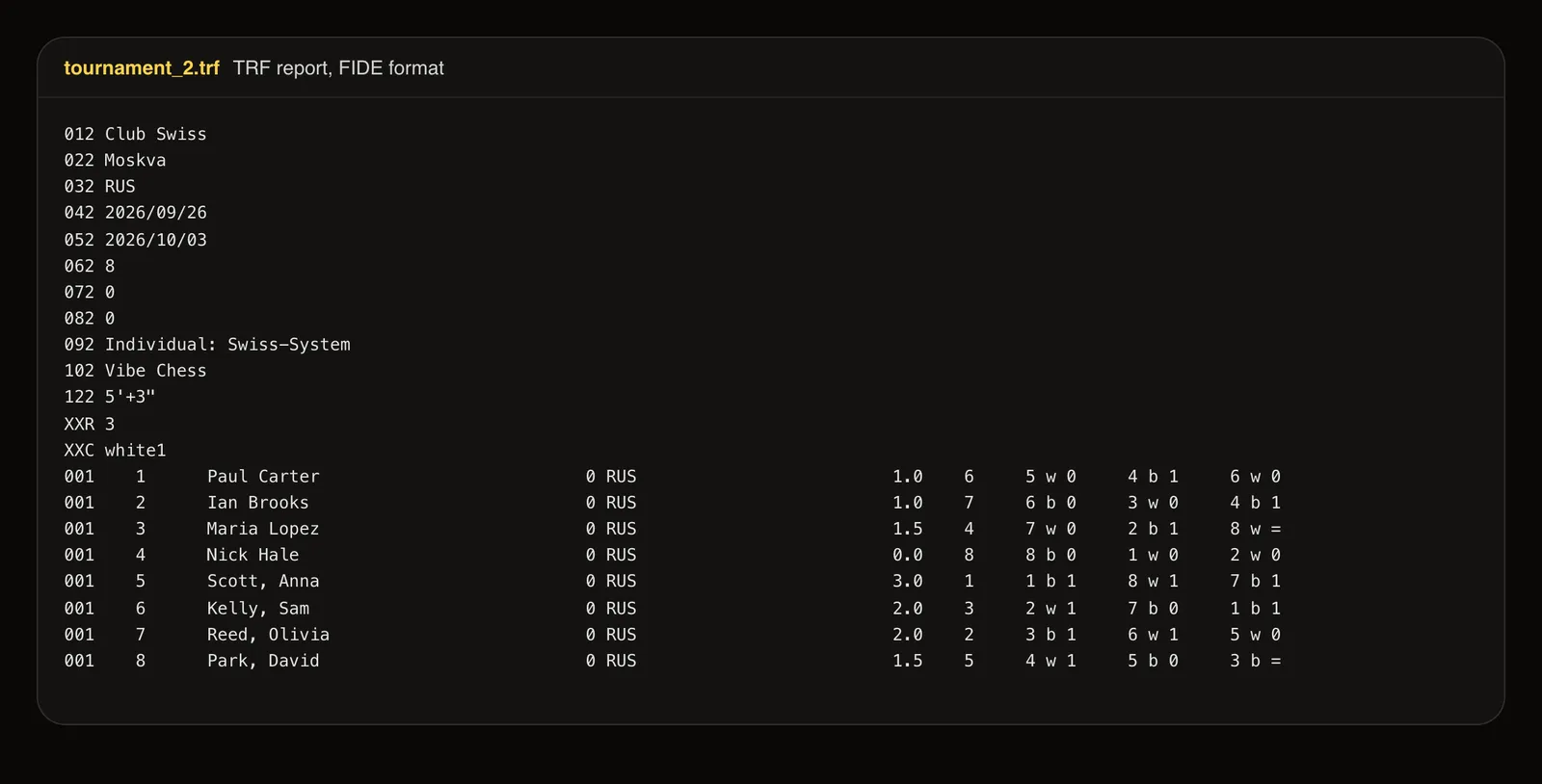
How the format works as a whole - the TRF format.
The tournament organiser's score window has six outcomes: White wins, Black wins, draw, White no-show, Black no-show and double forfeit. The last one is a separate button, not a draw. What happens after it is pressed:
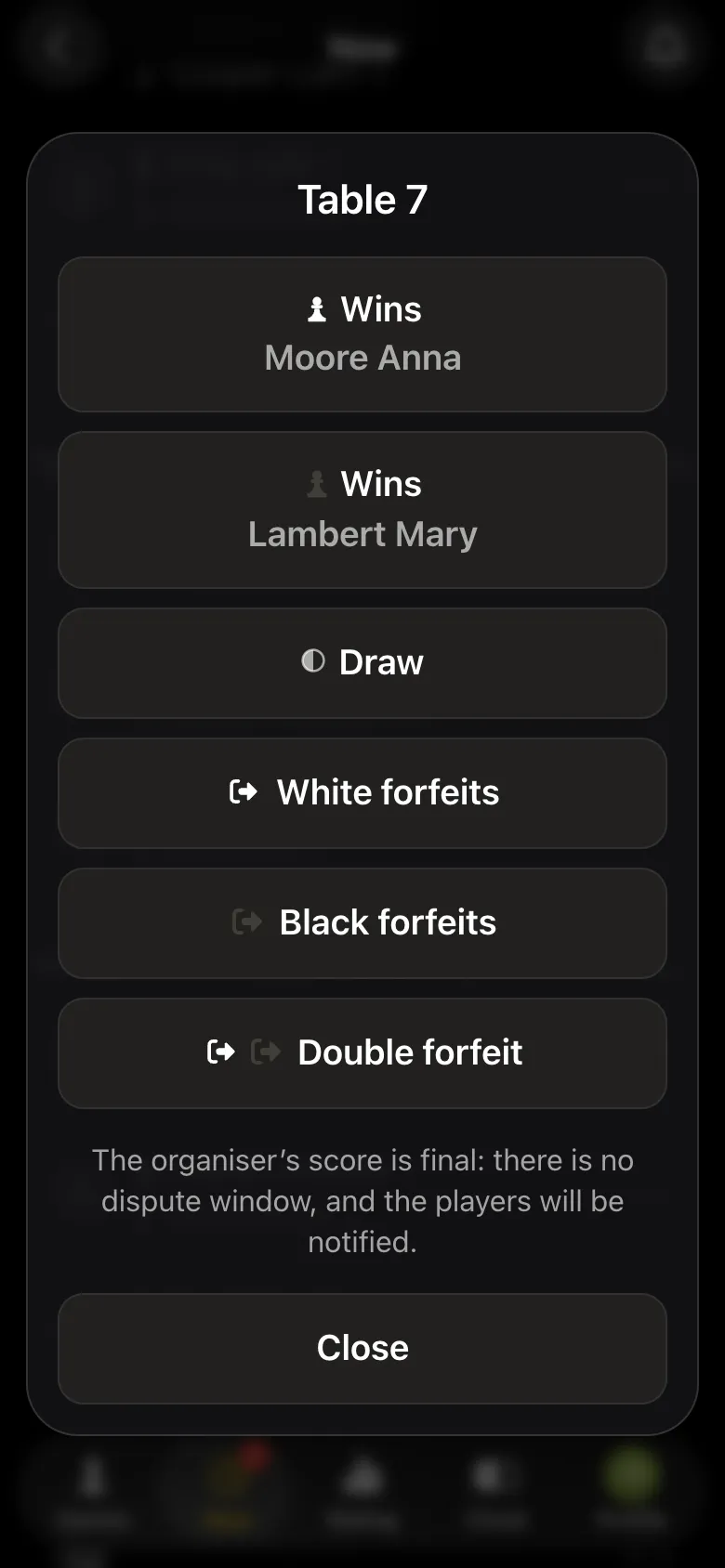
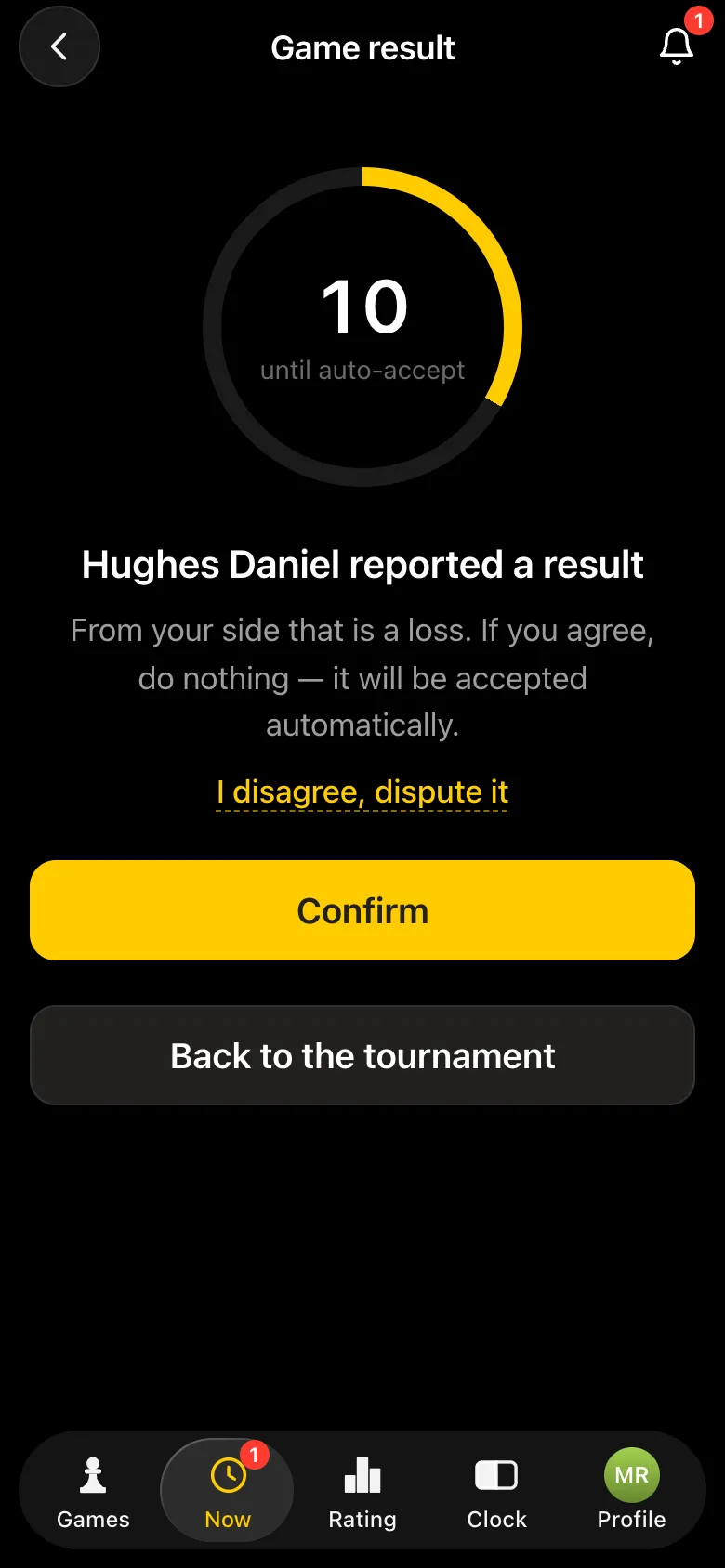
A single player's no-show can also be marked by their opponent right from their phone. Then the absent player has 30 seconds to object - maybe they are sitting at the next table. A no-show marked by the organiser takes effect at once: their score is final.
All of the arbiter's work in the app - arbiting a chess tournament.
It is the result of a game neither player turned up for, although the pairings brought them together. The score is 0 - 0: nobody gets points, and the game is not rated.
No. A draw gives both half a point for an unplayed game, moves them up the table and inflates their opponents' tiebreaks. The right score is zero for both.
Usually yes: a no-show without warning or good reason is grounds for withdrawal, and in a double forfeit this applies to both. If a player comes and explains the reason, the arbiter may put them back into the next round's pairings.
For both players that round shows the opponent number, the colour and the sign "−" - a loss by forfeit. Nobody gets a plus.
No. Unplayed games are not rated: neither with a single forfeit nor with a double one.
In the tournament organiser's score window for the game there is a separate Double forfeit button. Both players get zero and are withdrawn; if you correct the score to the real one, both come back by themselves.
Everything people usually keep in a spreadsheet is already in the app: pairings, points, tie-breaks, round order. Free, with no subscriptions and no cap on the number of players.
The bot is constantly improved based on real tournaments. If you need a feature that isn't there yet, message the developers right inside the bot with the /support command. Many features appeared exactly because organizers asked for them, and useful ideas get added quickly.
More about arbiting: an illegal move in chess, a fallen flag in chess, phones in the tournament hall, how many arbiters a tournament needs and the TRF format.

At the board since childhood: hazy about his rating, precise about every rook he has blundered. Counts an evening as a good one if the opponent stayed to talk afterwards instead of rushing off to check with an engine. Message →