The ready-made round-robin schedules from the annex to the FIDE tournament rules. Seven tables, from a group of four to a club event of sixteen. Each one shows who plays whom in every round and who gets White. Print it and pin it to the wall of the playing hall, or skip the paper entirely and run the event in an app that builds the schedule itself.
Odd field - pick the table one number up: 7 players use the “7-8” table.
The point of a Berger table is that a round-robin is paired exactly once. The players draw numbers before round one, and after that the event runs off a finished schedule: everyone meets everyone precisely once, colours come out almost even, and the organizer has nothing to calculate between rounds.
A round-robin is paired a single time: the players draw their starting numbers and from then on the table dictates the whole event. There is no recalculation between rounds the way there is in a Swiss.
“3-6” means number 3 plays White and number 6 plays Black. The tables are built so that colours alternate almost perfectly: with an even field, half the players get one extra White and the rest get one extra Black.
For 7 players take the “7-8 players” table, for 9 players the “9-10” one. Whoever is drawn against the highest number, which nobody holds, is free that round. Over the event every player sits out exactly once.
The player sitting out is awarded a full point or a zero depending on your regulations. Club and amateur events usually award the point so that nobody is punished by the draw; rated events spell it out in advance.
For a double round-robin FIDE recommends swapping the last two rounds of the first cycle when you build the second. Otherwise someone ends up with three games in a row on the same colour at the join between cycles.
A starting number in a round-robin gives no advantage: everyone faces the same field. It only decides the order of the games and which colour you hold in each of them.
A round-robin is wonderfully transparent, but the volume grows fast: every extra player adds one game for everyone else. The time estimates in the last column assume blitz or rapid.
| Players | Rounds | Games | Rough time |
|---|---|---|---|
| 4 | 3 | 6 | about an hour of blitz |
| 5 | 5 | 10 | an hour and a half, someone sits out each round |
| 6 | 5 | 15 | an evening of blitz or two evenings of rapid |
| 8 | 7 | 28 | a long evening of blitz |
| 10 | 9 | 45 | two evenings |
| 12 | 11 | 66 | a weekend or a club month |
| 14 | 13 | 91 | a club season |
| 16 | 15 | 120 | a club season on a fixed schedule |
Past sixteen players a round-robin stops fitting into any reasonable calendar: twenty players means 19 rounds and 190 games. For fields that size you switch to the Swiss system, where 5 to 9 rounds are enough no matter how many people turn up.
In every pair the first number has White. The tables match the “Details of Berger Table” annex to the FIDE tournament rules (Handbook C.05, Annex 1).
| Round | Pairings (White first) |
|---|---|
| Round 1 | 1–42–3 |
| Round 2 | 4–31–2 |
| Round 3 | 2–43–1 |
With 3 players number 4 is unassigned: whoever is drawn against it is free that round.
| Round | Pairings (White first) |
|---|---|
| Round 1 | 1–62–53–4 |
| Round 2 | 6–45–31–2 |
| Round 3 | 2–63–14–5 |
| Round 4 | 6–51–42–3 |
| Round 5 | 3–64–25–1 |
With 5 players number 6 is unassigned: whoever is drawn against it is free that round.
| Round | Pairings (White first) |
|---|---|
| Round 1 | 1–82–73–64–5 |
| Round 2 | 8–56–47–31–2 |
| Round 3 | 2–83–14–75–6 |
| Round 4 | 8–67–51–42–3 |
| Round 5 | 3–84–25–16–7 |
| Round 6 | 8–71–62–53–4 |
| Round 7 | 4–85–36–27–1 |
With 7 players number 8 is unassigned: whoever is drawn against it is free that round.
| Round | Pairings (White first) |
|---|---|
| Round 1 | 1–102–93–84–75–6 |
| Round 2 | 10–67–58–49–31–2 |
| Round 3 | 2–103–14–95–86–7 |
| Round 4 | 10–78–69–51–42–3 |
| Round 5 | 3–104–25–16–97–8 |
| Round 6 | 10–89–71–62–53–4 |
| Round 7 | 4–105–36–27–18–9 |
| Round 8 | 10–91–82–73–64–5 |
| Round 9 | 5–106–47–38–29–1 |
With 9 players number 10 is unassigned: whoever is drawn against it is free that round.
| Round | Pairings (White first) |
|---|---|
| Round 1 | 1–122–113–104–95–86–7 |
| Round 2 | 12–78–69–510–411–31–2 |
| Round 3 | 2–123–14–115–106–97–8 |
| Round 4 | 12–89–710–611–51–42–3 |
| Round 5 | 3–124–25–16–117–108–9 |
| Round 6 | 12–910–811–71–62–53–4 |
| Round 7 | 4–125–36–27–18–119–10 |
| Round 8 | 12–1011–91–82–73–64–5 |
| Round 9 | 5–126–47–38–29–110–11 |
| Round 10 | 12–111–102–93–84–75–6 |
| Round 11 | 6–127–58–49–310–211–1 |
With 11 players number 12 is unassigned: whoever is drawn against it is free that round.
| Round | Pairings (White first) |
|---|---|
| Round 1 | 1–142–133–124–115–106–97–8 |
| Round 2 | 14–89–710–611–512–413–31–2 |
| Round 3 | 2–143–14–135–126–117–108–9 |
| Round 4 | 14–910–811–712–613–51–42–3 |
| Round 5 | 3–144–25–16–137–128–119–10 |
| Round 6 | 14–1011–912–813–71–62–53–4 |
| Round 7 | 4–145–36–27–18–139–1210–11 |
| Round 8 | 14–1112–1013–91–82–73–64–5 |
| Round 9 | 5–146–47–38–29–110–1311–12 |
| Round 10 | 14–1213–111–102–93–84–75–6 |
| Round 11 | 6–147–58–49–310–211–112–13 |
| Round 12 | 14–131–122–113–104–95–86–7 |
| Round 13 | 7–148–69–510–411–312–213–1 |
With 13 players number 14 is unassigned: whoever is drawn against it is free that round.
| Round | Pairings (White first) |
|---|---|
| Round 1 | 1–162–153–144–135–126–117–108–9 |
| Round 2 | 16–910–811–712–613–514–415–31–2 |
| Round 3 | 2–163–14–155–146–137–128–119–10 |
| Round 4 | 16–1011–912–813–714–615–51–42–3 |
| Round 5 | 3–164–25–16–157–148–139–1210–11 |
| Round 6 | 16–1112–1013–914–815–71–62–53–4 |
| Round 7 | 4–165–36–27–18–159–1410–1311–12 |
| Round 8 | 16–1213–1114–1015–91–82–73–64–5 |
| Round 9 | 5–166–47–38–29–110–1511–1412–13 |
| Round 10 | 16–1314–1215–111–102–93–84–75–6 |
| Round 11 | 6–167–58–49–310–211–112–1513–14 |
| Round 12 | 16–1415–131–122–113–104–95–86–7 |
| Round 13 | 7–168–69–510–411–312–213–114–15 |
| Round 14 | 16–151–142–133–124–115–106–97–8 |
| Round 15 | 8–169–710–611–512–413–314–215–1 |
With 15 players number 16 is unassigned: whoever is drawn against it is free that round.
The tables are printable: in print mode the page switches to a white background and the interface elements are hidden.
Six people meet at the club for an evening of rapid. Before the start they draw numbers: Paul takes 1, Ivan 2, Maria 3, Oleg 4, Daria 5, Nikita 6. From there the organizer simply reads off the “5-6 players” table.
Round one: Paul has White against Nikita, Ivan has White against Daria, Maria has White against Oleg. Round two: Nikita has White against Oleg, Daria has White against Maria, Paul has White against Ivan. And so on through all five rounds, with no recalculation and no risk of anyone meeting twice.
When the event finishes and several players are level on points, the places between them are settled by the Sonneborn-Berger score. You do not have to work it out by hand: the Sonneborn-Berger calculator takes a filled-in cross-table and returns the points, the tie-break and the final placings, with a breakdown for each player.
A Berger table answers one question: who plays whom. The Vibe Chess app handles the rest: it pairs by the same FIDE table, seats the pairs at tables, recalculates points and tie-breaks after every round, puts the standings on a projector and exports the results as a PDF sheet and a TRF report. Below is the organizer's whole path through a six-player club evening. Every screen is from the real app, and the event was played in it from start to finish. All six players are guests: no Telegram, no account - the organizer entered them by name.
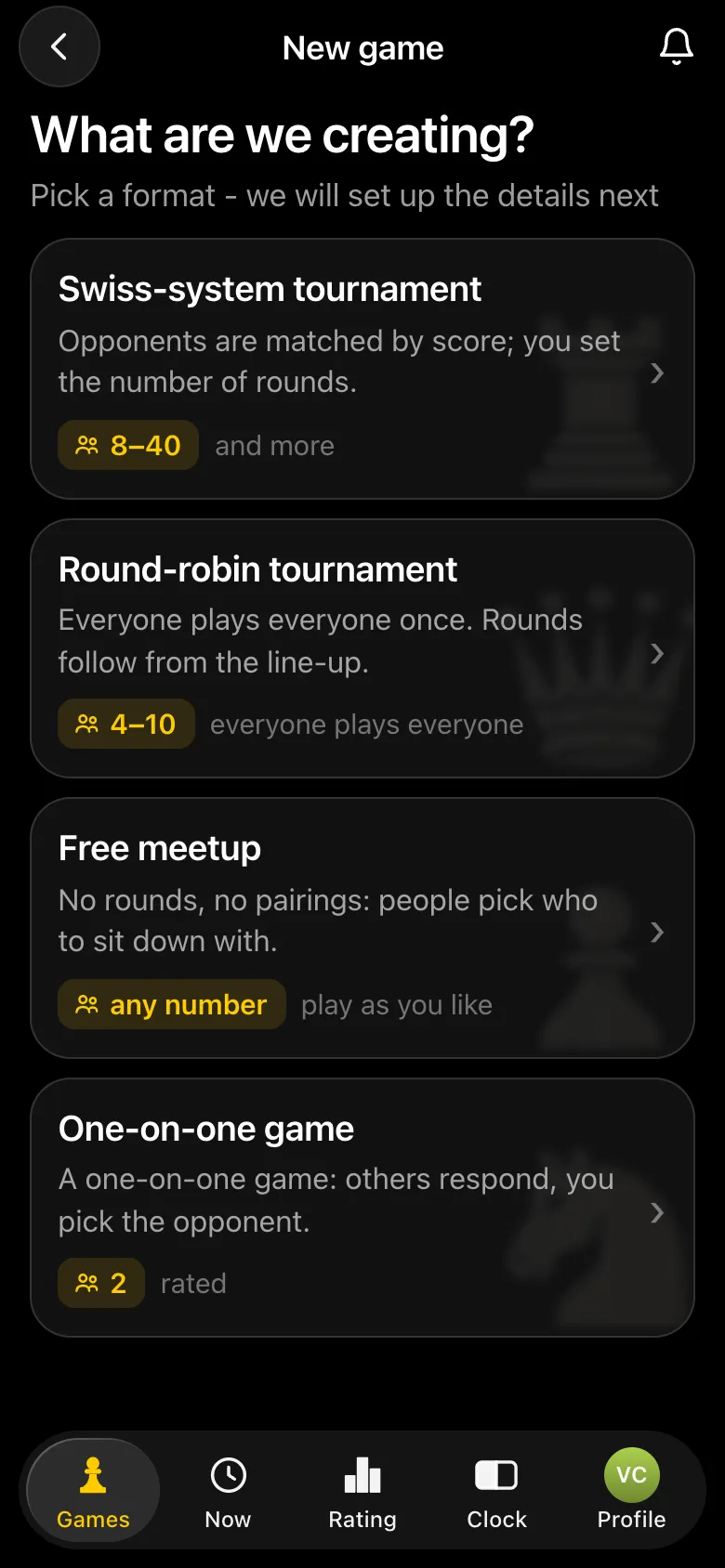
In the app: the Games tab, Create your own game, then Round-robin tournament. Next to it sit the Swiss system, a free meetup and a one-on-one game; you can still switch format until the event starts.
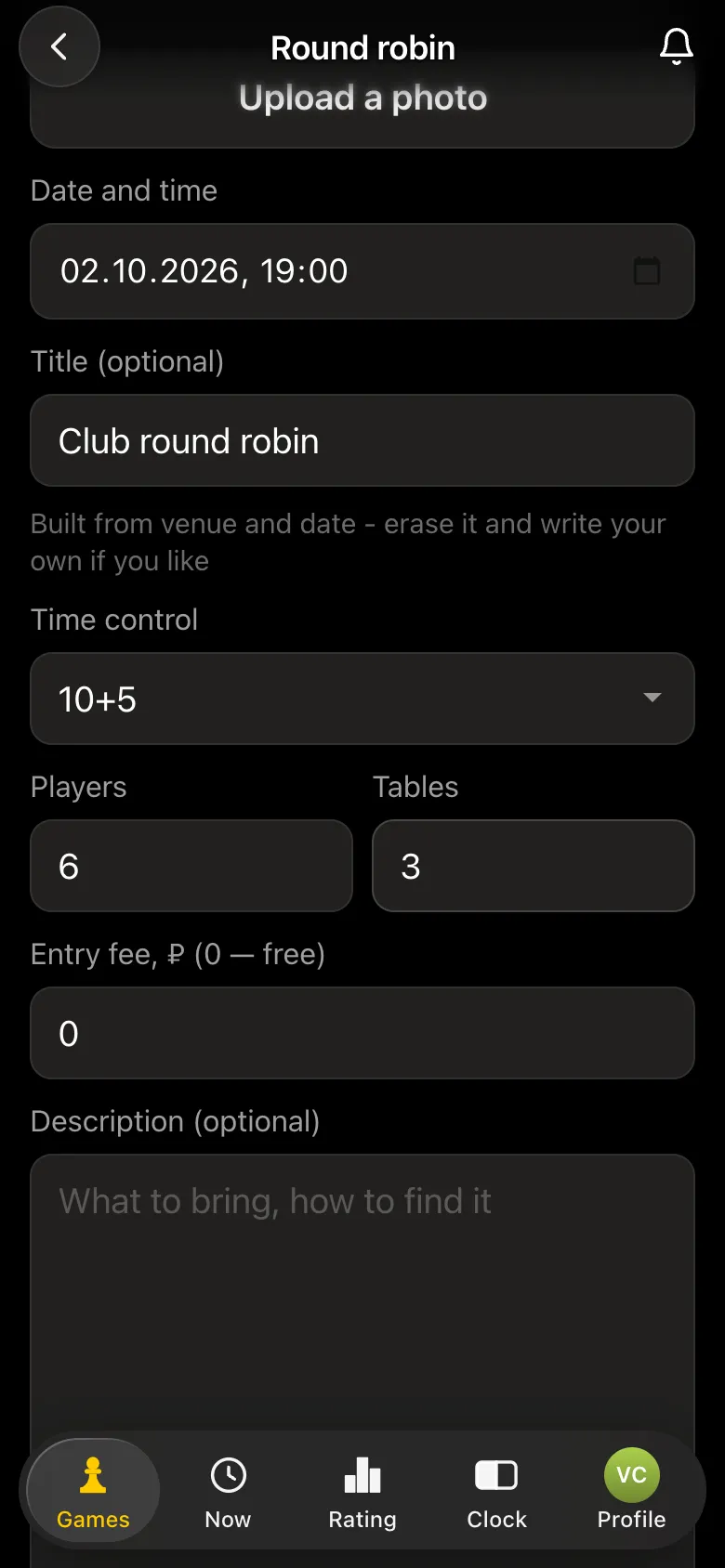
The form takes the venue and date, a title, the time control (from 1+1 bullet to 90+30 classical), how many players and how many tables, an entry fee (zero means free) and a description. You never set the number of rounds: in a round-robin the field decides it. Six players make five rounds, seven make seven rounds, and each player sits out once.
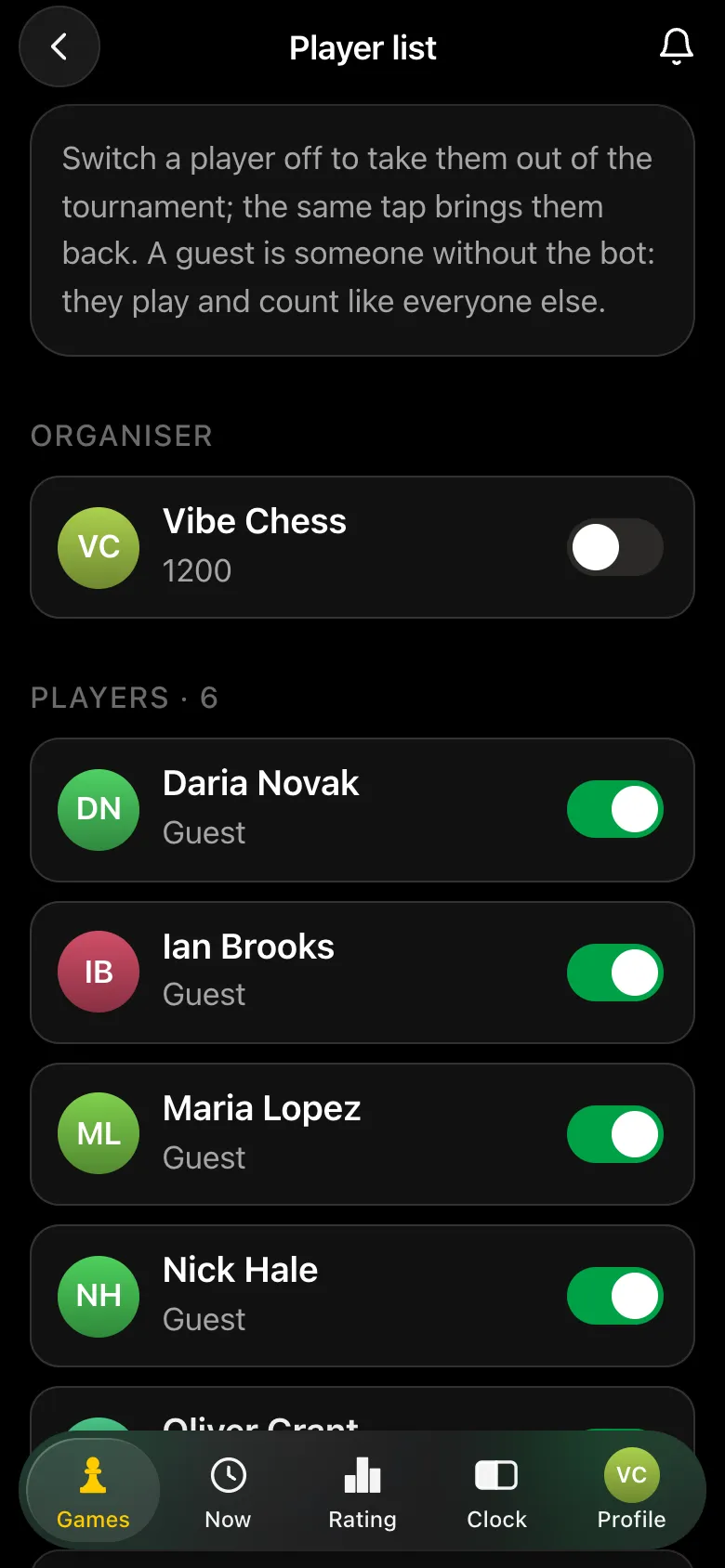
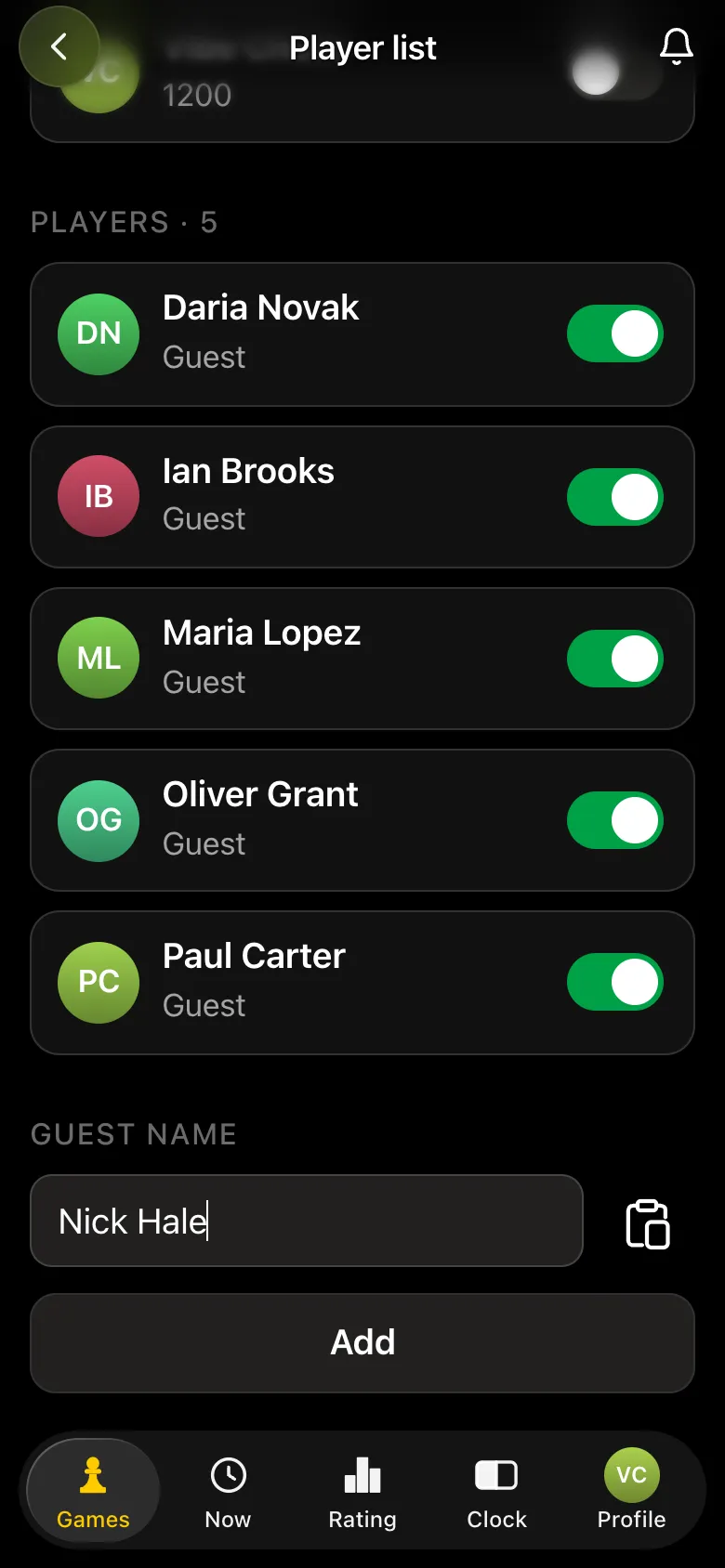
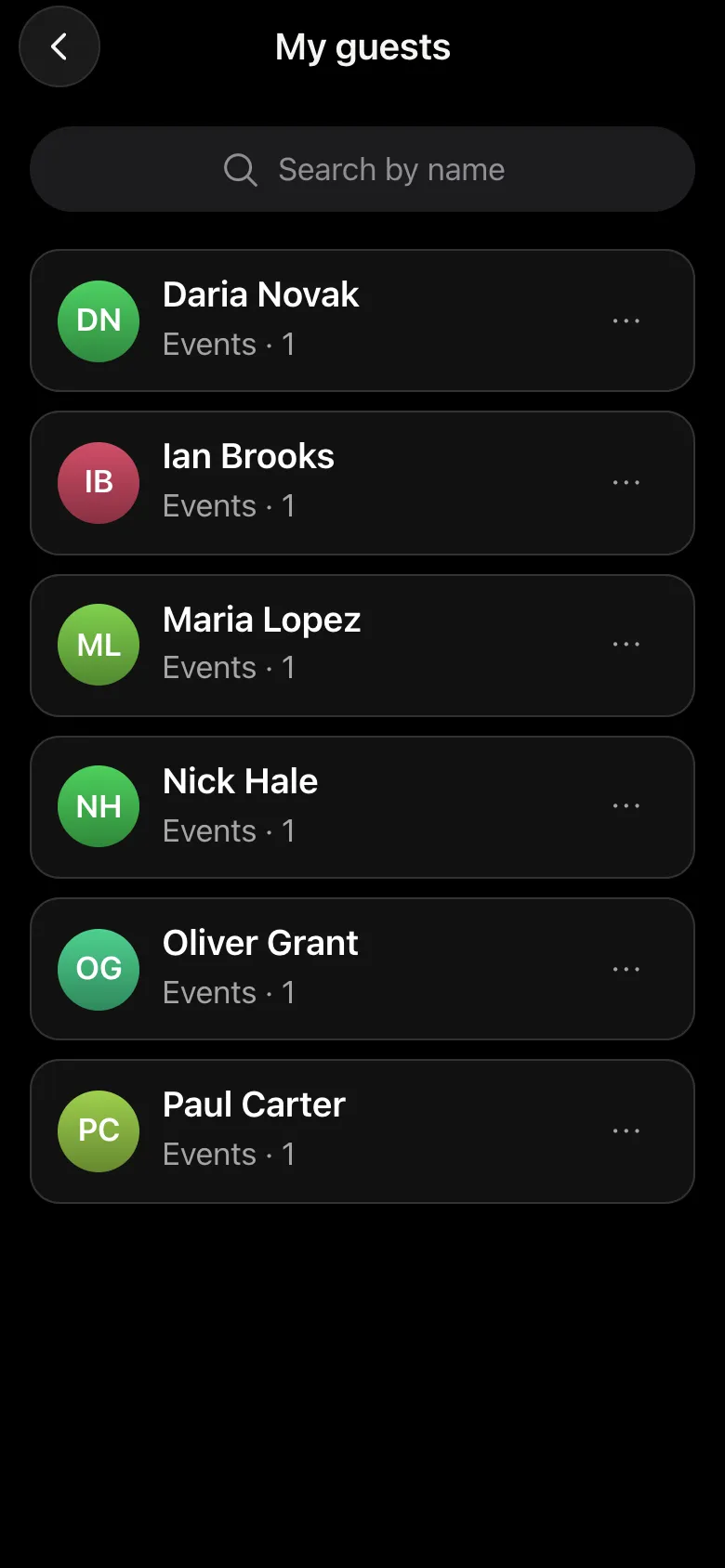
A guest is a player with no Telegram and no account. The organizer types a name into Guest name and taps Add - no phone, no link, no sign-up. A guest plays and counts like everyone else, with points, a place and tie-breaks, but no Elo rating: their games are unrated. You can add as many guests and players as you need: a round-robin can hold up to a hundred players, and an organizer's guest list keeps up to three hundred names. The organizer is entered by default; if you are only running the evening, switch your own row off.
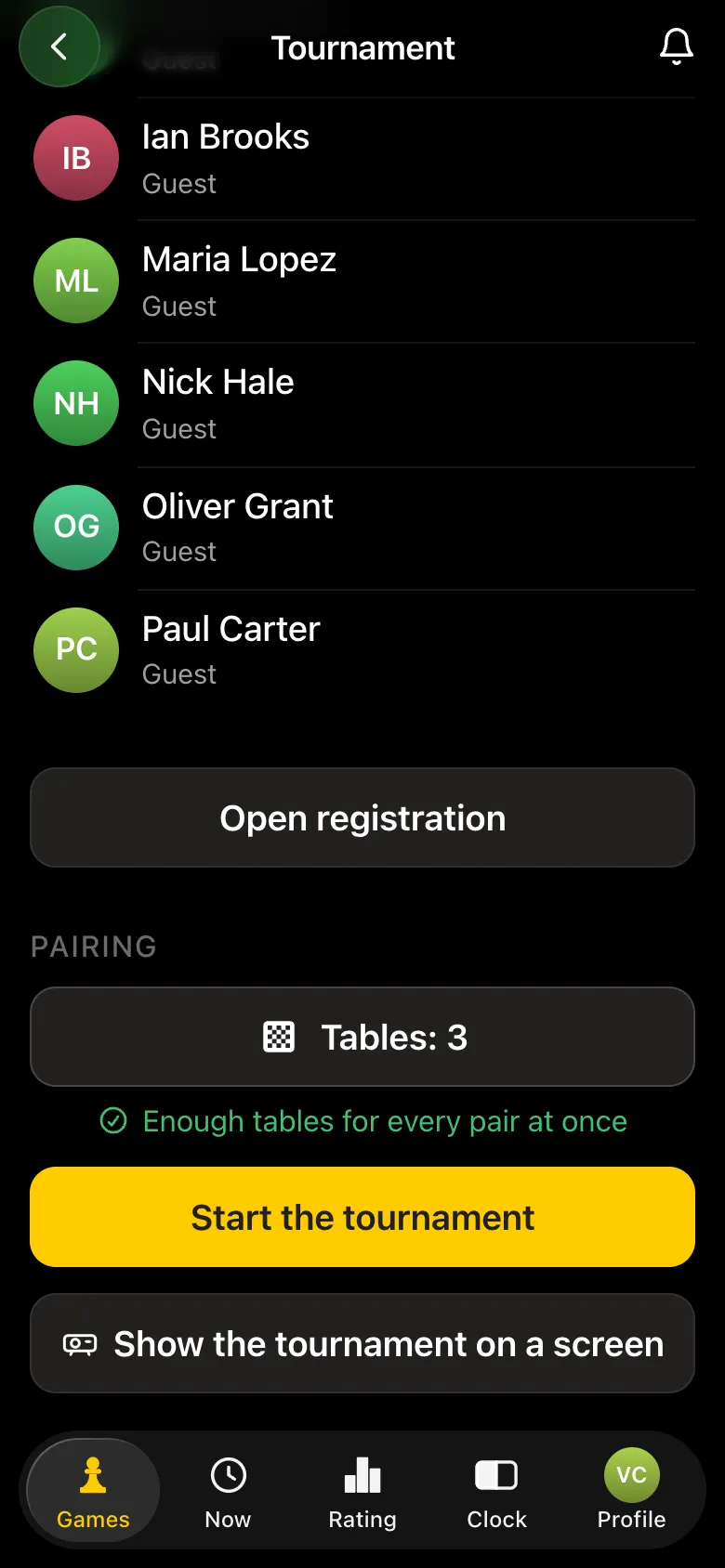
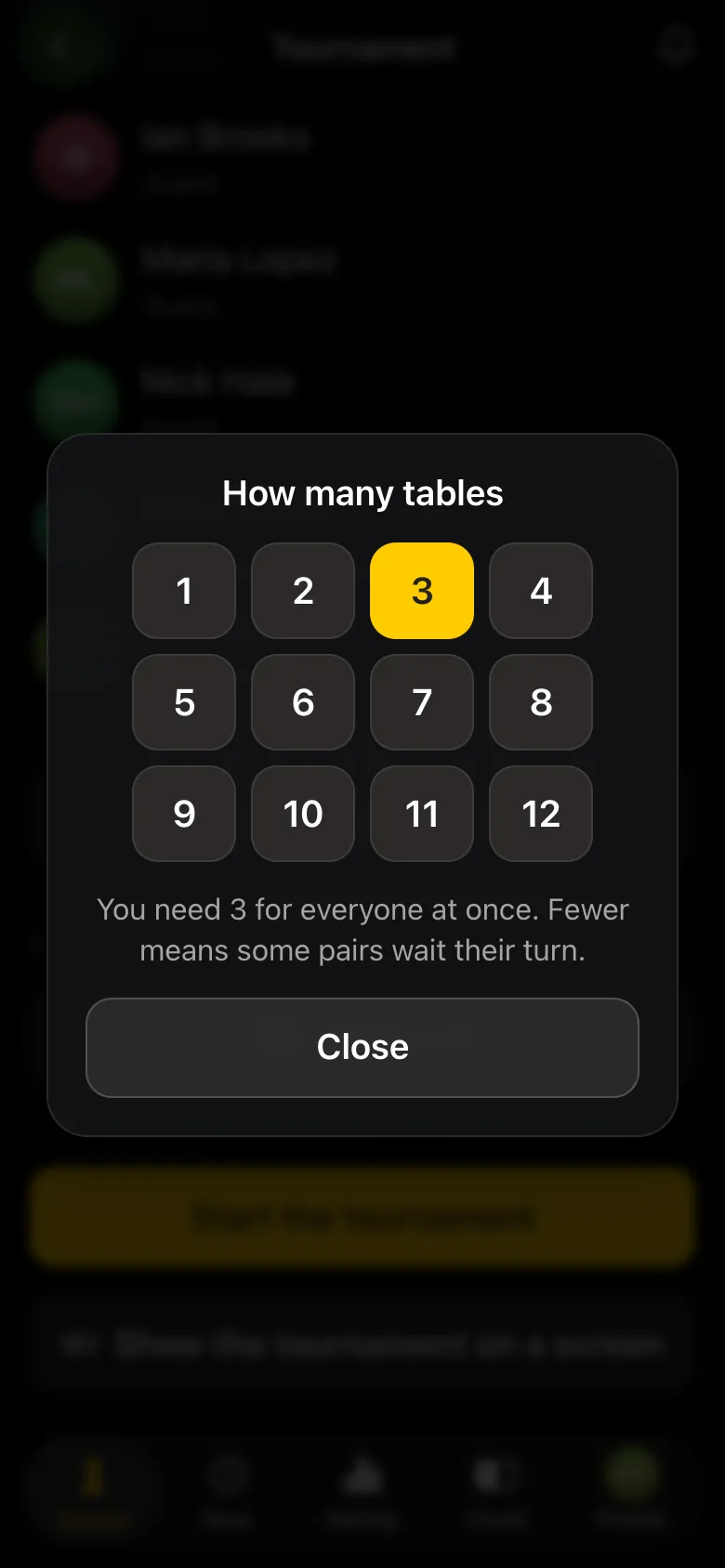
Once everyone is there, tap Close registration and the Pairing block appears. The Tables button opens a picker from one to twelve, and the app tells you how many you need for everyone at once. Fewer boards than pairs is fine: some pairs wait their turn and sit down when a table frees up.
Start the tournament hands out starting numbers and builds round one from the same FIDE table published on this page. Every pair gets its own table and colours. The next round appears on its own as soon as the last result of the current one is in. Players with the app see their table and opponent on their phone; for guests the organizer reads the pairings out or puts them on the projector.
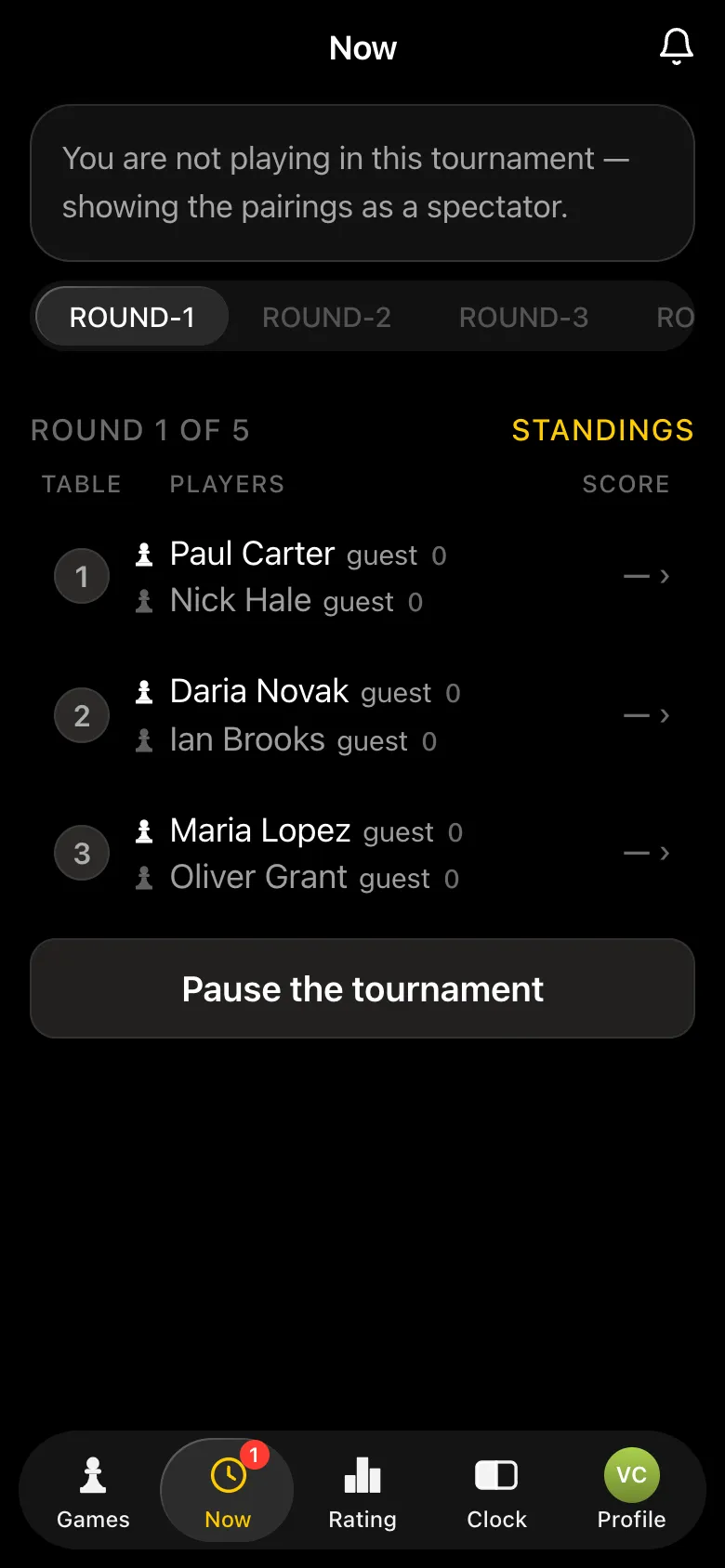
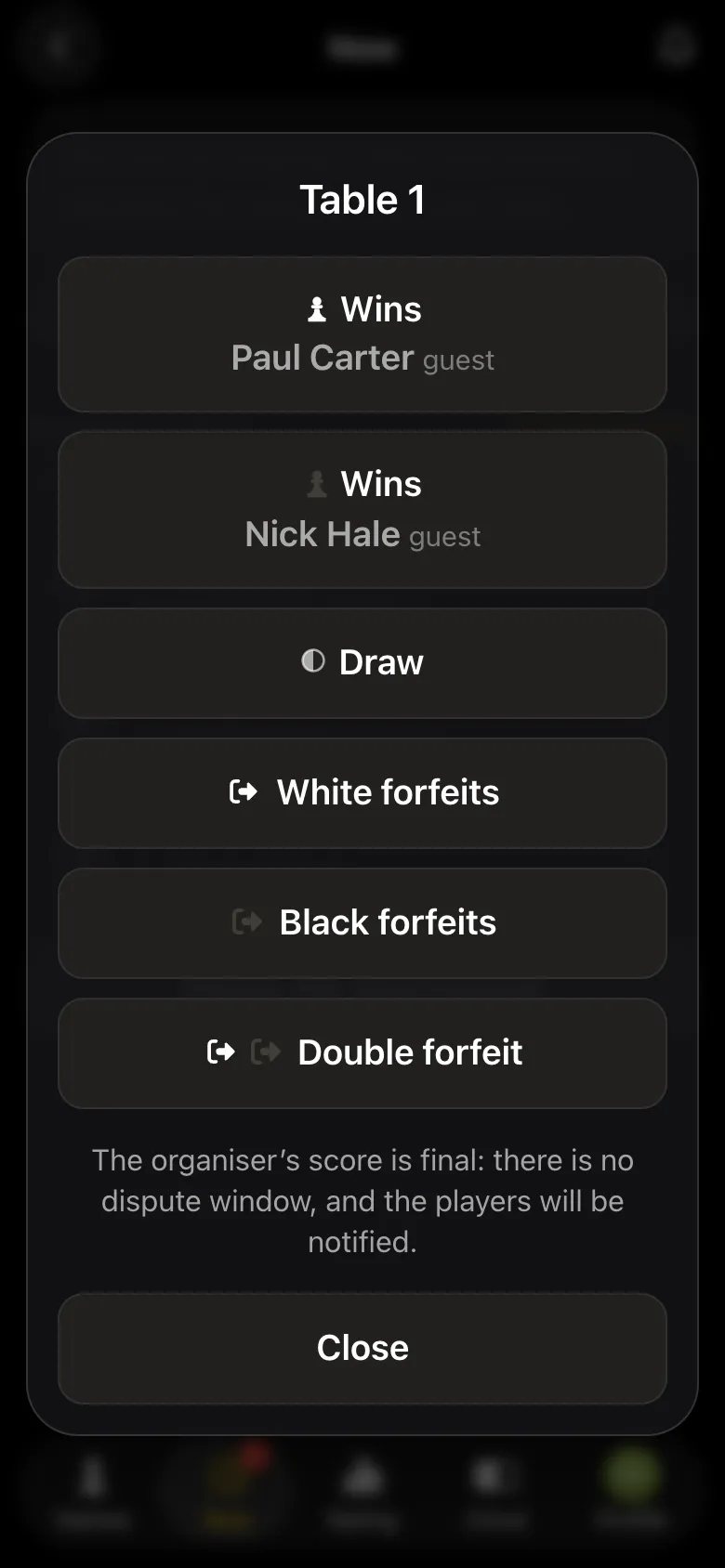
Tap a pair to open its table: White wins, Black wins, draw, White forfeits, Black forfeits or double forfeit. The organiser's score is final. Players with their own account can report their games themselves; guests' results are entered by the organiser.
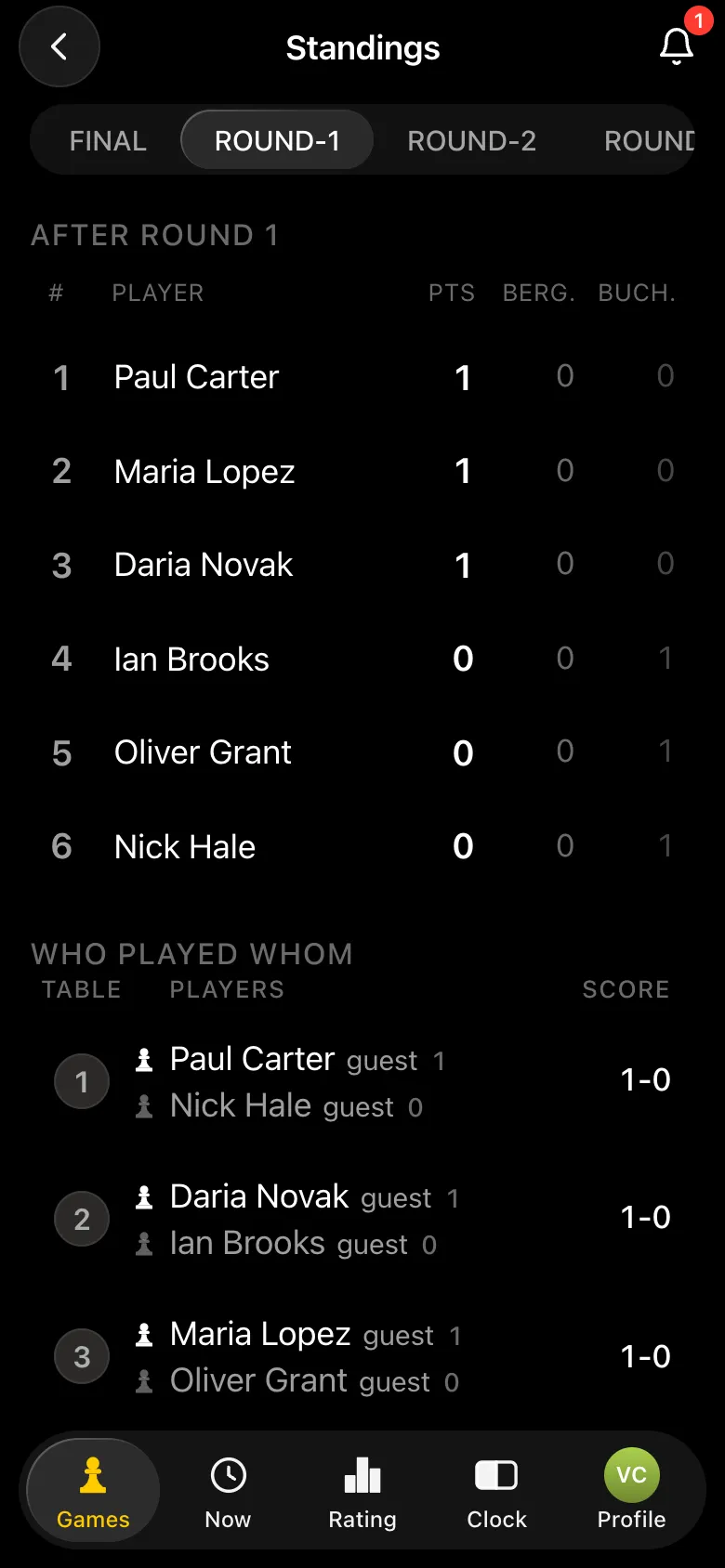
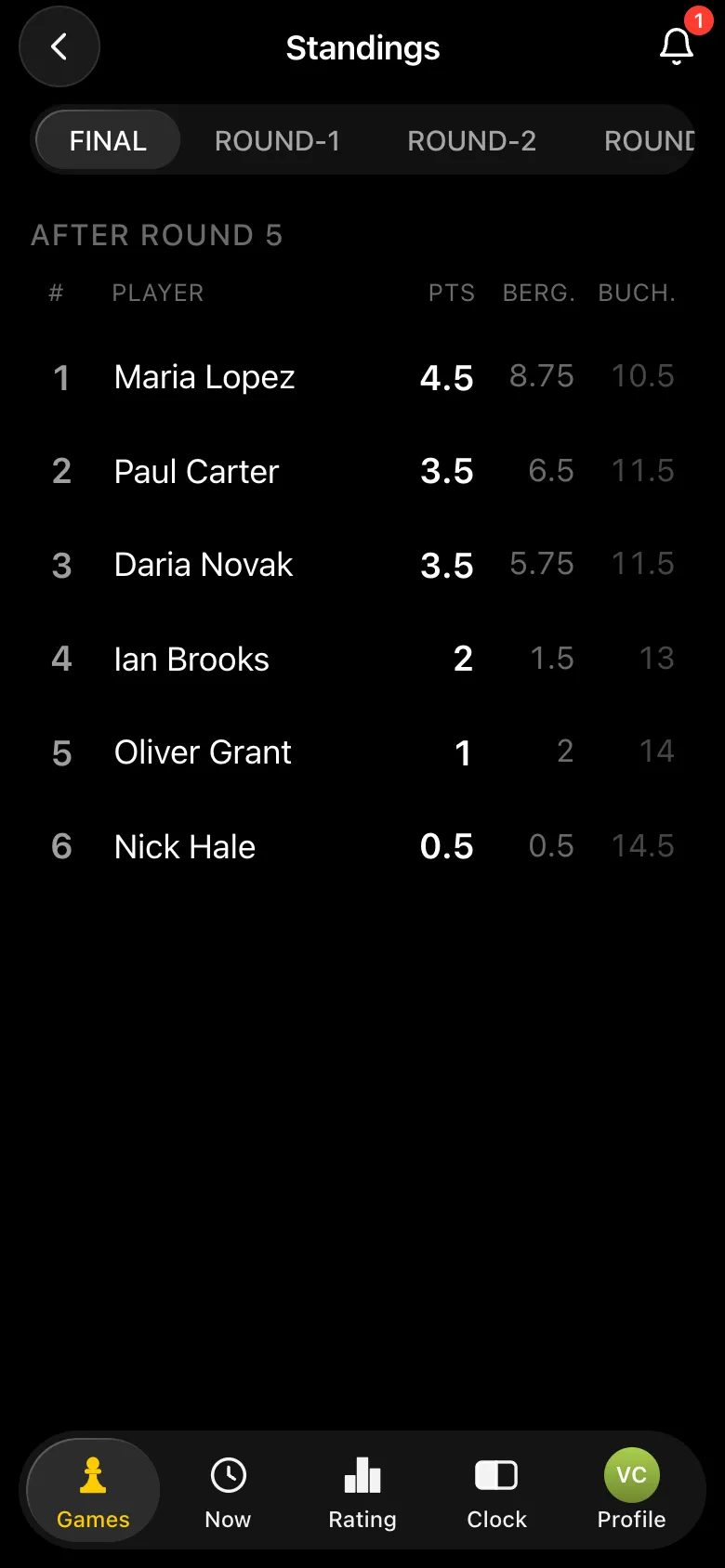
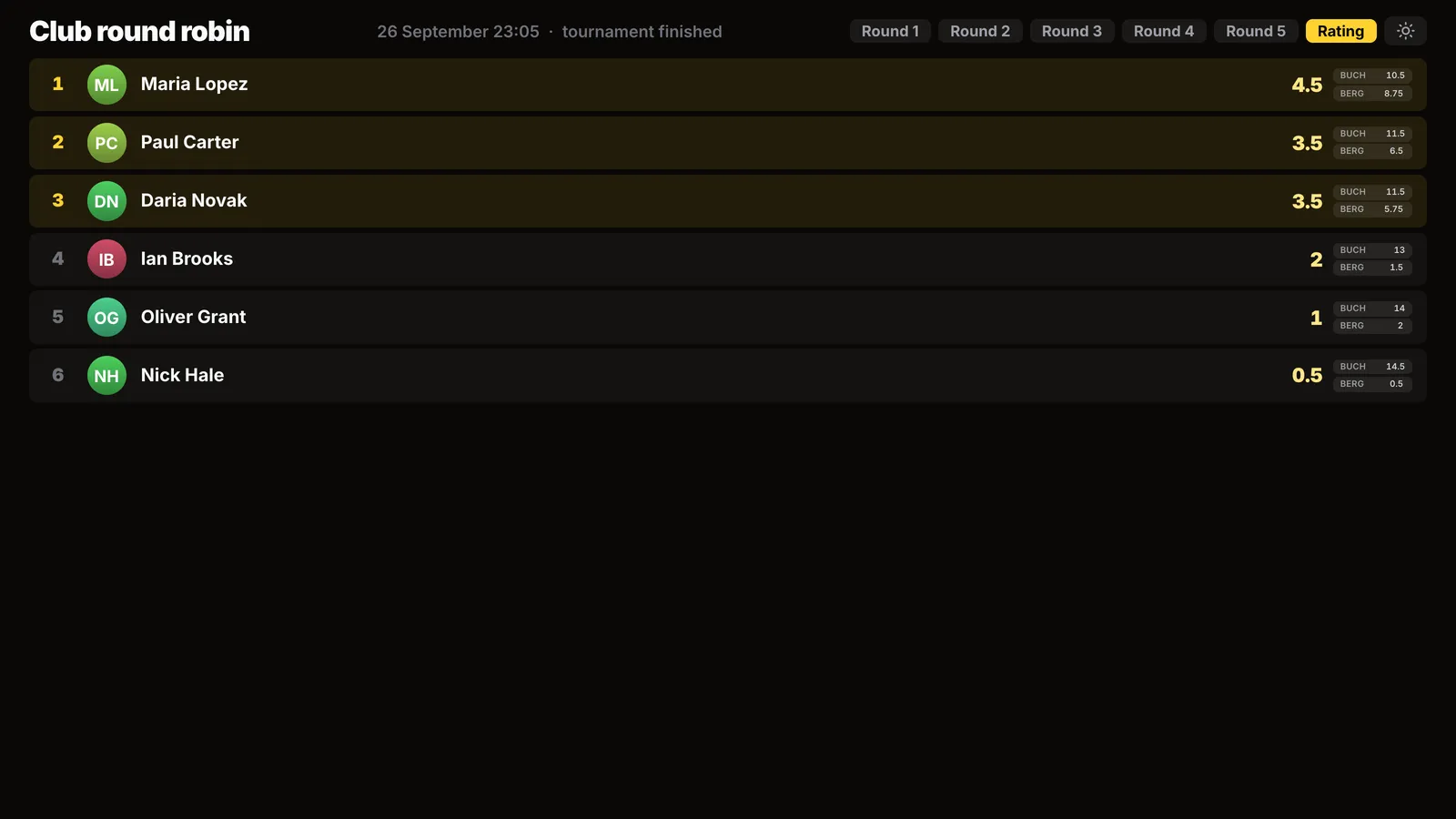
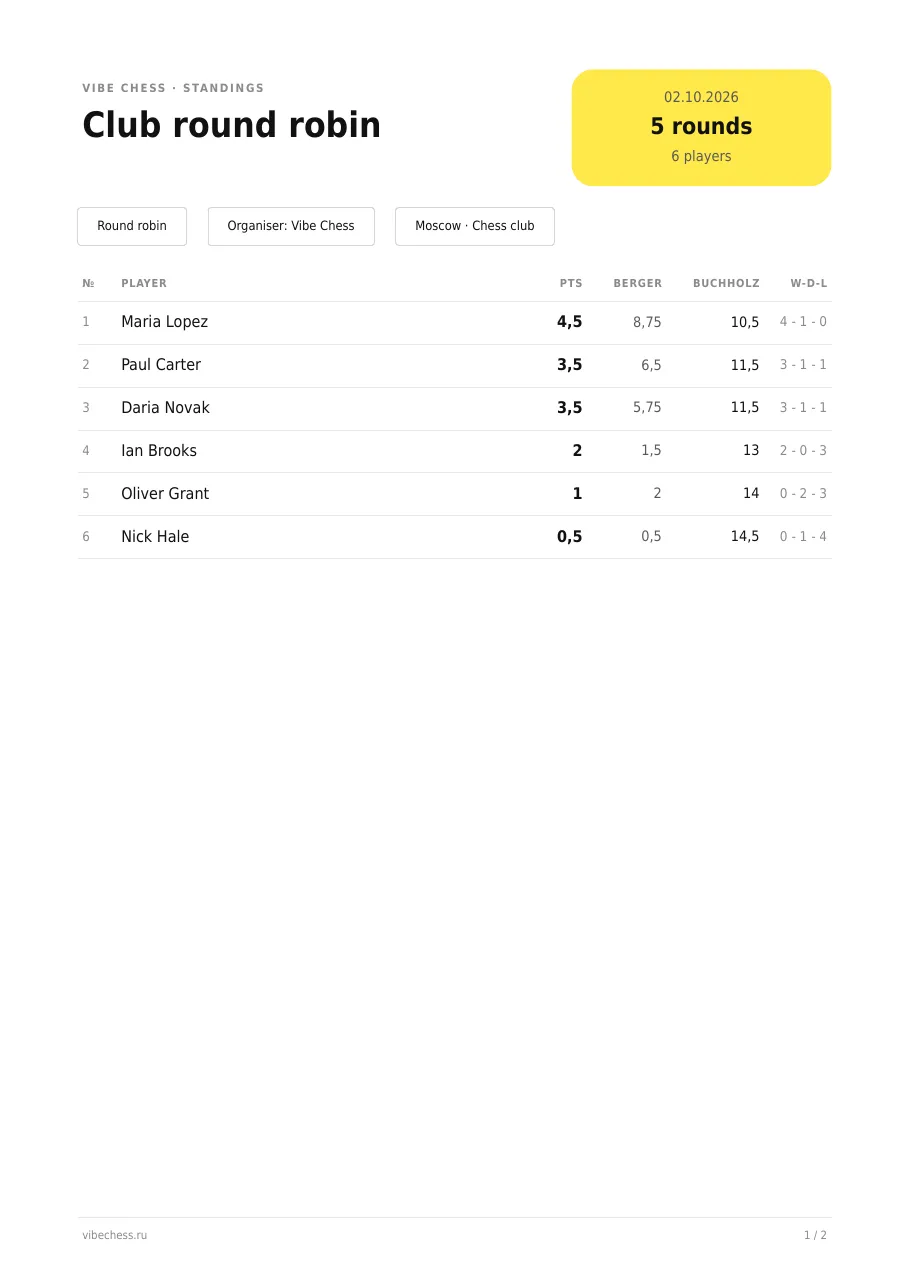
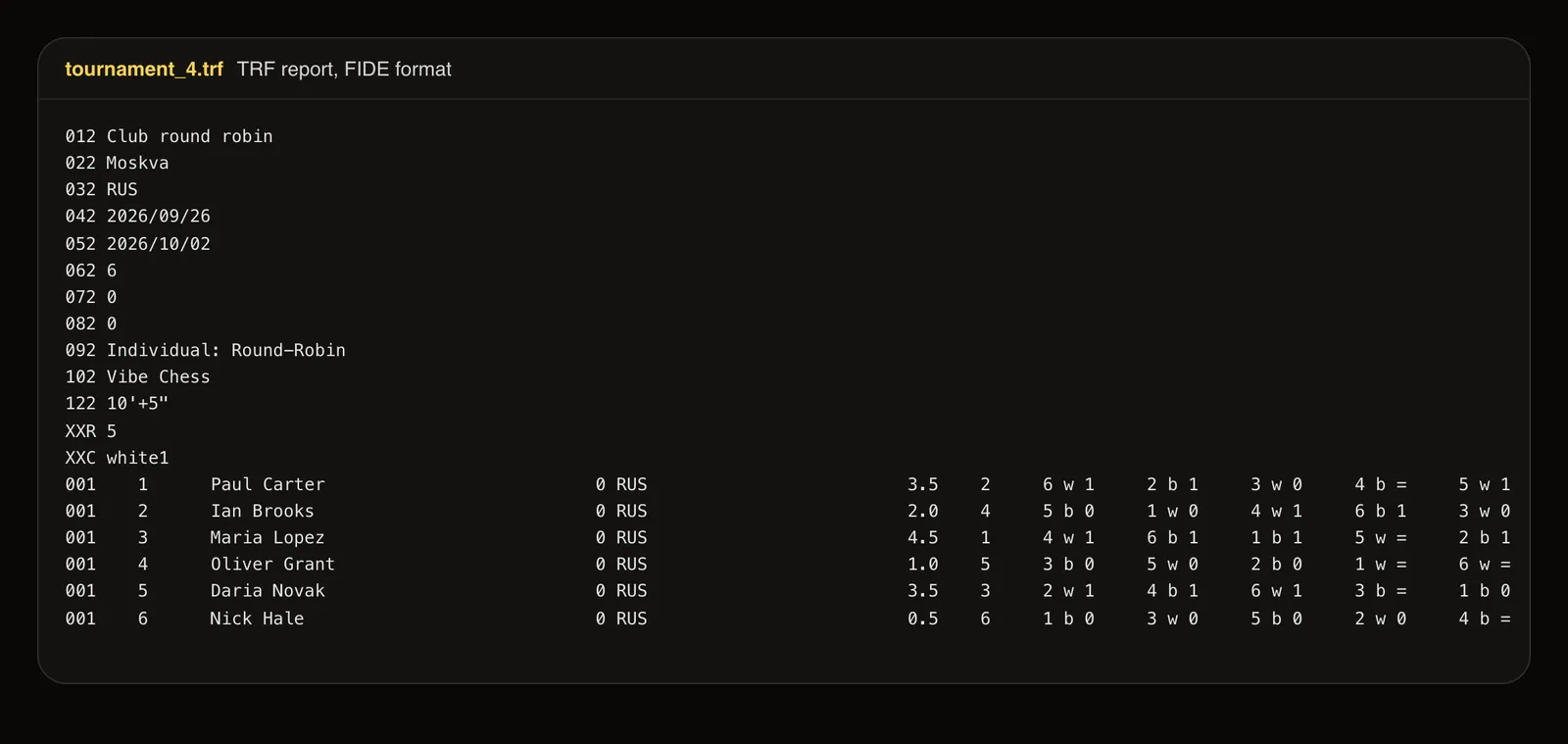
The table is recalculated after each round: points, Sonneborn-Berger and the Buchholz score, and the round tab adds who played whom with every score. When points are level, the Sonneborn-Berger score splits places in a round-robin. In our event Paul and Daria both finished on 3.5, and second place went to Paul: 6.5 against 5.75.
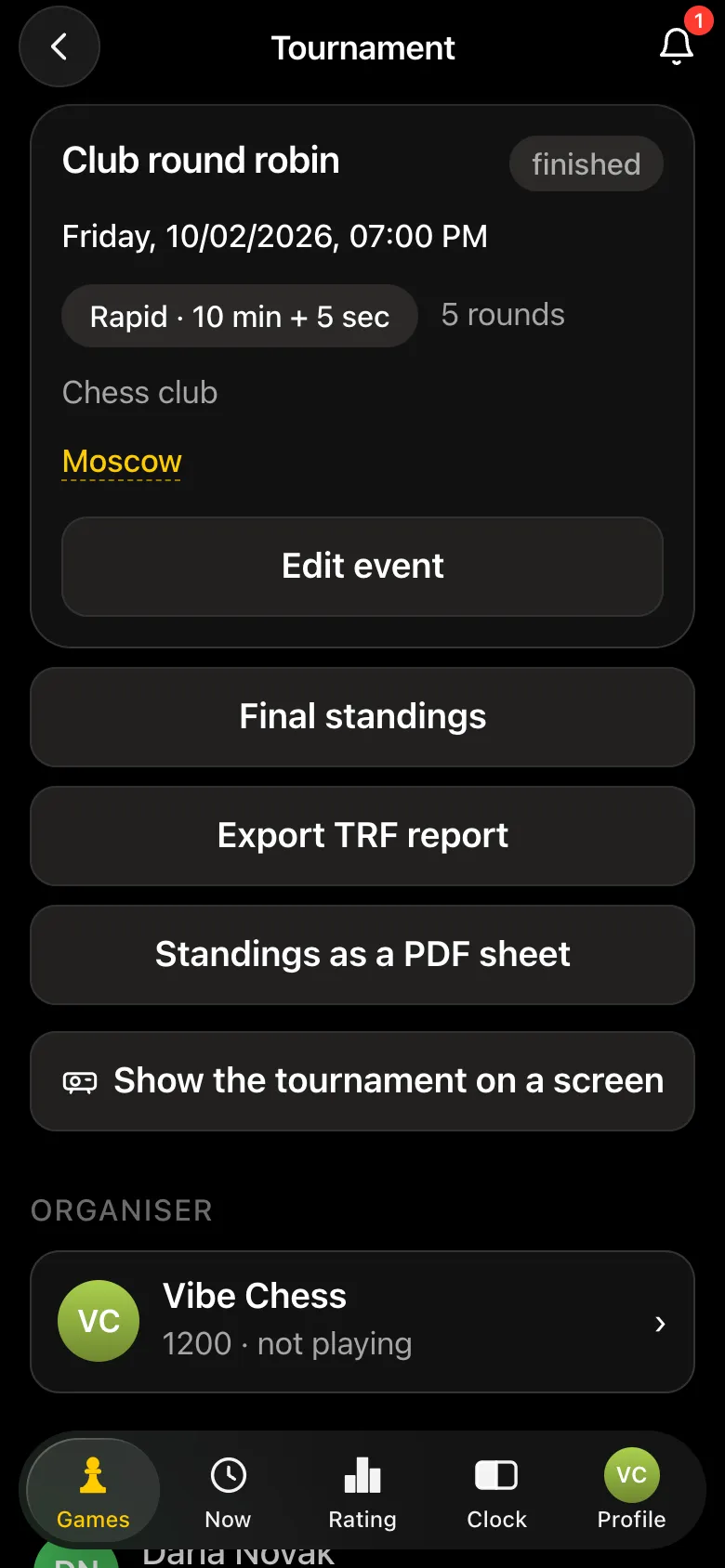
A finished event card has four buttons: Final standings, Export TRF report, Standings as a PDF sheet and Show the tournament on a screen. The PDF sheet and the TRF report arrive as documents in the organiser's chat with the Telegram bot, from where they are easy to print, forward to players or send to a federation. So the organiser needs Telegram for exports; guests do not.
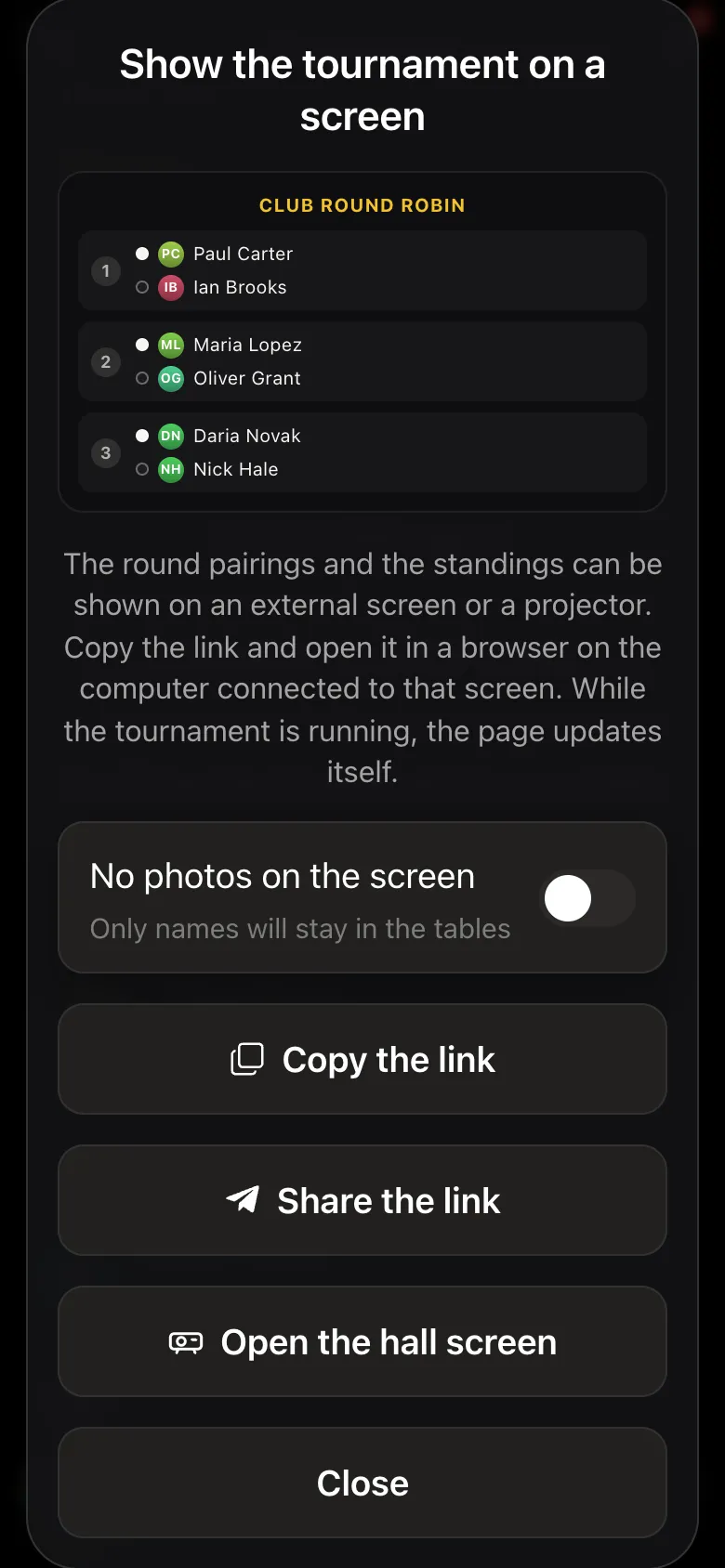
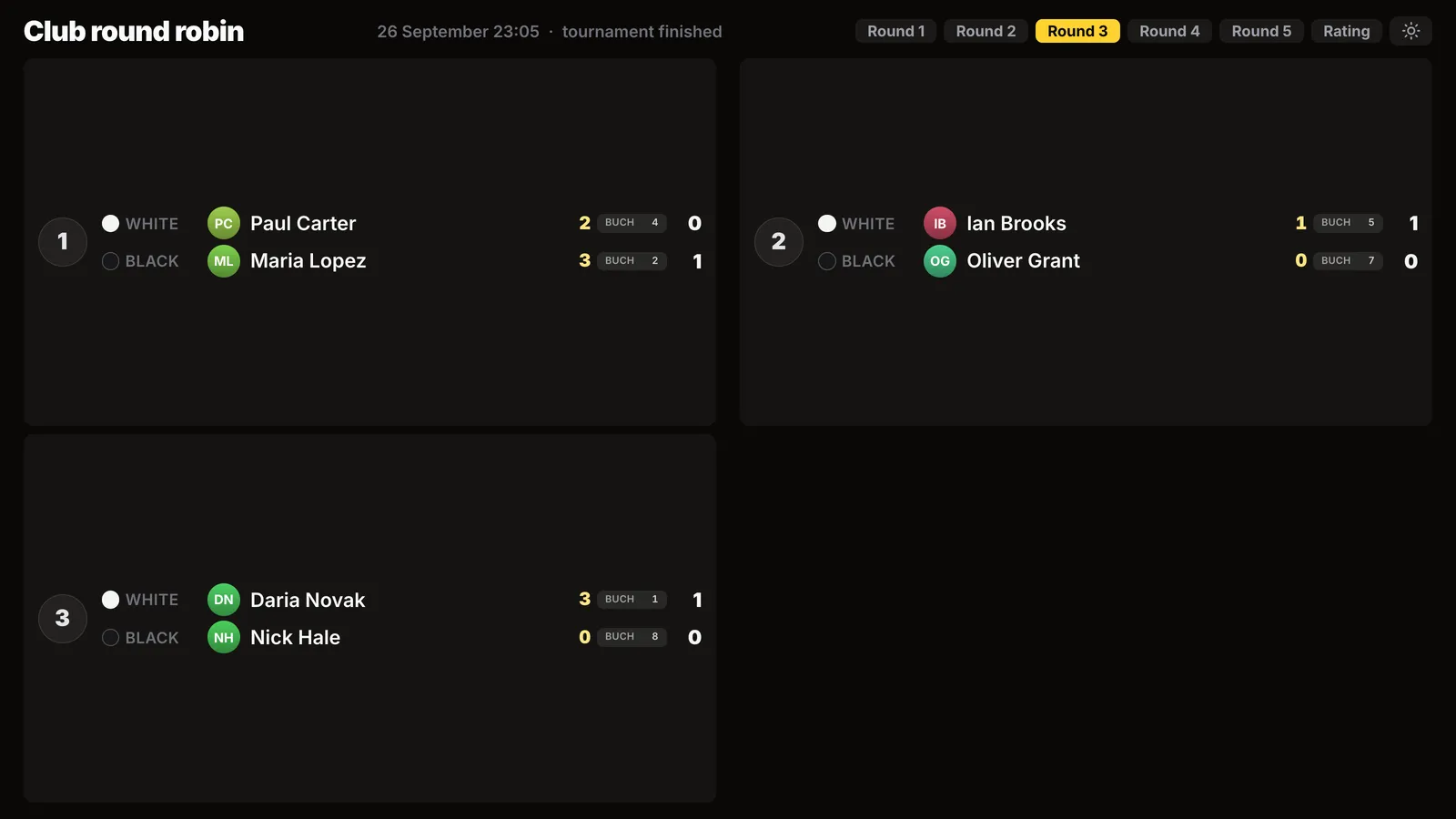
Show the tournament on a screen gives you a link to open in a browser on the computer connected to the projector or TV. The screen shows the round pairings and the standings large, edge to edge. While the event is running the page updates itself - the organiser does not have to switch anything. There is a light and a dark theme, and the No photos on the screen switch removes the face circles when the room should not see them.
An A4 sheet: title, date, number of rounds and players, system, organiser and venue. Then the table with points, Sonneborn-Berger, Buchholz and the win-draw-loss count. The second page lists every pairing round by round with its result - the complete record of the event. Print it for the wall, hand it to whoever asks where they finished, or drop it into the group chat.
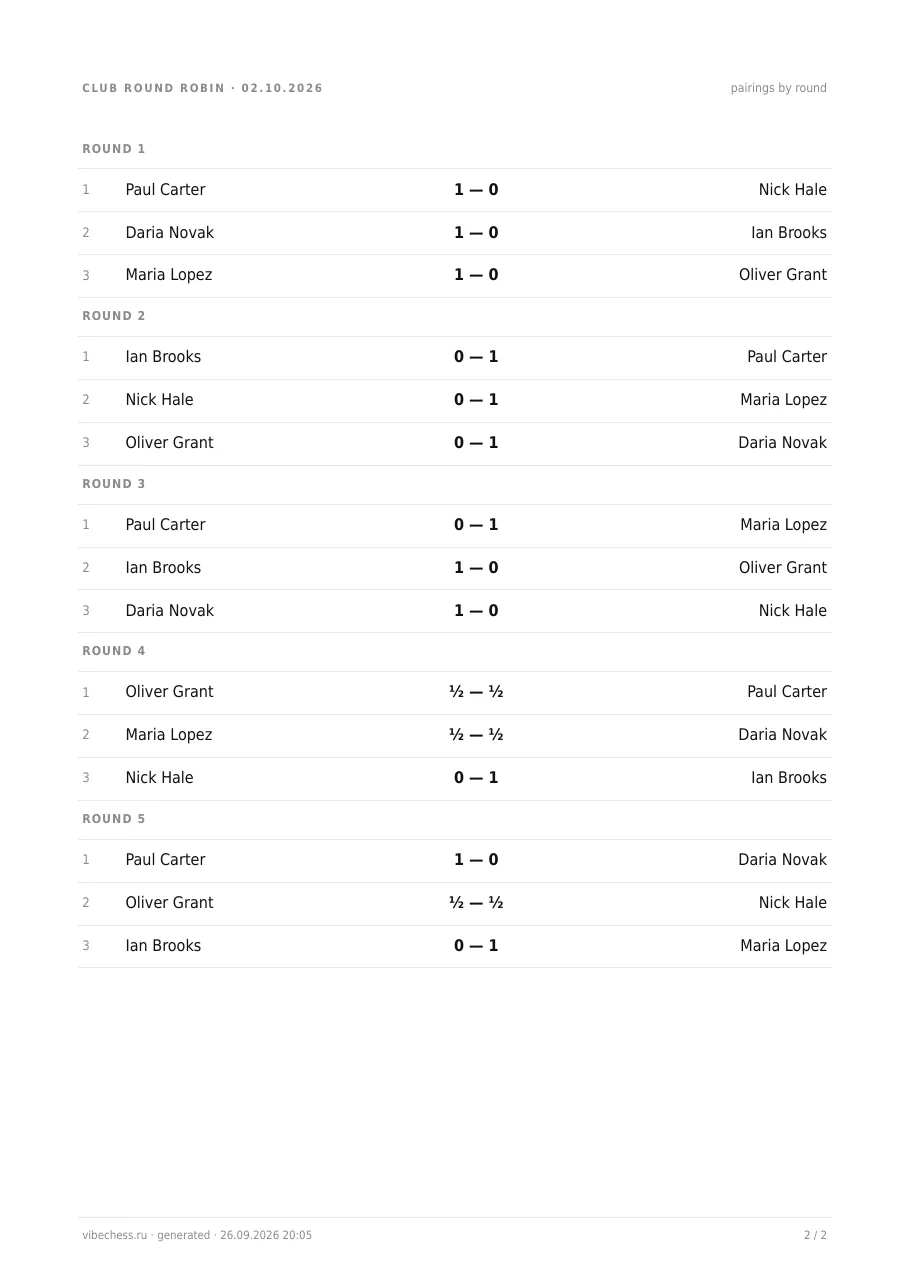
TRF is FIDE's standard tournament report format. It holds the event header (title, city, dates, system, time control, rounds) and one line per player: points, place and every game with the opponent's number, colour and result. Programs such as Swiss-Manager and national federations accept it.
In the Vibe Chess app a round-robin is created by picking the format: add the players, including guests without Telegram, and the full round schedule is generated from the field automatically. Results go in with a button press after each game, the table updates as you go, and the finished event exports as a TRF report. Free, no install, no limits.
It is a ready-made schedule for a round-robin. It tells you who plays whom in every round and who gets White. All the organizer has to do is hand out the numbers at the draw; the rest was worked out and standardised by FIDE long ago.
After Johann Nepomuk Berger, the Austrian player, theoretician and study composer who systematised the game order for round-robin events. The Sonneborn-Berger score is a different thing by the same author, and the two are easy to confuse: the table answers “who plays whom”, the score answers “who finishes higher on equal points”.
Use the “7-8 players” table on this page. The player paired with number 8 is free that round. Every player sits out exactly once, and the event still runs to 7 rounds.
The player whose number comes first in the pair. In the line “2-5”, number 2 has White and number 5 has Black. This holds in every table of the annex to the FIDE tournament rules.
With an even field there is one round fewer than there are players: 8 players means 7 rounds. With an odd field the number of rounds equals the number of players - 7 players means 7 rounds, but each of them sits out once. The total number of games is N×(N-1)/2.
Technically yes for a kitchen-table event, but then you have to police it by hand: nobody may meet twice and nobody should get three games in a row on one colour. A Berger table solves both at once, which is exactly why it was written into the tournament rules.
The first cycle is played straight off the table. In the second cycle the same pairings repeat with the colours reversed, but the last two rounds of the first cycle are swapped when you build it - that is the FIDE recommendation, and it prevents three games in a row on the same colour at the join.
Their remaining opponents get a bye instead of a game. Whether the games already played stand or are annulled depends on your regulations and on how much of the schedule the player completed - worth writing into the regulations before the start rather than after the argument.
In a round-robin the main tie-break is the Sonneborn-Berger score: the sum of the final scores of the opponents you beat, plus half the scores of those you drew with. Buchholz does not work here, because everybody faced exactly the same opposition.
Printing is handy when the event is played across several boards and people want to see the whole schedule at a glance. If you run the tournament in an app, the schedule is generated from the field automatically and the paper is purely decorative.
Yes. In the Vibe Chess app the organiser adds players as guests - just a name, no phone, account or sign-up. A guest plays like everyone else, with pairings, a table, colours, points and a place in the standings; only their games are unrated. Guests are kept in the My guests list, so next time you add them with one tap.
The tournament card in the app has a Show the tournament on a screen button. It gives you a link to open in a browser on the computer connected to the projector or TV, showing the round pairings and the standings with points and Sonneborn-Berger full-screen. While the event runs, the page updates itself.
Once the event is finished, its card shows Standings as a PDF sheet and Export TRF report. The A4 sheet with the final table and every pairing by round, and the FIDE-format report, arrive in the organiser's chat with the Telegram bot, ready to print, forward to players or send to a federation.