The basic rules of the FIDE Swiss system (C.04.1, 2026 edition) forbid only one thing in a pairing: two players do not meet twice. Neither family, nor club, nor federation is considered. Pairings are made by points, colours and starting numbers.
And changing correct pairings to favour anyone is forbidden (C.04.2, point 1.5). So if the pairing in a rated Swiss tournament brings a brother and sister together - they play. It is not a mistake but an honest pairing.
For round robins FIDE has the "Restricted Drawing of Lots" procedure (section C.06). It is used when the regulations require that players from one federation should not meet in the last three rounds, if possible.
How it works: in a round robin a player's number decides in advance in which round they play each opponent. The Varma tables split the numbers into groups so that numbers from one group do not meet in the last three rounds. A delegation draws its numbers from one envelope - and its players will play each other early in the tournament. The tables are made for tournaments of 10 to 20 players, with variants up to 24.
The regulations can apply the same technique to clubs and families: the point is the same, your own players meet earlier. How a round robin itself works - a round-robin chess tournament.
The point of the restriction is not that your own players never meet. That is impossible in a round robin and forbidden in a Swiss. The point is that their game should not decide places in the last rounds. When a draw or a loss to one of your own could hand a prize to a friend, the result raises questions - even if the game was played honestly.
In the first round such a game decides nothing, and there is no suspicion. So every way of "keeping your own apart" really means "pairing your own early".
| Format | Can they be kept apart | How |
|---|---|---|
| Swiss system, FIDE-rated | no | pairing knows nothing of family or clubs; changing correct pairings is forbidden |
| Round robin | the meeting can be brought forward | restricted drawing of lots: players from one group do not meet in the last three rounds, if possible |
| Team tournament | clubmates do not meet | teammates play together against another team |
| Groups within a tournament | they can be put in different groups | if relatives differ in age or level, they end up in different groups |
| Unrated amateur tournament | per the regulations | the rule is announced in advance, and the pairing software must support it |
For a junior tournament where a brother and sister differ in age, the most natural way is age groups. For clubs and companies - the team format: clubmates play together against another team.
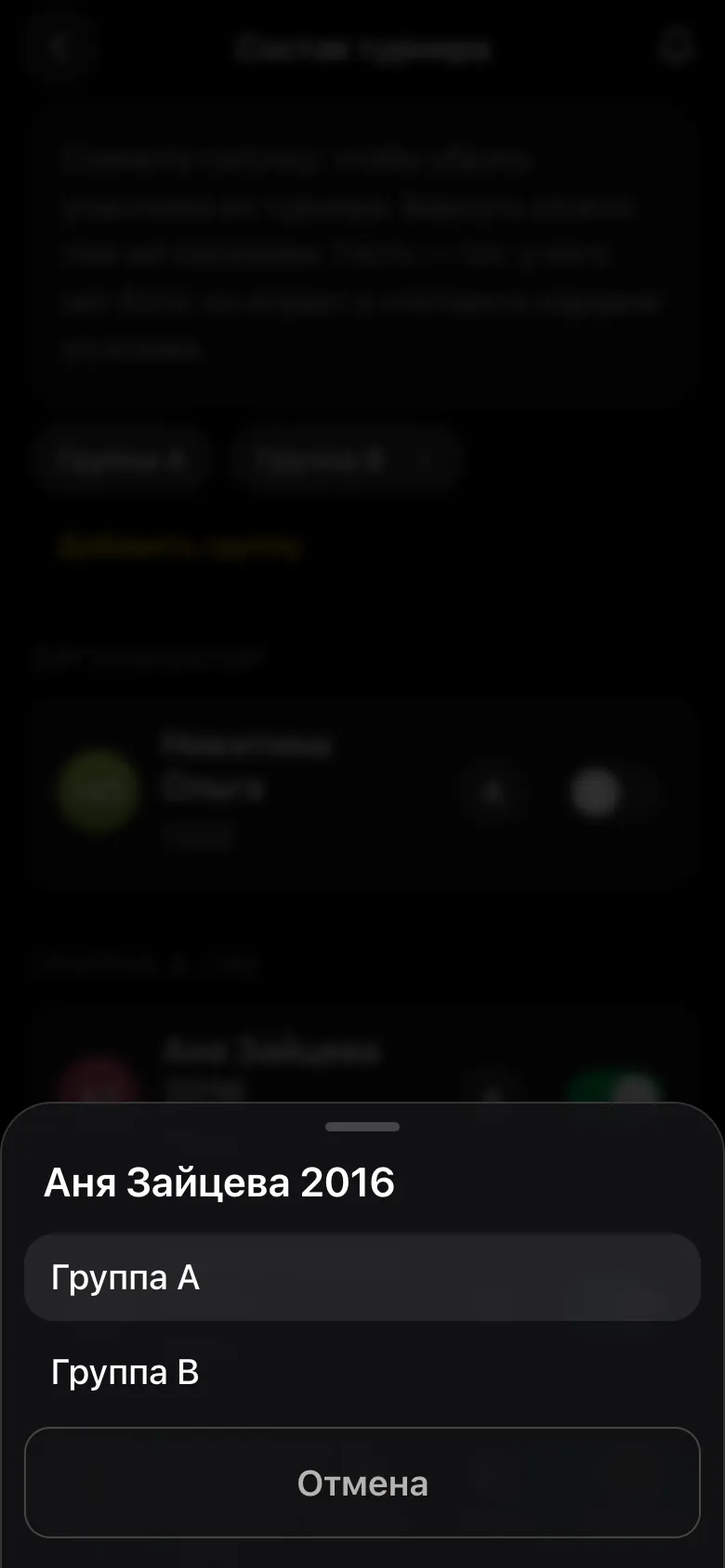
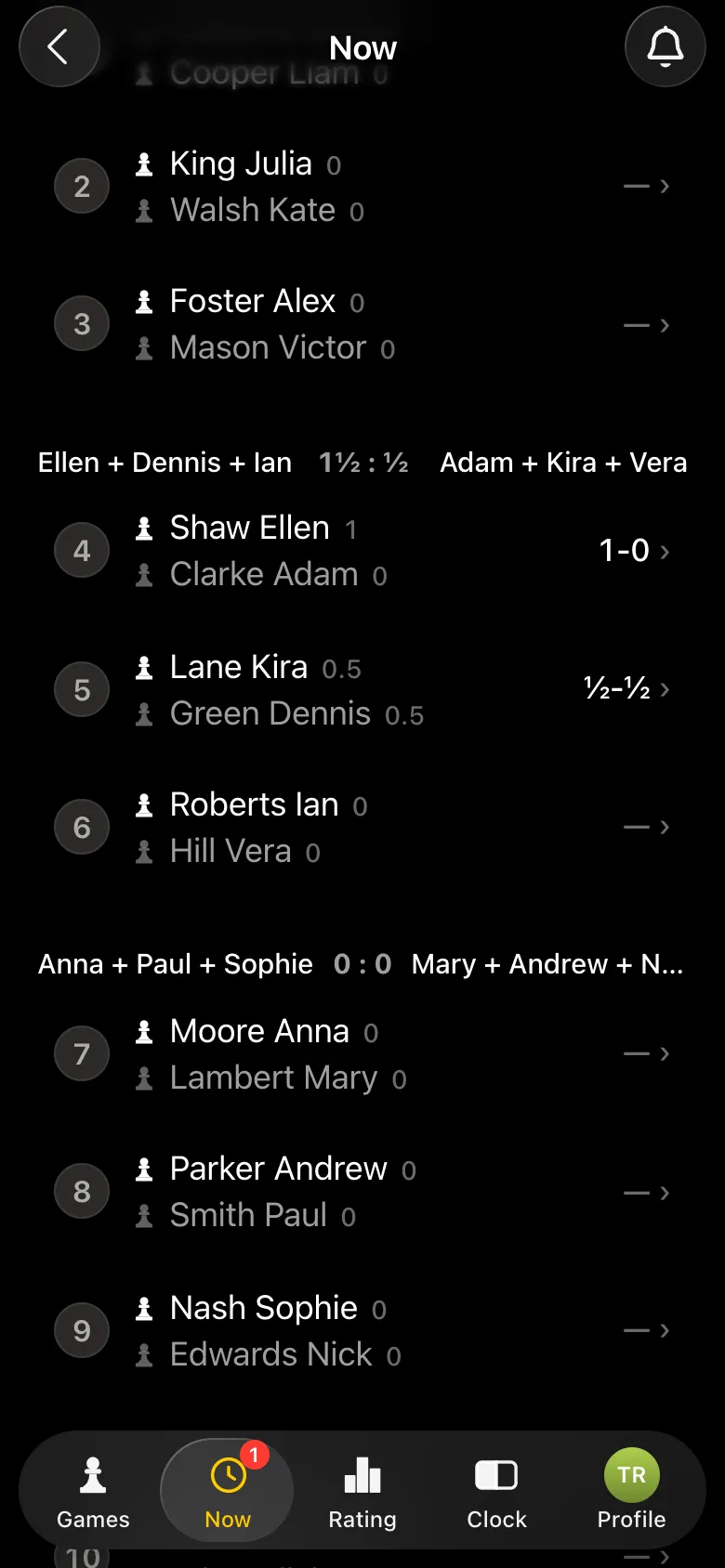
In the Vibe Chess app pairing uses only points, colours and the history of games - as the FIDE rules require. Forbidden pairs cannot be set. What you can do:
Not in a tournament under FIDE rules. Pairing does not take family into account, and changing correct pairings in anyone's favour is forbidden. The only restriction is a repeat game.
A FIDE procedure for round robins: numbers are drawn using the Varma tables so that players from one federation, if possible, do not meet in the last three rounds.
So that their game does not decide places at the end. A game in the first round decides nothing and raises no suspicion.
An unrated tournament may set its own rule if it is announced in advance. But the pairing software must be able to apply it, and age groups or a team format are fairer and simpler.
No. Pairings are calculated by points, colours and the history of games. Players can be kept apart with groups within the tournament or the team format.
The Vibe Chess app opens from a link and needs no installation. Setting up a tournament takes a minute: pick the system, set the date, the venue and the time control - the app handles the rest.
The bot is constantly improved based on real tournaments. If you need a feature that isn't there yet, message the developers right inside the bot with the /support command. Many features appeared exactly because organizers asked for them, and useful ideas get added quickly.
More about pairings: colour in the first round, manual pairing changes, accelerated pairings, a pairing error and the Swiss system for teams.

At the board since childhood: hazy about his rating, precise about every rook he has blundered. Counts an evening as a good one if the opponent stayed to talk afterwards instead of rushing off to check with an engine. Message →