In the Dutch system - FIDE's main Swiss system - the initial colour is decided by lot before the first round is paired (Article 5.1). The lot decides one thing: which colour the first starting number plays. All other first-round colours follow from it.
Starting numbers are given by strength: first by rating, with equal ratings - by FIDE title, then alphabetically (section C.04.2, point 2.2). The strongest player gets #1.
In the first round the top half of the starting list plays the bottom half: #1 against the first number of the bottom half, #2 against the second, and so on. Colour is allocated under Article 5.2.5: the higher-ranked player in a pair gets the drawn colour if their number is odd and the opposite one if it is even.
Example: ten players, the lot gave number one white.
| Board | White | Black |
|---|---|---|
| 1 | #1 | #6 |
| 2 | #7 | #2 |
| 3 | #3 | #8 |
| 4 | #9 | #4 |
| 5 | #5 | #10 |
Odd numbers of the top half (1, 3, 5) play white, even ones (2, 4) play black. So the strongest players get white and black half and half, and nobody has an advantage in advance. Had the lot given number one black, the whole layout would flip.
From round two there is no more drawing of lots: the pairing works out colour from each player's history. The basic rules of the FIDE Swiss system (C.04.1, 2026 edition):
| Rule | What it means | Source |
|---|---|---|
| Colour preference | whoever has played white less gets white | rule 8 of the basic Swiss rules |
| Difference between whites and blacks | no more than two either way | rule 6; some systems have exceptions in the last round |
| Three times in a row | the same colour is not allowed | rule 7 |
| Forfeit and bye | the colour does not count | only played games matter for colours |
| Colour in the last round | the same calculation decides, no drawing of lots | the Dutch system |
So over an odd number of rounds someone will inevitably play one colour one game more. That is normal, and the pairing makes sure the imbalance never exceeds two games.
In a round robin the colours are written in the Berger tables in advance: each number knows whom it plays and with which colour in every round. So the lot here is not about colour but about the number: players draw numbers, and with the number they get the whole colour schedule.
With an even number of players, half of them play white one game more. How the tables work - a round-robin chess tournament.
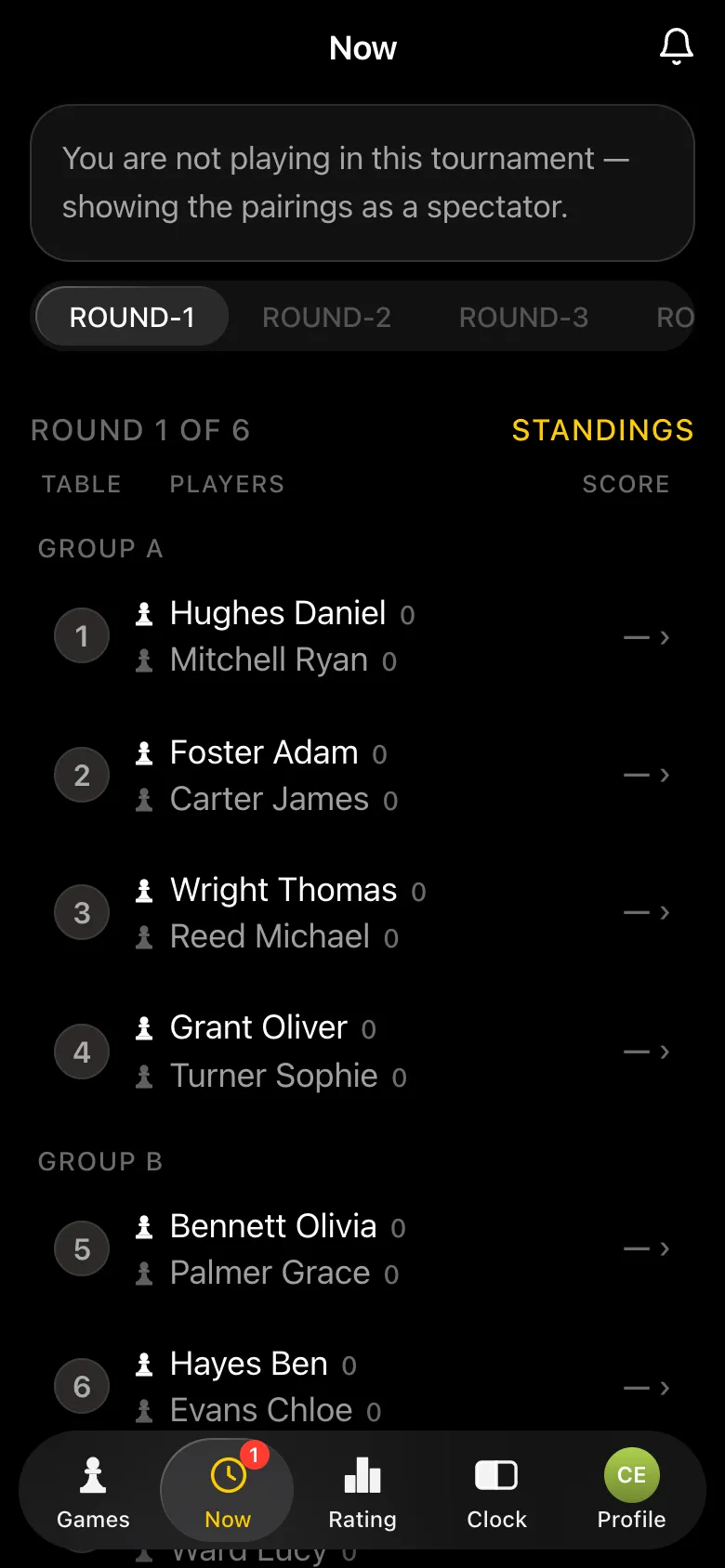
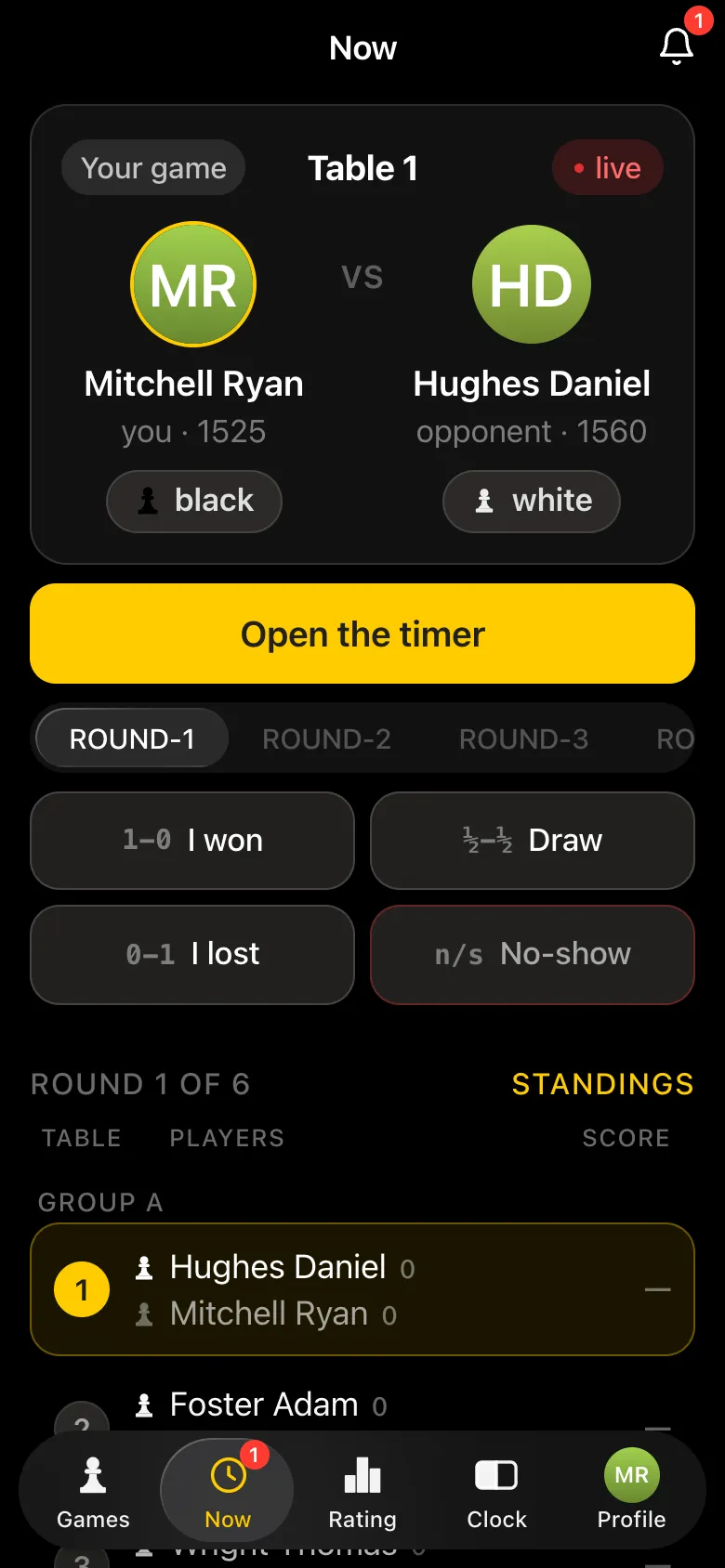
In the Vibe Chess app the first round is laid out automatically:
Under FIDE rules - by drawing lots before the first round is paired. The lot decides the colour of the first starting number, and the other first-round colours follow from it.
The higher-ranked player in a pair gets the drawn colour if their starting number is odd and the opposite one if it is even. So on boards 1, 3, 5 the stronger players have one colour, on boards 2, 4 the other.
No. Colour is decided by the lot and the starting number. Neither the player nor the arbiter can choose it.
No. Under the basic rules of the FIDE Swiss system nobody gets the same colour three times in a row, and the difference between whites and blacks does not exceed two.
No. Only played games count for colours: a forfeit and a bye do not go into the colour history.
On board one - the first starting number, that is the player with the highest Vibe Chess rating. After that colours alternate by the FIDE rule.
The Vibe Chess app is built for an evening over the board, not for online play: it keeps the sign-up list, the pairings and the table while you deal with people and the venue. All of it free.
The bot is constantly improved based on real tournaments. If you need a feature that isn't there yet, message the developers right inside the bot with the /support command. Many features appeared exactly because organizers asked for them, and useful ideas get added quickly.
More about pairings: accelerated pairings, relatives and clubmates in the pairings, manual pairing changes, a pairing error and online chess tournament pairing.

At the board since childhood: hazy about his rating, precise about every rook he has blundered. Counts an evening as a good one if the opponent stayed to talk afterwards instead of rushing off to check with an engine. Message →