The round robin is the fairest tournament format there is: everyone plays everyone, and the luck of the draw is taken out of it. And Sonneborn-Berger is its chief judge when points are shared. Here is everything an organiser and a player need: the formula for the number of rounds, Berger tables for the pairing, the order of colours, a walk-through of the tie-break with a live 6-player example, and a way to run such an event in the Vibe Chess app without paper or tables on your phone.
In a round robin every player meets every other one once (twice in a double round robin, with the colours reversed). The number of rounds is known in advance: with an even number of players there is one round fewer than there are players, with an odd number there are as many rounds as players, and then everyone sits out exactly one round.
Hence the format's main limitation: the number of games grows as N×(N-1)/2. Six people play their event in 5 rounds, while thirty would need 29 - more than an evening or even a weekend can hold. That is why large opens use the Swiss system, where far fewer rounds are needed, while the round robin is taken for club and home events with a group of up to 10-12 players.
| Players | Rounds | Games in total |
|---|---|---|
| 4 | 3 | 6 |
| 6 | 5 | 15 |
| 8 | 7 | 28 |
| 10 | 9 | 45 |
| 12 | 11 | 66 |
| 16 | 15 | 120 |
The club-evening classic is a tournament for 8: 7 rounds fit into one long evening of blitz or two evenings of rapid.
Under the FIDE tournament rules a round robin is paired once, before round one: the players draw numbers, and from then on the schedule of every round is set by a ready-made Berger table from the annex to the rules (FIDE Handbook C.05, Annex 1). The player whose number comes first in the pair has White.
| Round | Pairings (White listed first) |
|---|---|
| round 1 | 1–6, 2–5, 3–4 |
| round 2 | 6–4, 5–3, 1–2 |
| round 3 | 2–6, 3–1, 4–5 |
| round 4 | 6–5, 1–4, 2–3 |
| round 5 | 3–6, 4–2, 5–1 |
With 5 players you use the same table, and whoever is drawn against number 6 is free that round. In a double round robin FIDE recommends swapping the last two rounds of the first cycle so that nobody plays three games in a row with the same colour.
Tables for every tournament size - from four players to sixteen - are collected on a separate page: Berger tables with the round schedule, and they can be printed. For a paper record sheet you will want a tournament table template, and if you run the event on your phone the round schedule is built from the entry list automatically - more on that below.
When two or more players finish on the same number of points, a tie-break decides the places between them. For round robins that is Sonneborn-Berger:
SB = Σ scores of players beaten + ½ × Σ scores of players drawn with
The idea: not all points are equally valuable. A win over the leader, who scored a lot, weighs more than a win over a tail-ender. A draw with a strong opponent contributes too - half his score. And the games the player lost do not enter the tie-break at all. Of two players on equal points, the one who scored them against stronger opposition finishes higher.
Under the FIDE regulations, wins by an opponent's failure to appear are included in the sum on the same footing as played games. The tie-break is calculated strictly from the final crosstable: until the event is over the opponents' scores are still moving, and an interim number means nothing.
A club round robin: 6 players, 5 rounds, rapid 10+5. The winner was clear-cut - 4 points out of 5. What comes next is more interesting: three players finished on 2½. The sum of the opponents' scores (Buchholz) is identical for all three - in a round robin the opponents are shared, so that tie-break is useless here. Only Sonneborn-Berger sorts out the places.
| # | Player | Points | Wins | Draws | Sonneborn-Berger |
|---|---|---|---|---|---|
| 1 | Pavel Grigoriev | 4 | 3 | 2 | 9 |
| 2 | Oleg Tarasov | 2½ | 1 | 3 | 6½ |
| 3 | Darya Belova | 2½ | 2 | 1 | 5¼ |
| 4 | Nikita Orlov | 2½ | 2 | 1 | 4¾ |
| 5 | Maria Savelieva | 2 | 2 | 0 | 4 |
| 6 | Ivan Krylov | 1½ | 0 | 3 | 4½ |
The 2½ score group is highlighted: three players on equal points whom only Sonneborn-Berger could separate.
a win over Darya Belova (2½)
a draw with Pavel Grigoriev (4)
a draw with Nikita Orlov (2½)
a draw with Ivan Krylov (1½)
2,5 + 0,5 × (4 + 2,5 + 1,5)
a win over Nikita Orlov (2½)
a win over Maria Savelieva (2)
a draw with Ivan Krylov (1½)
(2,5 + 2) + 0,5 × 1,5
a win over Maria Savelieva (2)
a win over Ivan Krylov (1½)
a draw with Oleg Tarasov (2½)
(2 + 1,5) + 0,5 × 2,5
A telling outcome: Oleg Tarasov has a single win against his rivals' two, but three draws with strong opponents, the tournament winner among them, gave him the best Sonneborn-Berger in the group - and second place. The tie-break rewards the player who took his points in hard games rather than collecting them off the tail of the table.
Buchholz score- the sum of all the opponents' scores - was designed for the Swiss system, where every player has his own set of opponents. In a round robin the opponents are the same for everybody, so the sums nearly coincide: in the example above all three contenders for second place had a Buchholz of 12.5. Zero information for deciding the places.
Sonneborn-Berger solves the problem differently: it looks not at whom you played but at whom you beat and with whom you made peace. That is why the regulations pair them up like this: Swiss system - Buchholz first, round robin - Sonneborn-Berger first. The full set of tie-breaks and the order in which they apply is covered in the guide to chess tie-breaks. If Sonneborn-Berger is level too, the FIDE regulations suggest head-to-head and the Koya system - the points scored against opponents on 50% or more.
There is a historical irony in the name of this system. The idea of weighting wins by the strength of the opposition was proposed in 1873 by the Viennese master Oscar Gelbfuhs. The formula the world still uses was published in 1882 by Hermann Neustadtl. And William Sonneborn and Johann Berger, whose names the tie-break carries, were promoting a version of their own - one that added the square of your own score, and that is precisely the version that never caught on.
By the late 1880s the system had established itself in tournament practice under the name Sonneborn-Berger, and nobody bothered to rename it. Johann Berger left a second mark on chess as well: those very game-order tables for round robins that FIDE included in its tournament rules carry his name.
Everything described above is handled for you by our free app. You choose “Round-robin tournament”, add the players (guests without Telegram play too), and the round schedule is built from the entry list on its own - no Berger tables on paper. Results are entered with buttons after the game, and a disputed score is confirmed by the organiser. The demo event in the example above was run in exactly this way.

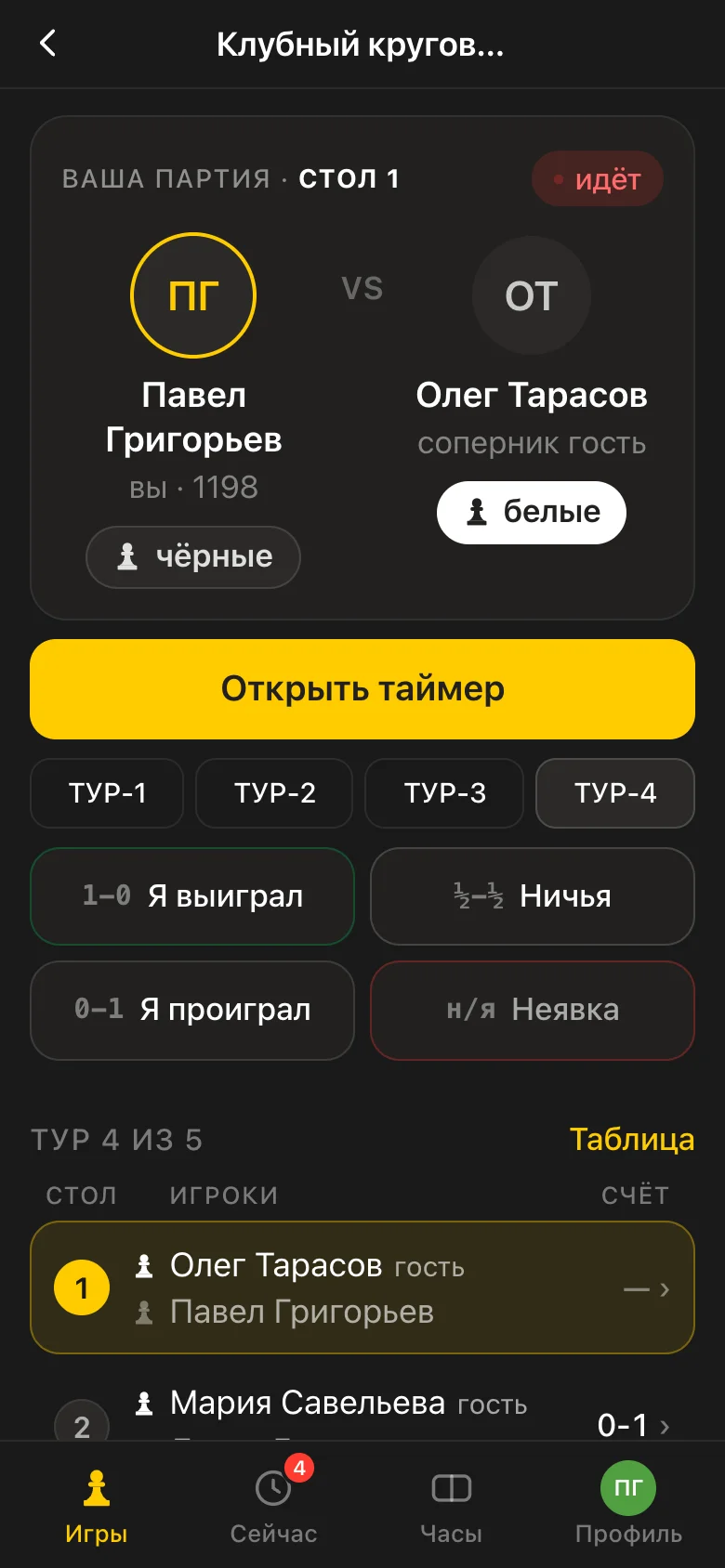
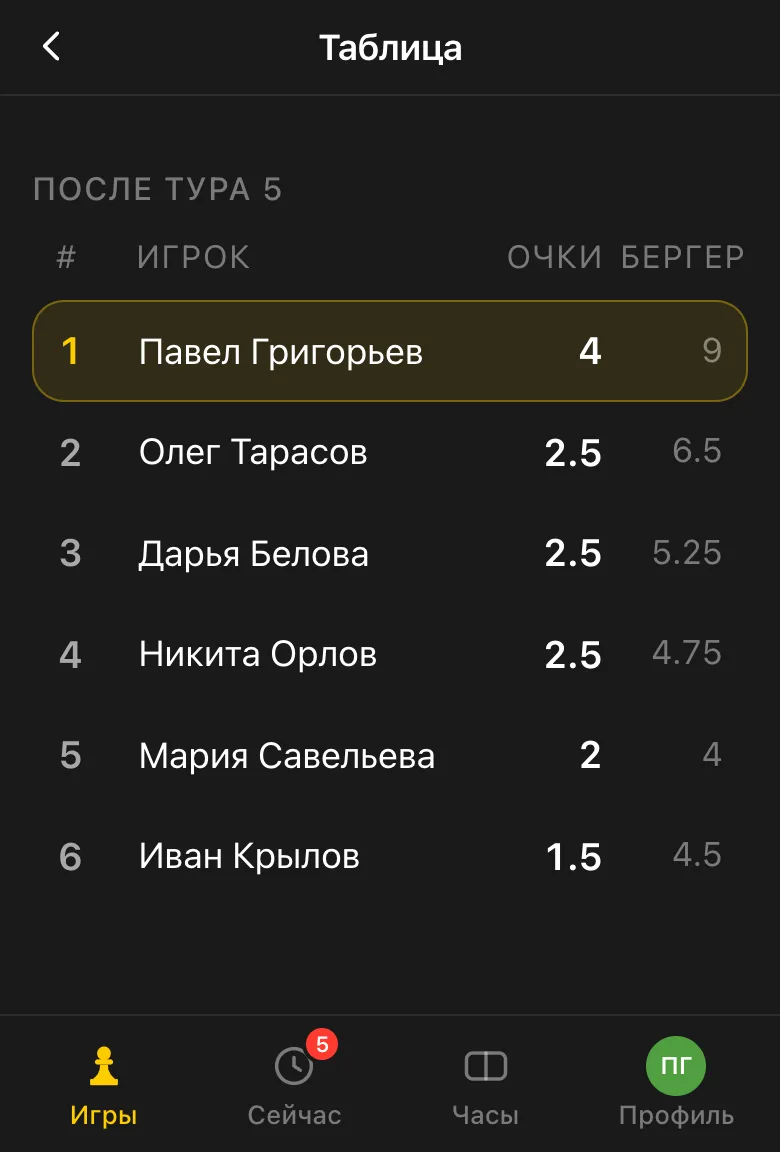
The app keeps the standings live as the event goes on, and in the round-robin format it calculates Sonneborn-Berger itself under the FIDE regulations - wins by forfeit included - and ranks players on equal points by it. The screenshot of the standings above was taken from the very tournament analysed in this article: all fifteen games were played as in our example, and the app produced exactly the same numbers - 9, 6½, 5¼, 4¾, 4 and 4½. The three players on 2½ are ordered by precisely those. At the end a TRF report is exported for arbiter software, while the manual calculation below remains for paper events and for checking.
Sonneborn-Berger is calculated from the opponents' final scores. Until every game has been played the opponents' scores can still change, and an interim calculation tells you nothing.
For the player whose tie-break you are calculating, list from the crosstable every opponent and the result against each one: win, draw or loss.
Take the final score of every opponent the player defeated and add them together. Under the FIDE regulations, wins by forfeit go into this sum on the same footing as ordinary ones.
Halve the final score of every opponent the player drew with and add it to the sum. The scores of opponents the player lost to are not counted at all.
The resulting number is compared only between players on the same number of points. Whoever has the higher Sonneborn-Berger takes the higher place.
You do not have to do it by hand: the Sonneborn-Berger calculator will work out the scores, the tie-break and the places straight from a filled-in crosstable. Planning a whole tournament, from the regulations to the prize-giving? There is a step-by-step plan in the guide to how to organise a chess tournament, and a comparison of automation tools is in the review of tournament software.
Sonneborn-Berger = the sum of the final scores of every opponent the player beat, plus half the sum of the scores of those he drew with. The scores of opponents he lost to are not included. The formula is fixed in the FIDE tie-break regulations: wins by forfeit count on the same footing as ordinary ones.
7 rounds and 28 games. The general rule: with an even number of players there are N-1 rounds, with an odd number N, and N×(N-1)/2 games in total. A 10-player event is 9 rounds and 45 games, a 12-player one is 11 rounds and 66 games.
Buchholz is the sum of all your opponents' scores, regardless of the result against them. Sonneborn-Berger weighs them: the score of a player you beat is taken in full, the score of a player you drew with counts half, the score of a player who beat you counts not at all. In a round robin everyone faces the same opponents, so Buchholz is practically identical for all and separates nobody - only Sonneborn-Berger works there.
For round robins the FIDE regulations suggest this order: the result of the individual game between the players concerned, then Sonneborn-Berger, then the Koya system - the number of points scored against all opponents on 50% or more. The exact order of tie-breaks is set by the regulations of the particular event, so write it down in advance.
They are the standard game-order tables for round robins from the FIDE tournament rules. From the number drawn at the lots, every player can see in advance which round he plays each opponent in and with which colour. Tables exist for any number of players: 3-4, 5-6, 7-8 and so on.
The player whose number appears first in the pair in the Berger table. In the pair “3-6”, for example, number 3 has White. That is how the colours are spread evenly: every player gets almost the same number of Whites and Blacks over the event.
You use the Berger table for the next even number, and the player who is drawn against the non-existent highest number is free that round. With 7 players you take the table for 7-8, and everyone sits out exactly one round.
FIDE recommends swapping the last two rounds of the first cycle when drawing up the schedule for the second. That protects players from three games in a row with the same colour at the junction of the cycles.
It is one and the same system, and the names got historically muddled. The idea of a weighted count was proposed by Oscar Gelbfuhs in 1873, and the modern formula was published by Hermann Neustadtl in 1882. William Sonneborn and Johann Berger promoted the system actively, and by 1886-1888 it had stuck under their names. Sonneborn and Berger's own version, incidentally, was different - it added the square of your own score - and it is not used today.
Yes. Under the wording of the FIDE tie-break regulations the sum includes the scores of opponents the player beat, wins by forfeit included. Pairing programs and apps make that adjustment automatically.
There is no point: the tie-break is built on the opponents' final scores, and those change right up to the last round. A draw by a tail-ender in the final round can reshuffle the places in the top score group even if the leaders themselves have already finished playing.
The practical limit is roughly 10-12 people for a single day, and up to 20 for a long club event played to a schedule. Beyond that the number of rounds grows too fast: 30 players would need 29 rounds. Larger fields use the Swiss system.