In straight lines: along a file or along a rank, as far as you like. Diagonals are closed to a rook, and it cannot jump - the first piece in the way stops the movement, though an enemy piece there may be captured.
Fourteen is always. Put a rook in the corner on a1, at the edge on e1 or in the middle - on an empty board it holds exactly 14 squares either way, because the length of a file and a rank does not change. No other piece works like that: a knight in a corner is four times weaker than the same knight in the centre, a bishop almost twice.
If the square does not matter, then a rook's strength is decided purely by who stands on its lines. And the pieces in its way are usually its own pawns.
Hence the key idea: an open file is a file with no pawns on it at all. A rook on an open file cuts through the board, while a rook locked in by its own pawns does nothing. That is also why rooks barely move early in the game - there is nowhere for them to go while the pawns are home.
The right order is the other way round: develop knights and bishops, castle, and only then bring a rook to the file that opened up after a pawn trade. In the opening that is the last stage - openings for White.
A rook that reaches the rank before last - the seventh for White, the second for Black - is worth special mention. That is where pawns that have not moved still sit, and where the enemy king ends up cut off.
Note what the rook on d7 does not do: it does not attack the pawns on a7 and b7, because the nearer pawn on c7 blocks the line, exactly as any piece would. A rook always hits only the first piece in each direction, and that is worth keeping in mind when you count threats.
Two rooks that reach the seventh rank together are known as "pigs on the seventh" - a crude nickname that sticks, and a position the defender usually loses. More patterns like this - tactics for beginners.
The one case where a rook moves not by its own rule but together with the king is castling. There it hops over the king and lands on the far side of it, right next to it.
One important detail: the right to castle is lost if that particular rook has already moved. Move the h1 rook and bring it back, and kingside castling is gone for good, while queenside castling remains. And in castling you touch the king first, otherwise an arbiter may rule that you have played a rook move. All four prohibitions - castling in chess.
Castling does something for the rook as well: it lifts it out of the corner, where it was idle, closer to the centre and towards an open file.
The rook is a squat piece shaped like a tower with battlements. In English notation it is written R; in Russian the piece is called ladya, a boat, and in several languages a tower or a castle - though "castle" as a verb means the move, not the piece.
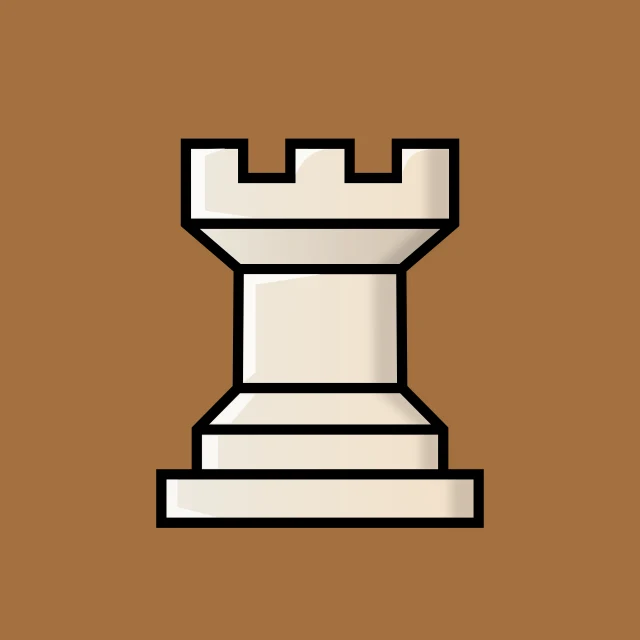
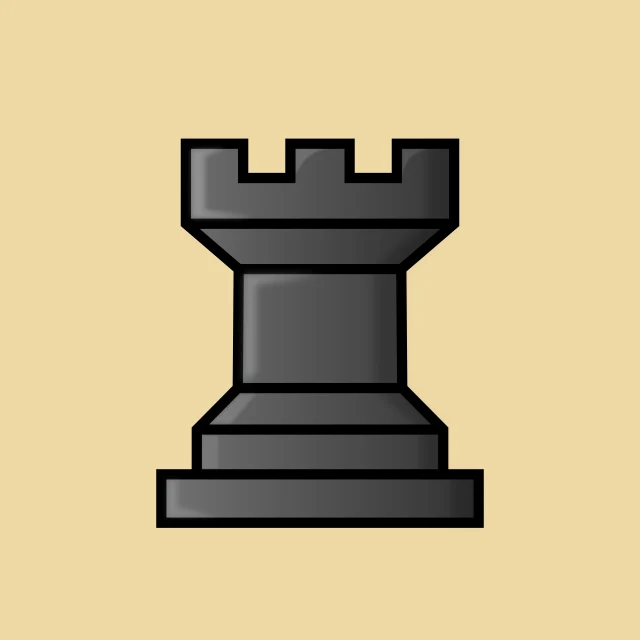
The name comes from the Persian rukh, a chariot: in the original game this piece was not a tower but a war wagon. Russian took the boat version, western Europe the tower, and the move is the same in all of them.
A rook is worth five pawns - more than a knight or a bishop, less than a queen. Together with the queen it counts as a heavy piece: either of them can mate with the help of its own king, while a single minor piece cannot. That technique - basic checkmates.
The full setup and the everyday names of the other pieces - chess board setup.
Along files and ranks for any number of squares, backwards included. Diagonals are closed to it and it cannot jump: the first piece in the way stops the movement, though an enemy piece there can be captured.
Fourteen, and it does not depend on the square: from a corner, from the edge or from the centre of an empty board it is always 14. What does matter is whether pawns sit on its lines - one friendly pawn ahead takes several squares away at once.
No. Only the knight jumps. The one moment a rook ends up on the far side of another piece is castling, but that is a joint move of king and rook, not a jump.
A file with no pawns on it. A rook on an open file cuts through the board, which is why players fight for such files during the game. A rook shut in by its own pawns does nothing at all.
Five. That is more than a knight or a bishop at three each, and less than a queen at nine. Two rooks come to ten, slightly more than a queen.
From the Persian rukh, a chariot - the piece was a war wagon in the original game. The tower shape came later in Europe, and Russian went with a boat instead. The move does not depend on the name.
Yes, but only on the side where that rook moved. Move the h1 rook and return it, and kingside castling is no longer available while queenside castling stays. The right is lost for good, even if the pieces go back to their squares.
The Vibe Chess app is built for an evening over the board, not for online play: it keeps the sign-up list, the pairings and the table while you deal with people and the venue. All of it free.
score groups, no rematches, no second bye
everyone plays everyone, the app works out the number of rounds
who is free and who is already at a board is shown under Now
The bot is constantly improved based on real tournaments. If you need a feature that isn't there yet, message the developers right inside the bot with the /support command. Many features appeared exactly because organizers asked for them, and useful ideas get added quickly.

At the board since childhood: hazy about his rating, precise about every rook he has blundered. Counts an evening as a good one if the opponent stayed to talk afterwards instead of rushing off to check with an engine. Message →