One square in any of eight directions. No range, no jumps: the king is the slowest piece on the board.
In a corner three squares remain, at the edge five. That is why the king is kept near the centre in the endgame and hidden in a corner behind pawns at the start: early on its job is not to work but to stay out of trouble.
The king captures exactly as it moves: it takes the square of an enemy piece and removes it. There is no separate capturing rule.
Onto an attacked square. This is the main restriction: the king may not step where any enemy piece could take it. The square is often completely empty - the ban comes from who covers it, not from what stands on it.
Onto a square next to the enemy king. Two kings never stand on adjacent squares - each would be attacking the other. The rule follows from the previous one, but it deserves its own line: the whole technique of mating a lone king rests on it.
Into check after its own move. If the king shields a line - that is, stands between a friendly piece and an enemy long-range one - it may step aside, but it may not open the line and stay under fire. The same rule forbids moving any piece that shields the king.
Yes - if the piece giving check is not protected. Capturing the attacker is one of the three legal answers to check, alongside moving away and blocking. The king captures the way it moves: one square in any direction.
The king may not take a piece that another enemy piece protects: after the capture it would stand in check itself, and moving into check is never allowed - not even to get out of one.
Beginners often assume a king in check is frozen and can only run. It is not: as long as it does not step into an attack, any capture next to it is allowed - the checking piece or any other, if that capture ends the check.
The king is the one piece that never leaves the board. It is not taken and not traded: the game ends earlier, at the moment when the attack can no longer be answered.
One practical consequence for beginners: saying "check" out loud is not required, but missing one is impossible - a move that fails to answer a check is simply illegal. More on check and mate - rules of chess.
Once per game the king may travel two squares at once - that is castling, and the rook comes along. The move counts as a king move, which is why the king is the piece you touch first.
You may not castle out of check, through an attacked square, or after the king has already moved. All four prohibitions with diagrams - castling in chess.
The tallest piece in the set, with a cross on top. The cross is the reliable sign: a queen has a crown of points and no cross. If the pieces are cheap and the cross has worn away, go by height - the king is taller.

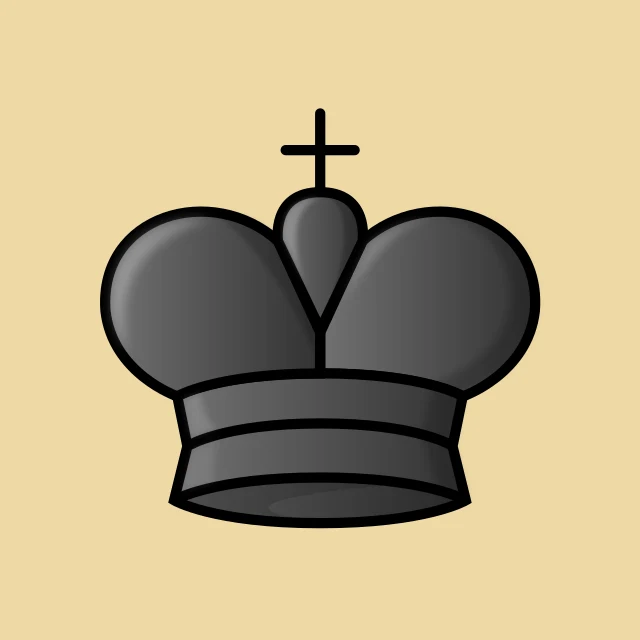

Each side has exactly one king and that never changes during the game: it cannot be traded and cannot be gained from a pawn. That is also why the king has no value in pawns - there is nothing to compare it with. How many of each piece a set holds - board setup.
The white king stands on e1, the black one on e8, facing each other. The king starts on a square of the opposite colour: White on dark e1, Black on light e8 - unlike the queen, which starts on its own colour.
Mixing up king and queen is the most common setup mistake, and the colour of the square settles it in a second: if the white king ended up on a light square, it and the queen are in each other's places.
While the board is full, the king hides. When almost nothing is left it turns into a working piece and walks to the centre: there is nothing left to mate it with, and eight squares around it is more than, say, a knight controls from the edge.
In practice that means the side with the more active king usually wins a pawn endgame. The king escorts its own passed pawn and stops the enemy one - a pawn does not get through without help. Positions to study - pawn endgames and endgames for beginners.
Mating also takes the king: a queen or rook alone cannot mate a lone king, you need your own king to take squares away - basic checkmates.
Yes, if the checking piece stands next to the king and is unprotected: capturing the attacker is a legal answer to check. If another enemy piece protects it, the capture is illegal - the king would be moving into check.
One square in any direction: along a file, a rank or a diagonal. From the centre it reaches eight squares, from the edge five, from a corner three. It captures exactly as it moves.
It is the tallest piece in the set, with a cross on top. The queen has a crown of points and no cross - that cross is how the two are told apart. Each side has one king.
Onto any square covered by an enemy piece, and onto a square next to the enemy king. It also may not open a line while standing between a friendly piece and an enemy long-range piece: staying under attack is never allowed.
Because each would then be attacked by the other, and moving into attack is forbidden. There is always at least one square between the kings - the whole technique of mating a lone king is built on this.
No. The king never leaves the board: the game ends earlier, when the attack cannot be answered - that is checkmate. A check means the attack must be dealt with immediately: move away, block, or take the attacker.
White on e1, Black on e8, opposite each other. The king starts on a square of the opposite colour: White on dark, Black on light. If the white king is on a light square, it has been swapped with the queen.
Only once per game and only when castling: the king shifts two squares towards a rook and the rook hops over it. In every other case the king moves exactly one square.
There are no club or arbiter roles in the app: the create button is available to everyone. You can announce a tournament today and run it this weekend.
The bot is constantly improved based on real tournaments. If you need a feature that isn't there yet, message the developers right inside the bot with the /support command. Many features appeared exactly because organizers asked for them, and useful ideas get added quickly.
At the board since childhood: hazy about his rating, precise about every rook he has blundered. Counts an evening as a good one if the opponent stayed to talk afterwards instead of rushing off to check with an engine. Message →