One square forward. The single exception is that particular pawn's first move: from its starting square it may step two squares at once, provided both are empty.
After that it is one square at a time. The right to the double step is not stored and does not come back: once the pawn has gone to e3, it moves one square per turn for the rest of the game.
Forward means towards the opponent: white pawns travel from the first rank towards the eighth, black pawns the other way. Each side has eight pawns and they start on the second row - chess board setup.
This is the thing to understand about pawns. A piece standing directly in front of a pawn cannot be taken by it - it simply blocks the way. Diagonally forward, on the other hand, the pawn captures, even though it may not move there without a capture.
Hence the most common situation on the board: two pawns meet head on and both stop. Neither can capture the other and neither can pass.
No. A pawn never captures backwards and never moves backwards - not in the opening, not in the endgame, not even when an enemy piece stands diagonally right behind it. It is the only piece with that restriction, and the FIDE rules make no exception.
Where does the question come from? Most often from checkers: in many versions of draughts a man captures both forwards and backwards, and people who learned that game first carry the rule over. In chess a backward pawn move is an illegal move, and at a tournament it is penalised: in blitz the first one gives your opponent an extra minute and the second loses the game.
Two rules that get mistaken for a backward capture are not exceptions at all:
One practical consequence: every pawn move is permanent. A rook or a knight can go back if the move was a mistake, a pawn cannot. That is why strong players move pawns more carefully than pieces.
The most surprising rule in chess, and the only one where the captured piece does not stand on the square the capturing piece lands on. It works like this: if an enemy pawn makes its double step from the starting square and lands beside yours, you may take it as though it had moved only one square.
Three conditions, without which there is no en passant:
The rule was not invented for elegance: without it the double step would let a pawn slip safely past an enemy pawn, while the point of the double step was only to speed up the opening.
On reaching the last rank a pawn must promote - to a queen, rook, bishop or knight, whichever the player chooses. It cannot stay a pawn, and it certainly cannot become a king.
Almost everyone takes a queen - it is the strongest. But the choice can be deliberate: promoting to a knight saves the day when a queen would give stalemate and a knight gives check. Choosing a weaker piece is called underpromotion.
There is no limit on the number of pieces: after several promotions you can have more than one queen. A set usually lacks a second queen, and at tournaments an upside-down rook stands in for it - arbiters accept that.
The pawn is the unit of measurement: every other piece is valued in pawns. A knight and a bishop are three, a rook five, a queen nine.
But a pawn's value changes during the game more than any piece's. Early on it is just a pawn; in the endgame a pawn nobody can stop from reaching the end is worth a queen - because a queen is what it becomes. Such pawns are called passed pawns, and pieces are given up for them.
Hence a practical rule for beginners: do not trade pawns for no reason. Every pawn is a future queen, and the pawn structure decides who will be better in the endgame. Positions to study - pawn endgames.
The smallest and plainest piece: a ball on a base, with no detail. A set has eight pawns per side - more than all the other pieces put together.
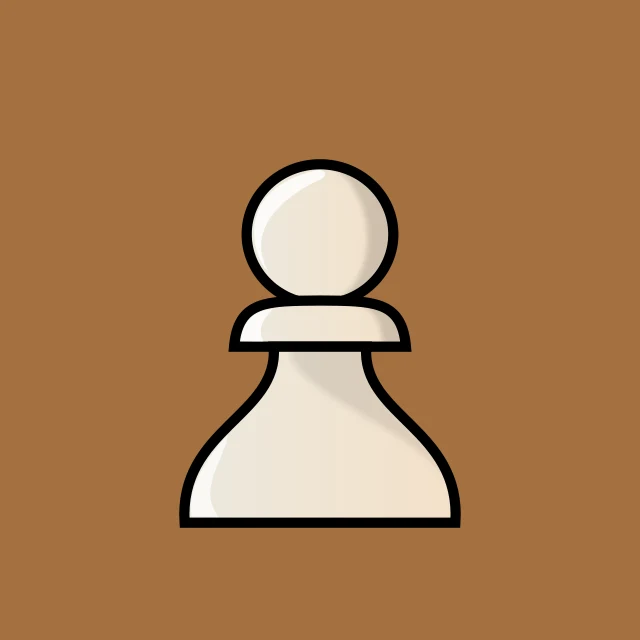
In notation a pawn has no letter of its own: the move is written simply as the square it arrives on - e4, d5. When a pawn captures, the file it comes from is given: exd5. How to read and write moves - chess notation.
One square forward, and from its starting square it may go two squares at once if both are free. The double step is available once: after the first move a pawn advances strictly one square at a time.
Diagonally forward, one square. A pawn cannot take a piece standing directly in front of it - that piece just blocks the way. It is the only piece whose move and capture go in different directions.
No, never. A pawn moves and captures only forward, towards the opponent, and the rules make no exception. En passant is not one: the pawn still moves forward there, it simply removes a piece from a neighbouring square.
If an enemy pawn makes its double step from the starting square and lands beside yours, you may capture it as if it had moved one square: your pawn goes to the square it skipped and the enemy pawn is removed. It has to be done immediately - one move later the right is gone.
A queen, rook, bishop or knight, whichever the player chooses. Staying a pawn is not allowed and becoming a king is impossible; promotion is compulsory. Almost everyone takes a queen, but a knight is sometimes chosen for a check, or a weaker piece to avoid stalemate.
As many as there are pawns that get through - the rules set no limit. At a tournament a set rarely has a second queen, so an upside-down rook is used and arbiters accept it.
The pawn is the unit itself: a knight and a bishop are three pawns, a rook five, a queen nine. But towards the end of the game a passed pawn that nobody can stop is worth almost a queen - because that is what it is about to become.
Everything people usually keep in a spreadsheet is already in the app: pairings, points, tie-breaks, round order. Free, with no subscriptions and no cap on the number of players.
The bot is constantly improved based on real tournaments. If you need a feature that isn't there yet, message the developers right inside the bot with the /support command. Many features appeared exactly because organizers asked for them, and useful ideas get added quickly.
At the board since childhood: hazy about his rating, precise about every rook he has blundered. Counts an evening as a good one if the opponent stayed to talk afterwards instead of rushing off to check with an engine. Message →