Two squares in one direction plus one square to the side - the outline of the letter L. From the centre there are eight such moves, spread evenly all around.
How you trace the L does not matter: a knight does not walk across squares, it lands straight on the target. The three paths below are just different ways to count the same move.
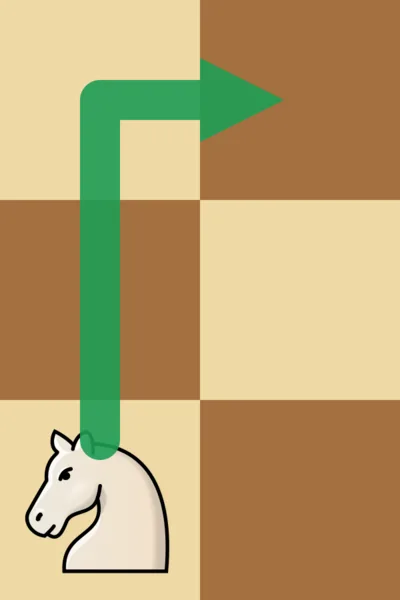
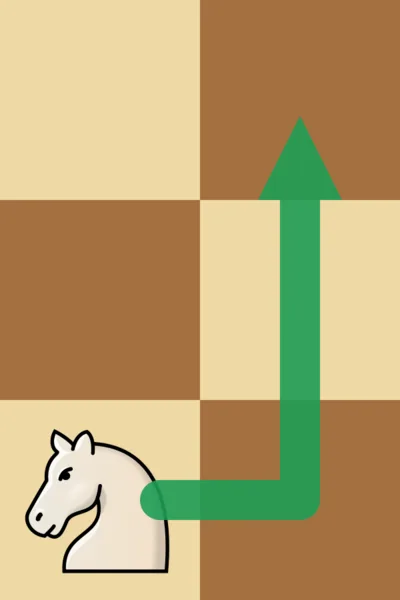
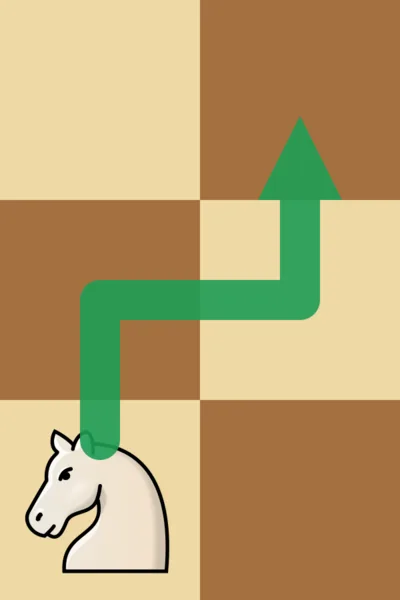
A useful check: a knight never lands on a square that shares a line or a diagonal with the one it stands on. In other words it can never step "to the next square" in any direction - the closest square it can reach is always one further out.
A knight captures with the same move: it lands on the square of an enemy piece and removes it. Pieces it jumped over are untouched, friendly or not.
This is what sets it apart. Rook, bishop and queen stop in front of the first piece in the way; a knight does not look at the way at all - only the starting and the landing square matter.
A practical consequence: at the very start of a game only pawns and knights can move. That is why most openings begin with a pawn to the centre and a knight to f3 or c3 - openings for White.
A second consequence: in a closed position a knight is stronger than a bishop. When the centre is packed with pawns a bishop has nowhere to go, while a knight hops across and works. On an open board it is the other way round: the bishop has the range.
A knight's move depends on its square more than any other piece's: part of the L simply falls off the board.
| Where the knight stands | Squares | What it means |
|---|---|---|
| Centre (d4, e5) | 8 | full strength |
| Third line from the edge (c3) | 6 | almost full |
| Edge (e1, a4) | 4 | half as strong |
| Next to a corner (b1) | 3 | nearly switched off |
| Corner (a1, h8) | 2 | the minimum possible |
This table is where the old saying "a knight on the rim is dim" comes from. Developing a knight to a3 or h3 without a concrete reason means choosing to play with a piece half as strong.
From a light square it lands on a dark one, from dark to light, with no exceptions - it is a geometric property of the L. Three things follow that are worth knowing early.
Mate with two knights is a common question: it exists only in studies, where the defender cooperates. Real mating technique - basic checkmates.
A fork is a single move that attacks two pieces at once. Knights produce them more often than any other piece: the move does not lie on a line, so two targets end up hit at the same time - and the knight sitting between them usually cannot be taken.
The most expensive fork is on king and queen: the check must be answered, and the queen is lost. That is exactly why beginners are told to check the squares from which an enemy knight reaches two of their pieces. Other patterns of the same kind - tactics for beginners, and knight traps in the opening - opening traps.
The knight is the only piece in the set shaped like an animal: a horse's head. In notation it is written N, not K - the letter K belongs to the king, so the knight took the second letter of its own name.

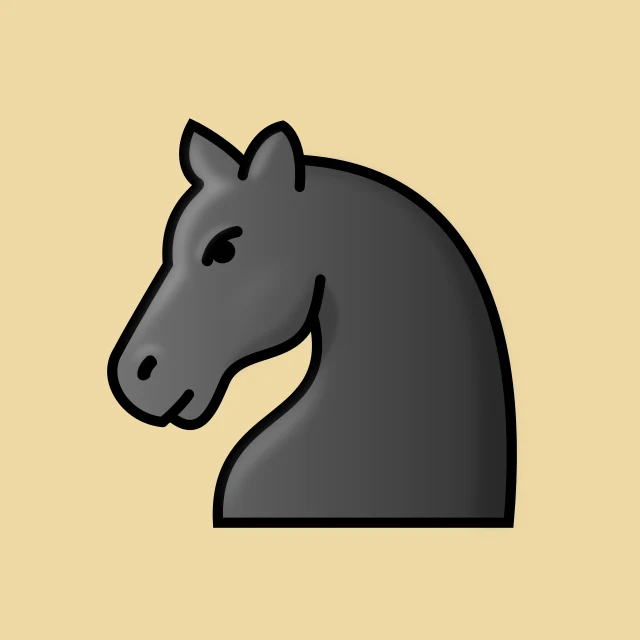
Each side starts with two knights, standing between the rook and the bishop: White on b1 and g1, Black on b8 and g8.
A knight is worth three pawns, the same as a bishop. The full setup step by step - chess board setup.
In an L: two squares along a file or a rank and one to the side. From the centre of an empty board it reaches eight squares, from a corner only two. It captures with the same move, landing on the enemy piece's square.
Yes, and it is the only piece that can. A knight does not pass through the squares between start and finish, so neither friendly nor enemy pieces block it - knights can move from the first move of the game.
Eight from the centre, six from the third line, four at the edge, three next to a corner and two from a corner. Hence the saying that a knight on the rim is dim: in the corner it is four times weaker than in the middle.
One knight move that attacks two enemy pieces at once. The most painful version hits king and queen: the check must be answered and the queen falls. Knights fork more often than other pieces because their move does not run along a line.
That is how the L works: from a light square a knight always arrives on a dark one and the other way round. So it needs at least three moves to return to the same square, and an odd number of moves to reach a square of the other colour.
Because K is already taken by the king. English notation gave the knight the second letter of its name. Russian has no such clash: the king there is written Kr.
Second in from the corners: White on b1 and g1, Black on b8 and g8, between the rook and the bishop. Each side has two, and a knight is worth three pawns - the same as a bishop.
The Vibe Chess app is built for an evening over the board, not for online play: it keeps the sign-up list, the pairings and the table while you deal with people and the venue. All of it free.
The bot is constantly improved based on real tournaments. If you need a feature that isn't there yet, message the developers right inside the bot with the /support command. Many features appeared exactly because organizers asked for them, and useful ideas get added quickly.
The knight is usually compared with the bishop - they cost the same. Nearby - queen, rook, king, pawn. Knight patterns - tactics for beginners. Mating with knights - why two knights cannot force mate.
At the board since childhood: hazy about his rating, precise about every rook he has blundered. Counts an evening as a good one if the opponent stayed to talk afterwards instead of rushing off to check with an engine. Message →