Along diagonals in any of four directions, as far as you like, until the board ends or a piece appears. A bishop does not jump: an enemy piece in the way can be captured, a friendly one closes the road.
It captures exactly as it moves, taking the square of an enemy piece. There is no separate capturing rule.
At the edge a bishop is noticeably weaker: from e1 or from a corner it holds seven squares instead of thirteen. The reason is simple - a corner has one diagonal leaving it instead of four.
A diagonal step always lands on a square of the same colour. So a bishop that begins the game on a light square will travel on light squares for a hundred moves - half the board is permanently out of reach.
That is why bishops are described by colour rather than by position: light-squared and dark-squared. This is not slang but a working idea: "Black's dark squares are weak" means the dark-squared bishop has been traded off and there is nothing left to guard them.
Hence the point about trades: when you give up a bishop you are not giving up "three pawns", you are giving up control over half the squares. The value scale does not show that - it is in the overview of the moves.
A bishop's range only works on an open board. Block four diagonals and it has no move at all, although the piece is intact and sitting in the centre.
In a real game this happens with one or two of your own central pawns rather than four, and it is called a "bad bishop": it is hemmed in by its own pawns and stares at their backs. The cure is either to reroute the bishop to a free diagonal or to push the pawns that block it.
The same property drives the comparison with the knight: in a closed position the knight is stronger because it jumps, while on an open board the bishop wins - it reaches both wings in a single move.
On its own a bishop is worth three pawns, the same as a knight. But a pair of bishops is rated above a pair of knights and above bishop-and-knight - precisely because together they cover both colours and the opponent has no safe squares left.
In practice: a trade that leaves you with two bishops while the opponent has bishop and knight is usually good, even when the pawn count is level. Chess literature calls it the advantage of the two bishops.
The other side of the coin is an endgame with opposite-coloured bishops. When each side has one bishop and the colours differ, the bishops can never meet or interfere with each other: such positions often end in a draw even a pawn or two down. All the ways a game can be drawn - draws in chess.
A bishop is a mid-height piece with a slanted cut on top, resembling a mitre - which is where the English name comes from. In Russian the piece is an elephant, in French a jester, in German a runner; the move is the same everywhere.

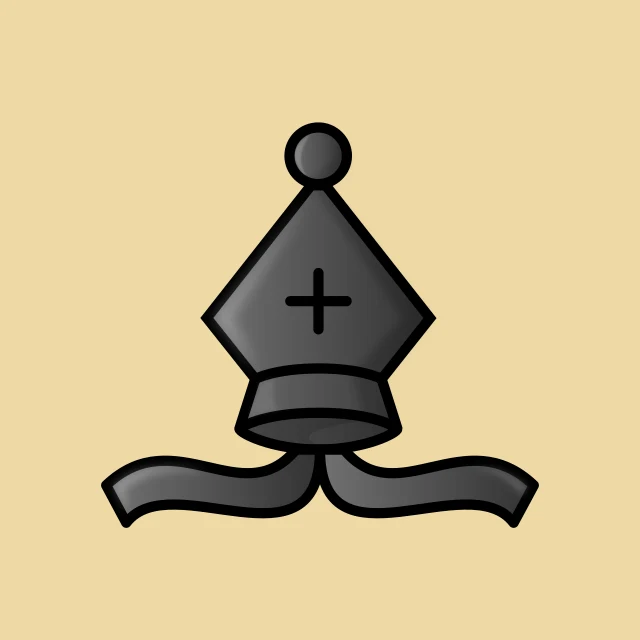

Each side has two bishops, standing next to the king and the queen: White on c1 and f1, Black on c8 and f8. In notation a bishop is B.
In the opening bishops are usually developed after the knights but before the rooks and queen: they need a pawn to move first and open a diagonal. How that looks in practice - openings for White. The full setup - board setup.
Along diagonals only, any number of squares, in any of four directions. It does not jump: an enemy piece in the way can be captured, a friendly one blocks the road. It captures exactly as it moves.
Yes. A bishop moves diagonally in any direction, including back towards its own side. The pawn is the only piece that cannot move backwards.
Because every diagonal step lands on a square of the same colour. A bishop that starts on a light square stays light-squared for the whole game, and half the board is permanently out of reach. That is exactly why a pair of bishops is valued above one.
Thirteen from the centre, seven from the edge or a corner. The difference comes from how many diagonals leave the square: four from the middle, one from a corner.
On paper they are equal at three pawns each. On an open board the bishop is stronger - it reaches both wings in one move. In a closed position the knight is stronger, because it jumps over pawns while the bishop has nowhere to go.
An endgame where each side has one bishop and the two travel on different colours. Such bishops can never meet or block each other, so the game often ends in a draw even when one side is a pawn up.
Next to the king and queen: White on c1 and f1, Black on c8 and f8. Each side has one light-squared and one dark-squared bishop - between them they cover the whole board.
No arbiter skills required. The app takes over the part that usually stops people from running tournaments at all: who plays whom in each round and who finishes first.
The bot is constantly improved based on real tournaments. If you need a feature that isn't there yet, message the developers right inside the bot with the /support command. Many features appeared exactly because organizers asked for them, and useful ideas get added quickly.

At the board since childhood: hazy about his rating, precise about every rook he has blundered. Counts an evening as a good one if the opponent stayed to talk afterwards instead of rushing off to check with an engine. Message →