Vibe ChessVibe ChessApp

A chess tournament for 100 or more players: how to organise it

Alexey Mudry · updated October 26, 2026
A tournament for a hundred people is not "a tournament for twenty, only bigger". Twenty players need one arbiter, a sheet of paper and a loud voice. A hundred - and the registration queue stretches to an hour, you cannot get near the pairings wall, and collecting results from fifty tables delays every round by a quarter of an hour. Below - a resource estimate, a day schedule, step-by-step preparation and what an app can take over.

The estimate: tables, space, rounds, arbiters

For a Swiss tournament with 100 players:

WhatHow manyWhy
Tables and boards50 + 2-3 spareone board per pair; spares for breakages and latecomers
Playing areaabout 200 m²a guide of 2 m² per player, plus registration and spectator areas
Swiss rounds8-9for 65-128 players
Arbiters without an appchief, deputy, secretary, 4-5 on the floorFIDE guide: 1 arbiter per 20-30 players
Arbiters with the appchief and 2 helpers on the floorpairing and score collection are done by the app
Socketsextension leads along the rowsphones with the clock run all day

More on each estimate: a chess tournament venue, how many rounds in a Swiss system, how many arbiters a tournament needs.

The day schedule

A round lasts roughly twice the time control plus the increment and 5-10 minutes of break. At a big tournament the break matters more than at a small one: the last game of a round holds up all the others.

FormatRoundWhole tournamentSuits
Blitz 5+3, 9 roundsabout 25 minutesabout 4 hoursone long evening or half a day
Rapid 10+5, 8 roundsabout 40 minutesabout 5.5 hours plus luncha full day, 10:00 to 17:00
Rapid 15+10, 7 roundsabout 55 minutesabout 6.5 hours plus luncha full day or two days
The longest part of the schedule is not the games but the gaps between rounds: collect results, make pairings, find your table. If each gap takes 15 minutes instead of 5, over nine rounds that is an extra hour and a half.

Registration without a queue

  • • Sign people up in advance, not on site. On the day the entrance only checks attendance - seconds per person, not minutes.
  • • Two or three registration desks - by alphabet or by group.
  • • Close registration 15 minutes before the start and pair round one from those present. Latecomers join from the next round.
  • • A cap on places and a waiting list - so you do not end up with 120 people for 50 tables: a tournament waiting list.

Pairings for fifty tables

The classic way is to print the pairings and pin them to the wall. With a hundred players there is a crowd at the wall, and the next round starts only when the last person has found their table. What works better:

  • • pairings on a big screen or projector - visible from anywhere in the room;
  • • pairings on everyone's phone: table and colour arrive by themselves;
  • • large numbers on every table, visible from the aisle;
  • • labelled rows: "tables 1-10", "11-20".
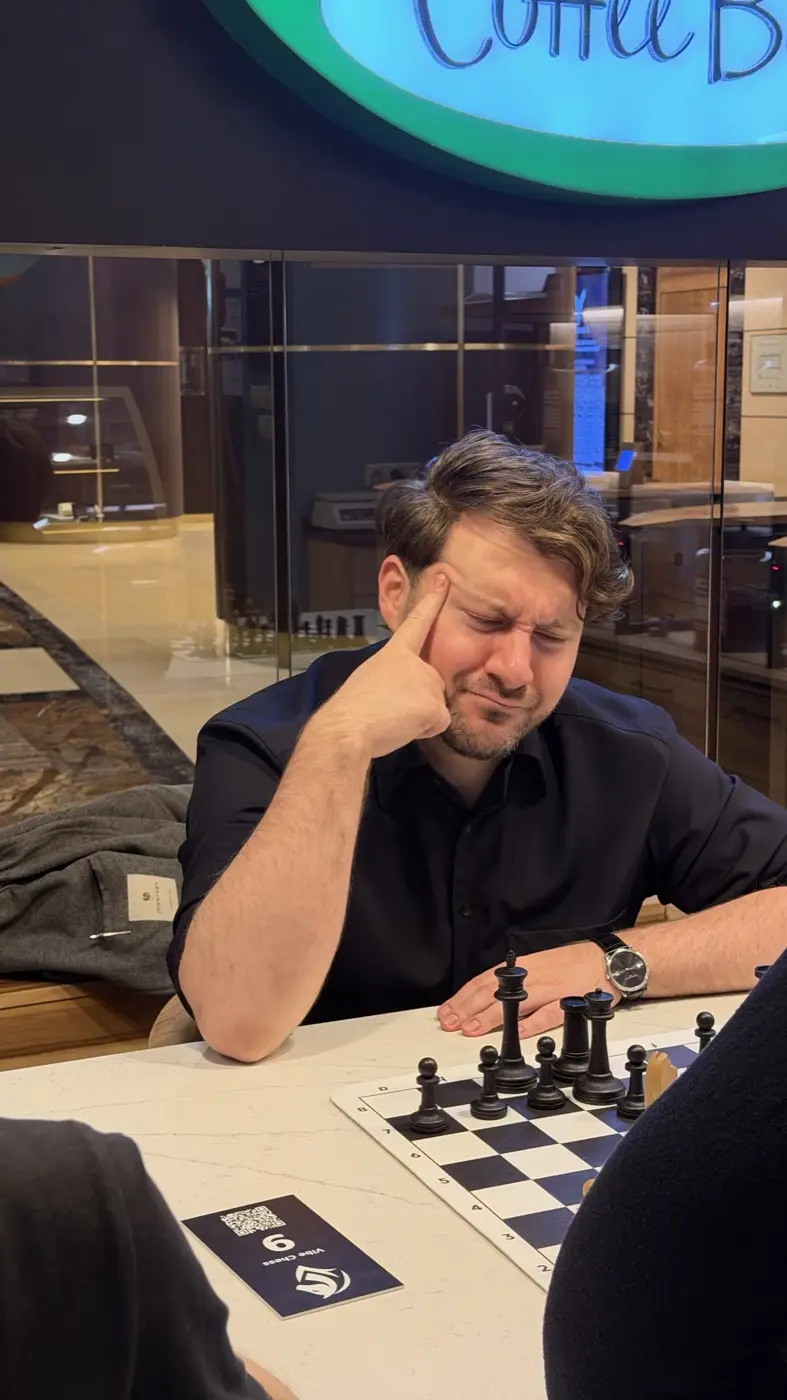
The Coffee Bean hall is full: players watching games and waiting for the next roundA tournament player at Coffee Bean thinking over a move, head resting on his hand
A Vibe Chess tournament in Moscow City: a full room, every player sees their pairing on their phone.

Internet for a hundred phones

If pairings, clocks and scores live on phones, internet becomes part of the equipment. The Wi-Fi of a café or school often cannot cope with a hundred connections at once. It is more reliable when everyone uses their own mobile data, with the venue Wi-Fi as a backup. Check the signal at the far row before the tournament. In detail - internet at a chess tournament.

Step-by-step preparation

WhenWhat to do
2-3 weeks aheadopen sign-up with a cap on places, announce the schedule and rules
A week aheadcheck the venue: tables, sockets, internet at the far rows, toilets, cloakroom
The day beforeconfirmation of attendance, set out and number the tables, check the screen
90 minutes beforeopen registration, attendance check-in
15 minutes beforeclose registration, read out the rules
Startpair round one from those present, pairings on the screen and on phones

The full list - the tournament organiser's checklist, what an arbiter should bring - the arbiter's kit.
What the Vibe Chess app takes over

  • • Sign-up with a cap on places - when places run out, sign-up closes by itself.
  • • A morning reminder on the day - with the address and time.
  • • Attendance check-in - only those present are paired in round one.
  • • Pairings on every phone and on the hall screen - nobody goes to the wall.
  • • Players enter the score, the opponent confirms - arbiters do not walk fifty tables.
  • • The next round is built as soon as all tables have finished.
  • • Groups - if a hundred people differ in level, each group has its own pairings and table.
  • • Results - to every player right after the last round.
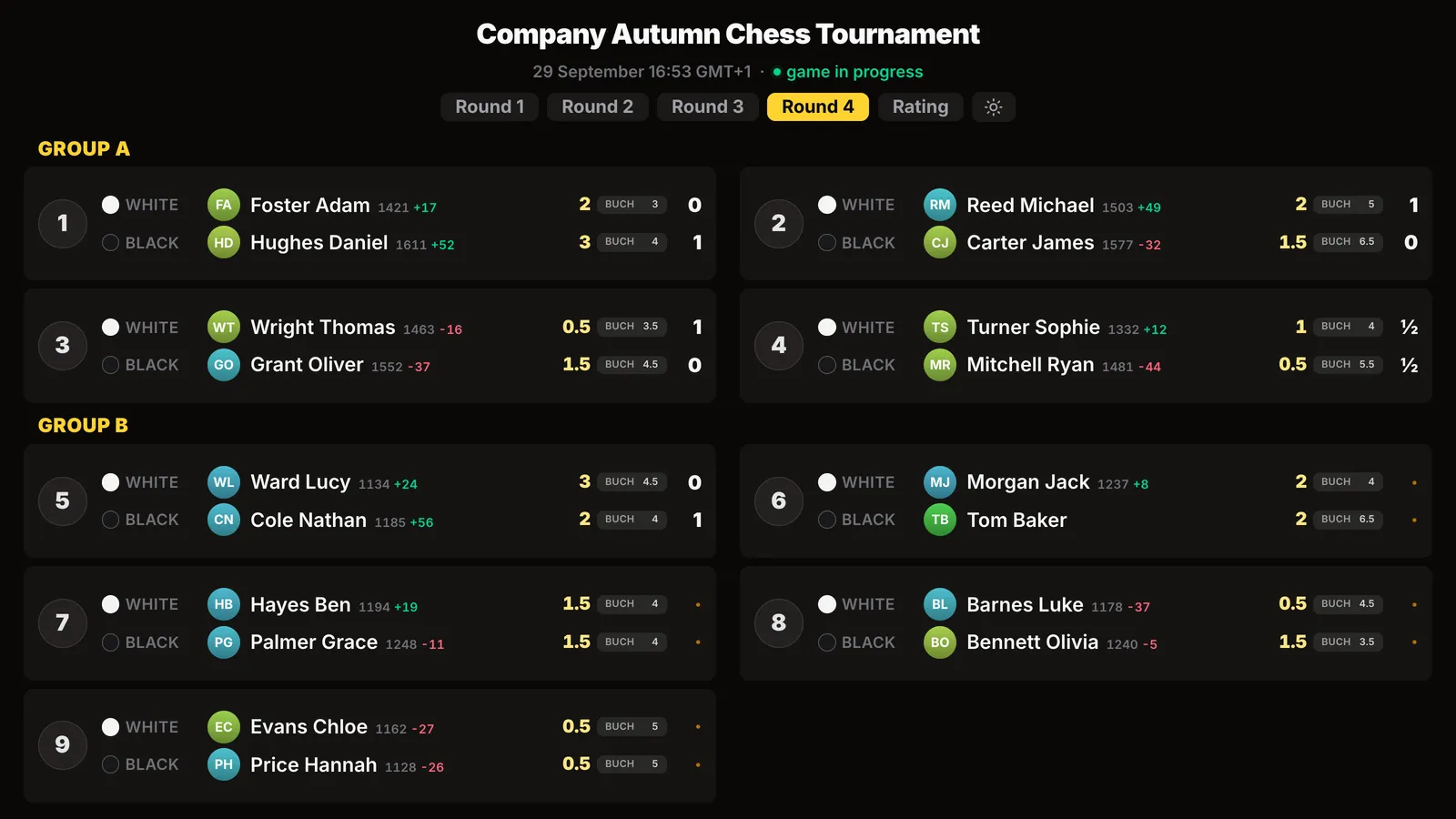
The hall screen: the round's pairings by table on a projector
The round's pairings on the hall screen.
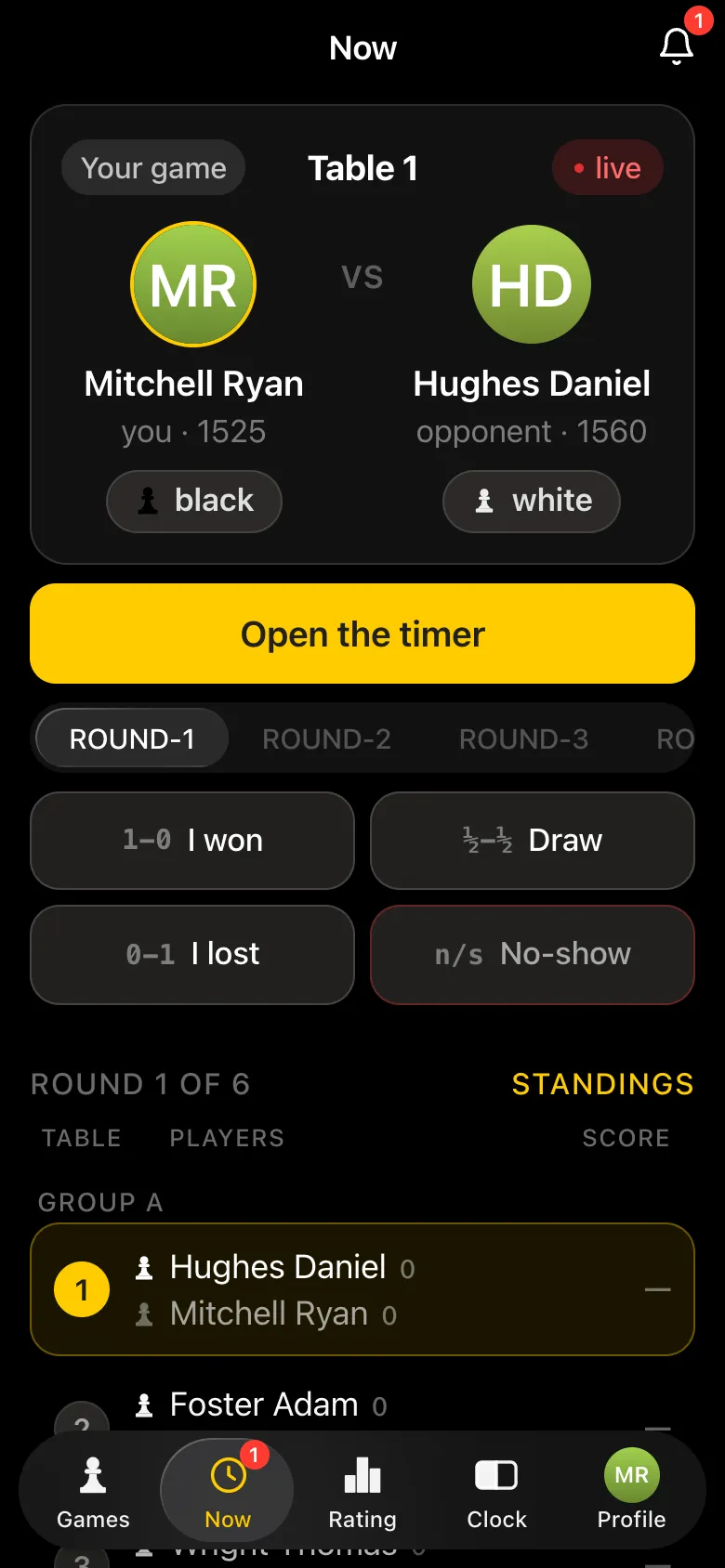
The player's Now screen, Your game: table 1, Mitchell Ryan with black against Hughes Daniel, result buttons
Your table and colour - on everyone's phone.
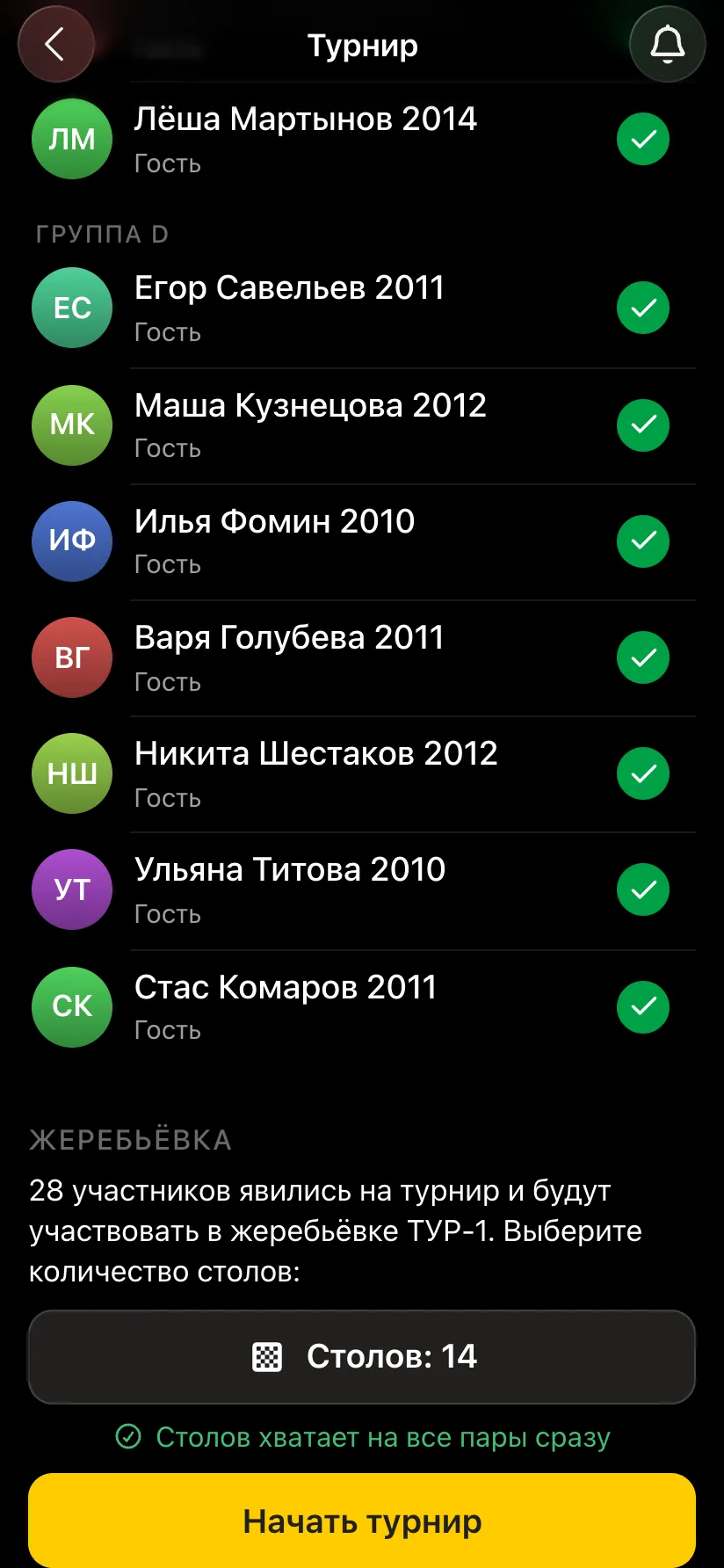
A tournament card: group D with green attendance ticks, a pairing block - 28 players, 14 tables, a Start the tournament button
Attendance checked - tables counted.

A hundred players - without a pairings wall

In the Vibe Chess app sign-up, attendance, pairings, scores and results run by themselves, and the arbiters watch the hall. Create a tournament for free.

Frequently asked questions about a big tournament

How many tables does a tournament for 100 players need?

50 tables with boards and two or three spares.

How many rounds should 100 players play?

In the Swiss system - 8-9 rounds: that is what it takes to find a winner among 65-128 players.

How many arbiters are needed?

Without an app - a chief arbiter, a deputy, a secretary and 4-5 floor arbiters. If an app does the pairing and score collection, by our estimate a chief arbiter and two helpers are enough.

How long does a tournament for 100 people last?

Blitz 5+3 over 9 rounds - about 4 hours, rapid 10+5 over 8 rounds - about 5.5 hours plus lunch.

How do I avoid a registration queue?

Sign people up online in advance and on the day only check attendance at two or three desks. Close registration 15 minutes before the start.

Will the internet cope with a hundred phones?

The venue Wi-Fi may not. Mobile data on each phone is more reliable, with Wi-Fi as a backup. Check the signal at the far rows in advance.

Free

The app instead of arbiter software

Pairings are computed by bbpPairings, an open-source engine implementing the Dutch system by FIDE rules: score groups, floats on an odd field, colour alternation. Free to use.

  1. 1The event is created in the app in a minute
  2. 2Players register themselves through the link
  3. 3The engine pairs every round, not the organizer
  4. 4The finished tournament exports as a TRF file that arbiter software accepts
  • Swiss system. proper rounds with correct pairings, not random matchups
  • Round robin. a full circle, with the round count derived from the field
  • Free meetup. a light format with no tournament machinery

More than a bot: the app, FIDE rules and a TRF report

  • The app. Besides the bot there is an app - inside Telegram and simply at playvibechess.com/app: what is on in your city, the player list, a live table, the current round, your profile and game history - everything that is awkward to read as chat messages.
  • Pairings by FIDE rules. Pairings are computed by bbpPairings, an open-source engine implementing the Dutch system: score groups, floats on an odd field, colour alternation, no rematches, and no player gets a bye twice.
  • A TRF report. A finished tournament exports as a single file in the FIDE data exchange format - the one arbiter software and federations accept. Your profile stores the FIDE ID, national federation code, title, sex and date of birth for it.
  • Free. All of the above, with no subscriptions, paid plans or limits on the number of tournaments and players.

Full overview

Missing a feature? Message the developers

The bot is constantly improved based on real tournaments. If you need a feature that isn't there yet, message the developers right inside the bot with the /support command. Many features appeared exactly because organizers asked for them, and useful ideas get added quickly.

Alexey Mudry
Alexey Mudry · hosted 37 events for Vibe Chess · 157 reviews · rating 5.0

At the board since childhood: hazy about his rating, precise about every rook he has blundered. Counts an evening as a good one if the opponent stayed to talk afterwards instead of rushing off to check with an engine. Message →