| Approach | How it works | Pro | Con |
|---|---|---|---|
| Hard cap | as many places as boards allow; signed up last - did not get in | simple and fair | some places stay empty because of no-shows |
| Cap plus waiting list | after the cap people go on a list; when a place frees up, the next one is called | no places are wasted | you have to run the list and message people |
| Overbooking | more sign-ups than boards, counting on no-shows | the room is full | if everyone comes, someone has no place |
| Walk-ins on the day | people without a sign-up play if places are left | nothing to manage | people travel without knowing if they will play |
For most amateur tournaments the second approach is best: a cap by the number of boards and a waiting list with confirmation the evening before. Overbooking only works if you know your audience well and keep spare boards.
Places - as many as the number of boards times two. With 20 boards, 40 players. In the Swiss system an odd number is no problem: one player per round gets a bye. Keep two or three more places for the organiser: for guests, the arbiter, a player coming from far away.
How to work out the floor space and tables for the number of players you need - a chess tournament venue.
Some people on the waiting list will come uninvited - "just in case there is a place". They are the best insurance against no-shows. The procedure is simple: before the start, mark which of the signed-up players came, and give the free places to waiting players in the hall - in waiting-list order.
A latecomer who arrives after the start may join a Swiss tournament from the next round - if the regulations allow it. More about no-shows - how to reduce no-shows at a tournament.

What the app does if a tournament has a set number of places:
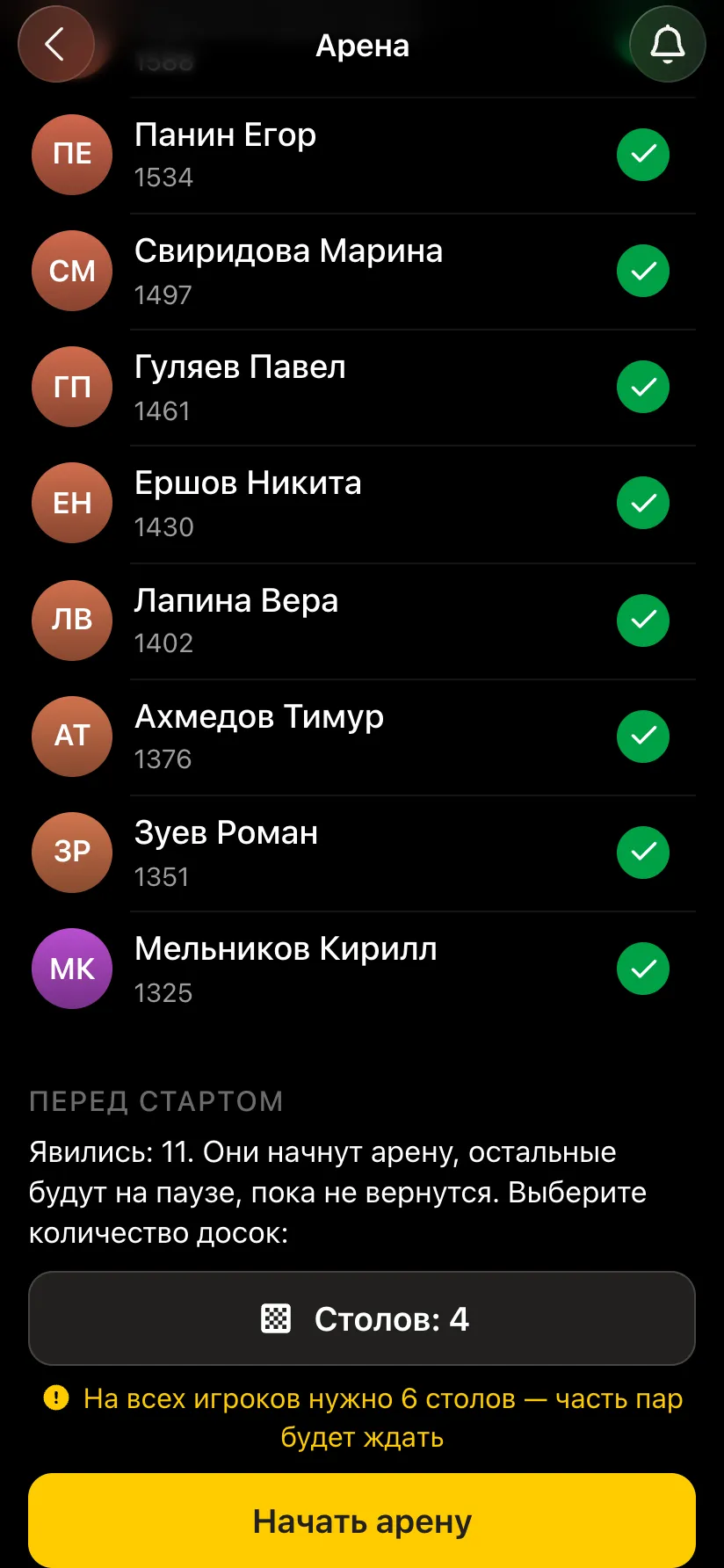
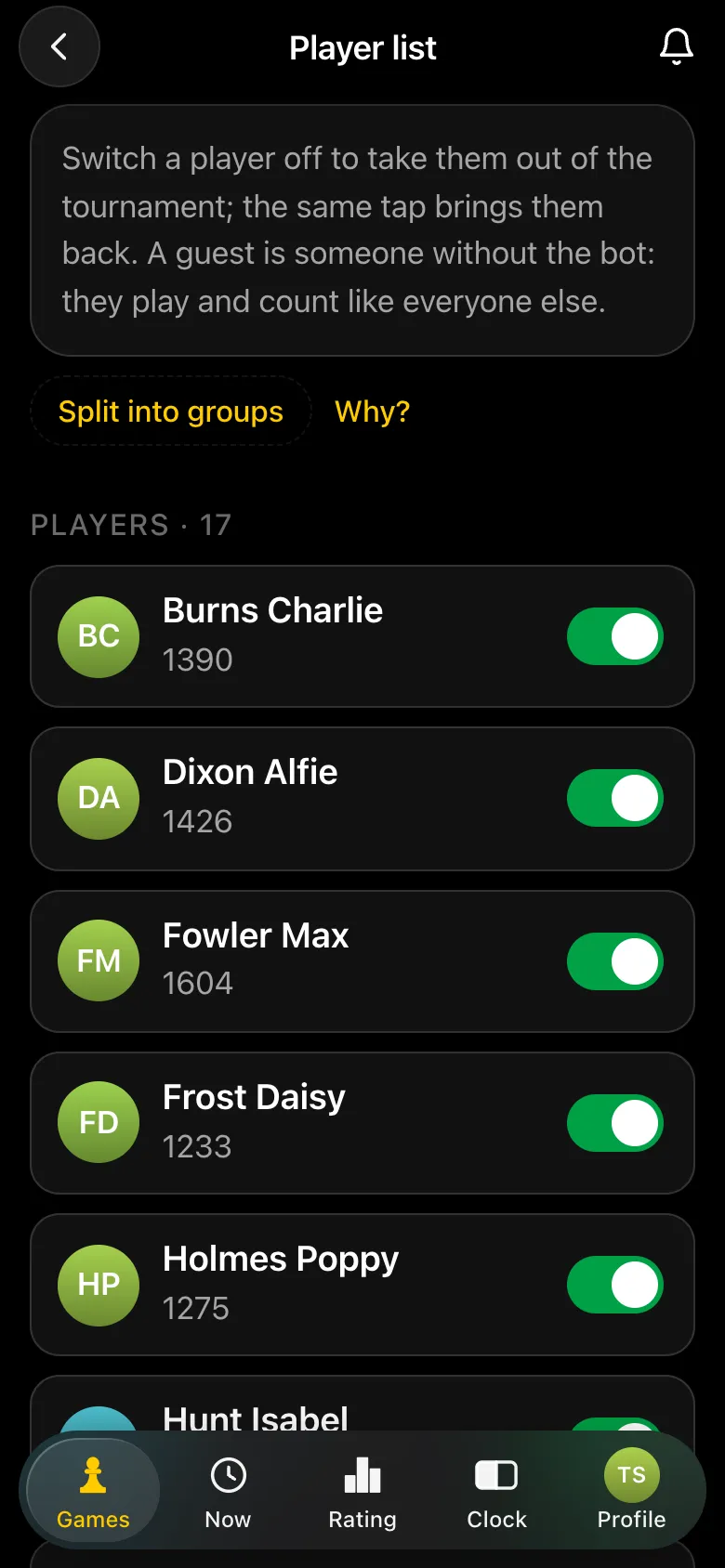
A queue of people who wanted to sign up after places ran out. If someone signed up drops out or does not confirm, the first person in the queue gets the place.
As many as the number of boards times two, plus two or three spare places kept by the organiser.
You can, if you know well how many usually do not come and keep spare boards. Otherwise a cap with a waiting list is more reliable.
If the person signed up drops out themselves or has not confirmed by the time set the evening before.
There is no queue with notifications yet. There is a cap on places: sign-up closes when places run out and opens again when someone leaves the list.
Pairings are computed by bbpPairings, an open-source engine implementing the Dutch system by FIDE rules: score groups, floats on an odd field, colour alternation. Free to use.
proper rounds with correct pairings, not random matchups
a full circle, with the round count derived from the field
a light format with no tournament machinery
The bot is constantly improved based on real tournaments. If you need a feature that isn't there yet, message the developers right inside the bot with the /support command. Many features appeared exactly because organizers asked for them, and useful ideas get added quickly.
More about players: how to reduce no-shows, tournament registration, tournament announcement templates and a chess tournament venue.

At the board since childhood: hazy about his rating, precise about every rook he has blundered. Counts an evening as a good one if the opponent stayed to talk afterwards instead of rushing off to check with an engine. Message →