FIDE has a table of how many arbiters to appoint to its events (section D.04.13 of the FIDE Handbook). For Swiss tournaments the rule is the same: a chief arbiter, one or two deputies and one arbiter for every 20 players in classical. In rapid and blitz - one arbiter per 30 players.
| FIDE event | Chief arbiter | Deputies | Floor arbiters |
|---|---|---|---|
| World Junior Championship (~250 players) | 1 | 2 | 1 per 20 players |
| World Amateur Championship (~150) | 1 | 1 | 1 per 20 players |
| World Senior Championship (~150) | 1 | 1 | 1 per 20 players |
| Continental Swiss championship (~400) | 1 | 2 | 1 per 20 players |
| World Rapid Championship (~150) | 1 | 1 | 1 per 30 players |
| World Blitz Championship (~150) | 1 | 1 | 1 per 30 players |
These are norms for FIDE championships, not a mandatory rule for a club. But as a guide they work everywhere: one floor arbiter can physically keep an eye on about 10-15 games. For rated tournaments, check the requirements for the number and category of arbiters with your federation - they depend on the event's status.
At a small tournament one person combines all four roles. As it grows, the secretary's work is the first to split off: pairings and standings take so much time that the chief arbiter stops seeing the hall.
If you break down arbiting at an amateur tournament by task, disputes and violations are a small share. Most of the time goes on routine that repeats every round. Here is how it is usually split and what changes when the tournament runs in the Vibe Chess app:
| Task | Usually | With the Vibe Chess app | Who does it |
|---|---|---|---|
| Registration and attendance | a paper list, checking at the door | sign-up in the app, attendance check-in before the round | the organiser |
| Pairings | the secretary enters results into the software, prints and posts the pairings | each round's pairings arrive on everyone's phone and go up on the hall screen | automatic |
| Clocks | set the control on every clock, check the batteries | the phone clock takes the tournament's control by itself | automatic |
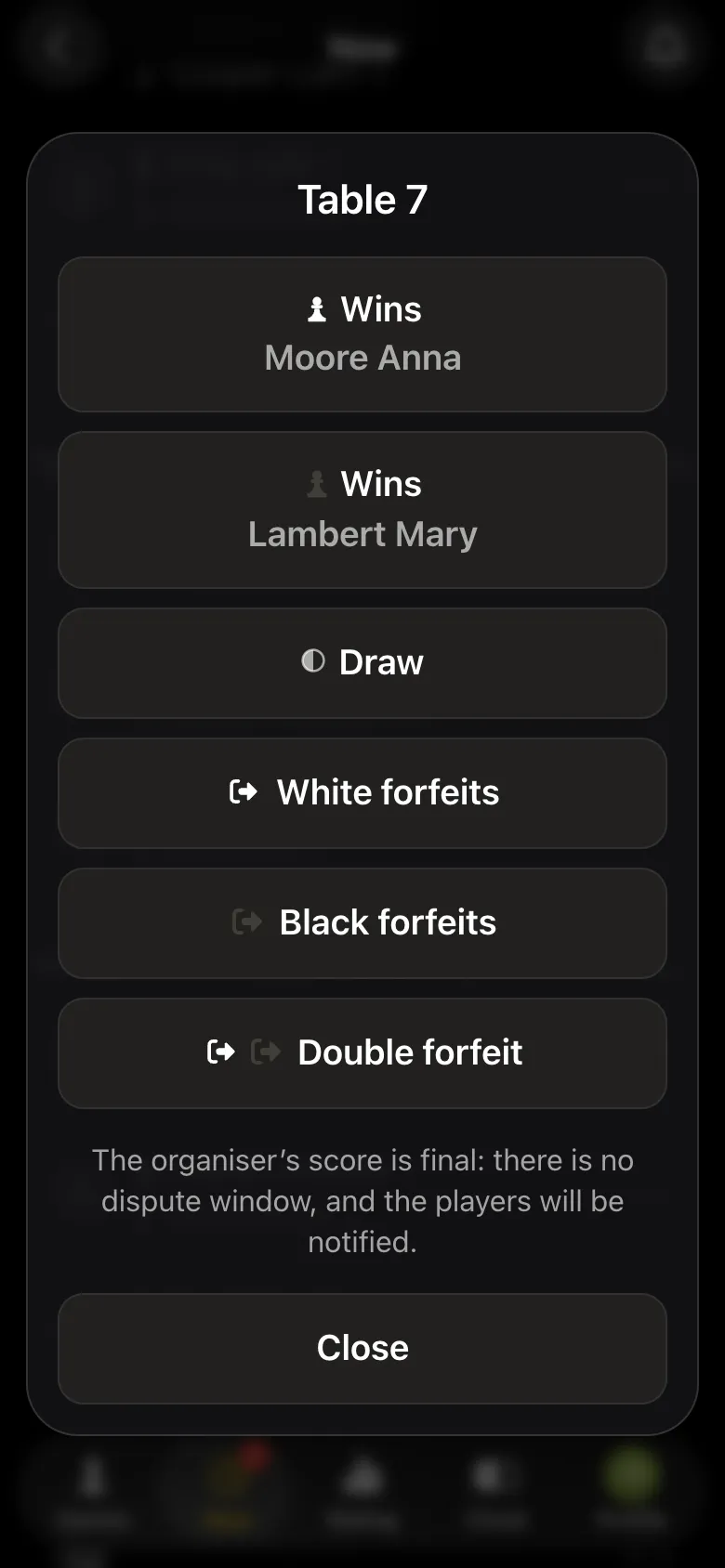
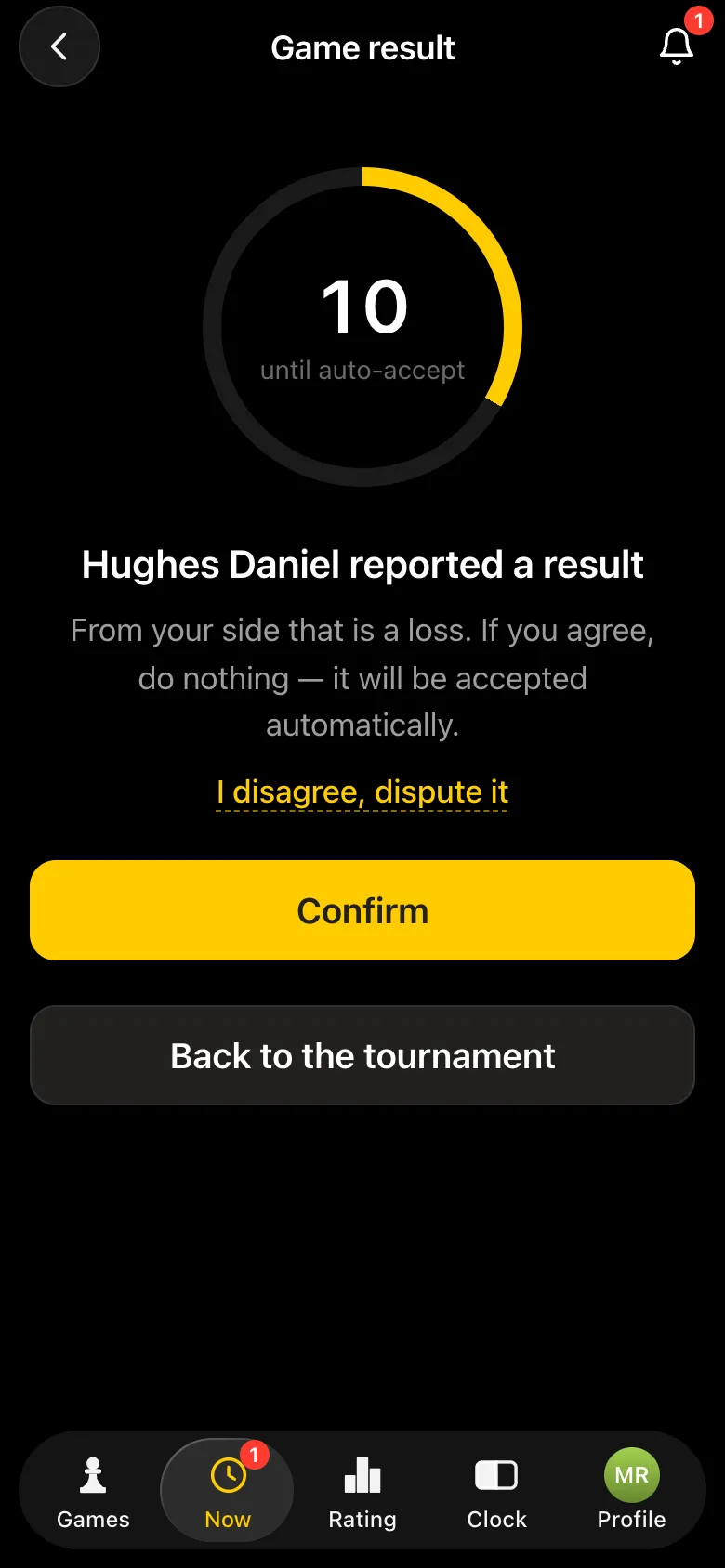
| Collecting results | walking the tables, scoresheets, manual entry | players enter the score themselves, the opponent confirms or disputes | arbiter - disputes only |
| Loss on time | the arbiter or the opponent records the flag | the clock stops at the flag, the result is accepted at once | automatic |
| Standings and tiebreaks | the secretary calculates and posts them | standings with Buchholz and Sonneborn-Berger update after every game | automatic |
| Recording and broadcast | scoresheets, electronic boards, a technician | a phone camera over the board, a broadcast by link | players set up the phone |
| Report | a protocol, TRF by hand | TRF and the standings as a PDF sheet | one button |
| Disputes, no-shows, order in the hall | arbiters | arbiters | stays with people |
A table for a Swiss tournament in rapid or blitz. The left column is normal practice guided by FIDE, the right one is our guide for a tournament run in the Vibe Chess app.
| Players | Usually | With the Vibe Chess app |
|---|---|---|
| up to 20 | 1 arbiter (combines all roles) | 1 organiser-arbiter |
| 20-40 | chief arbiter and secretary | 1 organiser-arbiter |
| 40-60 | chief, secretary, 1-2 floor arbiters | organiser-arbiter and 1 helper in the hall |
| 100 | chief, deputy, secretary, 4-5 floor arbiters | chief arbiter and 2 helpers in the hall |
| 150 and more | chief, 2 deputies, secretary, 1 arbiter per 20-30 players | chief arbiter and 1 helper per 40-50 players |
Why fewer people with the app: there is no need to collect scoresheets, enter results and print pairings every round. Players enter the score themselves, the next round is built at once, and everyone sees the pairings - on their phone and on the hall screen. A person in the hall is needed for what the app cannot do: settle a dispute, record a no-show, keep order.
For classical games with notation and for rated tournaments calculated by a federation, stick to FIDE norms: there a floor arbiter has to see every game.

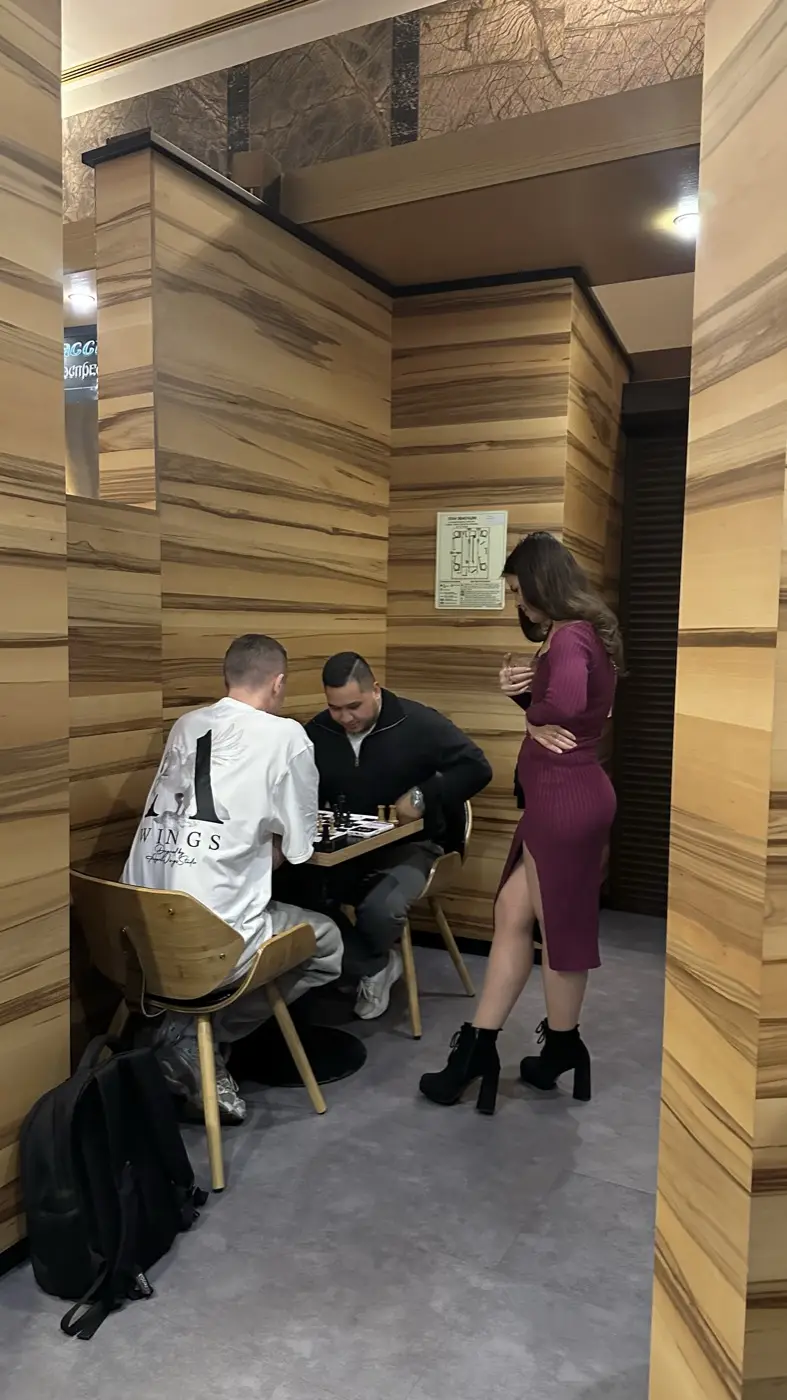
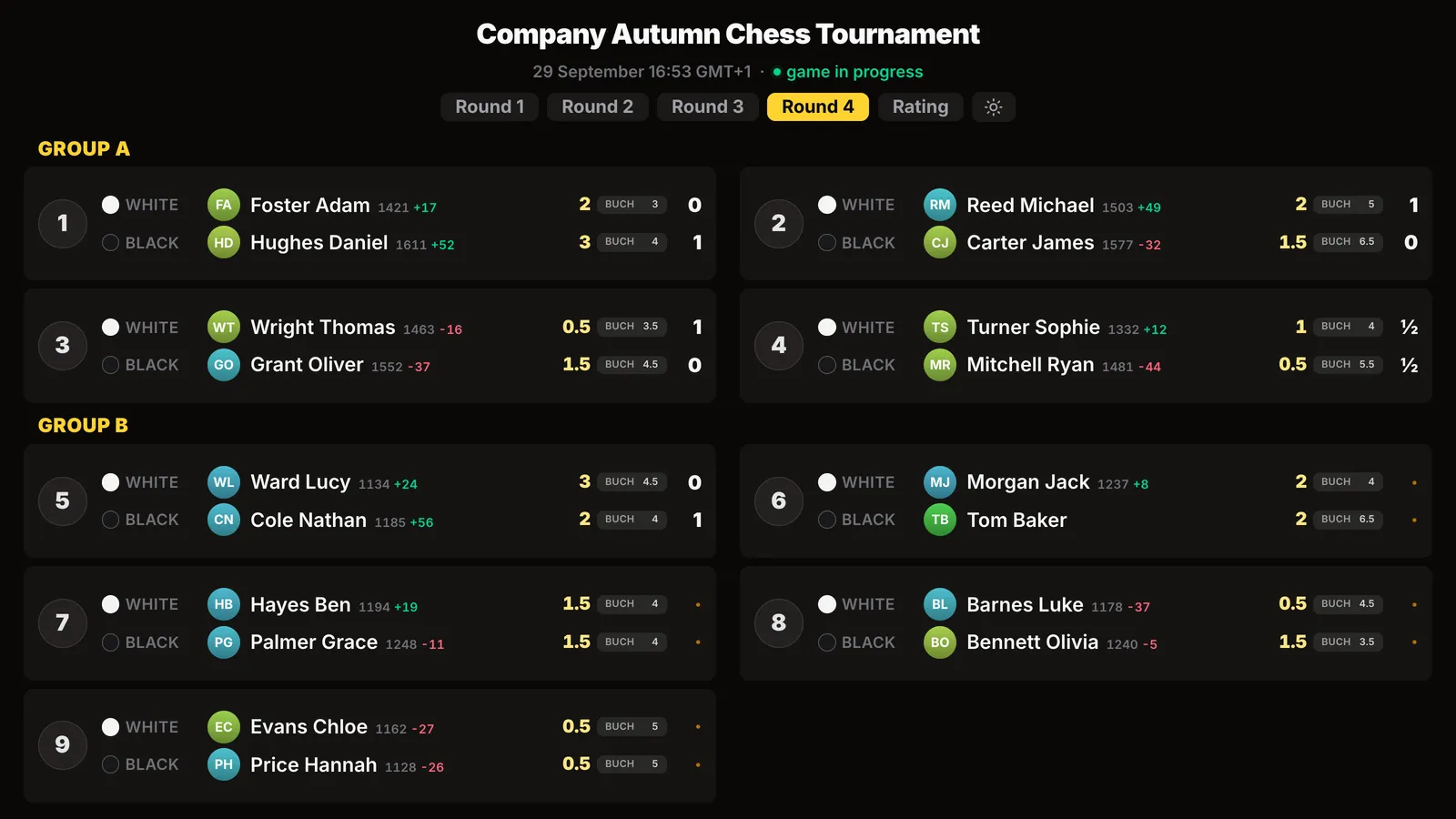
The tournament organiser has an arbiter's panel in the app. From it they run the tournament on their phone without leaving the hall:
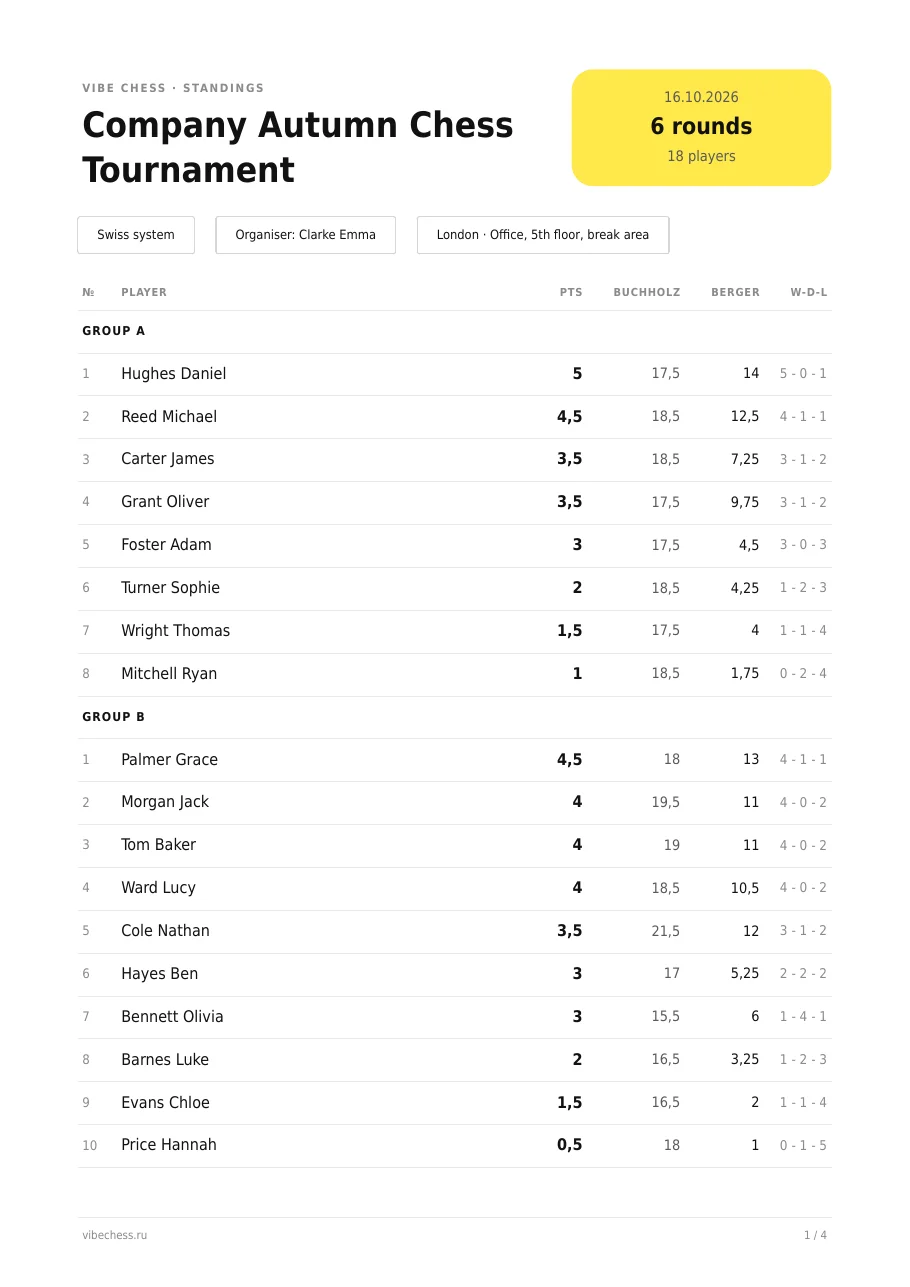
More about the arbiter's work - arbiting a chess tournament, about common cases - an illegal move, a fallen flag and a double forfeit.
How to prepare the whole tournament - the tournament organiser's checklist.
The FIDE guide is one arbiter per 20 players in classical and one per 30 in rapid and blitz, plus a chief arbiter. At an amateur tournament of up to 20-30 people one arbiter combining all roles is enough.
Our guide: up to 40 players the tournament is run by one organiser-arbiter, after that - one helper in the hall for every 40-50 players. The app takes over pairings, collecting results, clocks, standings and the report; people are left with disputes, no-shows and order in the hall.
For a friendly or club tournament - no. For a tournament rated by FIDE or a federation the arbiter's category matters; check the requirements with your federation.
It happens at small club tournaments, but it is awkward: an arbiter busy with their own game does not see the hall, and there is nobody to settle a dispute involving them. If there is no other way, agree in advance who decides disputes in their games.
The chief arbiter is responsible for the whole tournament and makes final decisions. A floor arbiter watches their own tables - flags, illegal moves, order - and calls the chief in a difficult case.
Without an app - yes, from 30-40 players: pairings and standings take too much time. With the Vibe Chess app this work does not have to be done by hand.
No arbiter skills required. The app takes over the part that usually stops people from running tournaments at all: who plays whom in each round and who finishes first.
The bot is constantly improved based on real tournaments. If you need a feature that isn't there yet, message the developers right inside the bot with the /support command. Many features appeared exactly because organizers asked for them, and useful ideas get added quickly.
More about arbiting: arbiting a chess tournament, phones in the tournament hall and how to organize a chess tournament.

At the board since childhood: hazy about his rating, precise about every rook he has blundered. Counts an evening as a good one if the opponent stayed to talk afterwards instead of rushing off to check with an engine. Message →