| Format | Days | Control and rounds | Who it suits |
|---|---|---|---|
| Weekend tournament | Friday evening + Saturday + Sunday | 5-7 rounds of rapid or classical 60+30 | for working people and school pupils |
| Two days | Saturday and Sunday | 6-9 rounds of rapid | a city open, a club championship |
| A week | 6-9 days, one round a day | 7-9 rounds of classical 90+30 | a rated open, a holiday festival |
A classical 90+30 game can last up to four hours, so no more than two rounds are scheduled per day. In detail - classical 90+30.
| Day | Round start | Rounds | What else |
|---|---|---|---|
| Friday | 19:00 | round 1 | registration from 18:00, opening |
| Saturday | 10:00, 15:00 | rounds 2 and 3 | a lunch break between rounds |
| Sunday | 10:00, 15:00 | rounds 4 and 5 | closing and prize-giving an hour after the last game |
In a multi-day tournament someone almost always cannot play one of the rounds. The FIDE rule is simple: whoever warned in advance that they would miss a round is not paired that round and scores zero - unless the regulations say otherwise (C.04.2, point 3.3). Many regulations give half a point for such a bye, but limit how many: for example, no more than one or two per tournament and not in the last rounds.
| What | When | Points | What next |
|---|---|---|---|
| Requested bye | warned the arbiter in advance | 0 or ½ - per the regulations | not paired that round |
| Pairing bye | an odd number of players | usually a point | once per tournament |
| No-show without warning | did not come to the game | 0, the opponent wins | usually withdrawn from the tournament |
How this differs from a no-show - a double forfeit and a bye in a Swiss tournament.
In a Swiss tournament postponing a game is almost impossible: the next round's pairings depend on its result. So instead of a postponement there is a requested bye. In a round robin the pairings are known in advance, and the regulations may allow a postponement with the consent of both players and the arbiter - on condition that the game is played by a certain round.
In a Swiss tournament the next round's pairings are published right after the round's last game - in the evening, if it was the last round of the day. That way players can prepare calmly and know when to come.
If the tournament is rated, players need FIDE IDs, and the arbiter needs a report for the federation: the arbiter's report after a tournament.
The app has no separate multi-day schedule, but a tournament with breaks between days can be run:
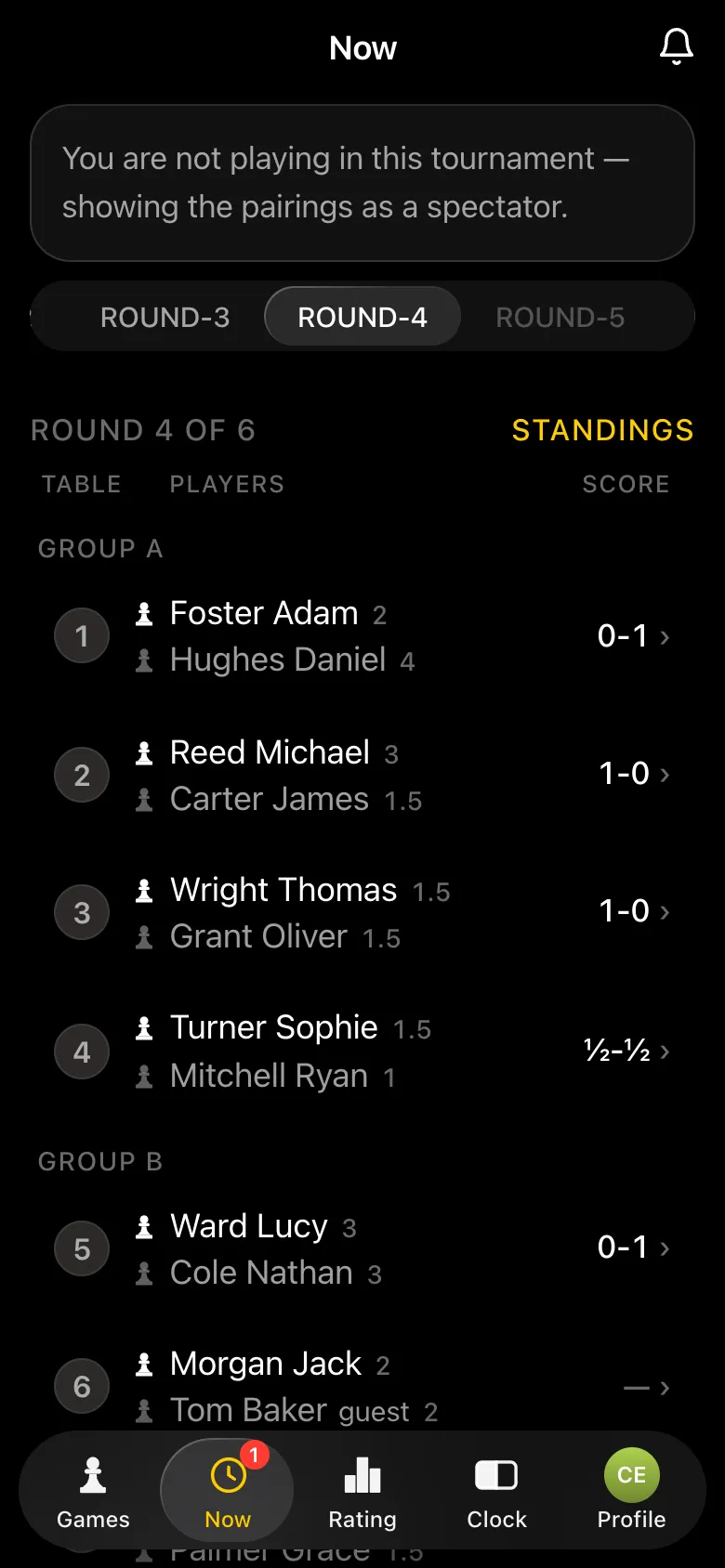
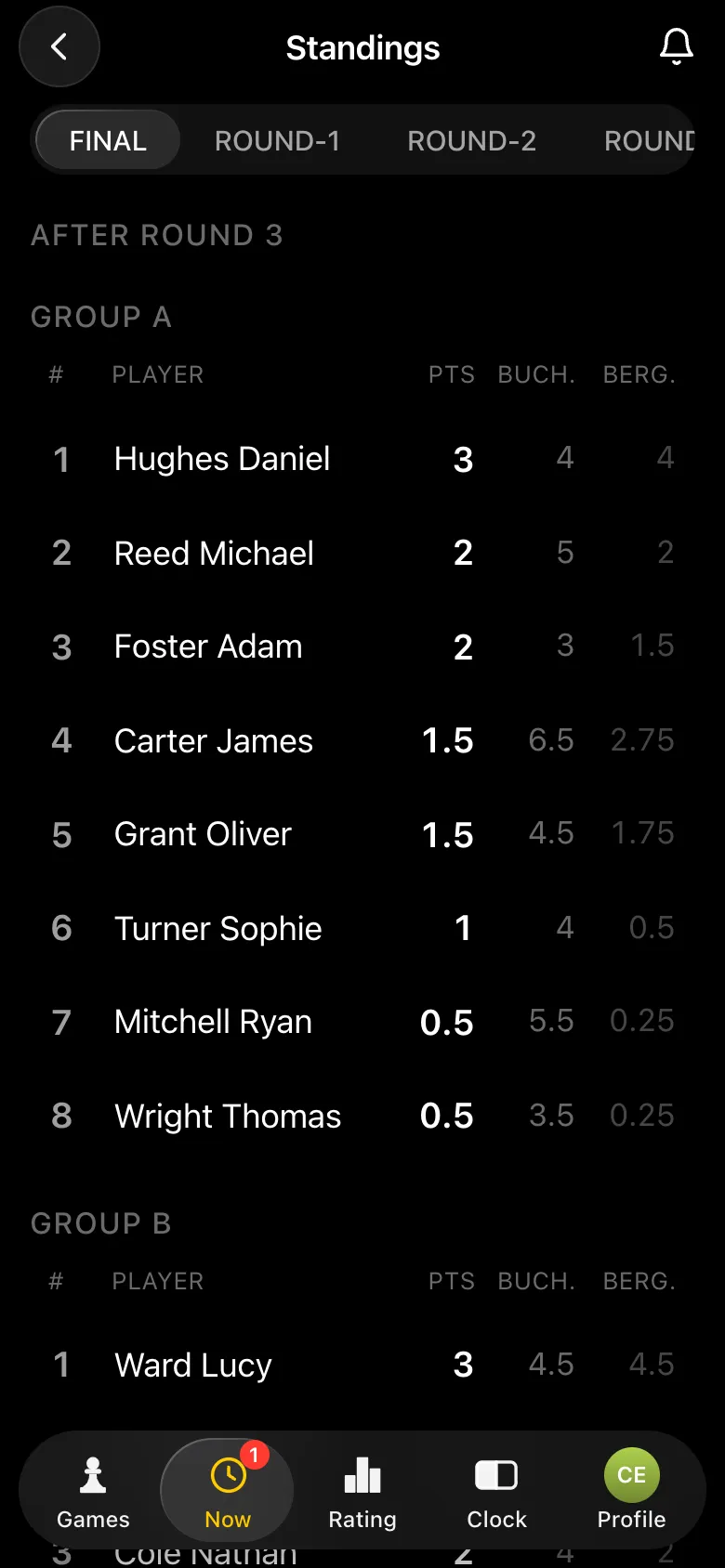
Classical 90+30 - no more than two rounds a day. Rapid - three or four rounds a day.
Yes, if you warn the arbiter in advance. Such a player is not paired that round; the bye is worth zero or half a point, as the regulations decide.
In a Swiss tournament almost never: the next round's pairings depend on the result. In a round robin - if the regulations allow it, with the consent of the players and the arbiter.
Right after the last game of the current round ends - if that was the last round of the day, then in the evening.
Yes, with a pause between days: the organiser pauses the tournament after the day's last round and resumes it at the start of the next - the round starts by itself. There is no day-by-day schedule with reminders yet.
Everything people usually keep in a spreadsheet is already in the app: pairings, points, tie-breaks, round order. Free, with no subscriptions and no cap on the number of players.
The bot is constantly improved based on real tournaments. If you need a feature that isn't there yet, message the developers right inside the bot with the /support command. Many features appeared exactly because organizers asked for them, and useful ideas get added quickly.
More about big tournaments: a tournament for 100 players, a chess festival, classical 90+30 and a chess tournament schedule.

At the board since childhood: hazy about his rating, precise about every rook he has blundered. Counts an evening as a good one if the opponent stayed to talk afterwards instead of rushing off to check with an engine. Message →