Vibe ChessVibe ChessApp

Offline and online chess tournaments: the difference and which to choose

Alexey Mudry · updated October 26, 2026
Chess today lives in two worlds. Online you can play twenty games in an evening against opponents from all over the world. Offline means real pieces, an opponent across the table, a handshake after the game and conversations over coffee between rounds. The formats differ far more than it seems: in rules, fairness, ratings, how it feels and what stays with you after the tournament. Below - the difference point by point, the pros and cons of each, when to choose which - and how the Vibe Chess app combines the best of both: live play at the board and online convenience.

Offline and online: the main difference in one table

Offline tournamentOnline tournament
Where people playat one board in a hall: a club, café, school, officeeach at home, on a website or in an app
Opponentacross the table, in persona username and an avatar on screen
Piecesreal ones: touch-movea mouse click or a tap on the screen
Timea chess clock, pressed by the playerthe clock is built into the board
Time controlmostly rapid and blitz, sometimes classicalmostly bullet and blitz
Fair playan arbiter in the hall, phones under controlthe site's algorithms, trust
Ratingclub, national and FIDE at official tournamentsthe site's rating (Lichess, Chess.com)
Geographyone city, one venuethe whole world
Preparationa hall, boards, clocks, an arbiter or an appa tournament link
Meeting peopleconversations between rounds, networkinga chat, rarely more
For spectatorsa live hall, a screen, a broadcasta broadcast on the site

Online tournaments: pros and cons

An online tournament takes place on a chess site: everyone plays from home, and the site runs the pairings, clocks and table. It is the most accessible format: a link - and a minute later a tournament for a hundred people.

Pros
  • + you can play from anywhere, even another country
  • + no hall, boards or clocks needed
  • + lots of games per evening, especially bullet and blitz
  • + every game recorded and analysed straight after play
  • + easy to gather players from different cities
Cons
  • − you cannot check that the opponent is playing on their own
  • − online ratings do not count towards FIDE or national ratings
  • − no atmosphere or live contact
  • − the screen is tiring, games are often played on autopilot
  • − easy to drop out in the middle of a round

How to run one - how to run an online chess tournament, where to play - Lichess or Chess.com.

Offline tournaments: pros and cons

An offline tournament means playing in person, on real boards in one hall: a chess club, café, school or office. That is how official competitions are held, and that is how clubs and communities are born.
Pros
  • + the opponent across the table - fair play without hints
  • + real pieces and a tournament atmosphere
  • + meeting people, conversations, networking between rounds
  • + official tournaments give national and FIDE ratings
  • + people come back - a community forms
Cons
  • − you need a hall, boards, clocks and an organiser
  • − only those who can get there play
  • − fewer games per evening than online
  • − someone has to run the pairings and the table
  • − games are not recorded automatically - without an app
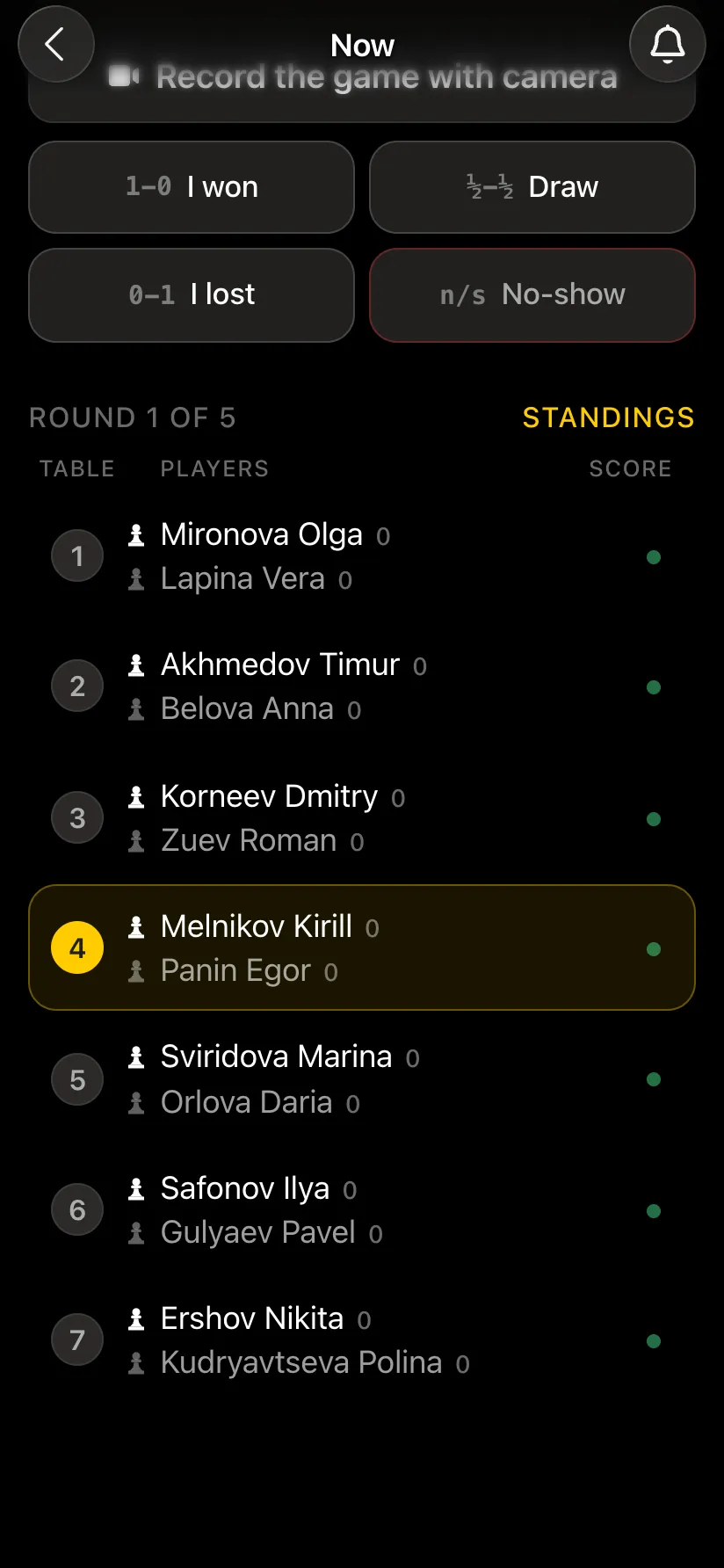
Round pairings of an offline tournament in the Vibe Chess app: seven tables, players with white and black
An offline tournament: the app runs the pairings.
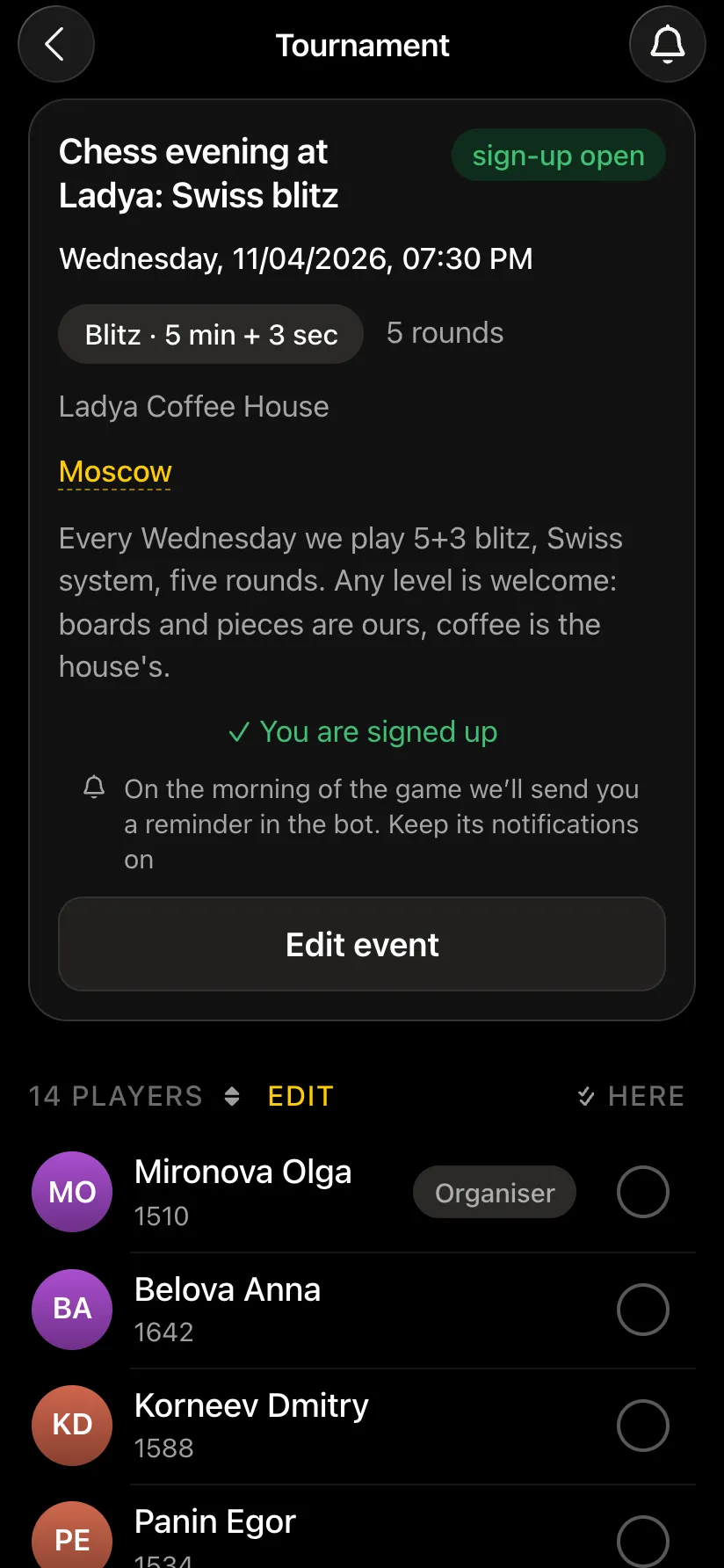
An offline tournament card at a coffee shop: date, time control, description and players
The evening's card: place, time, who is coming.

Where to find live tournaments near you - where to play chess in person.

Fair play: the main difference

🕵️

Online

The main threat is engine help: you cannot see your opponent and cannot check they are playing on their own. Sites catch cheaters with algorithms, but there is no certainty in any single game.
👀

Offline

Your opponent sits across from you, phones are off or handed in, an arbiter is in the hall. Engine help at the board is almost impossible - which is why official FIDE titles and ratings are given only for over-the-board tournaments.

The rules and what an organiser should do - fair play in an online tournament and fair play over the board.

Ratings: what counts and where

  • • An online rating - the site's internal rating (Lichess, Chess.com). It reflects playing strength on that site but does not count towards official ratings.
  • • National and FIDE ratings - only for official over-the-board tournaments with an arbiter and rating submission - FIDE.
  • • The Vibe Chess rating - for amateur over-the-board tournaments and meetups: it moves after every game played in person and shows your strength in live play.
  • • A club league rating - a separate rating within your own club that games elsewhere do not spoil - how to start a chess club.
Online ratings and over-the-board ratings often differ noticeably: online, mouse speed and bullet habits decide; at the board - composure, clock handling and the ability to think without interface hints.

Rules and the feel at the board

A player who grew up online notices a lot that is unfamiliar at their first live tournament:

  • • Touch-move. Pick up a piece - you must move it; release it on a square - the move is made.
  • • The player presses the clock with the hand they moved with. Forget to press - your time keeps running.
  • • An illegal move is not blocked. Someone has to notice it - you or your opponent.
  • • Recording moves is compulsory in classical; not in blitz - chess notation and scoresheets.
  • • You see the board in three dimensions - the position reads differently than on a screen, and the first games feel slower.

All of this quickly becomes habit - and most players later say a live game feels "real", while online feels like practice. The rules in full - chess rules.

Meeting people and community

An online tournament ends with the last game. An offline one carries on: analysis with your opponent, a chat over coffee, swapping contacts, an invitation to the next evening. Regular live tournaments grow into clubs and a crowd of your own that then travels to tournaments together. So for companies, schools and city communities, offline is also a way to bring people together - chess meetups.

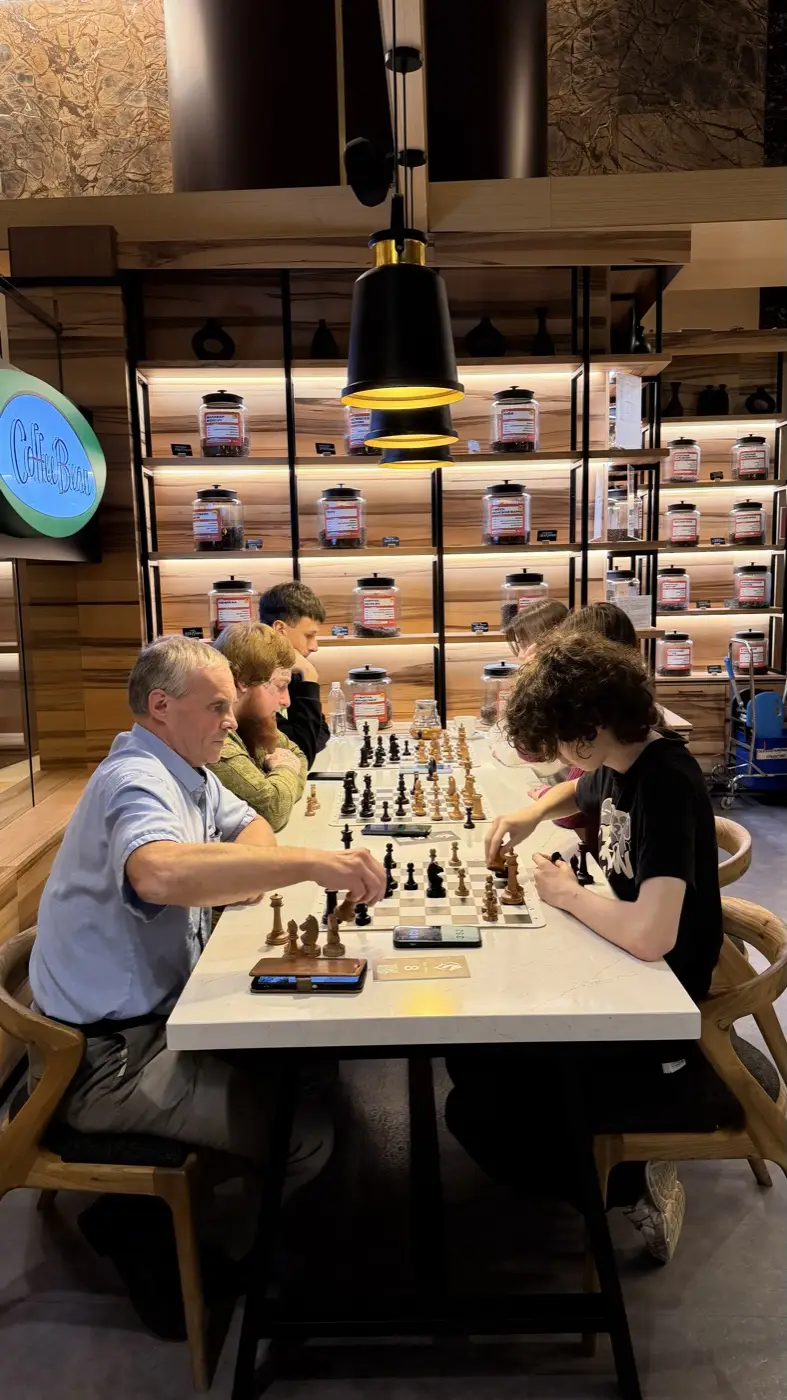
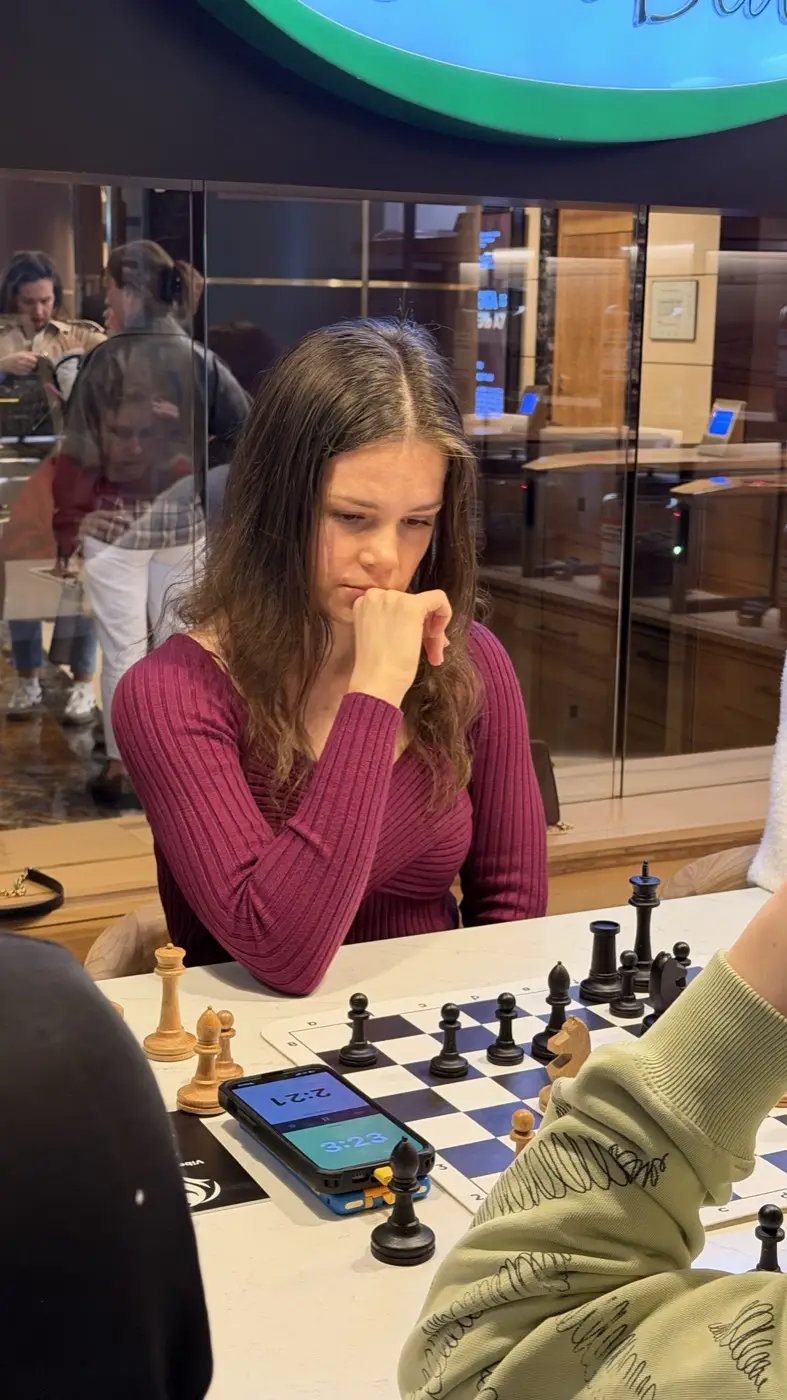
Tournament players waving at the camera after the last roundA row of tables in Coffee Bean: tournament games on several boards at onceA player in a burgundy sweater thinking over a move, a phone clock beside her
An offline tournament: live games and conversation - Coffee Bean, Moscow City, 17 October 2026.

When to choose online and when offline

🌍

Online

Players are in different cities; there is no hall; you need a quick qualifier or practice; you want many short games in one evening; for children just learning - at home under supervision.
🏛️

Offline

Atmosphere and meeting people matter; a tournament for a club, company or school; you need a fair result and a rating; you want people to come back and a community to form.
🔀

Hybrid

People play in person, while pairings, the table, game recording and the broadcast are online, in an app. That is how Vibe Chess tournaments work.

The best of both worlds: an offline tournament with online tools

The main drawbacks of offline are paper pairings, a hand-kept table and games nobody recorded. An app solves them: people play on real boards in a hall, and everything else works as it does online.
  • • Pairings and the table - the app pairs players, assigns tables and counts points by itself.
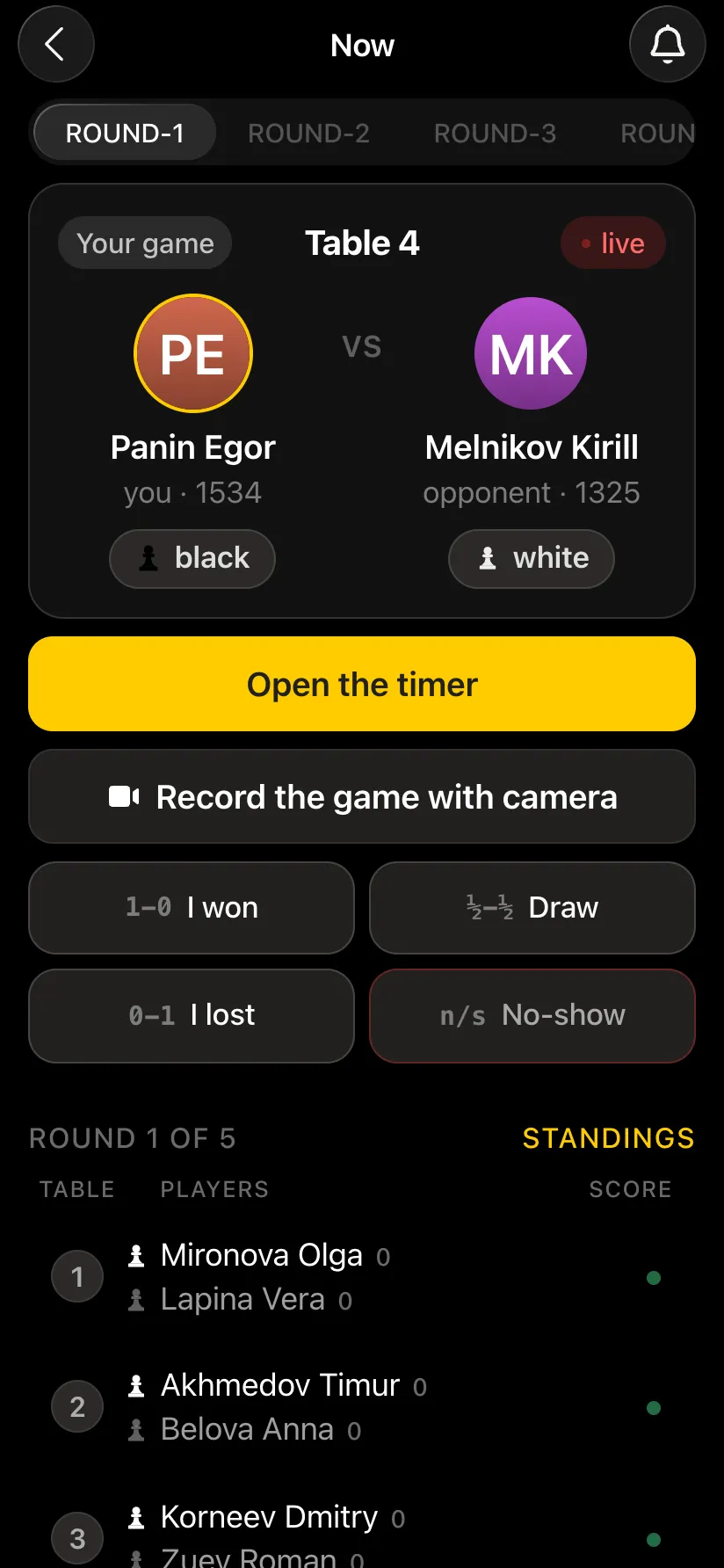
  • • Pairings on everyone's phone - table, colour and opponent, no sheet on the wall.
  • • Rating - moves after every live game.
  • • Game recording - the phone camera records the moves by itself, and the game can be analysed with an engine afterwards.
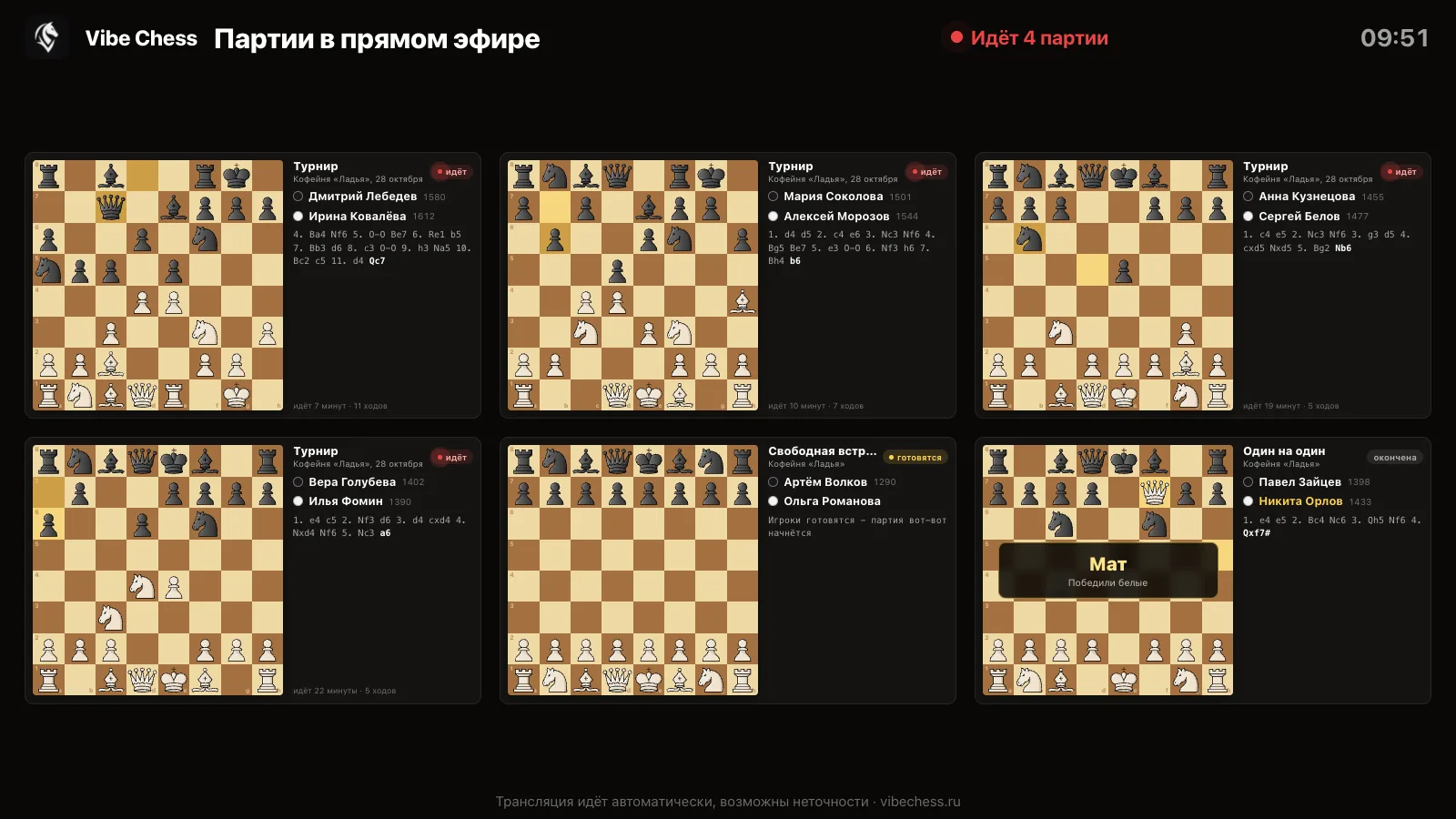
  • • Broadcast - the games are visible online at live.playvibechess.com.
  • • An arena like on Lichess - only in person: pairs form as soon as a table is free.
The live broadcast platform: six live games of an offline tournament, online
Offline games - online for viewers.
The player's screen: table, opponent, colour, clock and entering the score
For the player: table, opponent, clock.
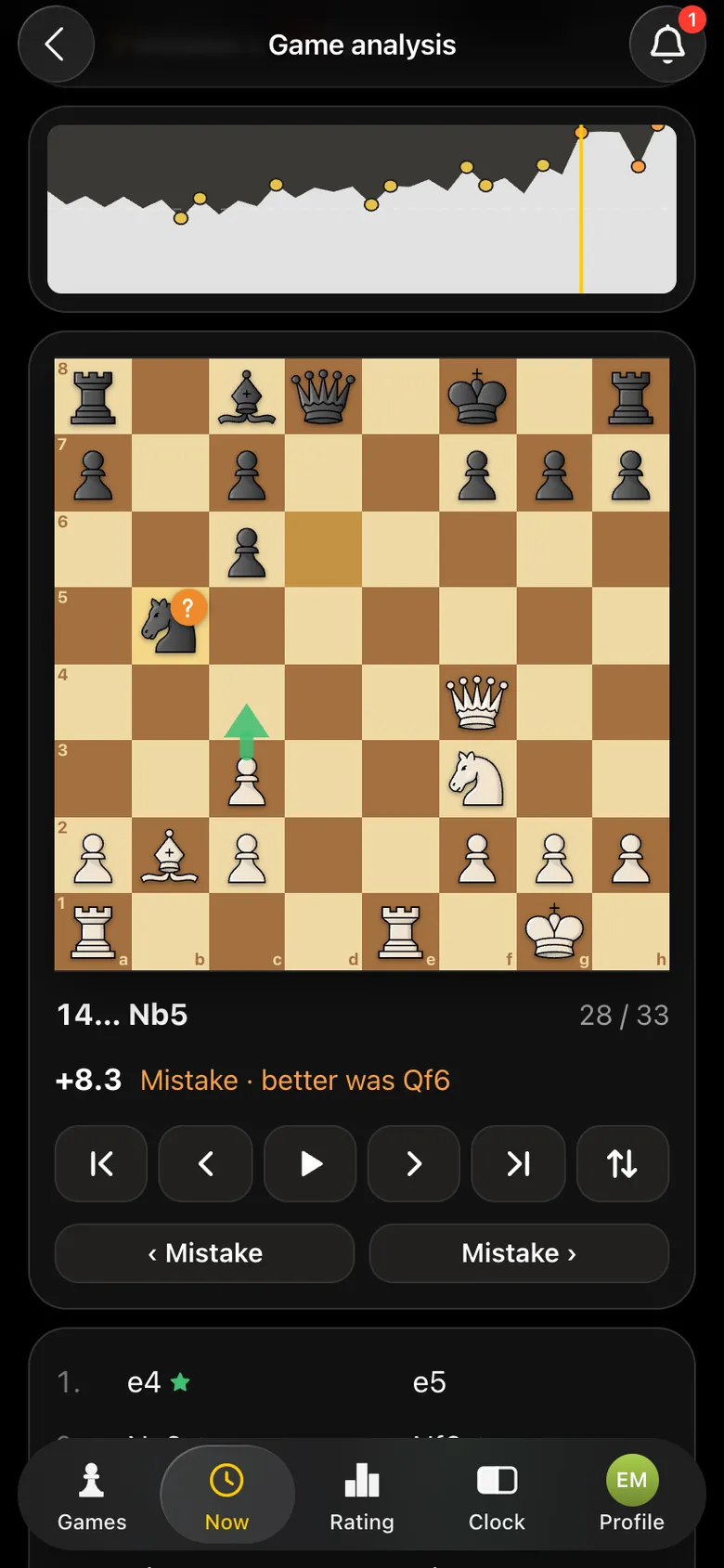
Analysis of a live game recorded by the camera: the evaluation graph and the best move
A live game can be analysed with an engine.

A similar approach is described in a hybrid chess tournament, and the broadcast itself in a chess game broadcast platform.

How to move from online to live tournaments

  1. Find a chess evening in your city - in the Vibe Chess app they appear in the city feed.
  2. Start with a casual meetup or a beginners' tournament - there is no pressure from the table.
  3. Before your first game, refresh touch-move and clock handling - the trainers in the app help.
  4. Choose a longer control than online: thinking at the board is slower.
  5. After the game, offer your opponent a post-mortem - that is how acquaintances start.

Need help with a tournament? Write to the developers

We build the Vibe Chess app ourselves and help organisers move tournaments from online to offline - and add online tools to offline. Write to us if you need to:

  • • choose a format and run your first live tournament;
  • • gather players - we will send out an invitation in your city;
  • • set up an online broadcast of live games.
Write to the developers on Telegram

Play in person

Open @vibechessbot - find a chess evening in your city or create your own tournament. Questions - write to the developers.

Frequently asked questions about offline and online tournaments

How does an offline chess tournament differ from an online one?

Offline, people play in person on real boards in one hall; online, everyone plays from their own place on a website or in an app. They differ in fair play, ratings, rules at the board, time control, preparation and social contact.

Which is better - an online or an offline tournament?

Online is more convenient for players from different cities and for quick tournaments. Offline is fairer and gives atmosphere, acquaintances and official ratings. The best option for a club is an offline tournament with online tools: pairings, the table and a broadcast in an app.

Does an online rating count towards FIDE?

No. Lichess and Chess.com ratings are the sites' internal ratings. FIDE and national ratings come only from official over-the-board tournaments.

Why does my online rating differ from my play at the board?

Online, speed and familiarity with the interface decide; at the board - composure, clock handling and the touch-move rule. So the ratings often differ.

Can an offline tournament be broadcast online?

Yes. In the Vibe Chess app games are recorded by a phone camera and shown online on live.playvibechess.com in real time.

How do I run an offline tournament without an arbiter and a paper table?

Create the tournament in the Vibe Chess app: it handles pairings, tables, the standings and results by itself, and players see their pairings on their phones.

Free

Three event formats in one app

The Vibe Chess app is built for an evening over the board, not for online play: it keeps the sign-up list, the pairings and the table while you deal with people and the venue. All of it free.

  1. 1Create the event and save the venue for next time
  2. 2Open sign-up, players arrive through the link
  3. 3Start the tournament and the app announces the pairings
  4. 4Keep entering results, then take the final table and the TRF file
  • Swiss system. score groups, no rematches, no second bye
  • Round robin. everyone plays everyone, the app works out the number of rounds
  • Free meetup. who is free and who is already at a board is shown under Now

More than a bot: the app, FIDE rules and a TRF report

  • The app. Besides the bot there is an app - inside Telegram and simply at playvibechess.com/app: what is on in your city, the player list, a live table, the current round, your profile and game history - everything that is awkward to read as chat messages.
  • Pairings by FIDE rules. Pairings are computed by bbpPairings, an open-source engine implementing the Dutch system: score groups, floats on an odd field, colour alternation, no rematches, and no player gets a bye twice.
  • A TRF report. A finished tournament exports as a single file in the FIDE data exchange format - the one arbiter software and federations accept. Your profile stores the FIDE ID, national federation code, title, sex and date of birth for it.
  • Free. All of the above, with no subscriptions, paid plans or limits on the number of tournaments and players.

Full overview

Missing a feature? Message the developers

The bot is constantly improved based on real tournaments. If you need a feature that isn't there yet, message the developers right inside the bot with the /support command. Many features appeared exactly because organizers asked for them, and useful ideas get added quickly.

Alexey Mudry
Alexey Mudry · hosted 37 events for Vibe Chess · 157 reviews · rating 5.0

At the board since childhood: hazy about his rating, precise about every rook he has blundered. Counts an evening as a good one if the opponent stayed to talk afterwards instead of rushing off to check with an engine. Message →