Vibe ChessVibe ChessApp

Neighbourhood chess tournament in the Vibe Chess app

Alexey Mudry · updated September 29, 2026
Chess in the courtyard is the easiest way to get to know your neighbours. Boards on the benches, a gazebo by the playground, half a weekend day - and it is no longer "the neighbour from the fifth floor" but Daniel, who plays the Sicilian. And if there is another building next door, you can hold a real match: "Northgate Court vs Riverside Court". In the Vibe Chess app such a tournament is run by one keen neighbour: they create the tournament and drop the link into the residents' chat, and the app handles the pairings, standings and rounds. Below is a match between two buildings, with a screenshot of every step. How a courtyard tournament works in general is covered in neighbourhood chess tournament.

Where to play: courtyard, gazebo, benches

A neighbourhood tournament does not need a hall. It needs flat surfaces for the boards and a place where neighbours gather anyway. Here is what works outdoors:

The courtyard gazebo

A roof against rain and sun, a table for two or three boards. The main "table 1" of a neighbourhood tournament.

Benches along the path

A board between two players right on the bench. Number them with sheets of paper - those are tables 2, 3, 4…

The playground

Parents play while the children are on the slide. Whoever has finished their game keeps an eye on everyone.

The courtyard between two buildings

Neutral ground for a match: neither building plays "at home".

The lobby or residents' lounge

If the building has a lobby, a lounge or a concierge area, it is the fallback for rain.

By the front entrance

For a small tournament in one building, a table by the entrance and a couple of benches are enough.

Neighbours bring their own boards and clocks - every building has five or six sets. Chess clocks are optional: the "Open the timer" button in the app turns a phone into a clock. If there is no gazebo and no benches, a nearby park or a street festival will do - chess at a city festival.

Two formats: a courtyard tournament and building vs building

A courtyard tournament.Residents of one development or even one building play. The name comes from the place: "The Maple Street Courtyard Cup", "Chess by Entrance 3", "The Northgate Court Cup". The goal is to get to know each other; nobody keeps a team score.

Building vs building.Two neighbouring buildings each field a team. The name is just like a football fixture: "Northgate Court vs Riverside Court", "No. 5 vs No. 7", "Phase one vs phase two", "Our courtyard vs the one across the road". Everyone plays their own games, and at the end the points of each building's players add up to the match score.

Below we walk through the second format - it has everything the courtyard tournament has, plus the building in the nickname and the match score.

Step 1. Agree with the building next door

Each building needs a captain - a neighbour who rounds up their own people and agrees the rules. Three things are worth settling:

  • Where to play. Best of all is a neutral courtyard between the buildings, a gazebo or a path with benches that both buildings can see.
  • How many players count. The teams are almost never equal: eight people come from one building, ten from the other. A fair rule is to count the points of the eight best from each building, while everyone can play.
  • When. A weekend, around noon: neighbours are at home, the courtyard is light, children are playing nearby.

Step 2. Create the tournament

Open the Vibe Chess bot and its app button, or the web version. Games - "Create your own game" - "Swiss-system tournament". Fill in:

  • Venue- as the neighbours know it: "Courtyard between Northgate and Riverside, gazebo by the playground". You can add an address and a map link - the same form has fields for them.
  • Title- "Northgate Court vs Riverside Court".
  • Time control - 10+5 rapid, five rounds: a game on a bench takes 15-25 minutes, the whole match about two and a half hours.
  • Tables - as many boards as the courtyard has: the gazebo plus the numbered benches.
  • Description - the match rules: where we play, what to bring, how to show your building and how the score works.

Leave "Private tournament" off for a neighbourhood match: an open tournament is visible in the city feed in the app, and neighbours from the buildings around will find it too.
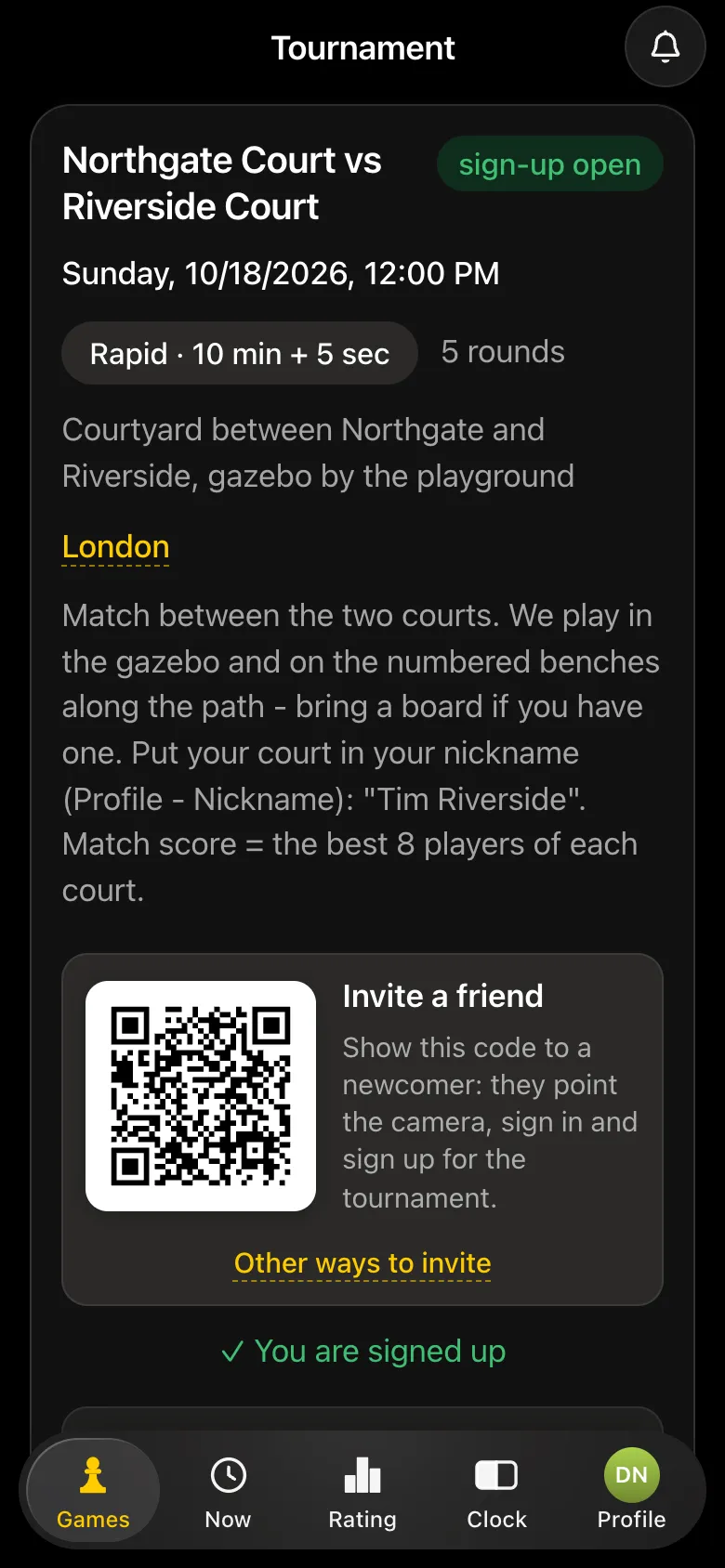
Tournament card Northgate Court vs Riverside Court: Sunday 12:00 PM, 10+5 rapid, 5 rounds, venue - courtyard between the buildings, gazebo by the playground, match rules in the description
The match card: the courtyard venue and the scoring rules right in the description.

Step 3. Your building in your nickname

The app keeps individual standings and does not know who lives where. So the building goes into the nickname: Profile - "Edit profile" - the "Nickname" field. The format is simple - first name and building: "Tim Riverside", "Andrew Northgate". The name in a tournament comes from the nickname, so the line-up, the pairings, the screen and the final standings all show at once who plays for which building.
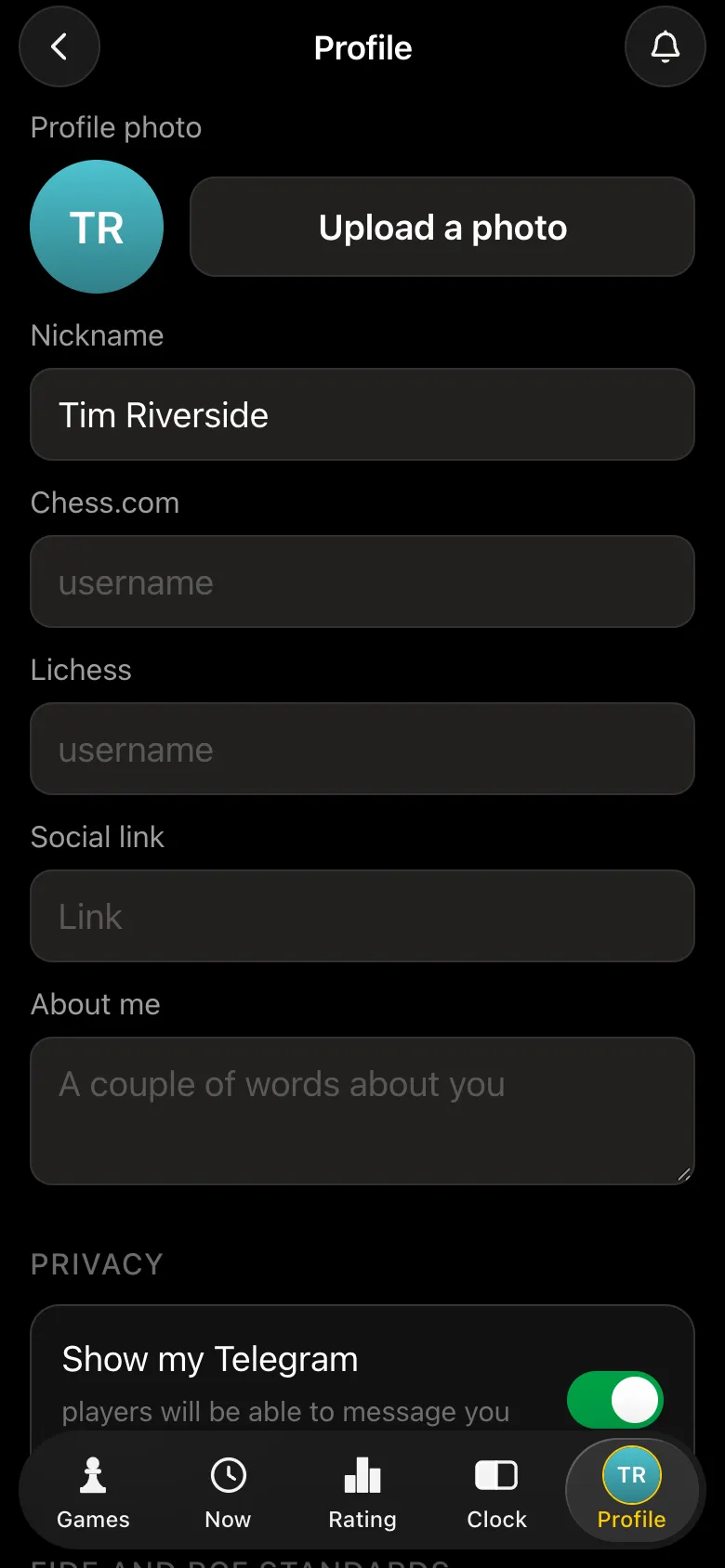
Edit profile: the Nickname field - Tim Riverside
A "name + building" nickname - and the building shows everywhere.
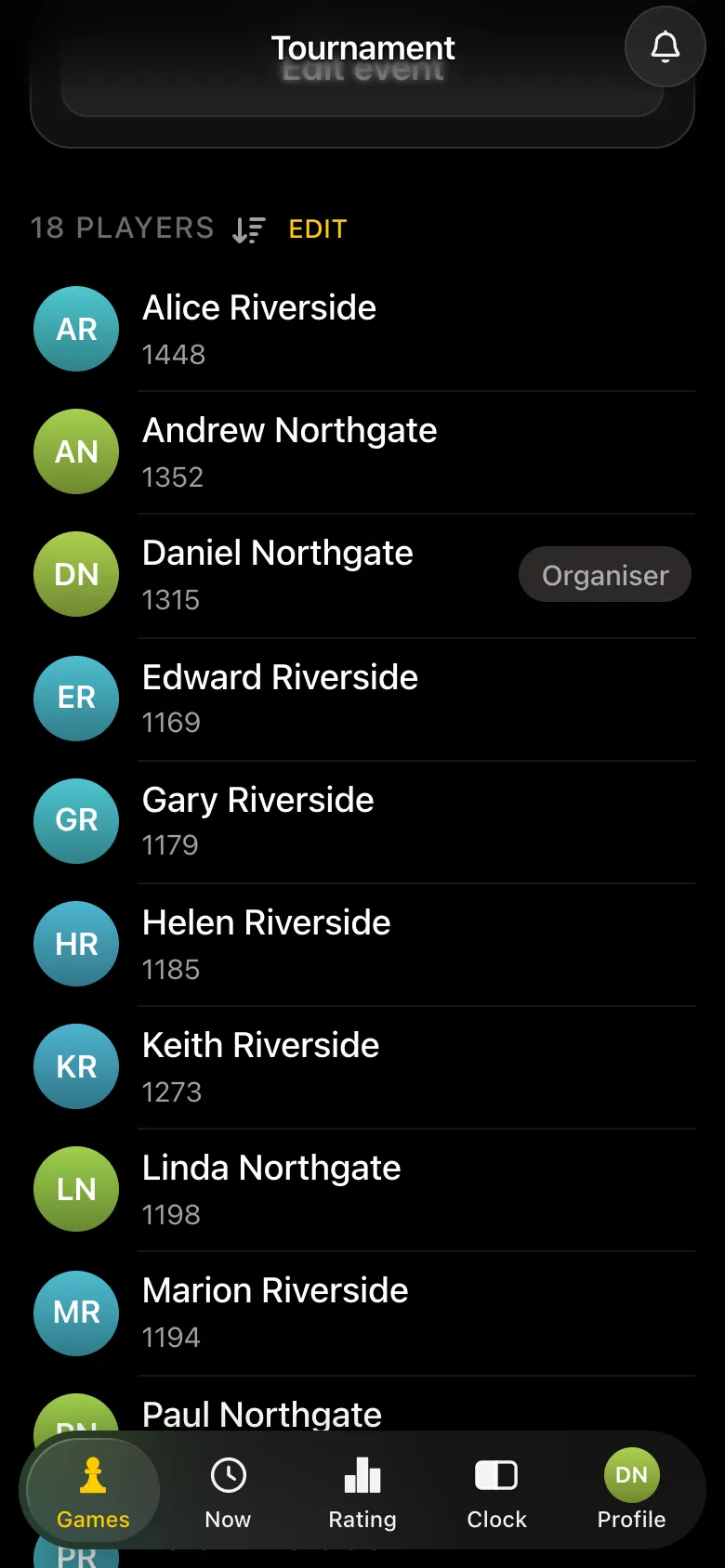
Tournament line-up: 18 players with nicknames Alice Riverside, Andrew Northgate, Daniel Northgate, Edward Riverside
The line-up: everyone's building is right in their name.

A neighbour without Telegram can play too: the organiser adds them as a guest by name on the player list screen - with the building straight away, for example "Kate Riverside".

Step 4. Invite the neighbours

The tournament card has an "Invite a friend" QR code and a link. Neighbourhood channels that work:

  • The building or residents' chat in Telegram - the link and a couple of words about the match.
  • A notice in the lift and on the entrance door - print the QR code with the date and place.
  • The noticeboard by the concierge or in the lobby.
  • The other building's chat - through their captain.

A neighbour scans the code, lands in the bot and signs up. The tournament appears in their app on the Games tab.
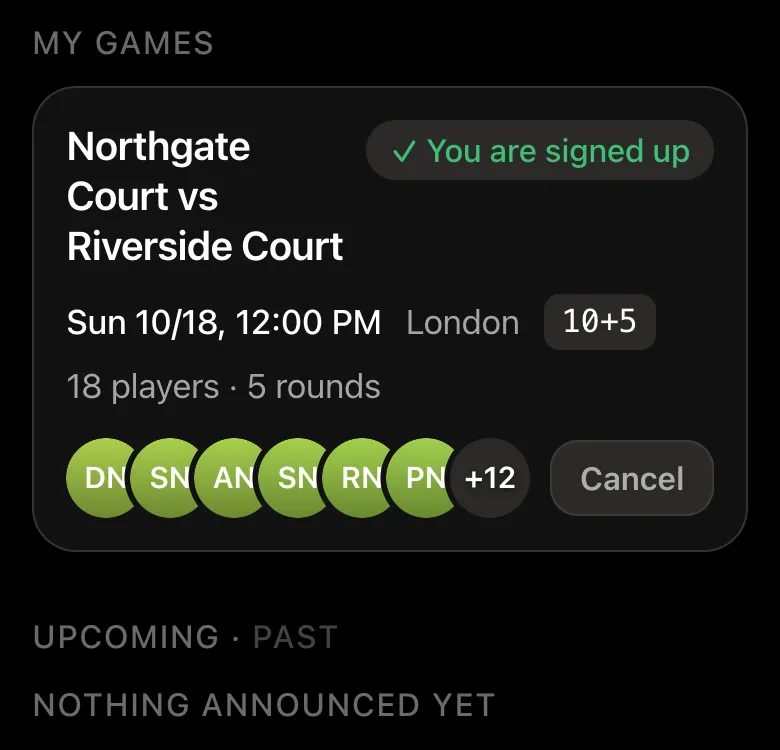
A neighbour's Games tab: the Northgate Court vs Riverside Court match card, 18 players, 5 rounds, You are signed up
The tournament on a neighbour's Games tab.

Step 5. The match in the courtyard

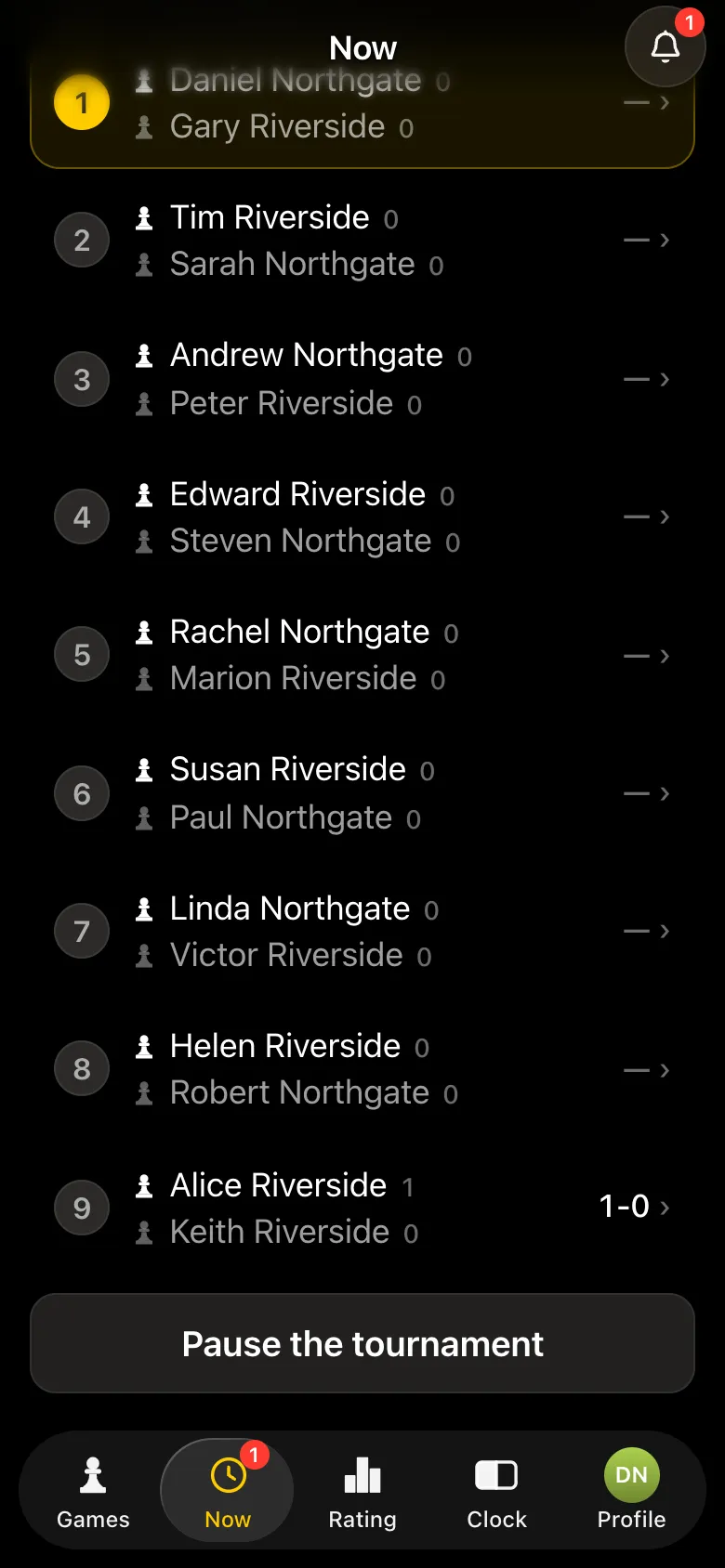
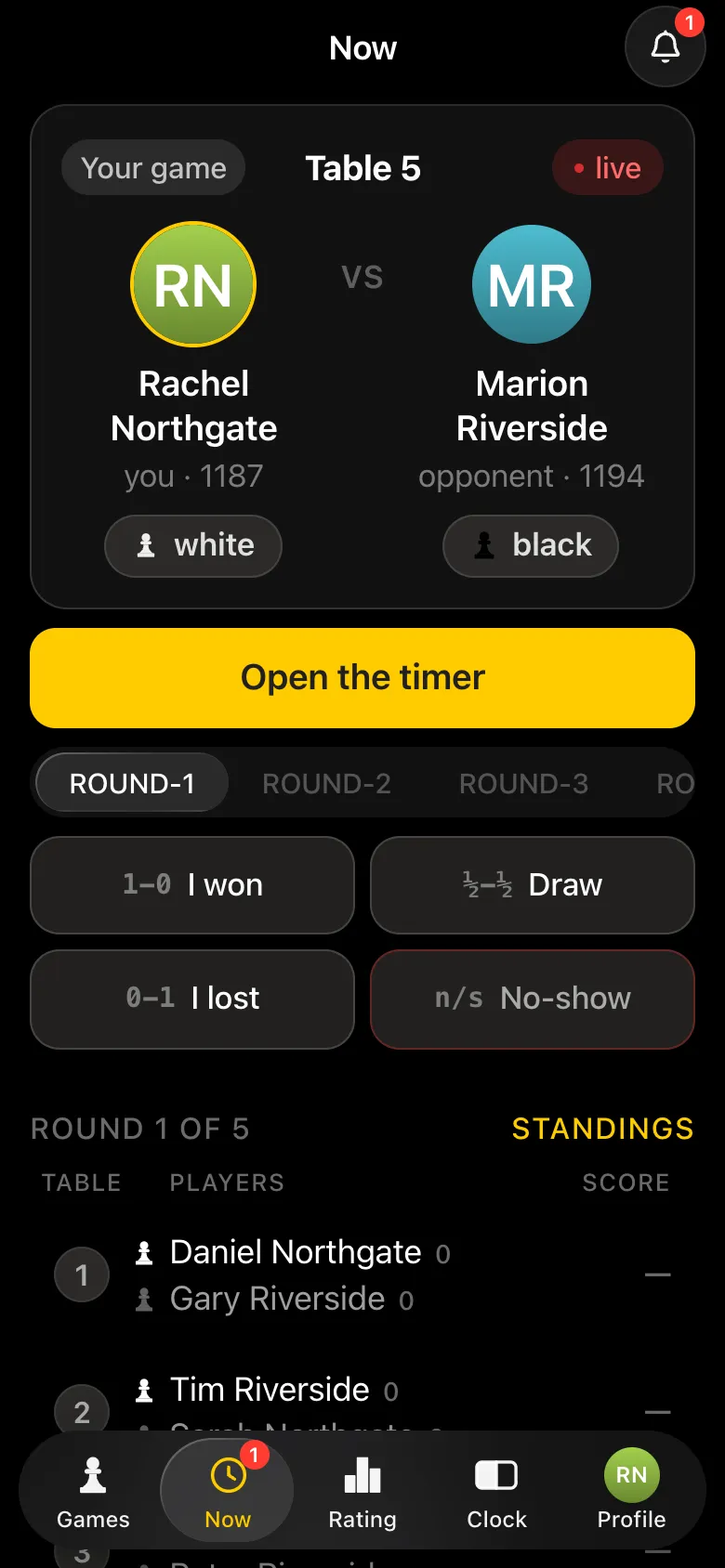
On match day the organiser closes registration and starts the tournament. Everyone sees their game on their phone: table number, colour, opponent. The table number is the number on the sheet taped to a bench or the gazebo table. Fewer boards than pairs? No problem: the extra pairs wait and take the first bench that frees up.
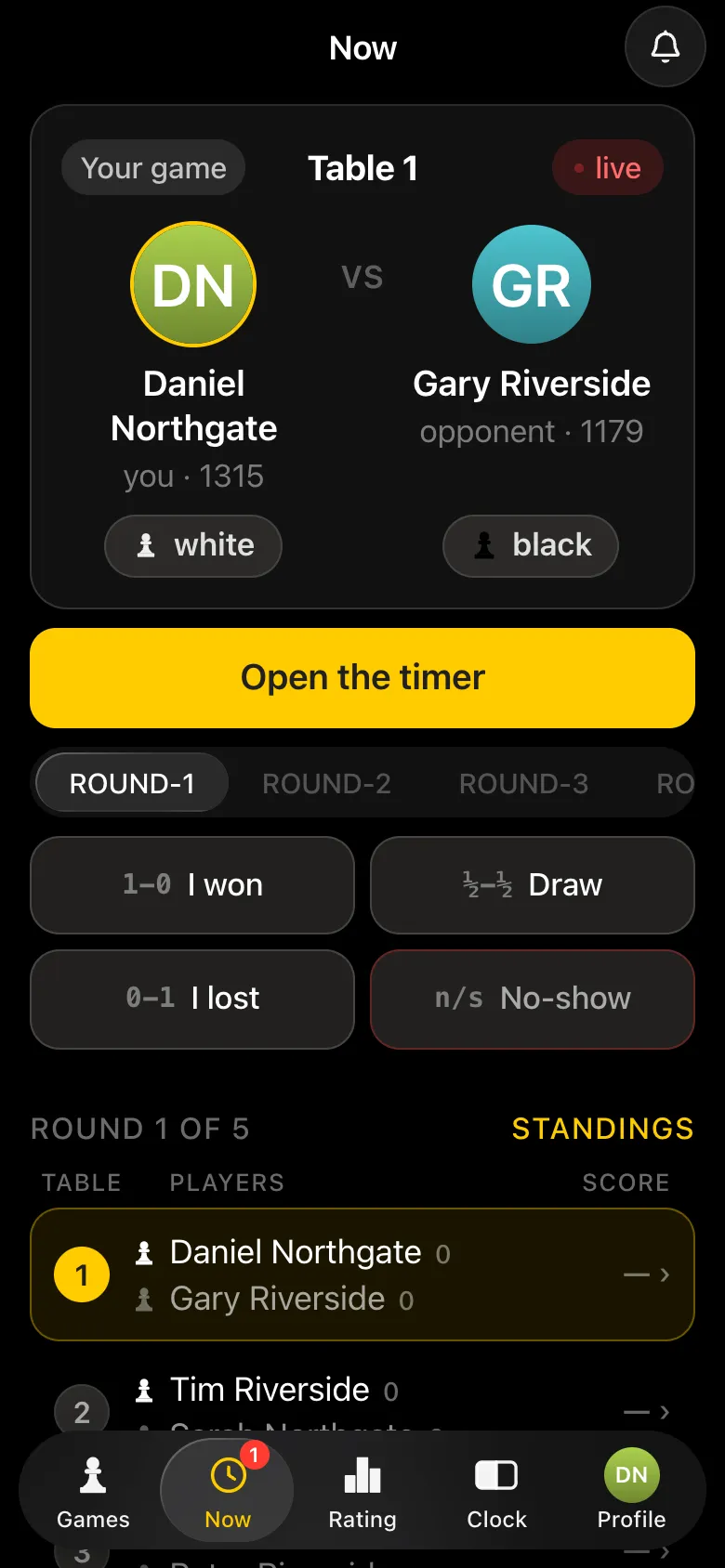
Round one on the organiser's screen: their game on table 1 against Gary Riverside and the round pairings with neighbours' nicknames
Round one: most pairings are between the buildings.
A neighbour's screen: table 5, Rachel Northgate against Marion Riverside, timer and result buttons
A player's screen: table, colour, timer, result buttons.
Round one: Alice Riverside and Keith Riverside from the same building at one board, result already in
The Swiss can pair two neighbours from the same building.

When a game ends, one player taps "I won", "Draw" or "I lost"; the opponent sees the entry and has 15 seconds to dispute it. Rounds are announced automatically. FIDE pairing rules match opponents by score and know nothing about buildings: sometimes two people from the same building sit at one board. For the match score that does not matter - the point from such a game stays with their building in full.

A screen for the supporters

If a neighbour has a laptop and a TV in the lobby, or a projector, put the tournament on a screen: "Show the tournament on a screen" on the card gives you a link, and the page updates by itself. The screen shows each nickname with its building, the rating and its change, and the points. Supporters from both buildings have something to watch.
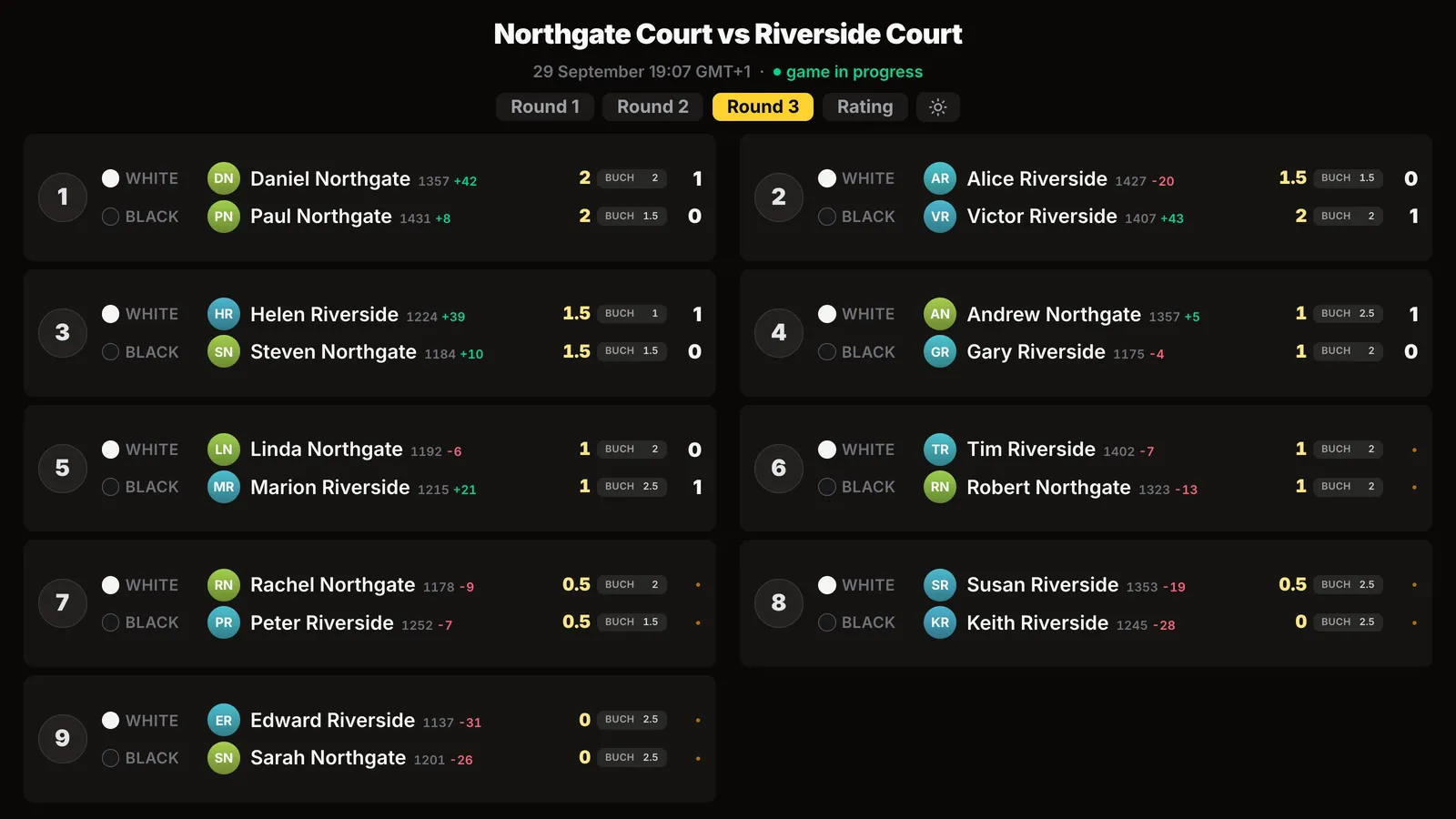
Tournament screen: round three pairings with Northgate and Riverside nicknames, rating, rating change, points and Buchholz
Round pairings on the screen: you can see who plays for which building.
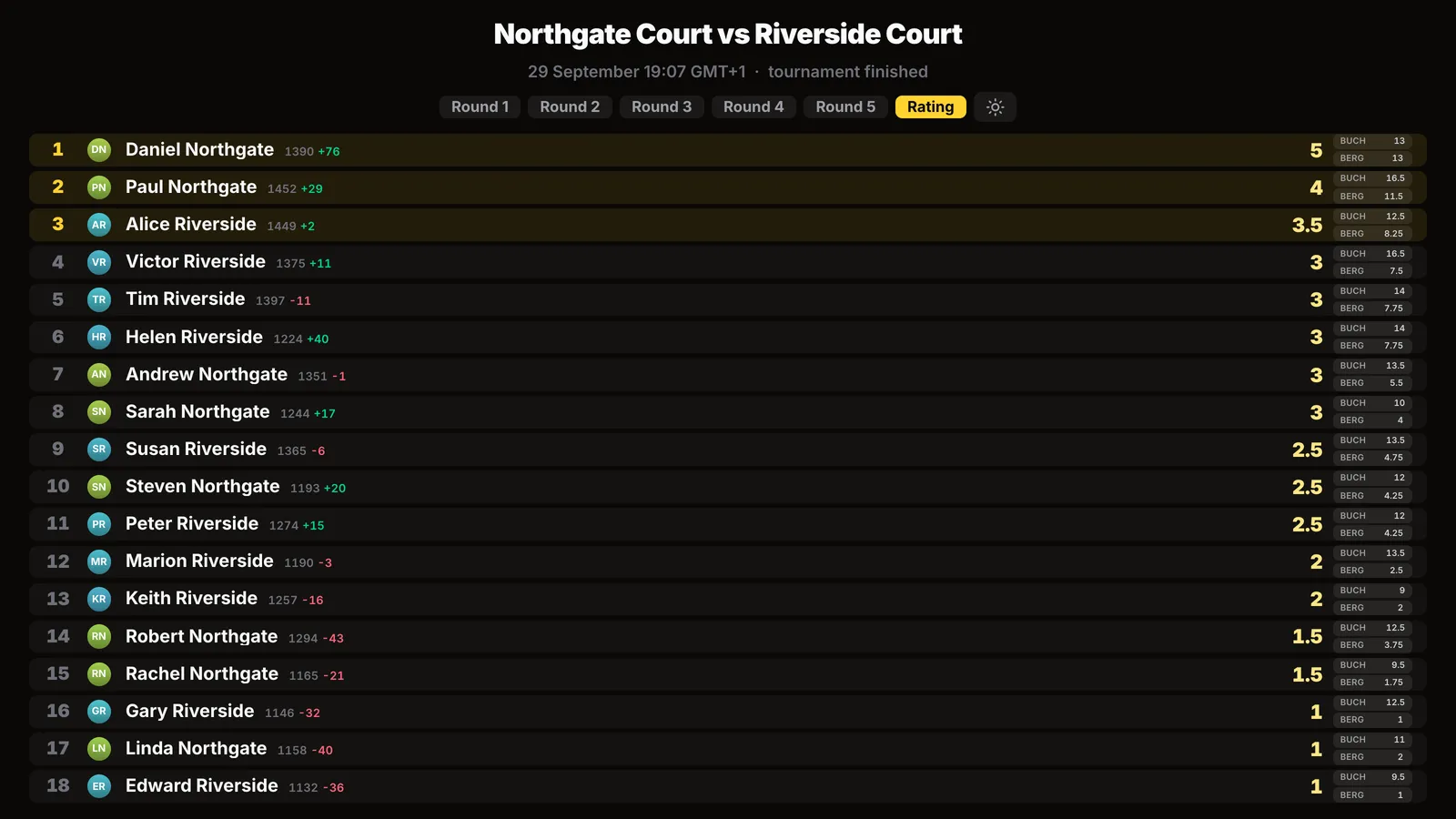
Final standings on the screen: 18 neighbours from two buildings with points, Buchholz and Berger
The final standings of the match.

Step 6. The building vs building match score

After the last round the tournament finishes on its own, and "Final standings" shows places and points. The app has no team scoring, so the captains work out the match score: they take the points of the eight best players from each building and add them up. With the nicknames it takes a minute.
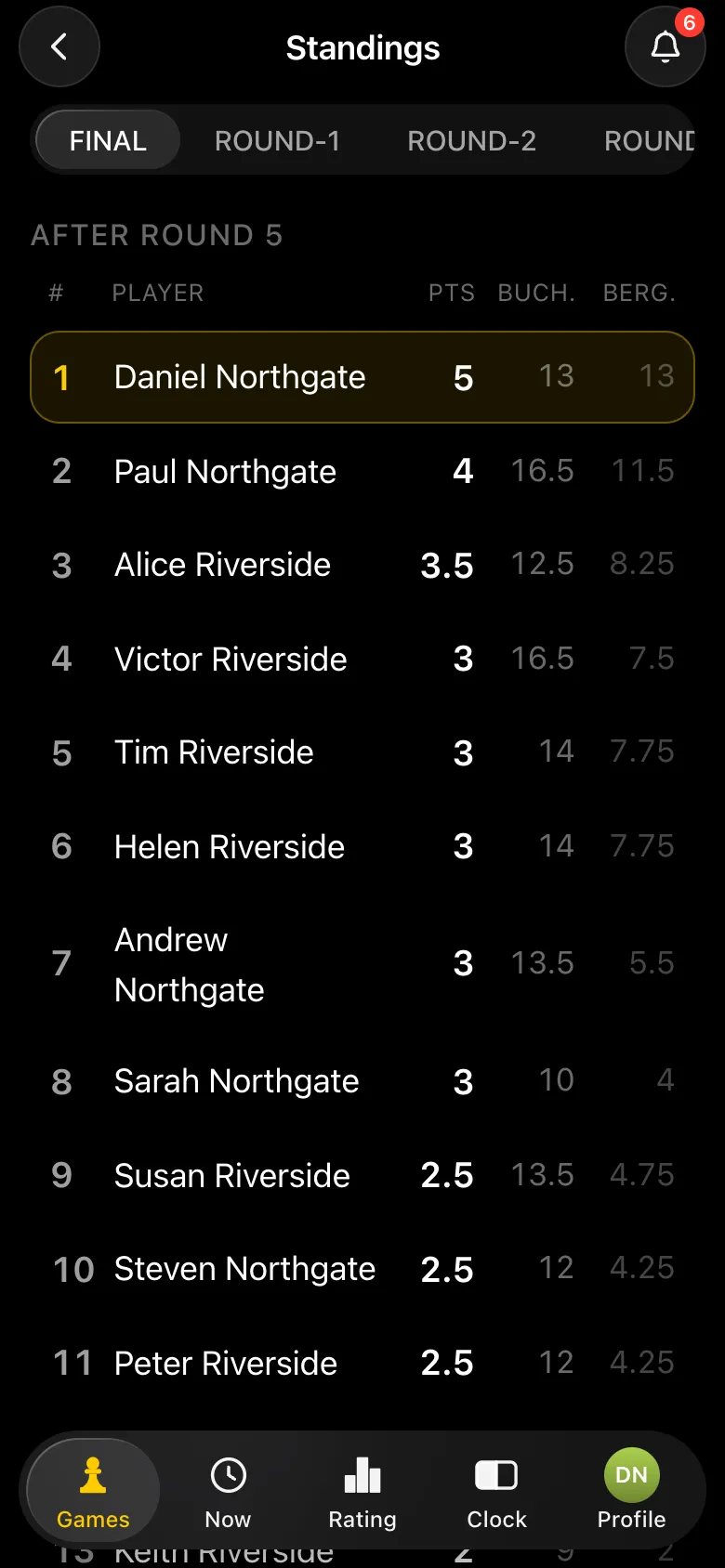
Final standings of the match: Daniel Northgate 5 points, Paul Northgate 4, Alice Riverside 3.5
The final standings - this is where the match score comes from.

Here is how it looks in our demo match: ten neighbours played for Riverside and eight for Northgate, and the best eight from each count.

Northgate Court

21.5
  • Daniel Northgate5
  • Paul Northgate4
  • Andrew Northgate3
  • Sarah Northgate3
  • Steven Northgate2.5
  • Robert Northgate1.5
  • Rachel Northgate1.5
  • Linda Northgate1

Riverside Court

21.5
  • Alice Riverside3.5
  • Victor Riverside3
  • Tim Riverside3
  • Helen Riverside3
  • Susan Riverside2.5
  • Peter Riverside2.5
  • Marion Riverside2
  • Keith Riverside2

A draw, 21.5 : 21.5 - the return match will have to decide it. If you want a winner on the day, agree a tie-break with the other captain beforehand, for example the building of the tournament winner. "Standings as a PDF sheet" sends an A4 sheet with places and points to the chat - it can go up by the lift in both buildings, with the match score added by hand at the top.
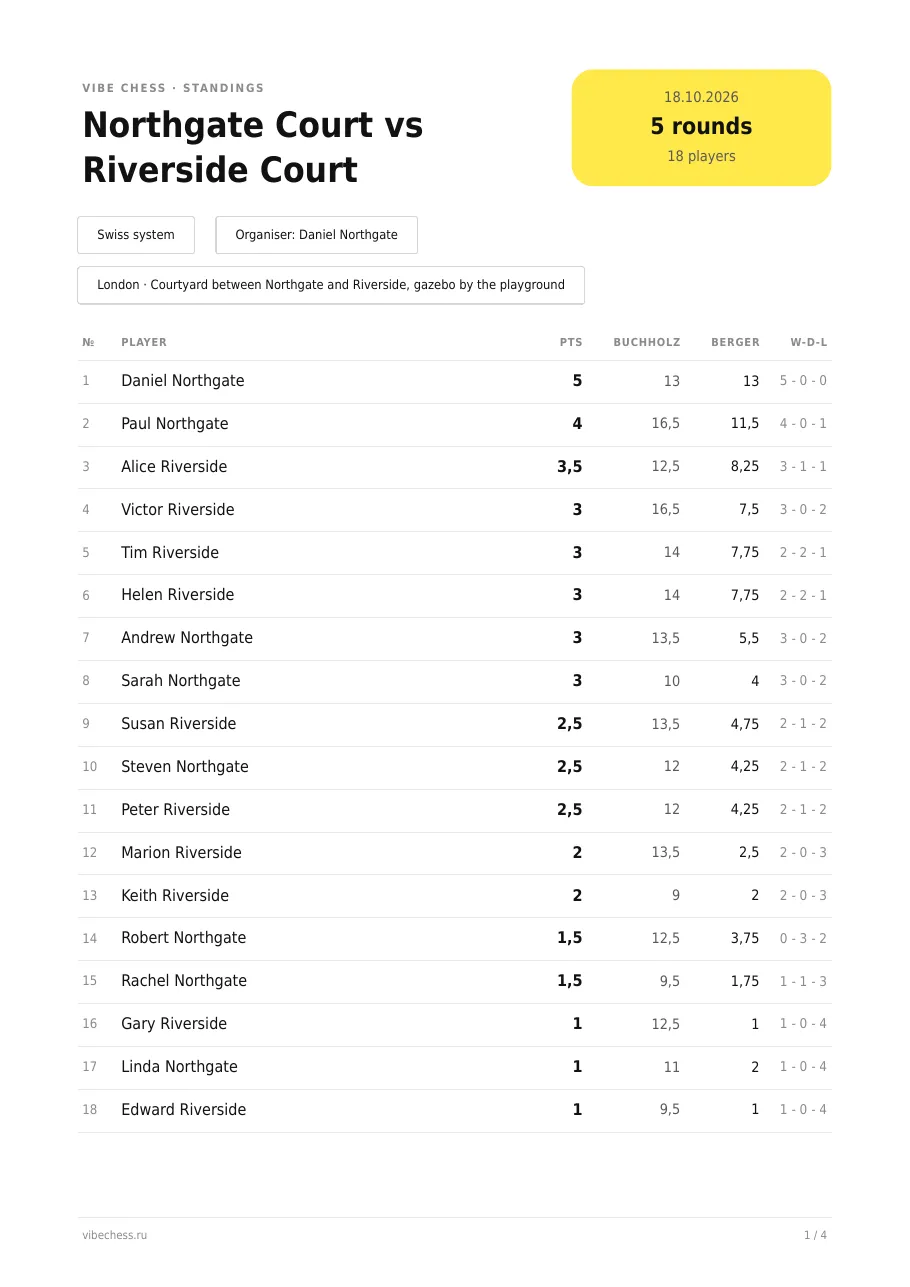
PDF results sheet Northgate Court vs Riverside Court with the neighbours' places, points and tie-breaks
The results sheet - for the noticeboard by the lift.

How to make the match a tradition

  • A return match.The first game in Northgate's courtyard, the return at Riverside. That way nobody always plays "away".
  • A season.A match once a month from spring to autumn and an overall score across the matches. You can set up a neighbours' league: Profile - Leagues - Create a league, with its own rating and season table (leagues all work the same way - see corporate chess tournament in the app).
  • A tournament for a street party. A community day, a block party, the opening of a new playground - chess fits the programme well. Ideas - chess festival.
  • The courtyard kids. Children get their own group in the same tournament or a separate tournament. How to do it - school tournament in the app.
  • Newcomers - start with a meetup. If half the courtyard is still remembering how the knight moves, begin with a free meetup without pairings - beginners' tournament in the app.

What the app does not do

  • Team scoring. The app does not work out the building vs building score - it is added up from the final standings. How real team tournaments work is covered in Swiss system for teams.
  • Pairings only between buildings. The pairings go by score and may put two neighbours from the same building together.
  • Work offline. Players need mobile internet in the courtyard.

Challenge the building next door

Open @vibechessbot in Telegram or the app in your browser, create a "your building vs the one next door" tournament and drop the link into the residents' chat. Questions about the app - message us on Telegram.

Common questions about a neighbourhood tournament in the app

How do I organise a chess match between two apartment buildings?

Create a Swiss-system tournament in the app called "Building 1 vs Building 2", players put their building in their profile nickname, and after the tournament the captains add up the points of the eight best players from each building.

How do I tell who is from which building?

By the nickname: in their profile everyone writes their first name and building, for example "Andrew Northgate". The name in a tournament comes from the nickname, so the building shows in the line-up, the pairings, on the screen and in the final standings.

Does the app work out the match score?

No, the app has no team scoring. It counts individual points, and the match score - the sum of the best players' points from each building - is added up by the captains from the final standings.

Where do we play if the courtyard has no tables?

On benches: the board goes between the two players. Number the benches with sheets of paper - those are the table numbers in the app. The fallback for rain is the lobby or the residents' lounge.

How do I invite the neighbours?

With a link in the building and residents' chats and a QR code on a notice in the lift or on the entrance door. An open tournament is also visible in the city feed in the app.

Do we need chess clocks?

Not necessarily: the Open the timer button in the app turns a phone into a clock with the right time control.

How much does it cost?

The app is free. It runs in Telegram through the @vibechessbot bot, and on a computer at playvibechess.com/app.

Free

Create your own tournament for free

The Vibe Chess app opens from a link and needs no installation. Setting up a tournament takes a minute: pick the system, set the date, the venue and the time control - the app handles the rest.

  1. 1Create the event and share the link - sign-up opens right away
  2. 2Press start and the app announces the first pairing
  3. 3Enter results, the table with points and Buchholz updates itself
  4. 4At the end - final standings and a TRF report in the FIDE data exchange format
  • Swiss system. for a large field: opponents are matched by score, you choose the number of rounds
  • Round robin. for a small circle: everyone plays everyone, the round count follows from the field
  • Free meetup. no rounds, no pairings: players sign up and pick opponents at the table

More than a bot: the app, FIDE rules and a TRF report

  • The app. Besides the bot there is an app - inside Telegram and simply at playvibechess.com/app: what is on in your city, the player list, a live table, the current round, your profile and game history - everything that is awkward to read as chat messages.
  • Pairings by FIDE rules. Pairings are computed by bbpPairings, an open-source engine implementing the Dutch system: score groups, floats on an odd field, colour alternation, no rematches, and no player gets a bye twice.
  • A TRF report. A finished tournament exports as a single file in the FIDE data exchange format - the one arbiter software and federations accept. Your profile stores the FIDE ID, national federation code, title, sex and date of birth for it.
  • Free. All of the above, with no subscriptions, paid plans or limits on the number of tournaments and players.

Full overview

Missing a feature? Message the developers

The bot is constantly improved based on real tournaments. If you need a feature that isn't there yet, message the developers right inside the bot with the /support command. Many features appeared exactly because organizers asked for them, and useful ideas get added quickly.

What to read next

The format with no app involved - neighbourhood chess tournament. Outdoors - chess at a city festival. A team format - team chess tournament. The same app for other audiences - beginners', school, summer camp and corporate tournaments.

Alexey Mudry
Alexey Mudry · hosted 15 Vibe Chess events

At the board since childhood: hazy about his rating, precise about every rook he has blundered. Counts an evening as a good one if the opponent stayed to talk afterwards instead of rushing off to check with an engine. Message →