Notation is the common language of chess players. The line 1. e4 e5 2. Nf3 Nc6 3. Bb5 means the same in London, Buenos Aires and Mumbai: it is the Ruy Lopez, and any chess player will set it up on a board in half a minute.
The board is an 8 by 8 grid. Files (columns) are labelled with letters a to hfrom left to right, as seen from White's side. Ranks (rows) are numbered 1 to 8from bottom to top: White's pieces start on ranks one and two, Black's on seven and eight.
A square is named by a letter and a number: e4 is where the e-file meets the fourth rank. The corner square a1 on White's left is dark, and the right-hand corner for each player is a light square - h1 (and a8for Black) - which is how you set the board up correctly. The queen starts on her own colour: White's on d1, Black's on d8.
More about the board and the starting position - chess board setup.
Every piece except the pawn is written with a capital letter. In English notation the letters are English, and it is the international standard. A pawn move is written with the square only: e4, d5.
| Piece | English (international) | Russian | Symbol |
|---|---|---|---|
| King | K | Кр | ♔ ♚ |
| Queen | Q | Ф | ♕ ♛ |
| Rook | R | Л | ♖ ♜ |
| Bishop | B | С | ♗ ♝ |
| Knight | N | К | ♘ ♞ |
| Pawn | not written (sometimes P) | not written (sometimes п) | ♙ ♟ |
Note: the knight is written N, because K is already taken by the king. Russian notation solves the same problem the other way round: the king gets two letters, Кр, so it is not confused with the knight К.
Other languages have their own letters - worth knowing if you read foreign books:
| Language | King | Queen | Rook | Bishop | Knight |
|---|---|---|---|---|---|
| German | K | D | T | L | S |
| French | R | D | T | F | C |
| Spanish | R | D | T | A | C |
| Italian | R | D | T | A | C |
To be independent of language, books and programs print figurine notation: a piece symbol instead of a letter, ♘f3 instead of Nf3. It reads the same in every country. How each piece moves - how chess pieces move.
The world's main notation is algebraic. FIDE recognises only this one in its competitions (Appendix C to the Laws of Chess). It has two forms.
| Long | Short | |
|---|---|---|
| What is written | the square it came from and the square it went to | only the square it went to |
| Pawn move | e2-e4 | e4 |
| Piece move | Ng1-f3 | Nf3 |
| Capture | Bf1xb5 | Bxb5 |
| Pawn capture | e4xd5 | exd5 |
Long notationis clearer: you can see where the piece came from. Children's coaches and old books like it. Short notation is the standard of modern books, programs and tournament scoresheets.
A capture is marked with x (some traditions use a colon :). A capturing pawn is named by its file: exd5 - the pawn from the e-file captured on d5. Very old records also use the shortest form, ed.
One "move" in notation is a pair: White's move and Black's reply. The number goes before White's move: 1. e4 e5 2. Nf3 Nc6 3. Bc4 Bc5. If a record starts with Black's move, an ellipsis follows the number: 3... Nf6.
| Move | How it is written | Example |
|---|---|---|
| Kingside castling | 0-0 | king to g1, rook to f1 |
| Queenside castling | 0-0-0 | king to c1, rook to d1 |
| Pawn promotion | e8=Q or e8Q | the new piece's letter after the square |
| En passant | exd6 e.p. | a pawn captures on the square the enemy pawn passed over |
The FIDE Laws write castling with zeros; the letter O (O-O) is common in English-language books and software and means the same. The conditions for castling - castling in chess.
| Symbol | Meaning |
|---|---|
+ | check |
++ | double check (some books use it for mate too) |
# | mate |
(=) | a draw offer - marked like this on the scoresheet |
1-0 | White wins |
0-1 | Black wins |
½-½ | a draw |
An example of a whole game - Scholar's Mate in four moves, in short notation:
1. e4 e5 2. Bc4 Nc6 3. Qh5 Nf6 4. Qxf7# 1-0
How not to fall for this mate - Scholar's Mate. When a game ends in a draw - draws in chess.
If either of two identical pieces can go to the same square, the short record is not enough - it is unclear which one moved. Then the piece's file is added after its letter, and if they share a file - its rank.
Long notation never has this ambiguity: the starting square is already given - Nb1-d2.
In game commentary, evaluation symbols are placed next to moves. Books, magazines and analysis software use them.
| Symbol | Meaning |
|---|---|
| ! | a strong move |
| !! | a brilliant move |
| ? | a mistake |
| ?? | a blunder |
| !? | an interesting move, worth attention |
| ?! | a dubious move |
| = | an equal position |
| ⩲ / ⩱ | White / Black is slightly better |
| ± / ∓ | White / Black is clearly better |
| +- / -+ | White / Black is winning |
| ∞ | an unclear position |
The positional evaluation symbols come from Chess Informant - a series that printed games without words, with symbols only, and could therefore be read in any country.
Before switching to algebraic, English-speaking countries used descriptive notation: a square was named after the piece that starts on its file, and ranks were counted from your own side. The move e4 there is P-K4 ("pawn to king four"), Nf3 is N-KB3, and for Black the same square has a different name, because Black counts from their own side. It is worth knowing to read older English and American books.
In correspondence chess, where opponents come from different countries and write in different alphabets, ICCF numeric notation is used: both files and ranks are digits from 1 to 8. A move is four digits: the from-square and the to-square. e2-e4 is written as 5254, Ng1-f3 as 7163. For a promotion a fifth digit gives the piece: 1 queen, 2 rook, 3 bishop, 4 knight.
Chess engines talk over the UCI protocol, where a move is simply two squares in a row: e2e4, g1f3, and a promotion is e7e8q. The piece is not given at all.
| Notation | Pawn move e2-e4 | Knight move g1-f3 | Where it is used |
|---|---|---|---|
| Short algebraic (English) | e4 | Nf3 | international tournaments, software, books |
| Short algebraic (Russian) | e4 | Кf3 | Russian books, scoresheets, apps |
| Long algebraic | e2-e4 | Ng1-f3 | children's textbooks, older books |
| Figurine | e4 | ♘f3 | books, magazines, websites |
| Descriptive | P-K4 | N-KB3 | older English books |
| ICCF numeric | 5254 | 7163 | correspondence chess |
| UCI | e2e4 | g1f3 | chess engines |
PGN (Portable Game Notation) is a text file with a whole game. First come tags in square brackets - event, site, date, round, players, result - and then the moves in short English notation:
[Event "Club tournament"]
[Site "London"]
[Date "2026.10.23"]
[Round "1"]
[White "Harris, Peter"]
[Black "Wood, Anna"]
[Result "1-0"]

1. e4 e5 2. Bc4 Nc6 3. Qh5 Nf6 4. Qxf7# 1-0
Every chess program and website opens PGN: you can load the file into any of them and step through the game move by move.
FEN records not a game but a single position - in one line: the placement by rank from top to bottom, whose move it is, castling rights, the en passant square and the move counters. The starting position looks like this:
rnbqkbnr/pppppppp/8/8/8/8/PPPPPPPP/RNBQKBNR w KQkq - 0 1
To set up a position and get its FEN - the chess board editor.
How a scoresheet is laid out, who signs it and what happens to it after the game - chess notation and scoresheets.
Nobody writes every move with a pen during blitz or a casual evening game in a café - but without a record the game cannot be reviewed later. In the Vibe Chess app the phone camera does this work: put the phone on a stand so it sees the board, and the app records every move in chess notation by itself.
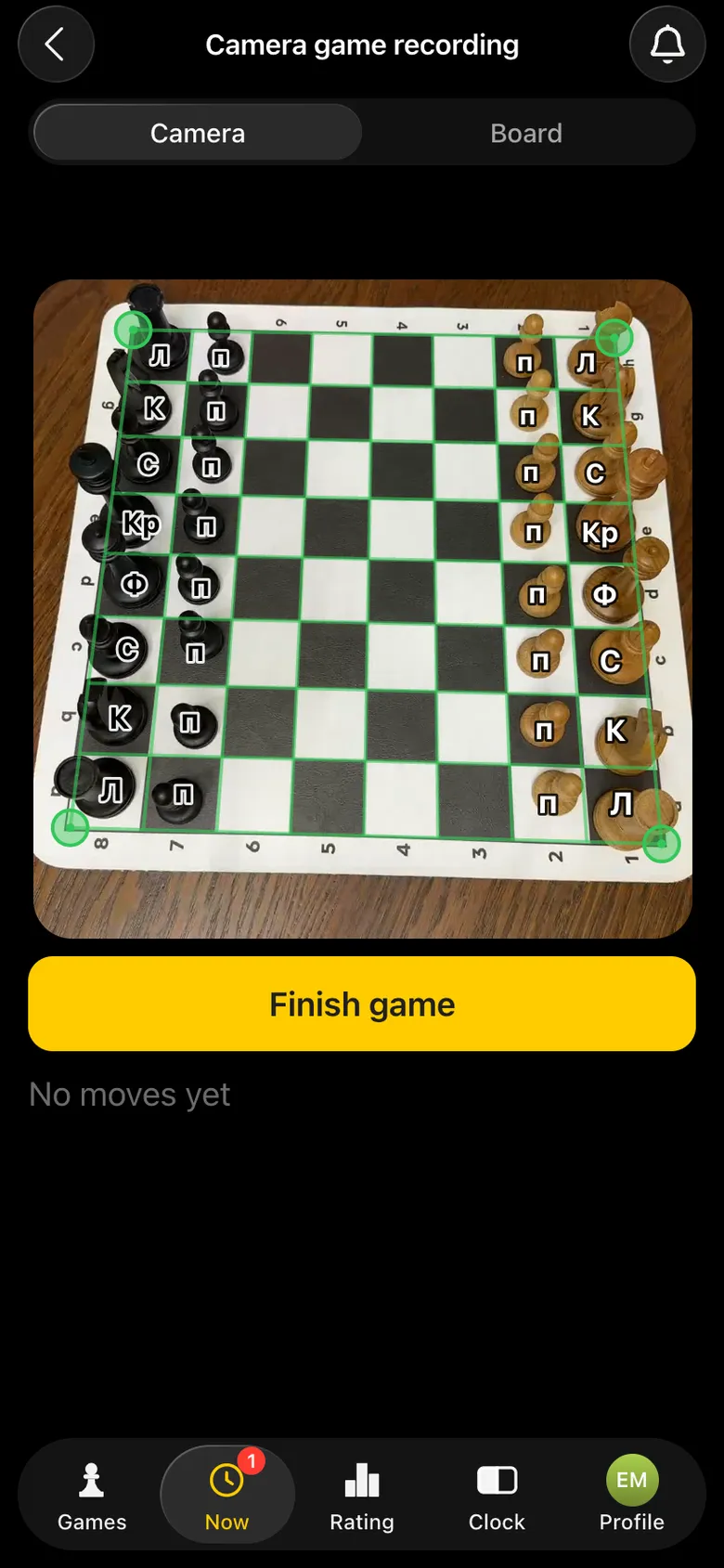
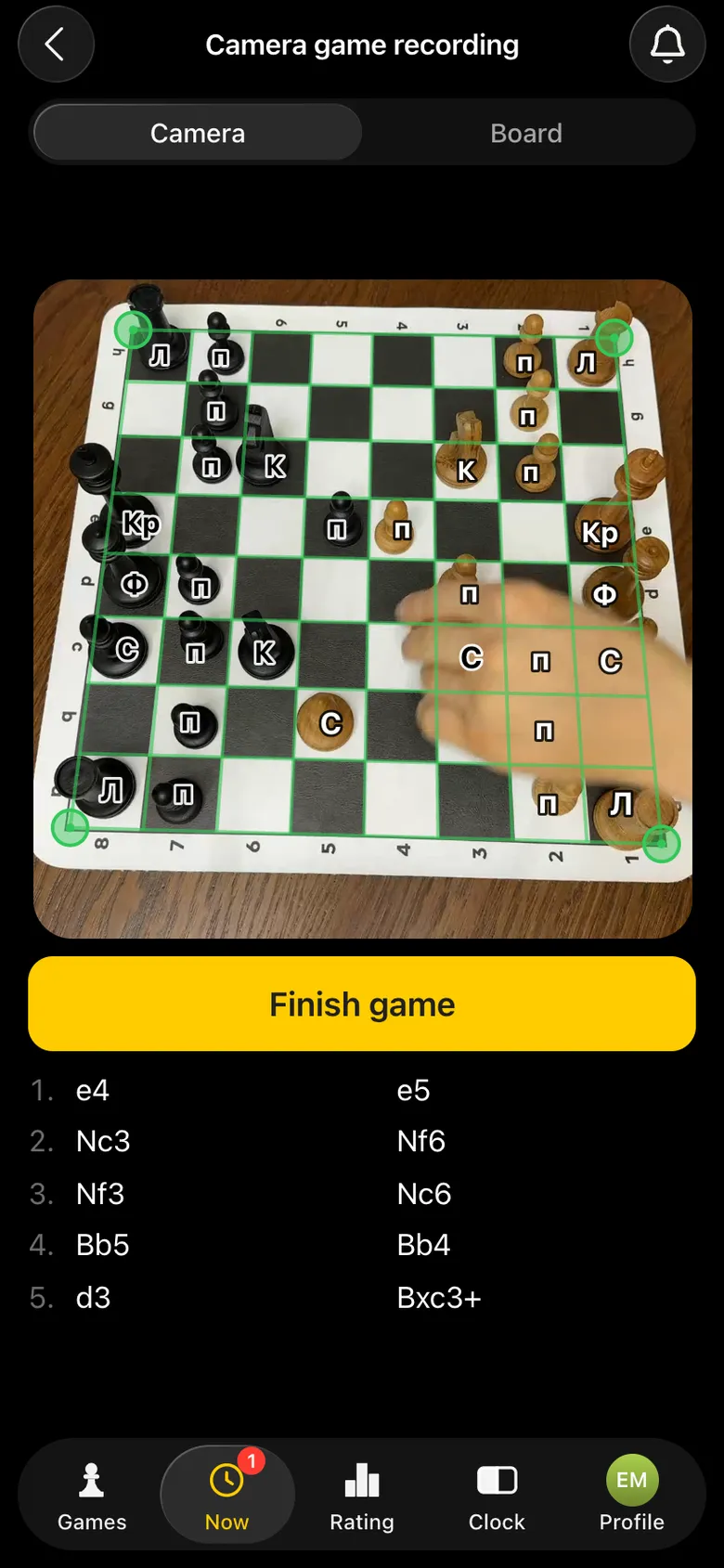
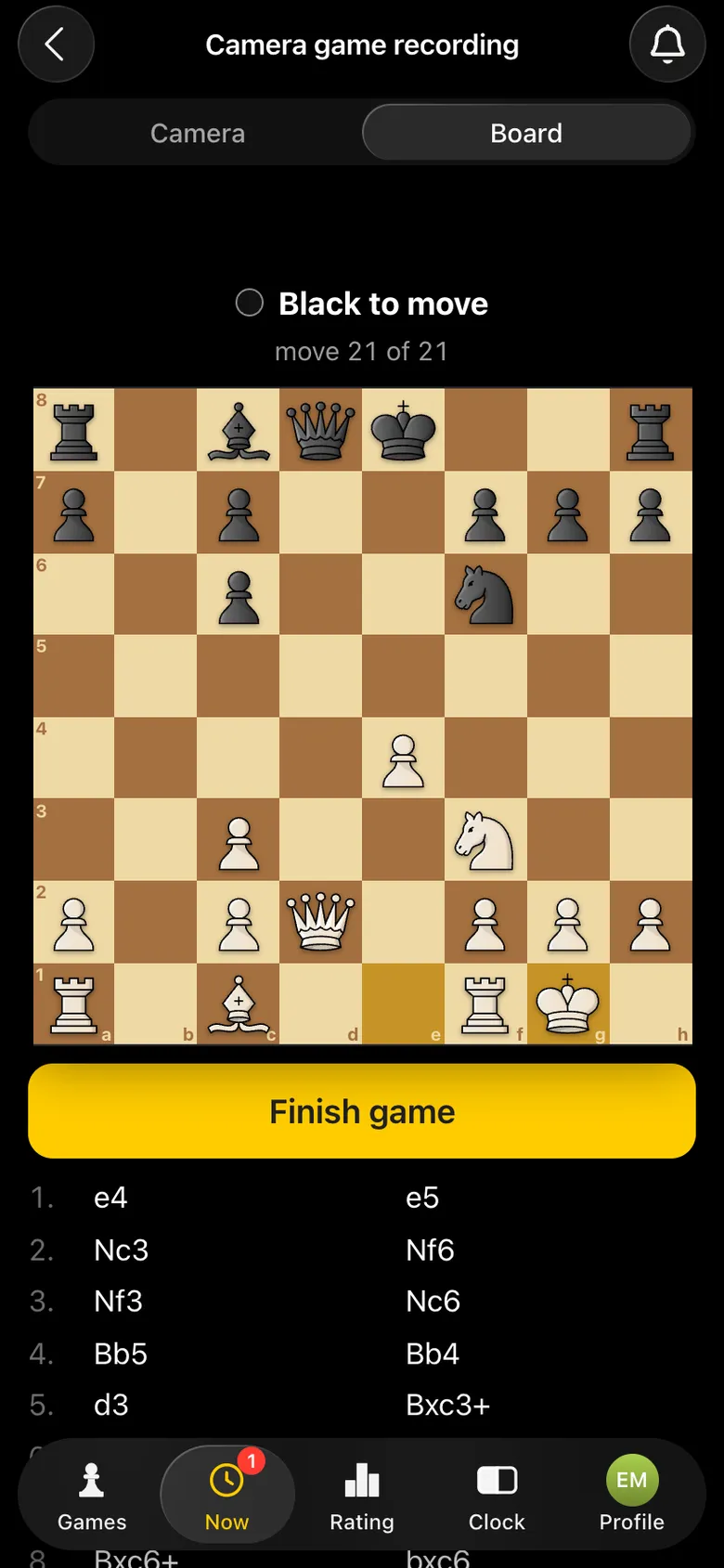
How to set up the phone and start recording - recording a chess game with a phone camera.
A recorded game is saved in the app with all its moves: you can step through it move by move, and the Game analysis button hands the record to an engine. It calculates each player's accuracy and marks moves with the same evaluation symbols as books do - inaccuracies, mistakes and blunders - and shows the best move in each position.
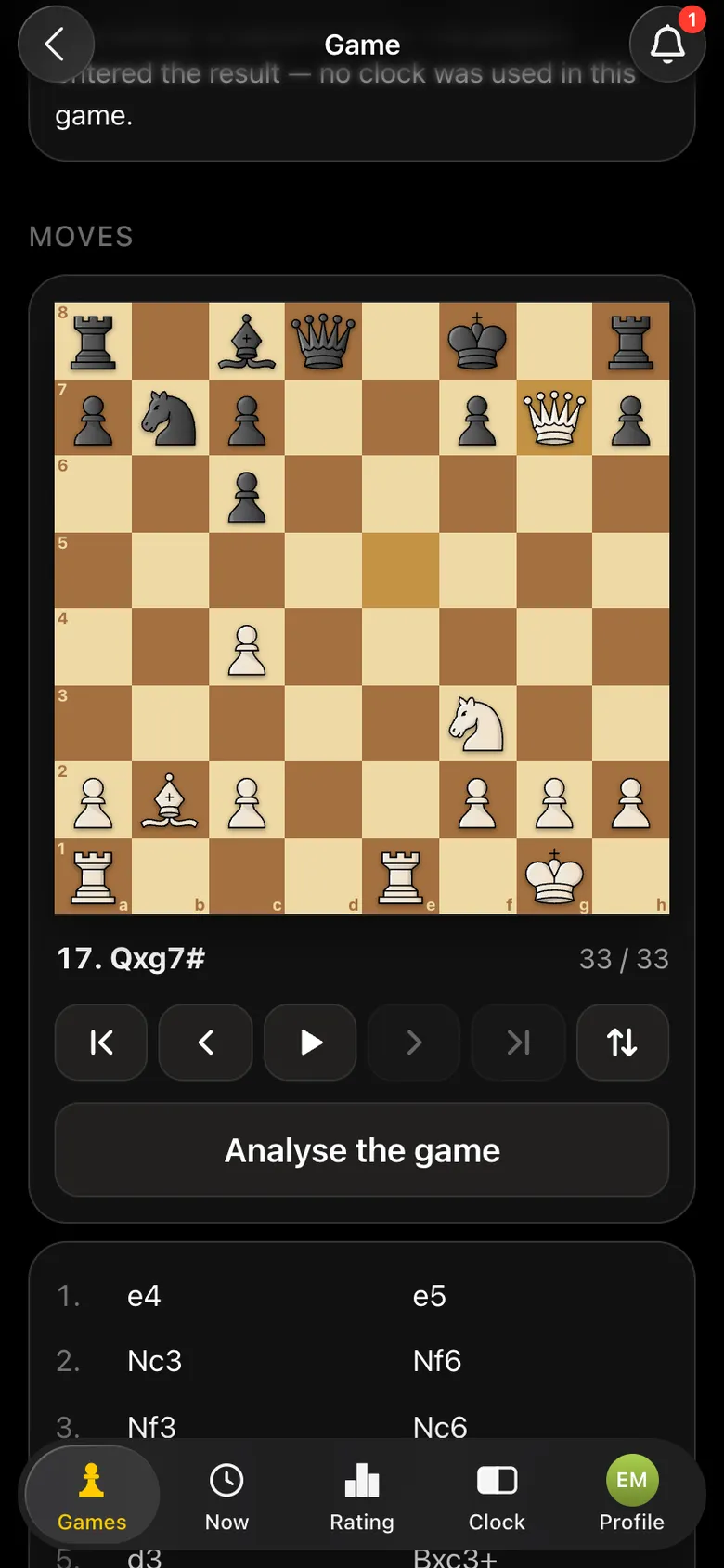
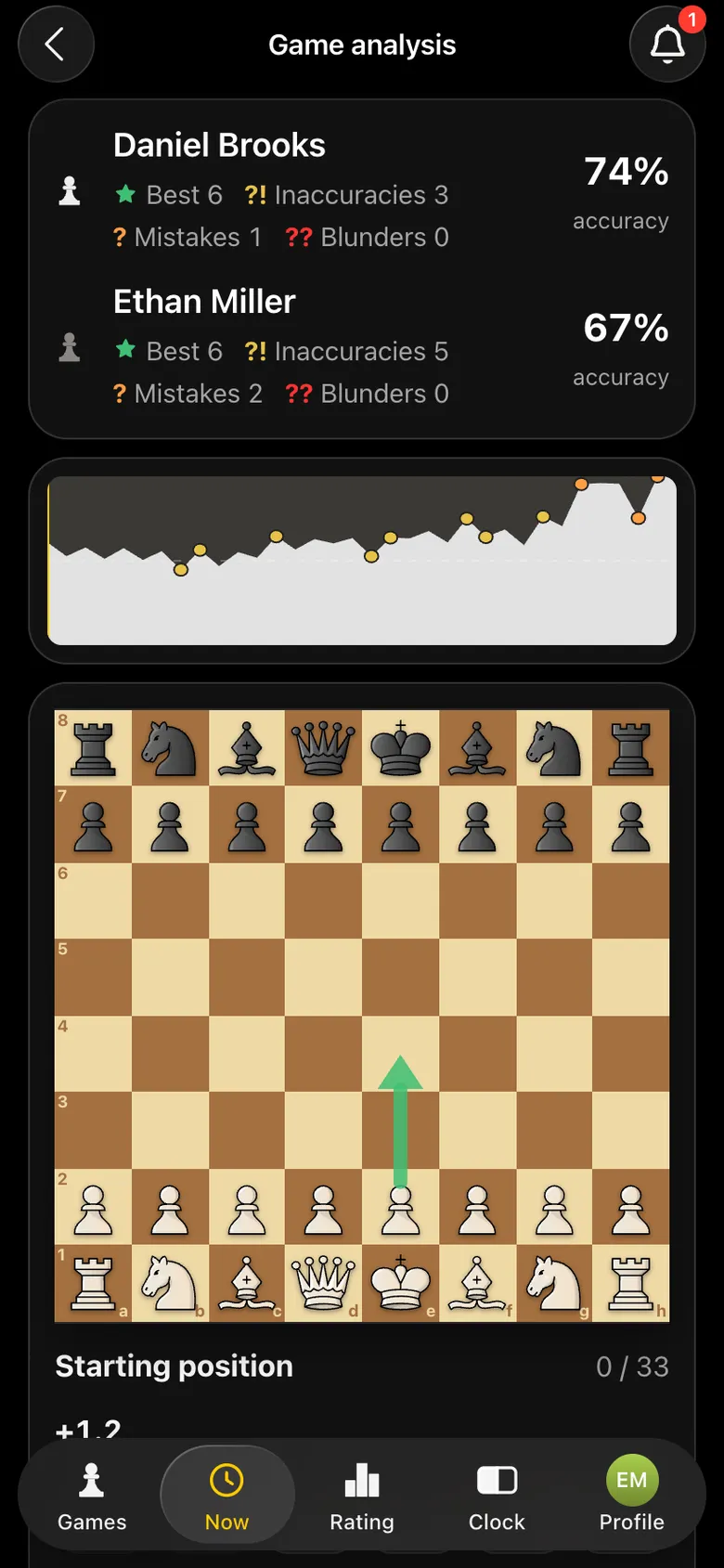
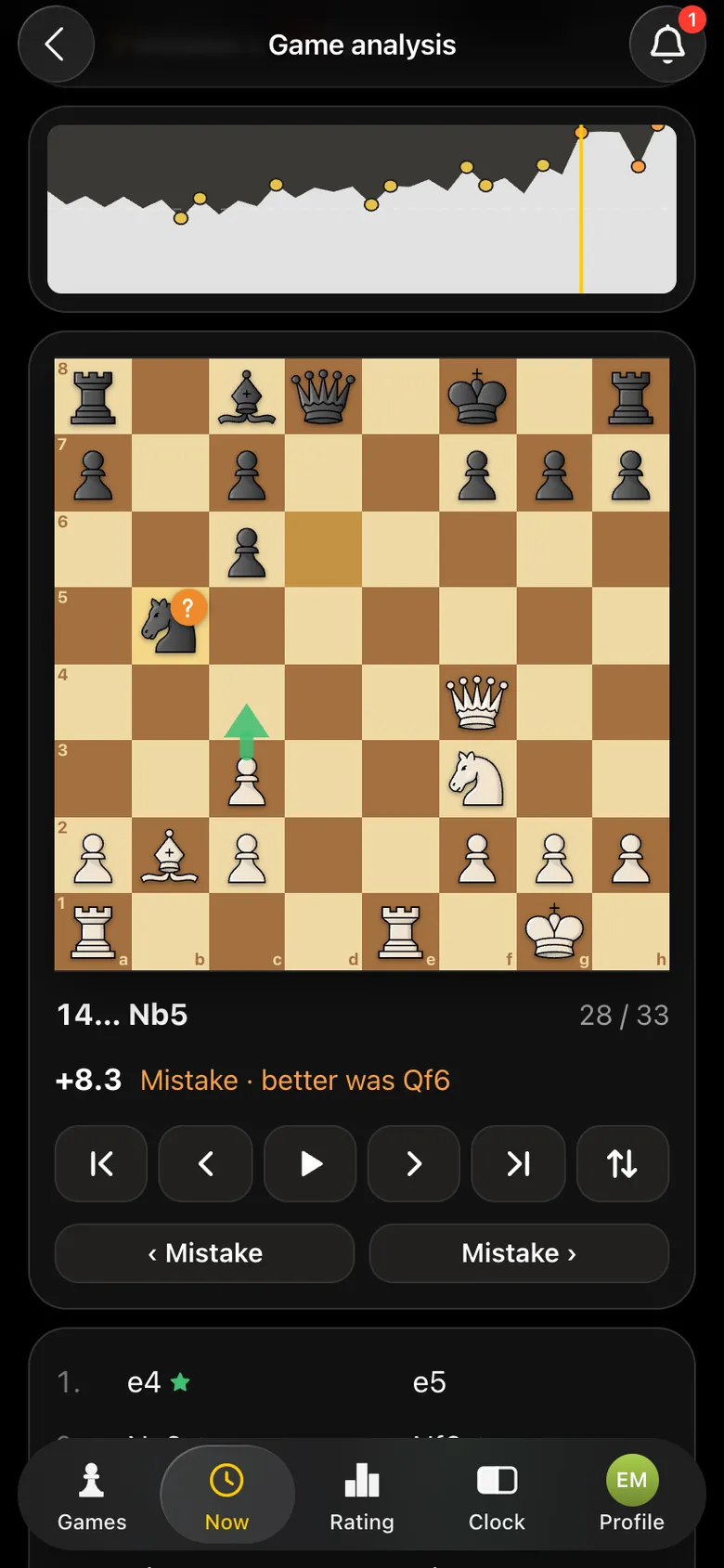
More about analysis - chess game analysis in the app.
Since the moves record themselves, they can be shown to viewers straight away. A game recorded by the camera appears on live.playvibechess.com: the board, the players and the latest moves in notation - the same second they are made at the board. Whole tournaments are broadcast this way, every table at once.
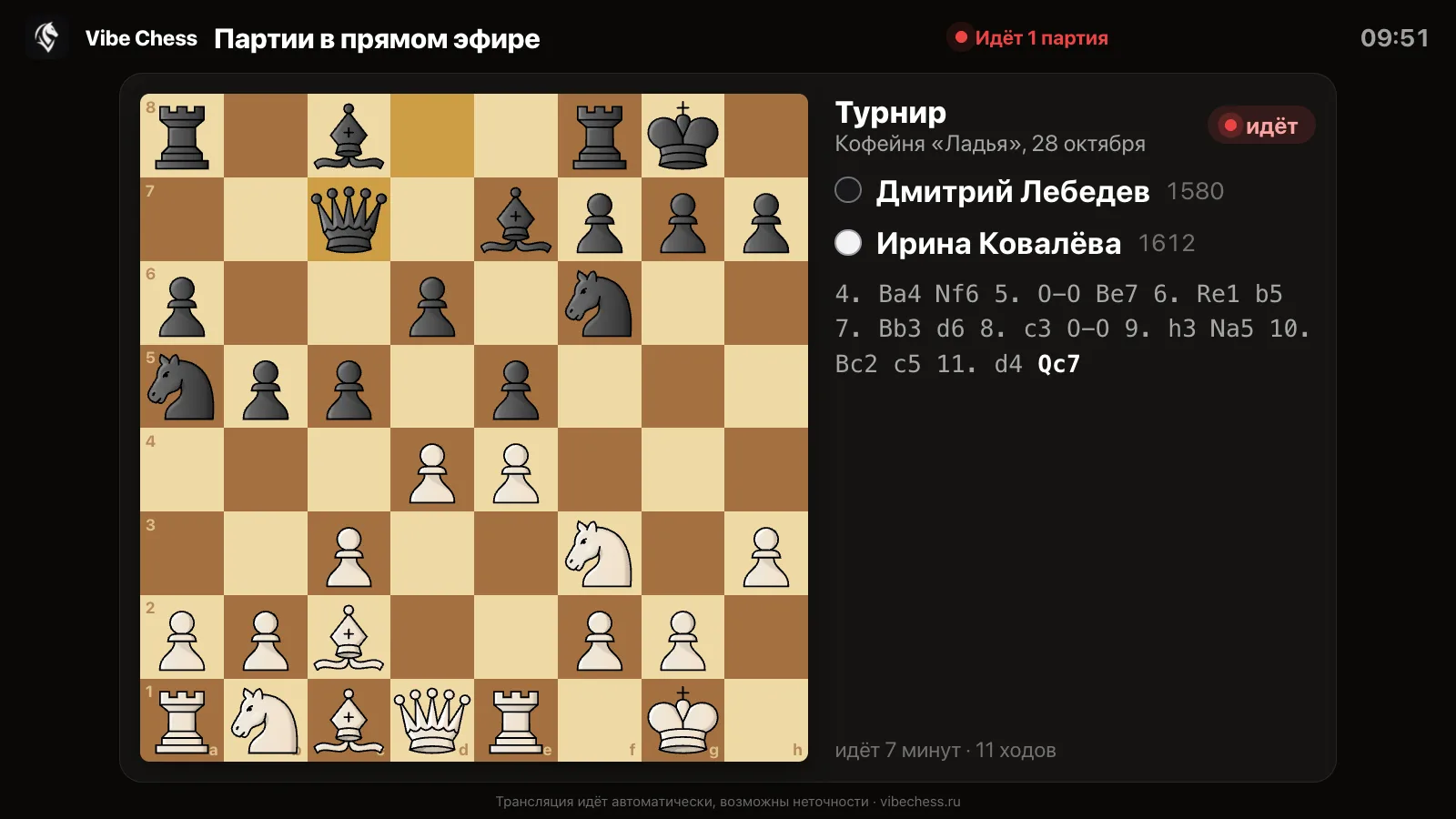
How to set this up at your tournament - a live chess tournament broadcast.
A system for writing down chess moves and positions. The main one is algebraic: a square is named by its file letter and rank number (e4), the piece letter goes before the square (Nf3), and a pawn move has no letter.
In English notation: K - king, Q - queen, R - rook, B - bishop, N - knight, the pawn has no letter. Other languages use their own letters, and figurine notation uses piece symbols.
Kingside - 0-0, queenside - 0-0-0. The FIDE Laws use zeros; O-O and O-O-O with the letter O mean the same.
Check - a "+" after the move, mate - "#". Some books also mark mate with "++".
Long notation gives both squares - from and to (e2-e4, Ng1-f3); short notation gives only the destination (e4, Nf3). Short notation is the standard of modern books and tournaments.
Add the piece's file after its letter (Nbd2), and if they share a file - its rank (R1a3).
In classical games - yes, the FIDE Laws require it; in time trouble with under five minutes and no 30-second increment you may stop. In rapid and blitz moves are not recorded.
PGN is a text format for a whole game: tags with the event and players, then the moves in short notation. FEN is one line with one position: the placement, whose move it is, castling rights, en passant and counters.
Yes. In the Vibe Chess app a phone camera set up by the board records every move in chess notation. The game is saved with all its moves, and you can step through it and analyse it with an engine.
There are no club or arbiter roles in the app: the create button is available to everyone. You can announce a tournament today and run it this weekend.
The bot is constantly improved based on real tournaments. If you need a feature that isn't there yet, message the developers right inside the bot with the /support command. Many features appeared exactly because organizers asked for them, and useful ideas get added quickly.
The scoresheet and recording rules at a tournament - chess notation and scoresheets. Camera recording - recording a chess game with a phone camera. Analysis - chess game analysis. How the pieces move - how chess pieces move. The full rules - chess rules. Broadcasting - a live chess tournament broadcast.

At the board since childhood: hazy about his rating, precise about every rook he has blundered. Counts an evening as a good one if the opponent stayed to talk afterwards instead of rushing off to check with an engine. Message →