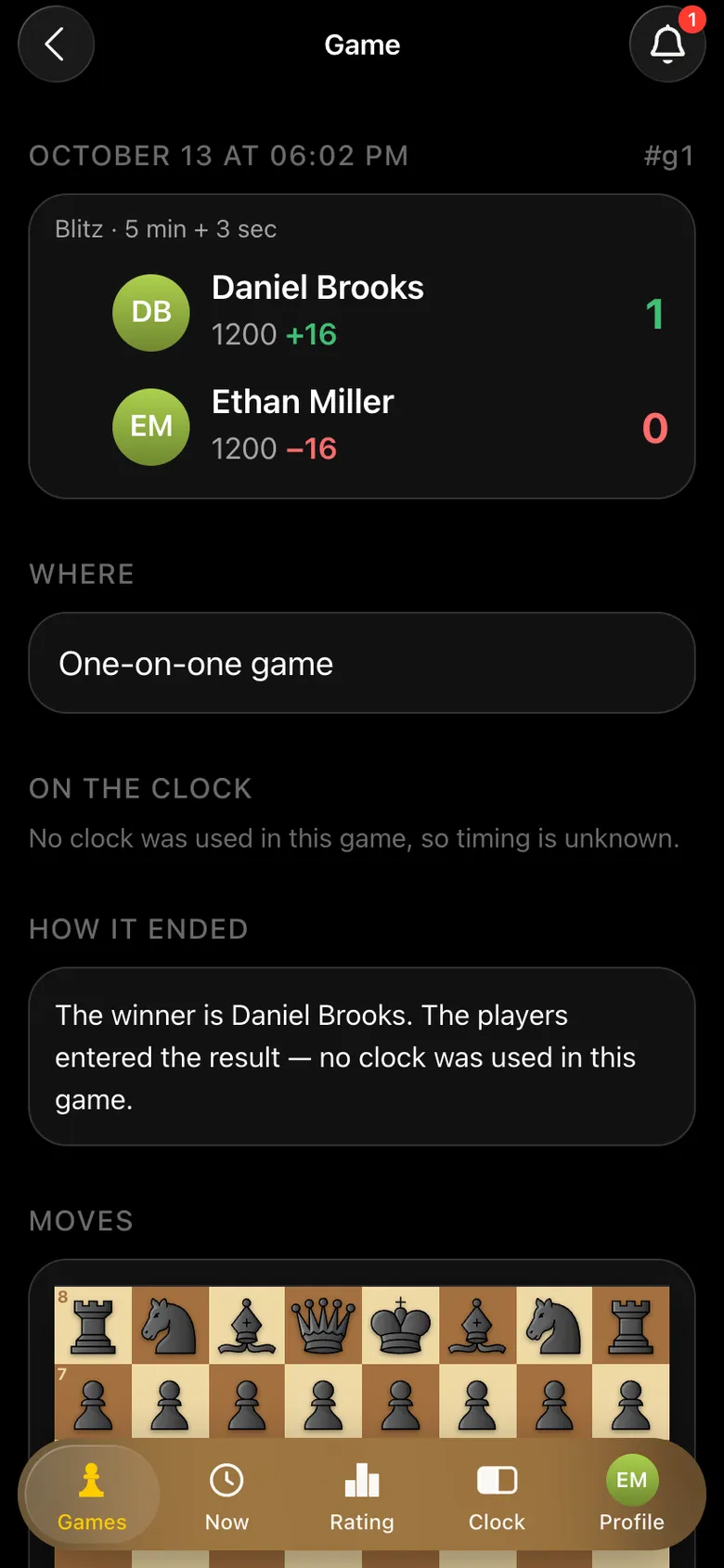
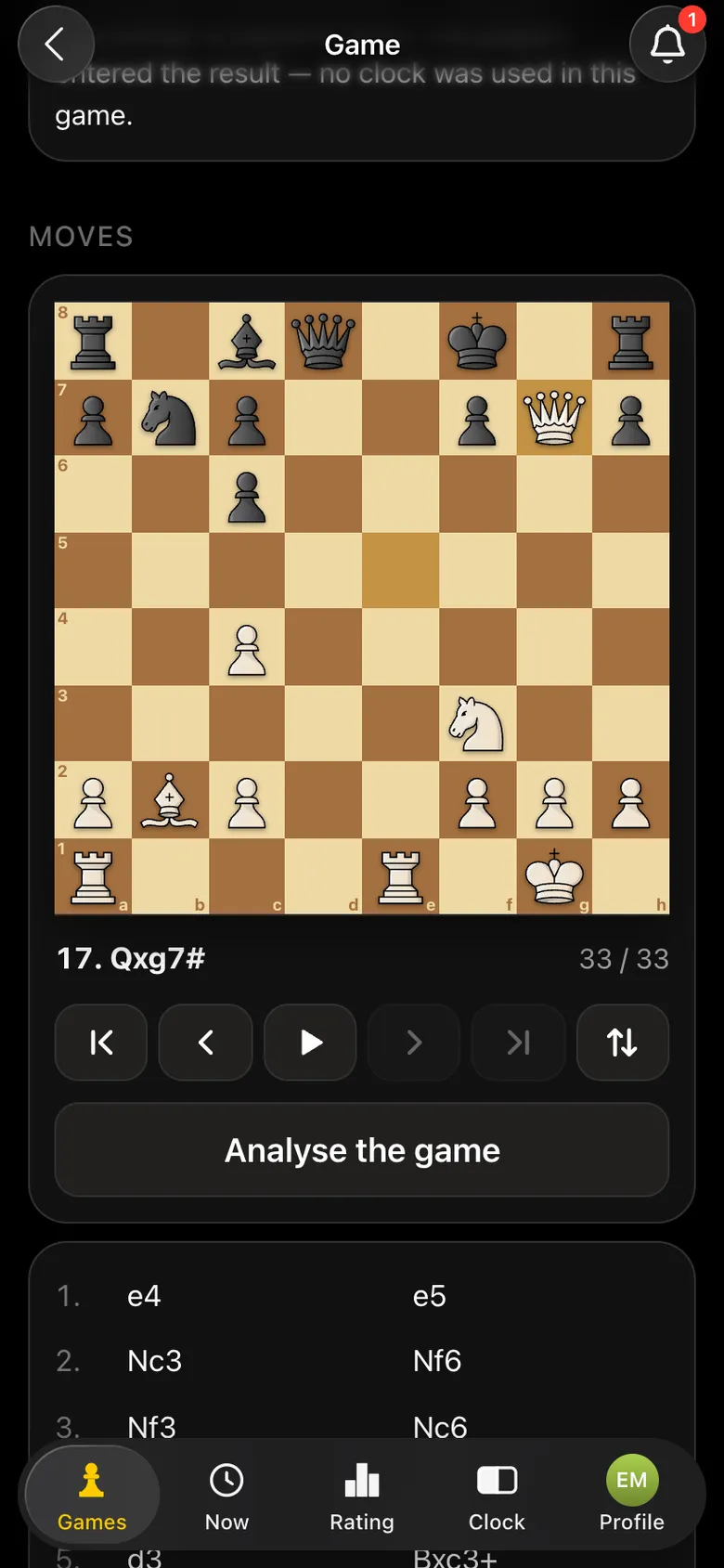
The Stockfish engine does the calculating, right on your phone rather than on a distant server. The finished analysis is saved with the game: the second time it opens instantly, and your opponent doesn't need to recalculate anything.
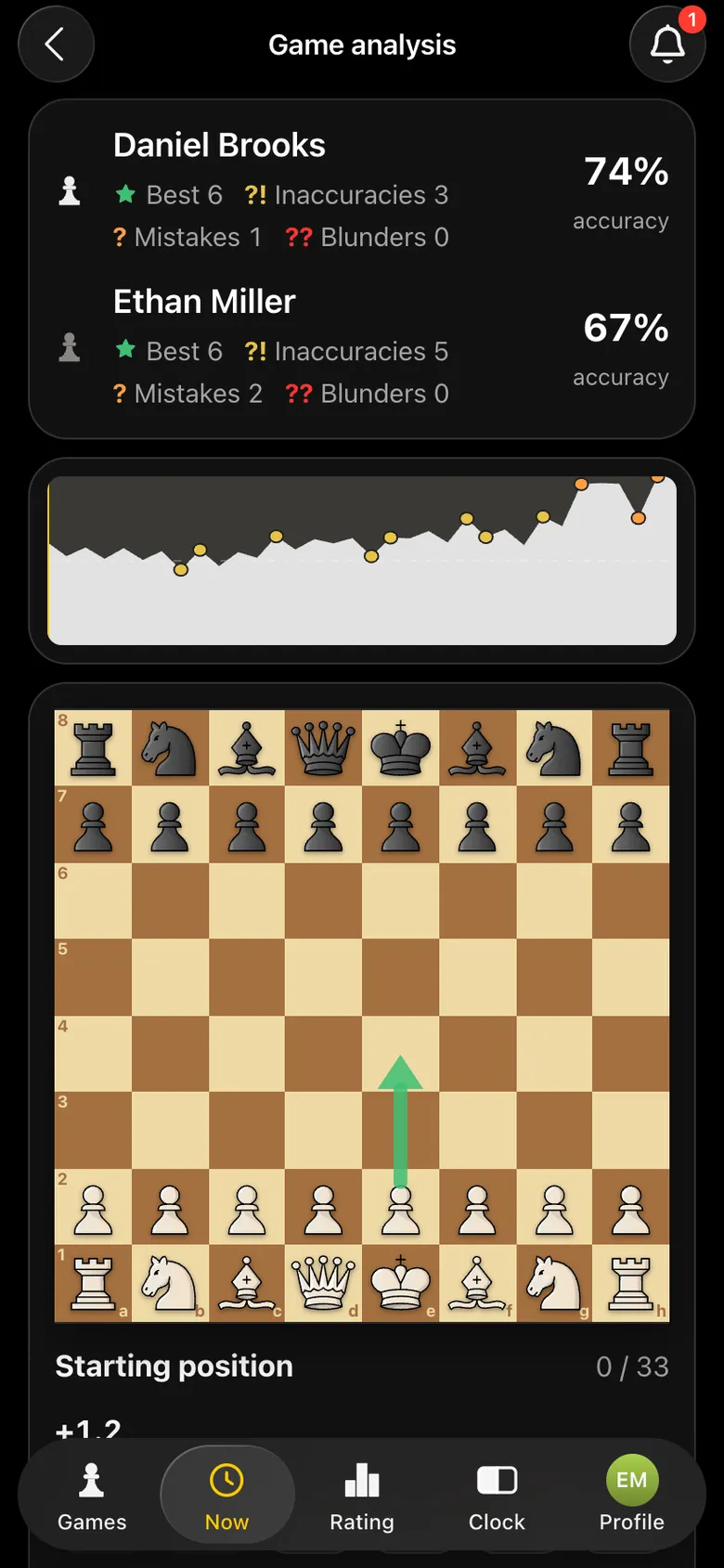
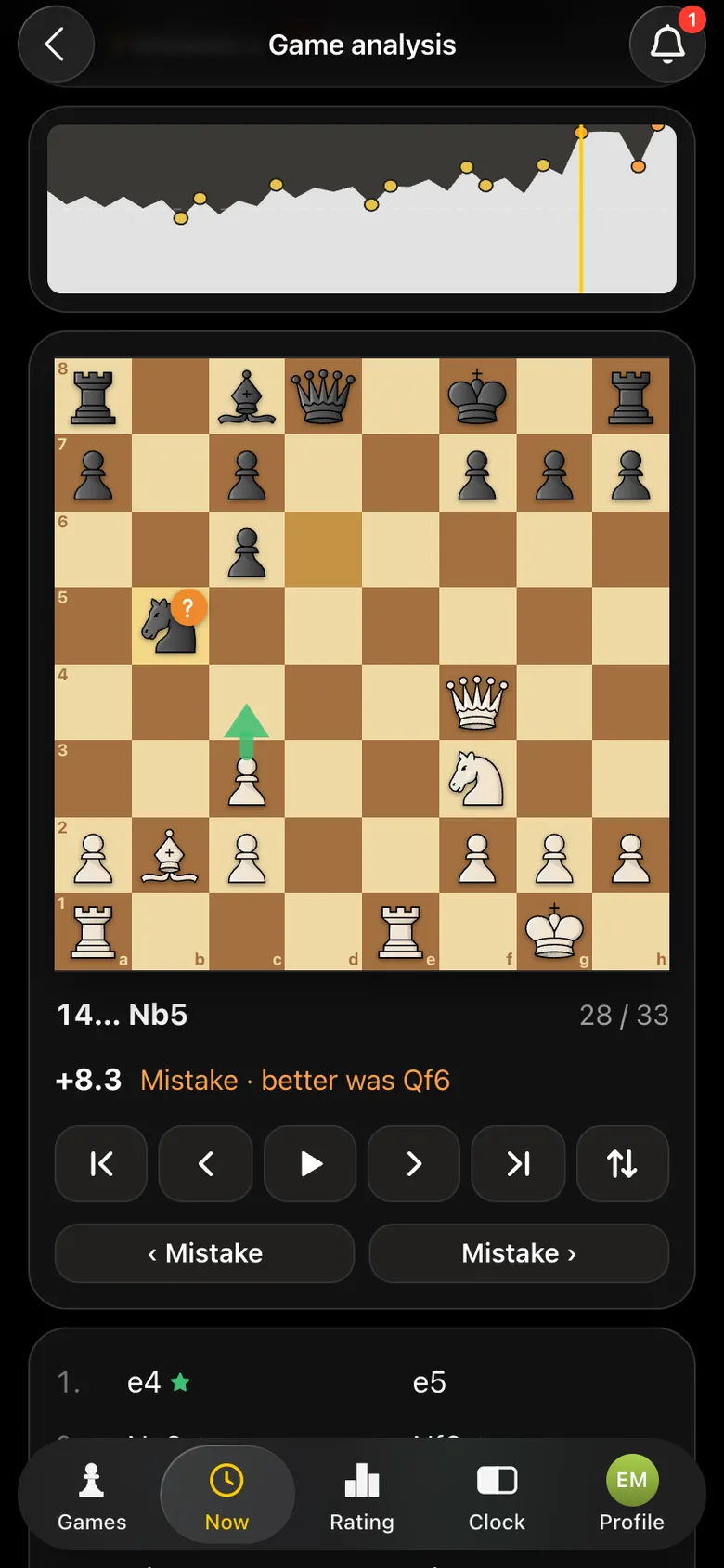
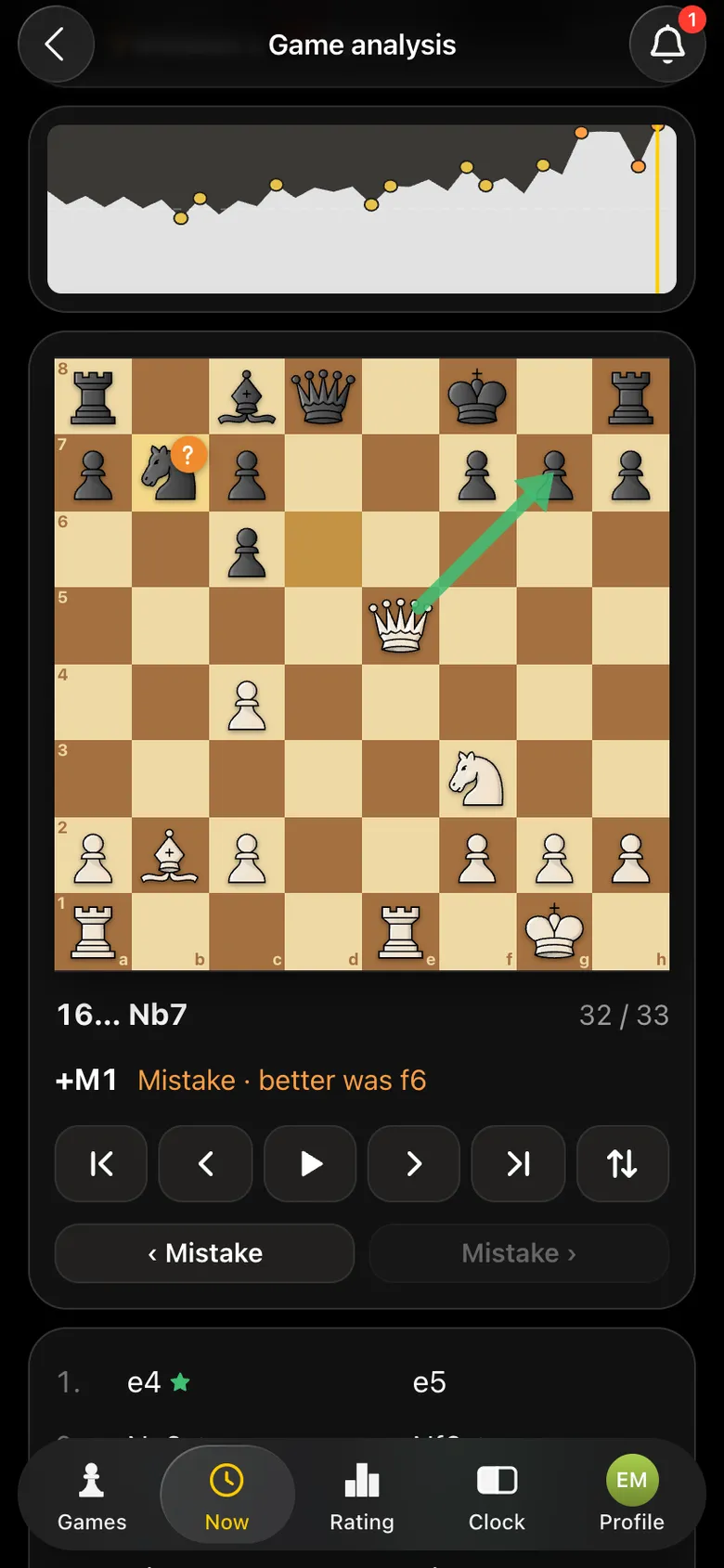
In this game White's accuracy is 74%: six best moves, three inaccuracies and one mistake. Black's is 67%: five inaccuracies and two mistakes, and after the last one White mated in one. The “‹ Mistake” and “Mistake ›” buttons lead straight through these moments.
The marks follow the same rules as Lichess. The evaluation of the position is converted into winning chances, and a move is judged by how much of those chances it gave away:
| Mark | Sign | Winning chances given away |
|---|---|---|
| Inaccuracy | ?! | 10 points or more |
| Mistake | ? | 20 points or more |
| Blunder | ?? | 30 points or more |
Chances rather than pawns, and for a reason. Losing a pawn in an equal position matters; with an extra queen it means almost nothing. Converting to winning chances takes care of that: a move that changes nothing in a won position is not marked, even if the engine found something stronger. A move that matches the best one is never marked.
A move's accuracy shows how much of the winning chances it kept. The best move gives 100%. A move that gave away 10 points (an inaccuracy) is about 64%, 20 points (a mistake) about 40%, 30 points (a blunder) about 25%. A player's accuracy is the average over all their moves in the game. The formula is the same as on Lichess, so the numbers are comparable with what you know from online games.
Because of the averaging, one blunder in a short game drops accuracy more than in a long one. So what matters is not the number itself but how it moves from game to game and in which positions it dips.
Analysis is good when it checks your thinking rather than replacing it. Before you tap the button, recall two or three moments where you hesitated and decide what you would play now. Then open the analysis and compare. More on the method - how to analyse your games with an engine.
It is best done together with your opponent right after the game: you share the same analysis, and the game is still fresh in both your minds.
Record it with the phone camera in the Vibe Chess app, then after the game open the game card and tap “Analyse the game”. The engine calculates the players' accuracy, shows a graph and marks inaccuracies, mistakes and blunders.
No. The Stockfish engine runs right on your phone; you don't pay separately for analysis.
A percentage showing how much of the winning chances a player kept with their moves. The best move gives 100%, a blunder about 25% or less, and the accuracy for the game is the average over all moves. The app uses the same formula as Lichess.
The size of the loss. An inaccuracy gives away 10 points of winning chances or more, a mistake 20 or more, a blunder 30 or more. That is why the same lost pawn can be a blunder in an equal position and not be marked at all with a big advantage.
Yes, the analysis is stored with the game. Whoever opens it first calculates it, and it opens instantly for the other player.
The Vibe Chess app is built for an evening over the board, not for online play: it keeps the sign-up list, the pairings and the table while you deal with people and the venue. All of it free.
The bot is constantly improved based on real tournaments. If you need a feature that isn't there yet, message the developers right inside the bot with the /support command. Many features appeared exactly because organizers asked for them, and useful ideas get added quickly.
How to record a game - recording a game with the phone camera. What recognition can do - board recognition. The method of self-review - analysing games with an engine. Famous games analysed move by move - famous chess games.

At the board since childhood: hazy about his rating, precise about every rook he has blundered. Counts an evening as a good one if the opponent stayed to talk afterwards instead of rushing off to check with an engine. Message →