Vibe ChessVibe ChessApp

A tournament report for a sports authority and a grant maker: figures, photos, reach

Alexey Mudry · updated October 26, 2026
The tournament is over - and whoever gave money or a room for it needs a report. A sports authority - for its own reporting, a grant maker - to check what was promised against what was delivered, a sponsor - to decide whether to take part again. A good report is short and made of figures, photos and links. Below - which metrics to collect, a "planned and actual" table, the report structure and what to do before the tournament so you do not have to reconstruct the figures from memory.

Who needs a report and why

  • • A sports authority or local council - for its own reporting on community events: how many people, what ages, how many children.
  • • A grant maker - checks the metrics in the application against the outcome. A missed metric with no explanation is the main risk for the next application.
  • • A sponsor and the venue - look at people and publications: how many guests came, where their logo was seen. More - chess tournament sponsorship.

Figures: planned and actual

The main part of the report is a table where what was promised stands next to what was achieved. An example for a tournament announced for 40 players:

MetricPlannedActualWhere to get it
Players4046the tournament field
Of whom children under 181519birth years at sign-up
Newcomers - first tournament1014compare with past tournament lists
Women and girls811the tournament field
Games played100115results, pairings of all rounds
Districts or cities of players35a sign-up question
Publications about the tournament57links to posts and articles
If a metric was missed, say why in one line: "the tournament clashed with a school olympiad, 12 children came instead of 15". An explained shortfall reads calmly, an unexplained one reads as a failure.

A two-page report structure

1. In brief

What the tournament was, where, when, for whom. Three or four lines that can go into a council report unedited.

2. Figures: planned and actual

A table of metrics from the application or agreement - what was promised next to what was achieved.

3. How it went

Format, number of rounds, time control, winners, special moments: children's first tournaments, guests, a broadcast.

4. Photos

Five to ten shots: a wide shot of the hall, play at the boards, the prize-giving, partners' logos in frame.

5. Publications

Links to the announcement, results, players' posts, press coverage.

6. Appendices

The regulations, final standings, list of players, feedback, a financial report - if required.

Photos for the report

Photos prove the event happened and show its scale. What a report needs:
  • • a wide shot of the hall that shows the number of players;
  • • play at the boards up close - focused faces, clocks in view;
  • • the prize-giving with the winners;
  • • the sponsor's or venue's logo in frame, if there was one;
  • • children - only with parental consent: parental consent for photos.
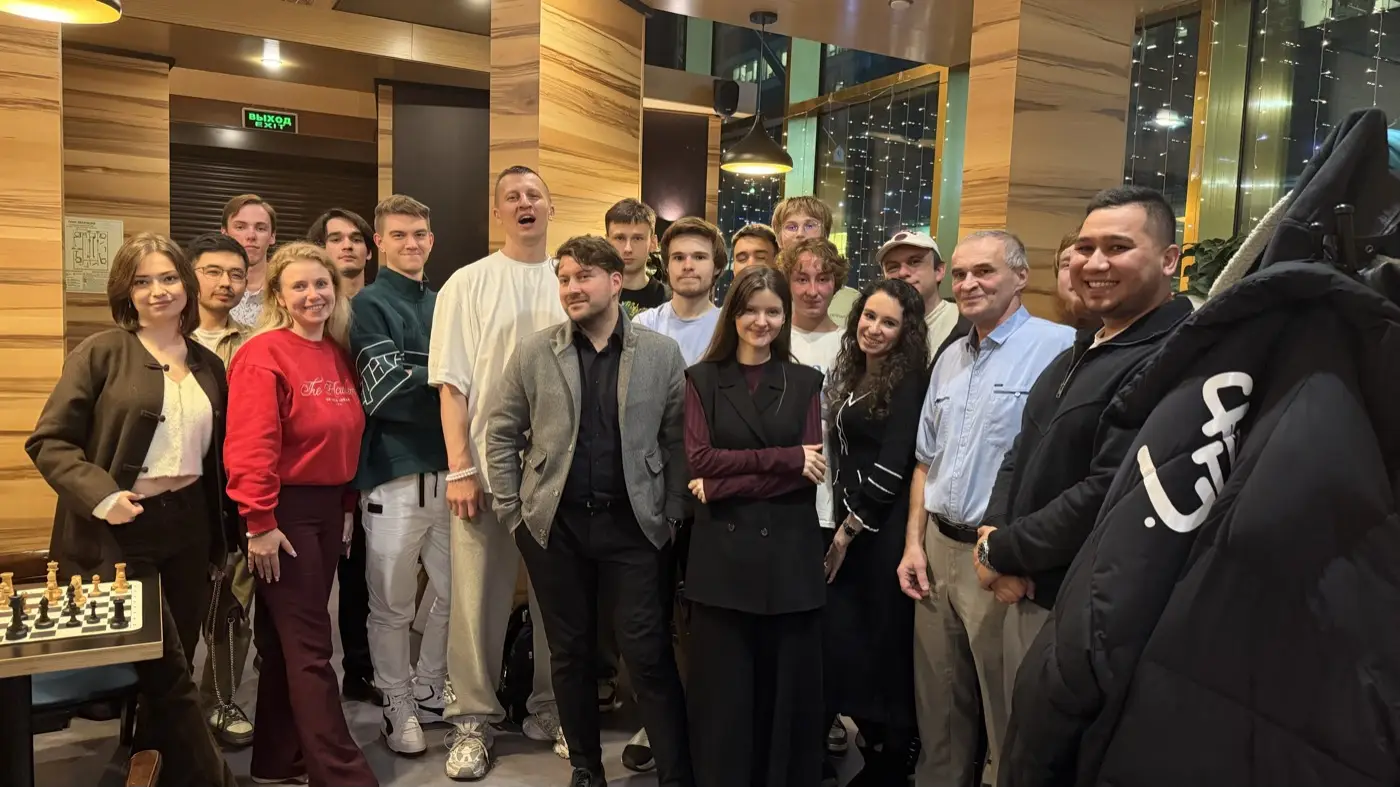
Group photo of the chess tournament players at Coffee Bean, Moscow City
A group photo of the players at a Vibe Chess tournament in Moscow City - a shot that shows the scale at once.

What to shoot and when - chess tournament photography.

What to do before the tournament so the report writes itself

  • • list the metrics from the application or agreement - and decide where you will get each one;
  • • ask for year of birth and district at sign-up - otherwise age and geography cannot be counted;
  • • collect consents to data processing and photos if the report will include lists and pictures;
  • • appoint someone to take photos - and ask for a wide shot of the hall at the start of round one;
  • • save links to all publications straight away rather than hunting for them a month later.

How to write the grant application itself - grants for chess projects.

What the Vibe Chess app gives you for the report

If the tournament ran in the app, the figures and documents for the report are already there:
  • • the field - who signed up and who played; those who did not come are shown as a separate "registered but did not come" block;
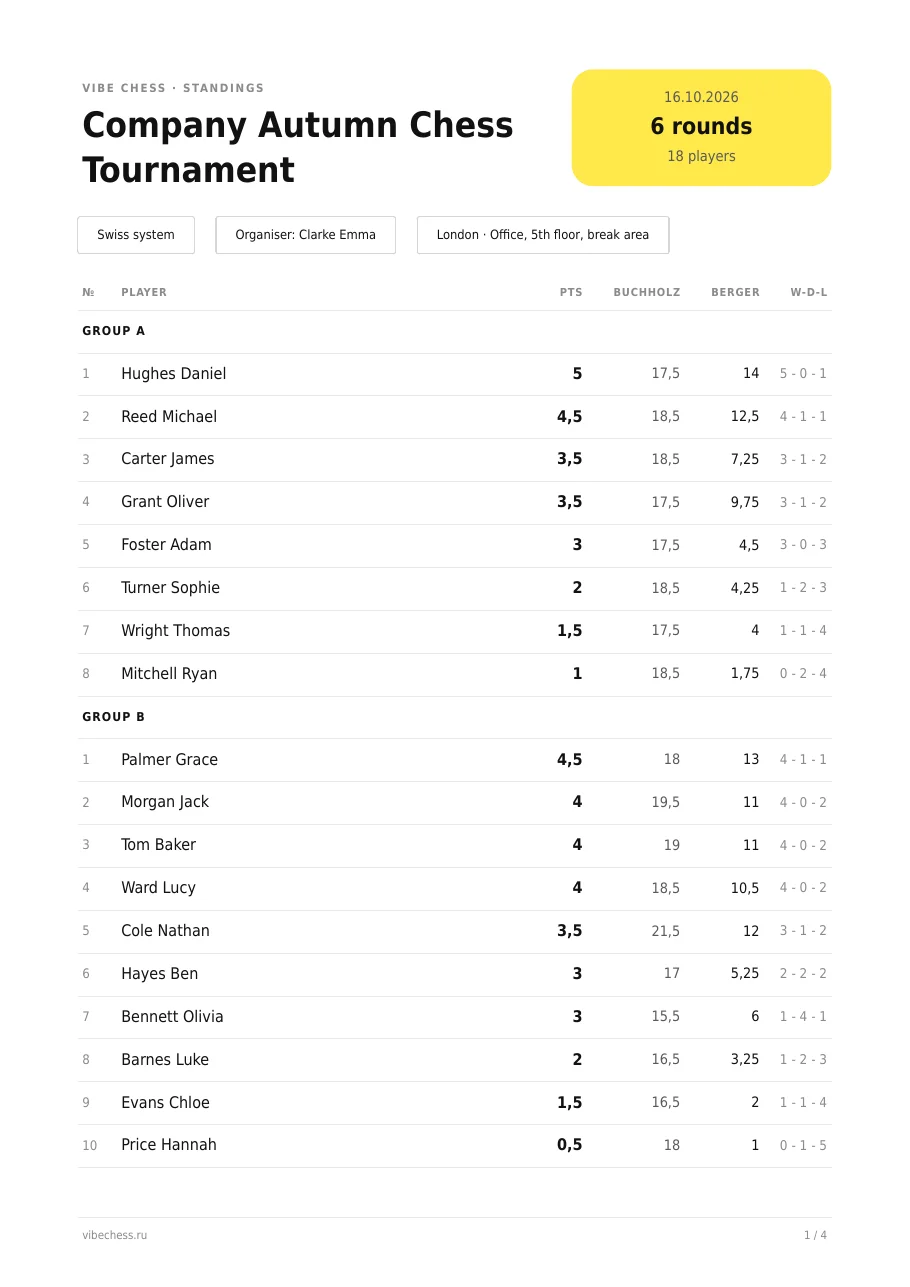
  • • standings as a PDF sheet - places, points, tiebreaks and the pairings of all rounds;
  • • a TRF report - if the tournament is rated;
  • • groups - separate results if the tournament was split by age.
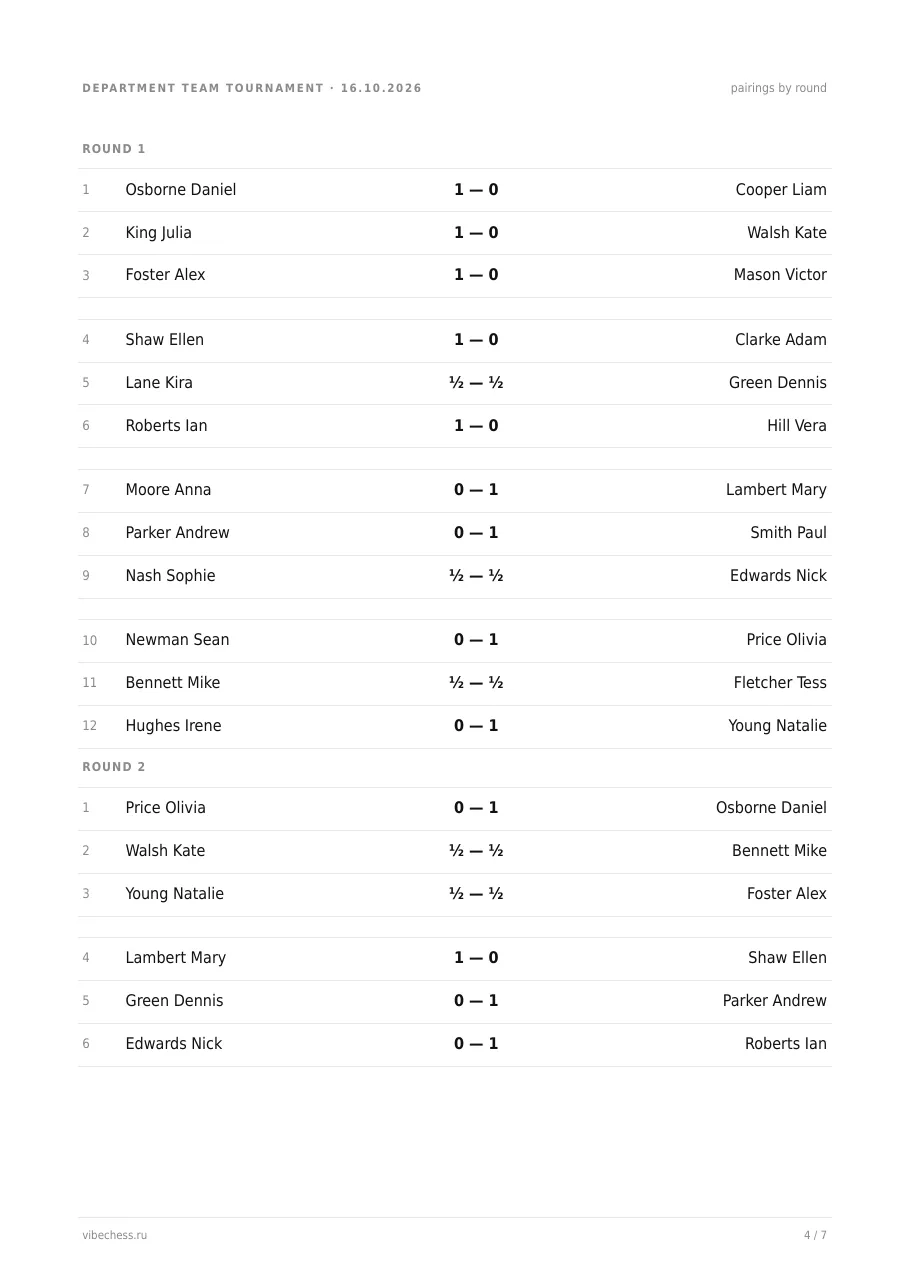
Tournament standings as a PDF sheet: places, points, Buchholz, Sonneborn-Berger, individual results
Standings as a PDF sheet - for the report's appendix.
The second page of the standings sheet: pairings and results by round
Pairings and results of every round.
The app does not count the reach of publications or the number of broadcast viewers - those figures come from social media statistics. Need the tournament's metrics exported in one file for a report - write to the developers, the link is at the bottom of the page.

A report starts with the results

In the Vibe Chess app the field, standings and pairings of all rounds are ready straight after the tournament. Create a tournament for free.

Frequently asked questions about a tournament report

What goes into a chess tournament report?

A short summary of the tournament, a "planned and actual" metrics table, how it went, photos, links to publications and appendices: the regulations, final standings, list of players.

What figures does a grant maker need?

The ones you promised in the application: usually the number of players, children, newcomers, events and publications. Every shortfall against the plan is worth explaining in one line.

How many photos should I attach to the report?

Five to ten: a wide shot of the hall, play at the boards, the prize-giving, partners' logos. Children - only with parental consent.

How do I count newcomers?

Compare the field with past tournament lists, or ask at sign-up whether this is the player's first tournament.

What data for the report does the Vibe Chess app provide?

The field and the no-shows, standings as a PDF sheet with rounds, a TRF report and results by group. Social media reach and broadcast viewers come from social media statistics.

Three event formats in one app

The Vibe Chess app is built for an evening over the board, not for online play: it keeps the sign-up list, the pairings and the table while you deal with people and the venue. All of it free.

Swiss system

score groups, no rematches, no second bye

Round robin

everyone plays everyone, the app works out the number of rounds

Free meetup

who is free and who is already at a board is shown under Now

How the tournament runs
  1. 1Create the event and save the venue for next time
  2. 2Open sign-up, players arrive through the link
  3. 3Start the tournament and the app announces the pairings
  4. 4Keep entering results, then take the final table and the TRF file

More than a bot: the app, FIDE rules and a TRF report

  • The app. Besides the bot there is an app - inside Telegram and simply at playvibechess.com/app: what is on in your city, the player list, a live table, the current round, your profile and game history - everything that is awkward to read as chat messages.
  • Pairings by FIDE rules. Pairings are computed by bbpPairings, an open-source engine implementing the Dutch system: score groups, floats on an odd field, colour alternation, no rematches, and no player gets a bye twice.
  • A TRF report. A finished tournament exports as a single file in the FIDE data exchange format - the one arbiter software and federations accept. Your profile stores the FIDE ID, national federation code, title, sex and date of birth for it.
  • Free. All of the above, with no subscriptions, paid plans or limits on the number of tournaments and players.

Full overview

Missing a feature? Message the developers

The bot is constantly improved based on real tournaments. If you need a feature that isn't there yet, message the developers right inside the bot with the /support command. Many features appeared exactly because organizers asked for them, and useful ideas get added quickly.

Alexey Mudry
Alexey Mudry · hosted 37 events for Vibe Chess · 157 reviews · rating 5.0

At the board since childhood: hazy about his rating, precise about every rook he has blundered. Counts an evening as a good one if the opponent stayed to talk afterwards instead of rushing off to check with an engine. Message →