Vibe ChessVibe ChessApp

Parental consent for photos and data at a junior tournament

Alexey Mudry · updated October 26, 2026
At a junior tournament the organiser handles children's data from the first minute: name and year of birth are needed for the pairings, results with surnames go to the chat and social media, and parents photograph every game. Which of this needs parental consent and which does not? Below - a table of cases, what a consent should contain, two templates you can print, and what to do if parents object to photos.

When parental consent is needed: a table

Decisions about a child's data are made by their legal representative - a parent or guardian. What needs consent depends on what you do. The table follows Russian law, where Vibe Chess started:

What you doWhat it is in lawWhich consent
You take the name, surname and date of birth for sign-up and pairingprocessing of personal dataparental consent to processing
You publish a table with children's surnames on a website, social media or a chatmaking personal data publica separate consent to publication
You pass data to a federation for rating or rankstransfer to a third partystate it in the consent to processing
You publish a wide shot of the hall where the child is one of manyan image at a sports eventunder Russian law no consent is needed, but it is better to warn parents
You publish a portrait or close-up of a childthe image is the main subjectparental consent to the image
You run a video stream showing children's facespublication of an imageparental consent to the image
This is not legal advice. The table and templates below are a starting point for an amateur tournament organiser. Data protection rules differ by country - in the EU and the UK, for example, the GDPR applies. If the tournament is run by a school or sports organisation, or you collect a lot of data, check your documents with a lawyer and the current law of your country.

Why there are two consents

  • • Consent to processing (in Russia - Article 9 of the federal law on personal data, 152-FZ) - to sign the child up, make the pairings and table, pass results to the federation.
  • • Consent to publication (Article 10.1 of the same law) - to make data public: a table with surnames, photos, video. Since 2021 it has been drawn up separately from other consents, and the parent may specify what may and may not be published.

Images are also covered by Article 152.1 of the Russian Civil Code: a person's photo may be published with their consent, and for a child the parent consents. Without consent - if the photo was taken at a public event, including a sports competition, and the person is not its main subject. A wide shot of the hall - allowed, a portrait of a child - only with consent. Many other countries draw the line in a similar place, but check your own.

Template 1: consent to the processing of personal data

For sign-up, pairings, results and passing data to the federation:

CONSENT TO THE PROCESSING OF A MINOR'S PERSONAL DATA I, ______________________ (full name of the parent or legal guardian), ID document ____ No. ______, issued by ____________________, acting on behalf of the minor ______________________ (full name), date of birth __.__.____, give my consent to ______________________ (organiser: name, registration number, address) to process the child's personal data: surname, first name, date of birth, city, sports rank and rating, game results - for the purposes of: taking part in the chess tournament "__________" on __.__.____, making the pairings and standings, recording the results, passing the results to the chess federation for rating. Actions: collection, recording, storage, correction, use, transfer to the chess federation, deletion. Valid until: __.__.____. This consent may be withdrawn by a written notice to the organiser. "__" ________ 20__ __________ (signature) __________ (name)

Template 2: consent to publishing data and photos

A separate sheet. The parent ticks what they allow and can write restrictions - for example, "first name only, no surname":

CONSENT TO THE PUBLICATION OF A MINOR'S PERSONAL DATA AND IMAGE I, ______________________ (full name of the parent or legal guardian), phone or e-mail: ______________________, acting on behalf of the minor ______________________ (full name), give my consent to ______________________ (organiser: name, registration number, address) to publish the following data of the child: [ ] surname and first name [ ] first name only [ ] year of birth [ ] results and place in the tournament [ ] photo and video images from the tournament Where it is published: ______________________ (website, social media groups, tournament chat). Purpose: publishing the tournament results and telling people about it. Conditions and restrictions: ______________________ (for example: no surname; no close-ups; not to be passed to third parties). Valid until: __.__.____. This consent may be withdrawn by a written notice to the organiser; after withdrawal the data and photos are removed from the organiser's publications. "__" ________ 20__ __________ (signature) __________ (name)

If the child is 14-17, it is better to have their signature next to the parent's: a teenager decides a lot about their own photos, and their consent heads off disputes.

If parents object to photos

  • • mark the child on the list and tell the photographer their name and table;
  • • agree on a marker - for example, a sticker on the badge: such a child is not photographed in close-up;
  • • check wide shots before publishing and drop any frame where the child is in the centre;
  • • in the results publish only the first name or initials, if that was requested;
  • • ask parents in the hall not to post photos of other people's children.

What to photograph at a tournament and how - in chess tournament photography.

Children's data in the Vibe Chess app

The app is designed so that as little children's data as possible is needed:
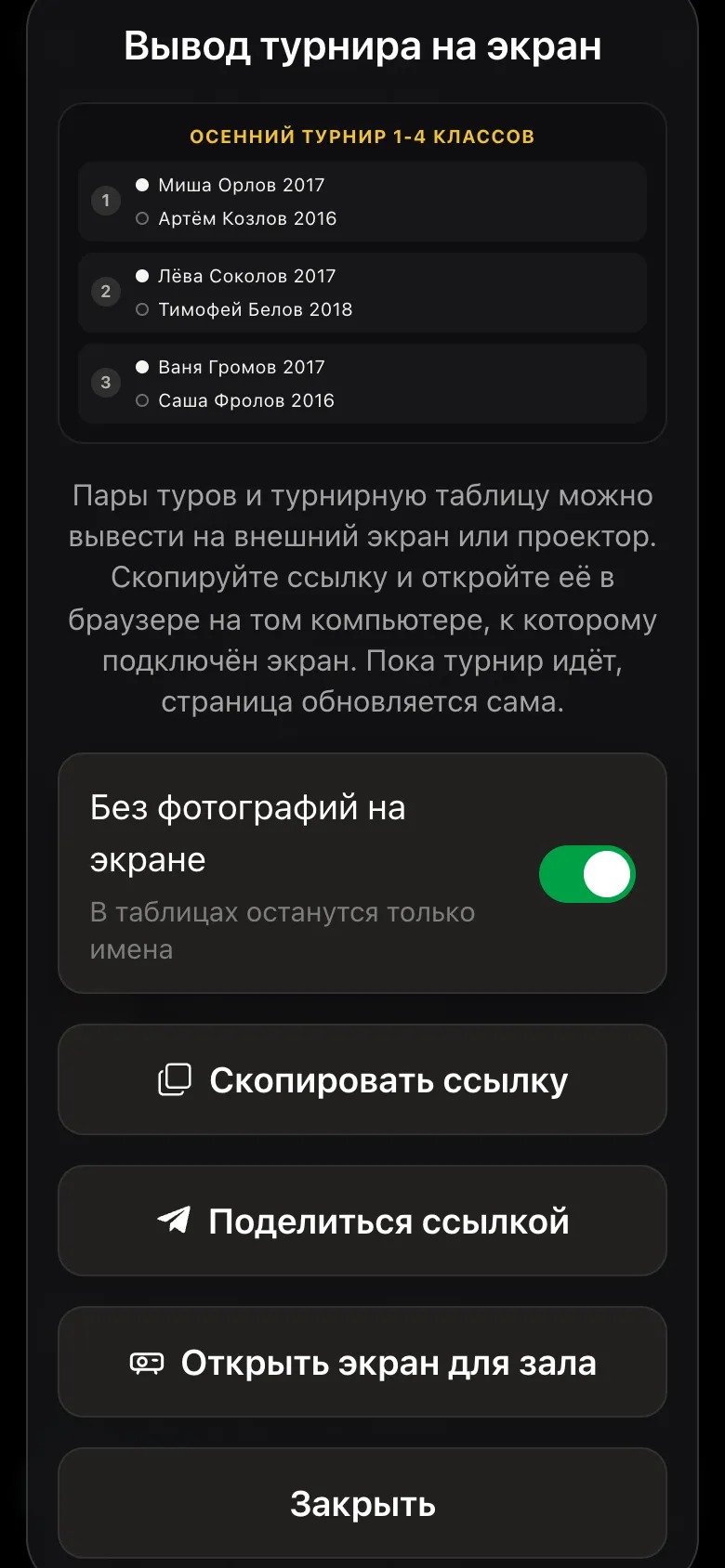
  • • a child is added as a guest - by name, without a phone or an account; a first name alone is enough;
  • • a hall screen without photos - the "No photos on the screen" toggle removes faces, names stay;
  • • the broadcast is moves, not video: viewers see the board with the game, not an image of the children at the table.
The Show the tournament on a screen window: the No photos on the screen toggle is on, buttons Copy link and Open the hall screen
The No photos on the screen toggle.
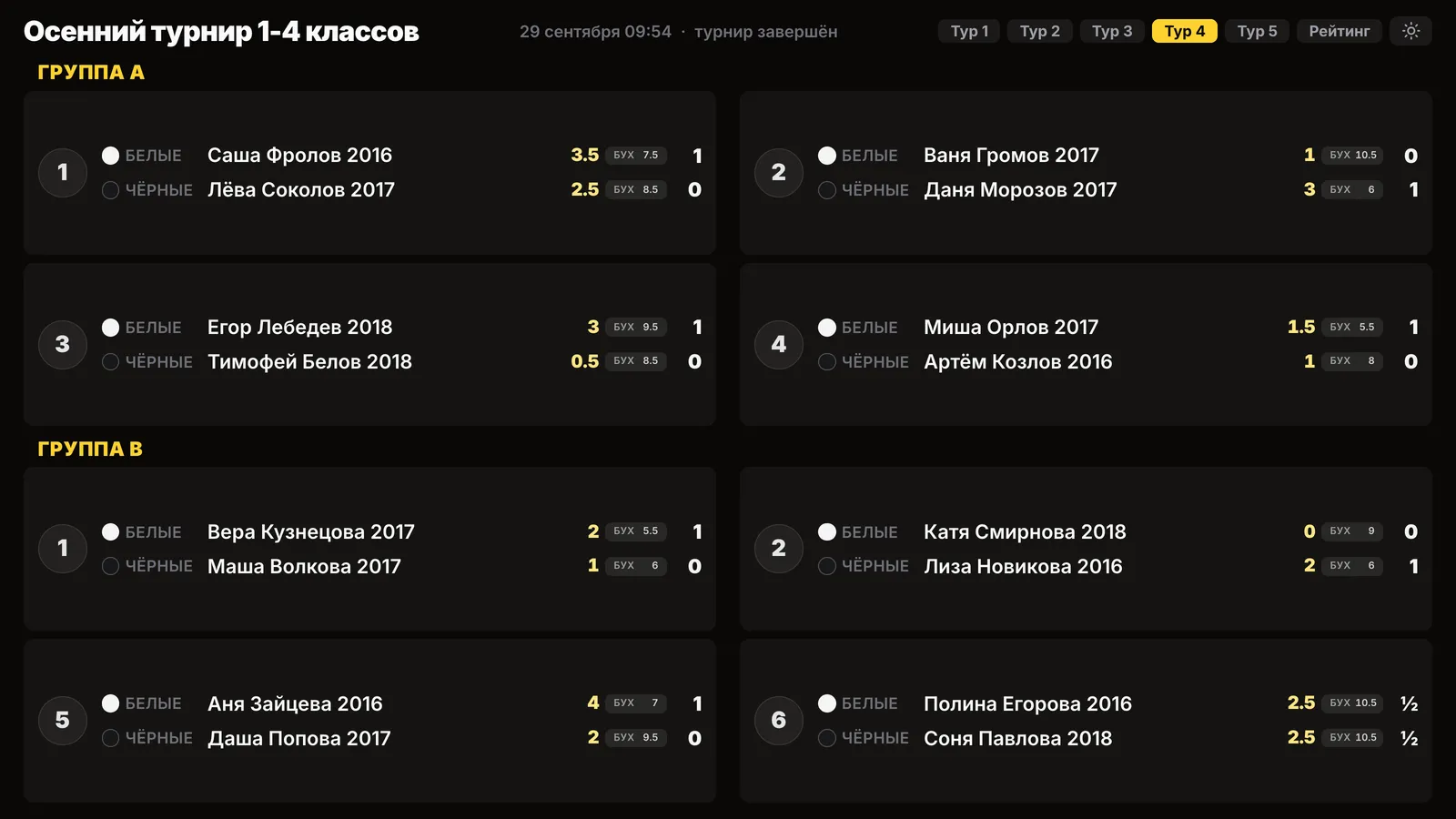
The hall screen on a projector: round four pairings, group A and group B separately, names only, no photos
The hall sees the round's pairings - without faces.

How to run a junior tournament - a children's chess tournament, a guide for parents - parents at a junior chess tournament.

A junior tournament without extra data

In the Vibe Chess app children are added as guests by first name, the hall screen shows pairings without faces, and broadcast viewers see the board, not video. Create a tournament for free.

Frequently asked questions about parental consent

Is parental consent needed to photograph a child at a tournament?

To publish a portrait or close-up - yes. Under Russian law a wide shot of the hall at a sports competition, where the child is one of many, may be published without consent; other countries have their own rules. In practice it is better to get consent in advance.

Can I publish a table with children's surnames?

That is making personal data public, and it needs a separate parental consent. Without consent - publish only first names or initials.

Why two consents rather than one?

Under Russian law, consent to publish data is drawn up separately from consent to process it. In it the parent states what may and may not be published.

Who signs the consent for a child?

The legal representative - a parent or guardian. If the child is 14-17, it is better for them to sign too.

What if a parent withdraws consent?

Remove the child's photos and surname from the organiser's publications and stop using their data, except where the law allows it without consent.

Is consent needed if a child is added to the Vibe Chess app?

Yes, if you enter a surname and publish the results. A child can be added by first name only - then there is less data. In the broadcast viewers see the board with the moves, not video.

Anyone can be the organizer

There are no club or arbiter roles in the app: the create button is available to everyone. You can announce a tournament today and run it this weekend.

Swiss

when there are more than ten players and nobody should be knocked out

Round robin

when the field is small and fairness matters most

Free meetup

when you simply want to get together and play

How the tournament runs
  1. 1Create the event, open sign-up, share the link
  2. 2Start the tournament - the app announces the pairing
  3. 3Record results as the evening goes
  4. 4Show the final standings and export the TRF report

More than a bot: the app, FIDE rules and a TRF report

  • The app. Besides the bot there is an app - inside Telegram and simply at playvibechess.com/app: what is on in your city, the player list, a live table, the current round, your profile and game history - everything that is awkward to read as chat messages.
  • Pairings by FIDE rules. Pairings are computed by bbpPairings, an open-source engine implementing the Dutch system: score groups, floats on an odd field, colour alternation, no rematches, and no player gets a bye twice.
  • A TRF report. A finished tournament exports as a single file in the FIDE data exchange format - the one arbiter software and federations accept. Your profile stores the FIDE ID, national federation code, title, sex and date of birth for it.
  • Free. All of the above, with no subscriptions, paid plans or limits on the number of tournaments and players.

Full overview

Missing a feature? Message the developers

The bot is constantly improved based on real tournaments. If you need a feature that isn't there yet, message the developers right inside the bot with the /support command. Many features appeared exactly because organizers asked for them, and useful ideas get added quickly.

Alexey Mudry
Alexey Mudry · hosted 37 events for Vibe Chess · 157 reviews · rating 5.0

At the board since childhood: hazy about his rating, precise about every rook he has blundered. Counts an evening as a good one if the opponent stayed to talk afterwards instead of rushing off to check with an engine. Message →