Eight rows of eight cells - 64 squares. Light and dark are equal in number: 32 of each. The colours alternate along every row and every column, so two squares of the same colour never share a side - only a corner.
"Light" and "dark" are about meaning rather than paint. They are called white and black squares even though wooden boards use cream and brown and tournament vinyl uses buff and green. All that matters is that there are two colours and they alternate.
The words "square" and "cell" mean the same thing here. Books and notation prefer "square": the e4 square, the promotion square, an attacked square.
Every square has a name made of a letter and a number. The letter is the file from a to h, counted left to right from White's side. The number is the rank from 1 to 8, counted upwards, again from White's side.
So e4 is where the e file crosses the fourth rank. The order never changes: letter first, number second. There is no such thing as "4e" in chess.
Coordinates are not decoration: notation, the whole of chess literature and every post-mortem rest on them. How to write moves down - chess notation.
Below is a board with every one of the 64 squares labelled. Keep it in view until the coordinates stick: when a game commentary names a square, find it here first.
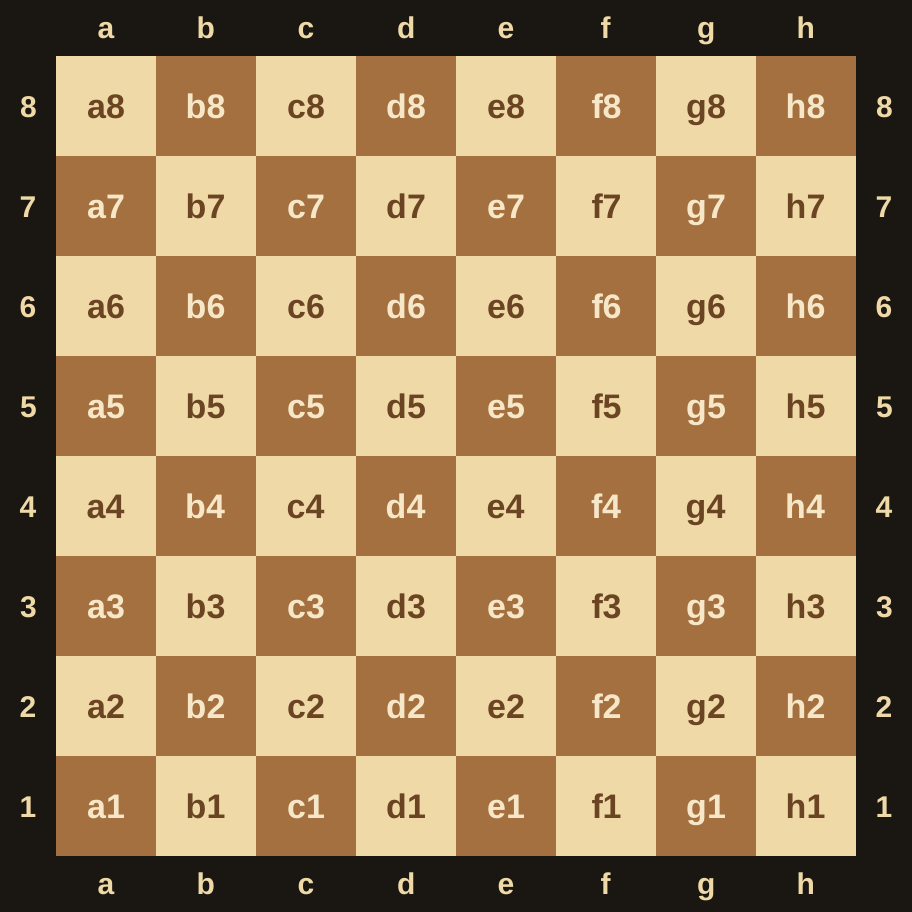
There is also a sheet to print on A4. Page one labels every square; page two shows only the letters and numbers on the edges, for practice - name squares aloud or write them in with a pen. The sheet is grey so the labels survive a black-and-white printer.
Coordinates stick fastest in play: in the board editor place a piece, name its square, then check against the labels on the edge.
a1 is dark, h1 is light. So a8 is light and h8 is dark: corners on the same diagonal share a colour.
Hence the rule for turning the board: the corner square on each player's right must be light - for White and for Black alike. Turn it the wrong way and the whole setup shifts: king and queen swap places. A walk-through with the usual mistakes - board setup.
The colour of any square can be worked out in your head: add the number of the file (a is first, h is eighth) to the number of the rank. An even sum means a dark square, an odd one a light square. For a1 that is 1 + 1 = 2, even, so dark; for e4 it is 5 + 4 = 9, odd, so light.
Three kinds of line, each with its own role in a game.
Diagonals are shorter than lines: the longest holds eight squares, while a corner diagonal such as a2-b1 holds only two. That is why a bishop in a corner is nearly twice as weak as one in the centre.
The four squares in the middle - d4, e4, d5, e5 - are called the centre. This is not decoration: a piece in the centre controls more squares than the same piece at the edge, which is why the first moves nearly always go to the centre or fight for it.
The numbers show how much it matters: a knight controls eight squares from the centre and two from a corner; a queen 27 against 21. The full table for every piece - how chess pieces move.
People also speak of the "extended centre" - the same four squares plus the ring around them, from c3 to f6. For a beginner one rule is enough: in the opening, pieces go towards the middle of the board rather than the edge. How that looks in actual openings - openings for White.
Board size is set by square size, and that is chosen to fit the pieces: the base of the king should take up roughly 75-80 per cent of the square. If pieces drown in the square or overhang its edge, playing is awkward and pieces get knocked over.
| Where | Square | Board side |
|---|---|---|
| FIDE tournament standard | 50-60 mm | about 50-55 cm |
| Most common at events | 55 mm | about 52 cm |
| Travel set | 20-30 mm | 20-25 cm |
Equipment in detail - which boards to buy for a tournament, how many sets you need for a given number of players and how vinyl differs from wood - chess boards for a tournament.
An electronic board works the same way: the same 64 squares and the same coordinates, only the pieces move by touch. There is one difference - it can be flipped: playing Black it is convenient to see the board from your own side, and then the numbering runs top to bottom.
To set up any position, push the pieces around and see where they can go, use the board editor - the same board with move hints: a circle shows where a piece can go, corners show which piece can be captured.
At Vibe Chess events the board is an ordinary wooden one, while the pairings and the crosstable live in the app: counting them by hand on paper takes longer than playing.
On this page: a picture with every square labelled and an A4 PDF sheet. Page one labels all 64 squares, page two has only the letters and numbers on the edges, for practice.
64: eight rows of eight. Light and dark squares are equal in number, 32 each. The colours alternate, so two squares of the same colour only ever touch at a corner.
Dark. That makes h1 light, a8 light and h8 dark. The colour of any square can be worked out in your head: add the file number to the rank number, an even sum is a dark square and an odd one is light.
So that the corner square on each player's right is light - h1 for White and a8 for Black. Turn the board the wrong way and the king and queen end up swapped when you set the pieces out.
A square, or a cell - the two mean the same thing. Books and notation prefer square: the e4 square, the promotion square, an attacked square.
The file letter from a to h comes first, then the rank number from 1 to 8, and the count always runs from White's side. So e4 is where the e file crosses the fourth rank. There is no such notation as 4e.
The four middle ones: d4, e4, d5 and e5. A piece in the centre controls more squares than at the edge - a knight covers eight squares from the middle and two from a corner. That is why the opening brings pieces towards the middle.
For a tournament the FIDE standard puts the square at 50-60 mm, most often 55 mm, which makes the board about 50-55 cm across. The simple guide is that the base of the king should cover roughly 75-80 per cent of a square.
Everything people usually keep in a spreadsheet is already in the app: pairings, points, tie-breaks, round order. Free, with no subscriptions and no cap on the number of players.
The bot is constantly improved based on real tournaments. If you need a feature that isn't there yet, message the developers right inside the bot with the /support command. Many features appeared exactly because organizers asked for them, and useful ideas get added quickly.
What goes on the board - board setup. How the pieces travel across it - piece moves. The board as a tool - position editor. Equipment for an event - tournament boards.

At the board since childhood: hazy about his rating, precise about every rook he has blundered. Counts an evening as a good one if the opponent stayed to talk afterwards instead of rushing off to check with an engine. Message →