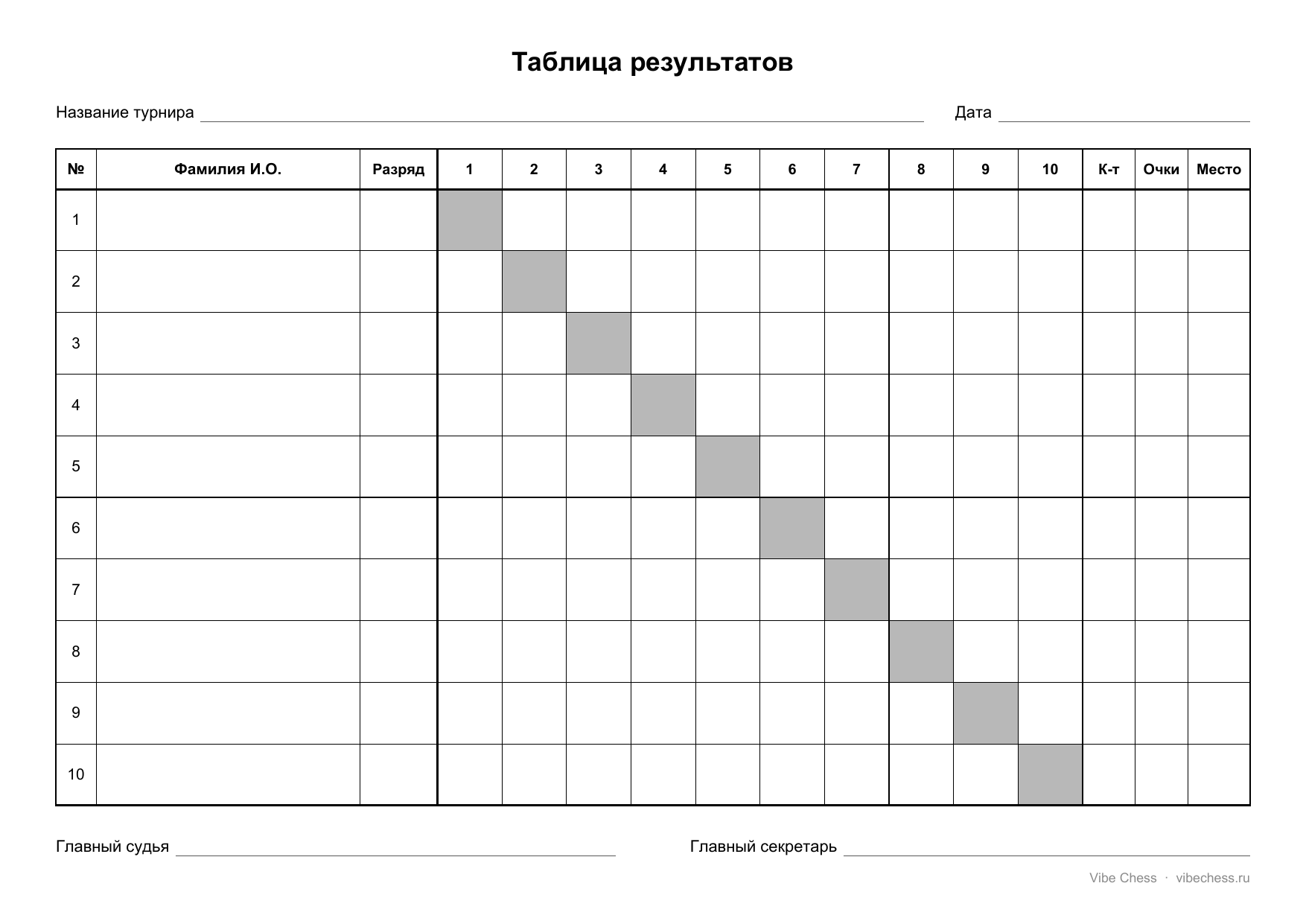
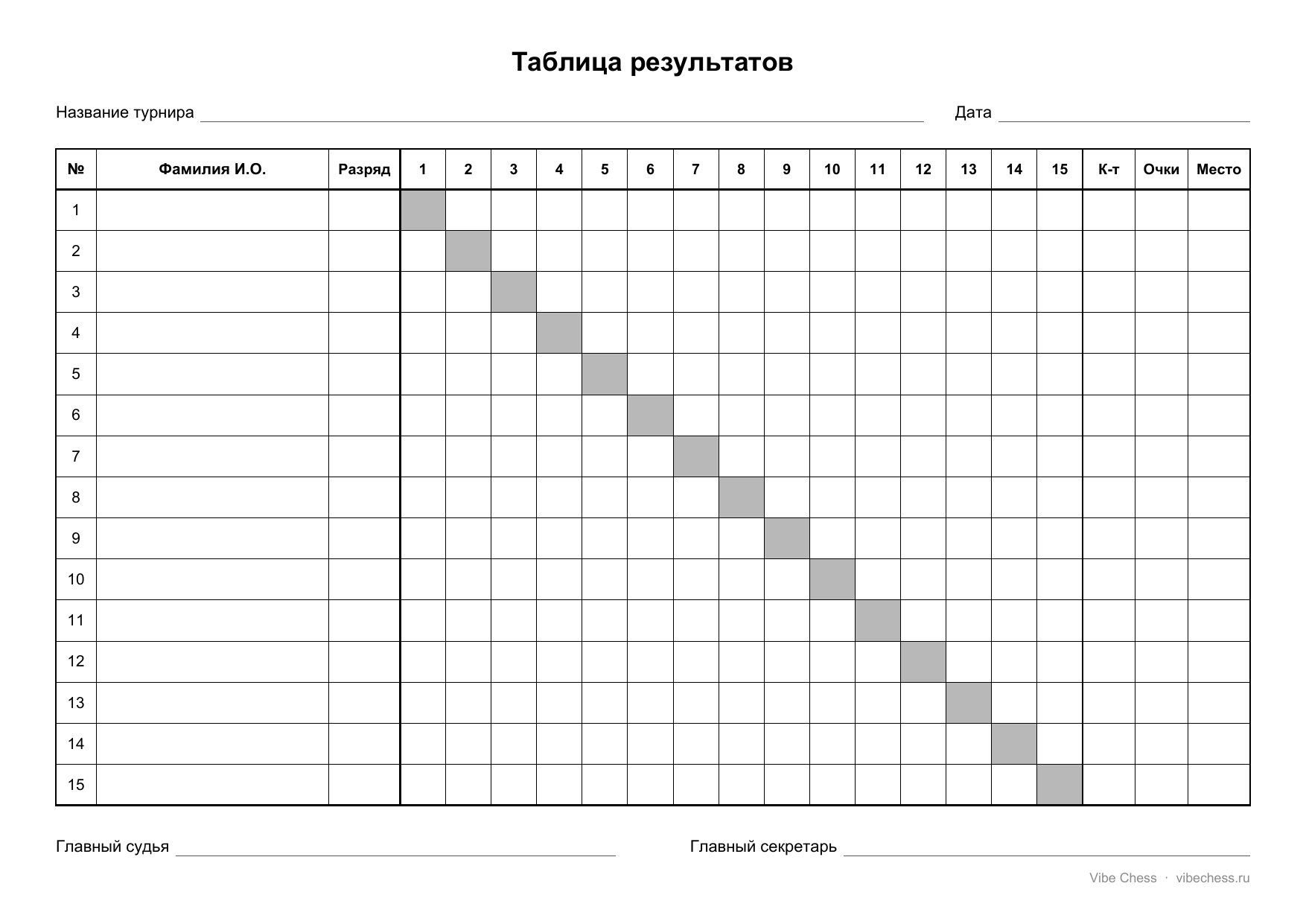
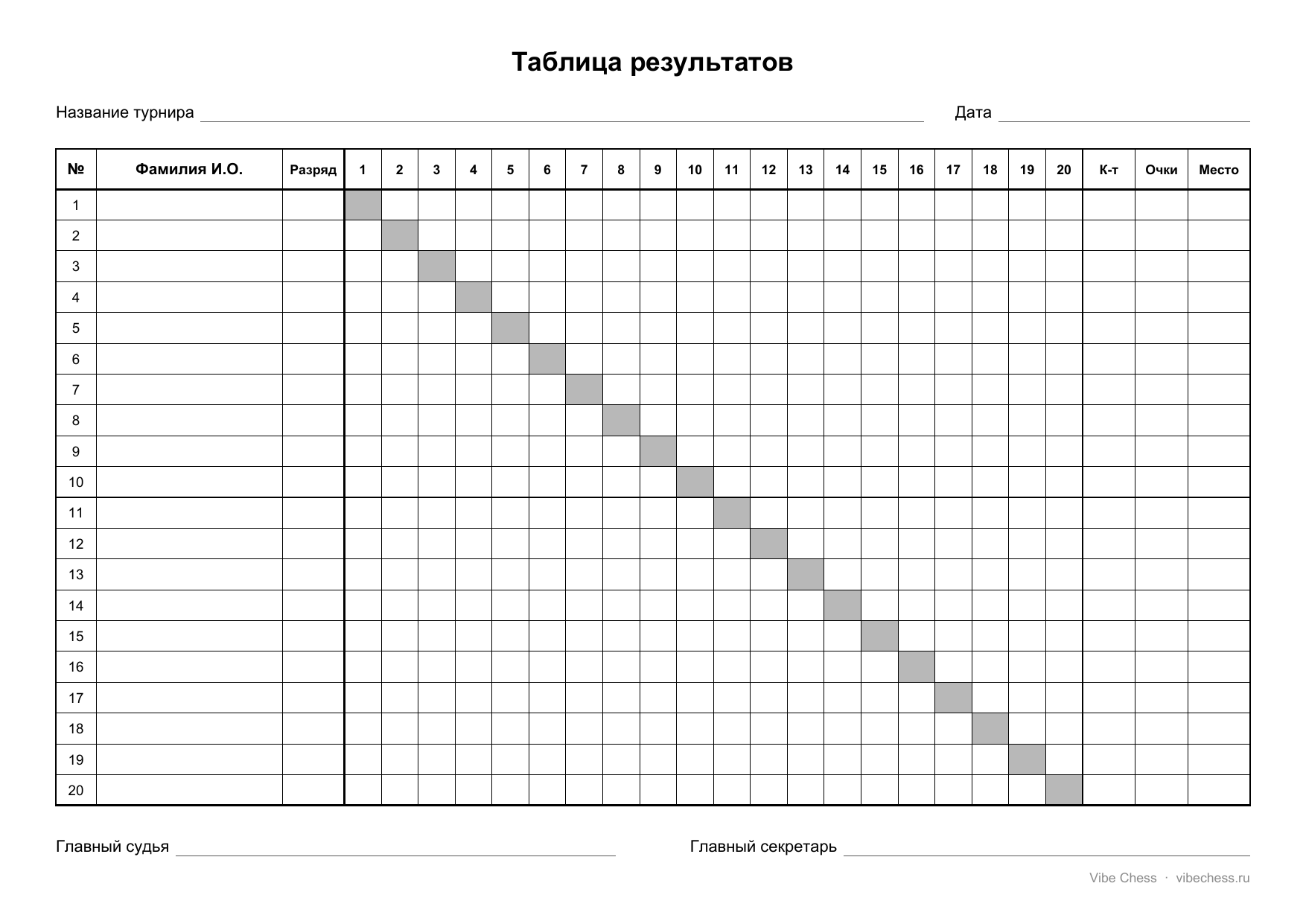
Picture a typical situation: 17 amateurs have gathered at a factory or an office and decided to play a Swiss tournament. The organiser takes a sheet, writes out the surnames and rules a grid by rounds. After every round he pairs the players by hand so that those on similar scores meet and those who have already played each other do not, keeps an eye on the colours, and gives one of them a bye because the field is odd.
Then he collects the results, writes them into the table and recalculates the scores. And at the end comes the most tedious part: the Buchholz score, that is, the sum of the scores of all the opponents of every player. For 17 people that is dozens of additions on a calculator, where it is easy to slip and end up with the wrong places.
Ruling the grid by hand is certainly not compulsory. We have made ready-made round-robin table forms - print one out and fill it in. That is a fair option for a small tournament, where everyone plays everyone anyway and there is next to nothing to calculate.
All three forms are A4, landscape, black-and-white printing. A walk-through with a filled-in example on real numbers and the rules for calculating the tie-break is in the article on tournament table template.
An important caveat: this is a the round robin table, where everyone plays everyone. For the Swiss system a paper form will not save you - there the pairings are made afresh before every round, and that is exactly the work paper does not take off your hands.
The Vibe Chess bot keeps all the same Swiss logic but does it itself. The pairing avoids repeat meetings and alternates the colours automatically. The pairings go to the players privately with a board number - nothing has to be announced. Players mark the results with buttons. And the Buchholz score is recalculated after every round instantly and without mistakes.
All the organiser has to do is send the /next_round command between rounds - and then he is free: he can play himself rather than sit over a table. Those same 17 people at the factory run their tournament over their lunch breaks without picking up a pen once.
| Task | On paper | In the bot |
|---|---|---|
| Pairing a round | by hand, scanning the grid | automatic |
| Repeat pairings | easy to miss | ruled out |
| Announcing the pairings | out loud / a printout | privately to each player |
| Buchholz | on a calculator | itself, after the round |
| The organiser's role | tied to the table | free, can play |
Nothing fundamental - tournaments have been run that way for a long time. But it takes time and produces mistakes: repeat pairings, a miscalculated Buchholz, an organiser tied to the table. The bot removes the manual work and leaves the format unchanged.
Yes, it is the same Swiss system and the same Buchholz score. The only difference is that the pairing and the arithmetic are done by a program rather than by a person with a sheet of paper.
It is the sum of the final scores of all a player's opponents. For 15-20 people that is slow to do by hand and easy to get wrong - there is a detailed walk-through with formulas in a separate article, and the bot does it automatically.
Players only need Telegram to receive their pairings and mark their results. Anyone without a smartphone is added by the organiser as a guest by name - they play, and the organiser enters their results.
No, it is if anything more convenient: 8 people means 5 rounds of blitz in an evening. The bot will hand out the pairings and work out the standings faster than you can rule a grid on a sheet of paper.
The Vibe Chess app is built for an evening over the board, not for online play: it keeps the sign-up list, the pairings and the table while you deal with people and the venue. All of it free.
The bot is constantly improved based on real tournaments. If you need a feature that isn't there yet, message the developers right inside the bot with the /support command. Many features appeared exactly because organizers asked for them, and useful ideas get added quickly.
The full guide is how an organiser runs a tournament in the bot. How the tie-break is calculated is the Buchholz score. A tournament right inside the messenger - how to run a tournament in Telegram. Equipment for the games is a chess clock on your phone.

At the board since childhood: hazy about his rating, precise about every rook he has blundered. Counts an evening as a good one if the opponent stayed to talk afterwards instead of rushing off to check with an engine. Message →