Every team has a line-up and a board order. Board one, also called board A, is usually the captain and the strongest player; boards B, C and D follow in decreasing strength. The order is declared before the event and stays fixed: that way nobody can hide a strong player on the last board against a weak opponent.
Each round two teams play a match. Players sit opposite each other by board number: captains play captains, board A plays the other team's board A, B plays B, C plays C. Colours alternate along the boards: if a team has White on board one, it has Black on board two and White again on board three. So no team gets an extra White in a match.
The match score is the sum of the games: a win on a board gives the team a point, a draw half a point. A match on three boards can end 2½ : ½, 2 : 1 or level at 1½ : 1½. From there the Swiss system does what it does in an individual event: the next round brings together teams on the same score, with no repeat pairings.
Every game adds to a shared score. A lost board is not a lost match: a teammate can win it back.
The weakest player sits on the last board and meets players like themselves. Captains get the strong opponents, everyone else gets equals.
Finished your game? Watch your team's other boards. Every game has twice the audience of an individual event.
Department against department, faculty against faculty, street against street: a team comes with a name and supporters built in.
Team standings for the teams and individual standings for every player: one event gives you both the best team and the best player.
Twenty teams are fine: each round pairs teams on equal scores, and five to seven rounds are enough to find the strongest.
There is no single number - the regulations set it. At the Chess Olympiad a team plays on four boards and has one reserve. National and club team championships often use six to eight boards. For an evening event at a company, university or club, two or three boards are usually enough: teams form quickly and the boards of a match finish at about the same time.
A rule of thumb: the more boards, the more people each team needs and the longer everyone waits for the last game of a match. Two or three is the most comfortable size for a one-evening tournament. In the Vibe Chess app a team has two, three or four players.
A team tournament has two possible main scores, and the regulations must say in advance which one decides places.
| Match score on three boards | Match points | Board points |
|---|---|---|
| 2½ : ½ | 2 : 0 | 2½ and ½ |
| 2 : 1 | 2 : 0 | 2 and 1 |
| 1½ : 1½ | 1 : 1 | 1½ and 1½ |
| ½ : 2½ | 0 : 2 | ½ and 2½ |
The other score usually comes first among the tie-breaks: board points when match points decide, and the other way round. Then come team Buchholz (the strength of opponents), the direct encounter, the number of matches won and the Sonneborn-Berger score. How Buchholz works in an individual event is explained in Buchholz score; for teams it is worked out the same way, only from the opponents' match points. More on scoring systems in chess tie-breaks.
Open the Vibe Chess bot and its app button, or the web version. Games - Create your own game - the "Team Swiss" format. Its card says the main thing: teams of 2-4 play matches on several boards, paired by the Swiss system, with team and individual standings.
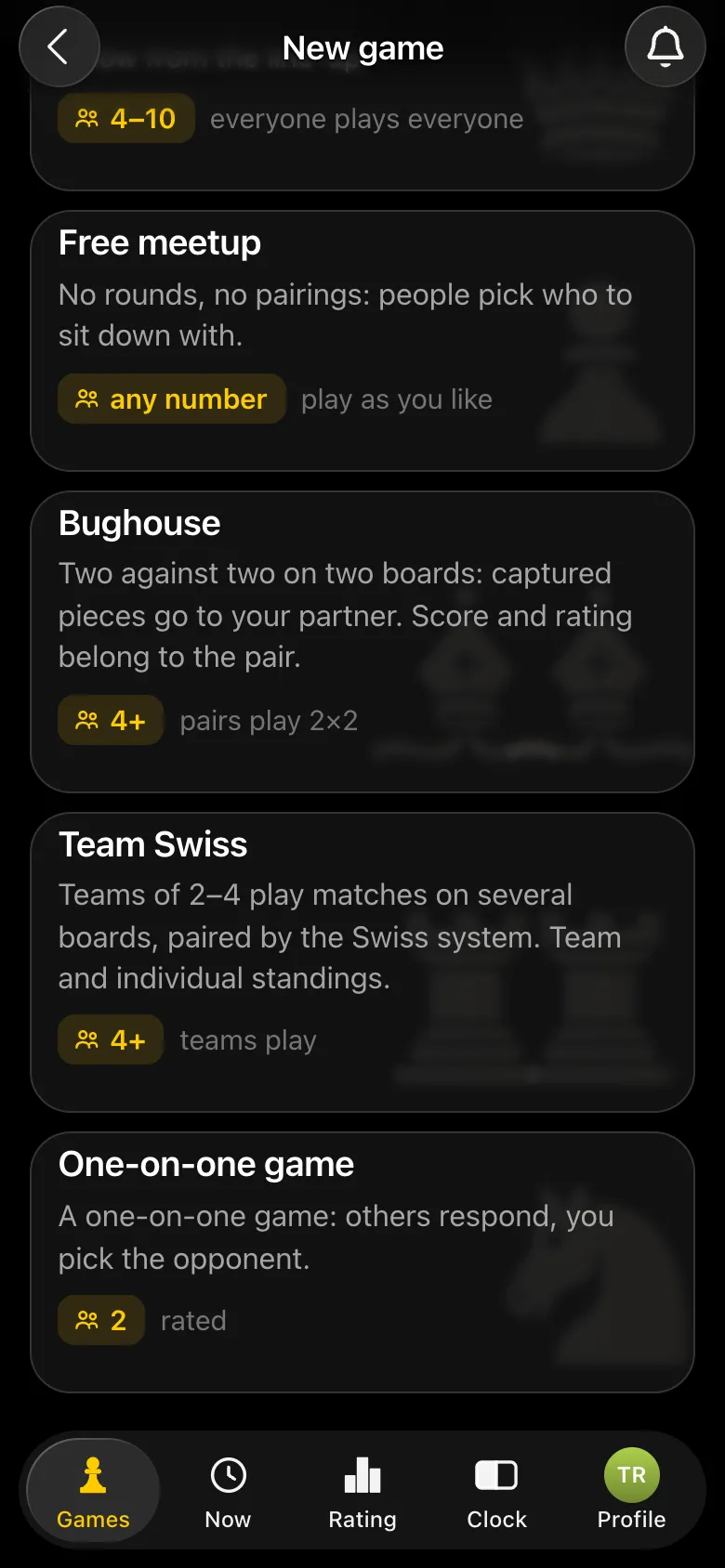
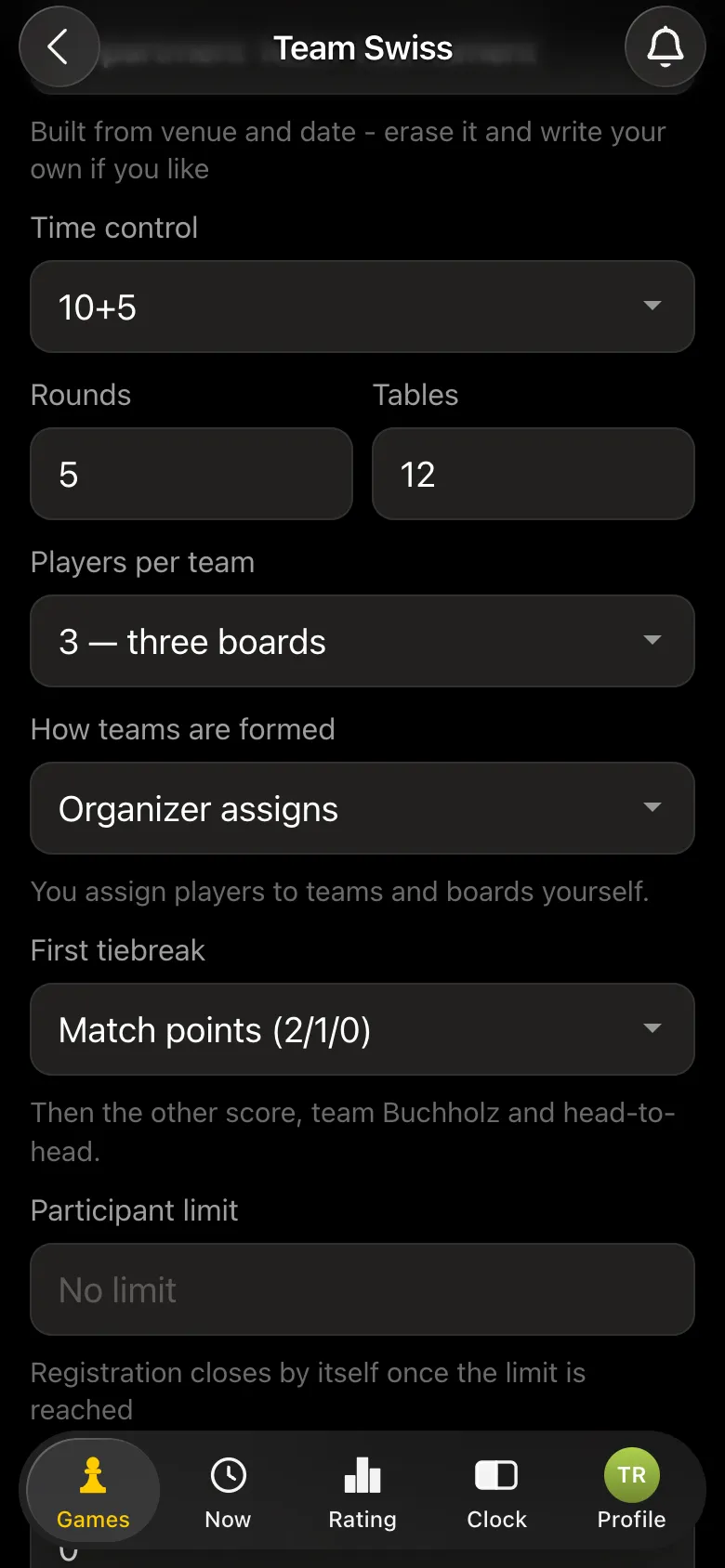
Venue, date and time, title and time control work as in an ordinary tournament. Then come the fields an individual Swiss does not have. Let us go through each of them.
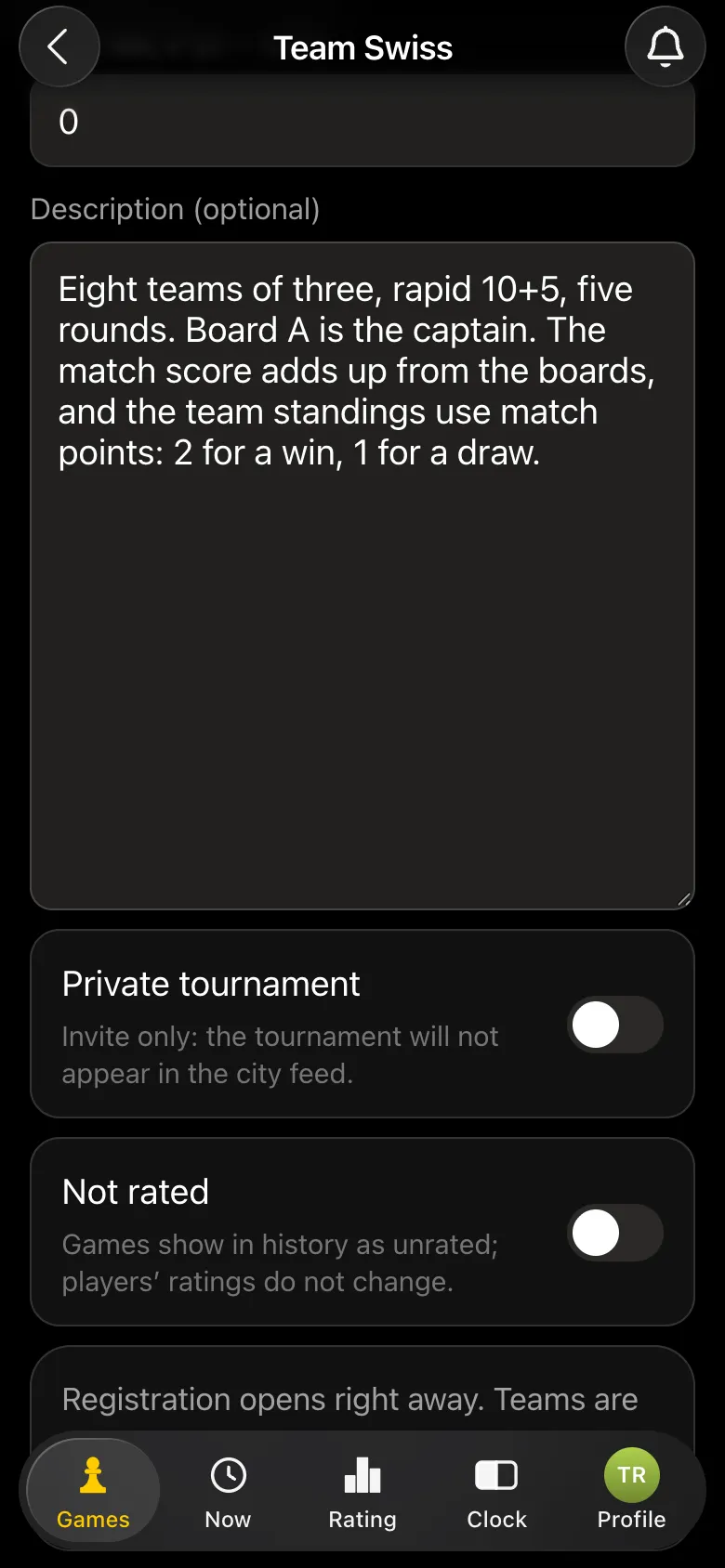
"Not rated".By default the games of a team tournament count towards the individual Vibe Chess rating, as the rules intend. If the event is a friendly one - say, a festive match between departments with beginners at the boards - turn this switch on: the games stay in history marked unrated, and players' ratings do not change. "Private tournament" works as usual: the event does not appear in the city feed, and only your link lets people sign up.
Players sign up as usual - by link or QR code. While registration is open, the tournament card shows a block of teams above the line-up: each team has a name, an average rating and its boards in order. The app builds the team name itself from first names in board order: "Anna + Paul + Sophie". An empty place reads "Board is free".
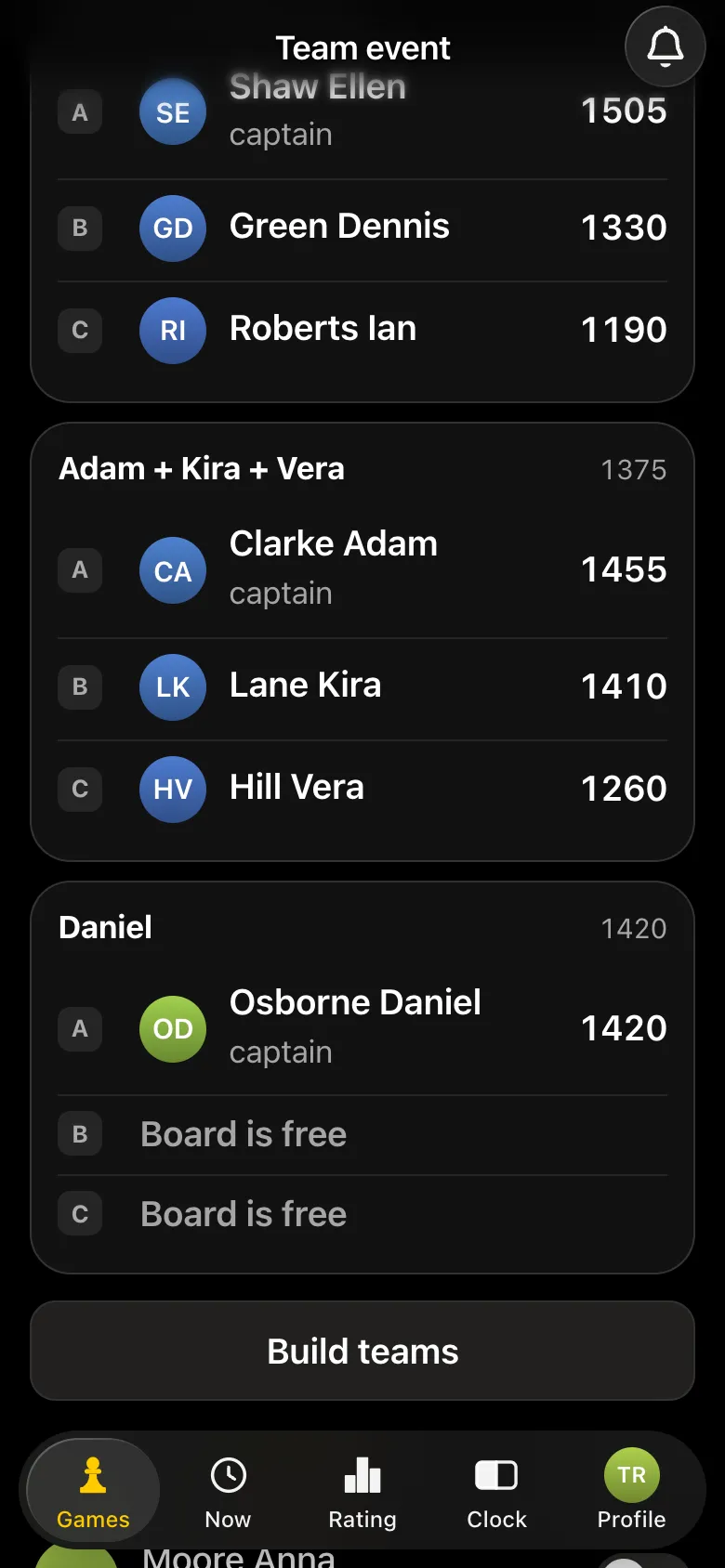
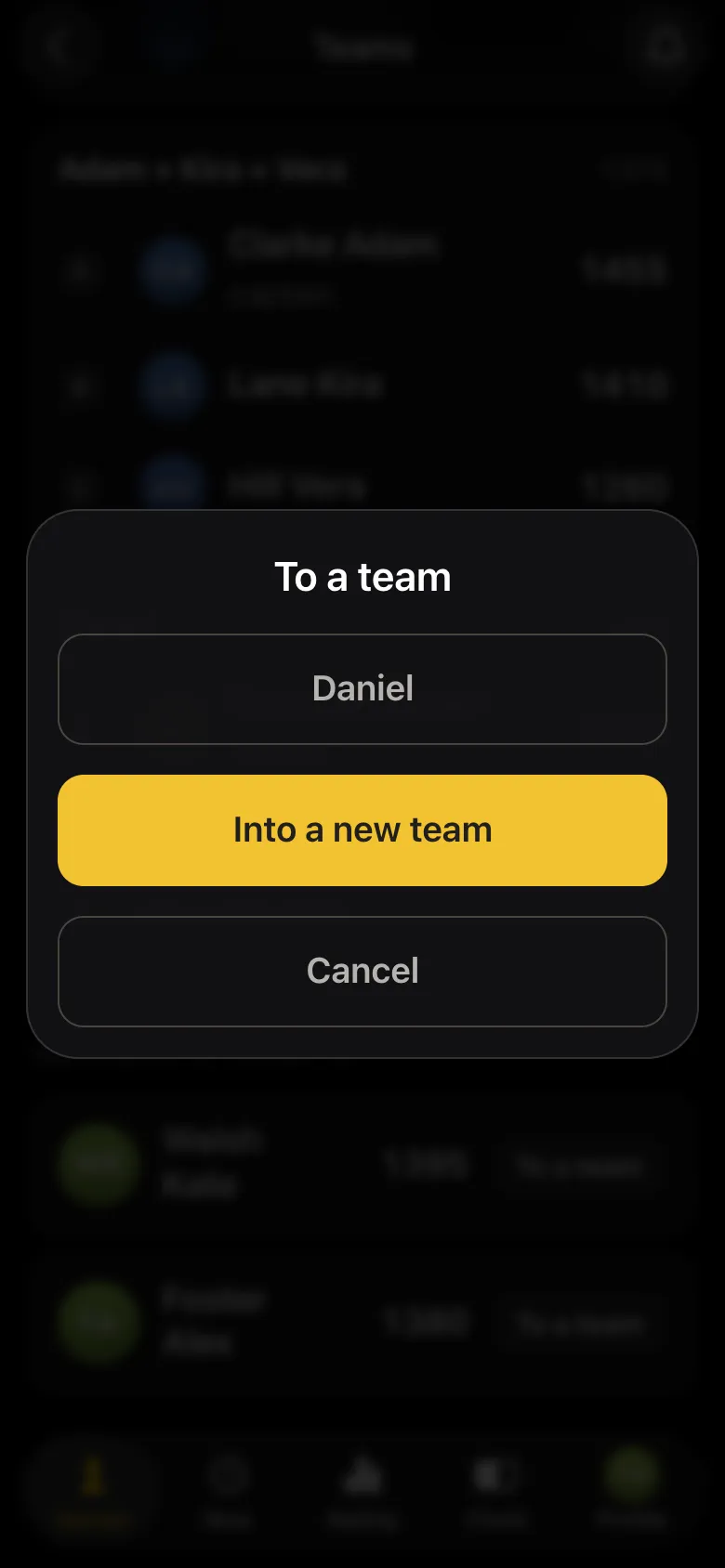
The "Build teams" button opens the teams screen. In our example the organiser assigns the teams: "New team" creates an empty team, and at the bottom of the screen is the "Without a team" list. Every free player has a "To a team" button: put them into a team with a free board or into a new one. The player takes the first free board.
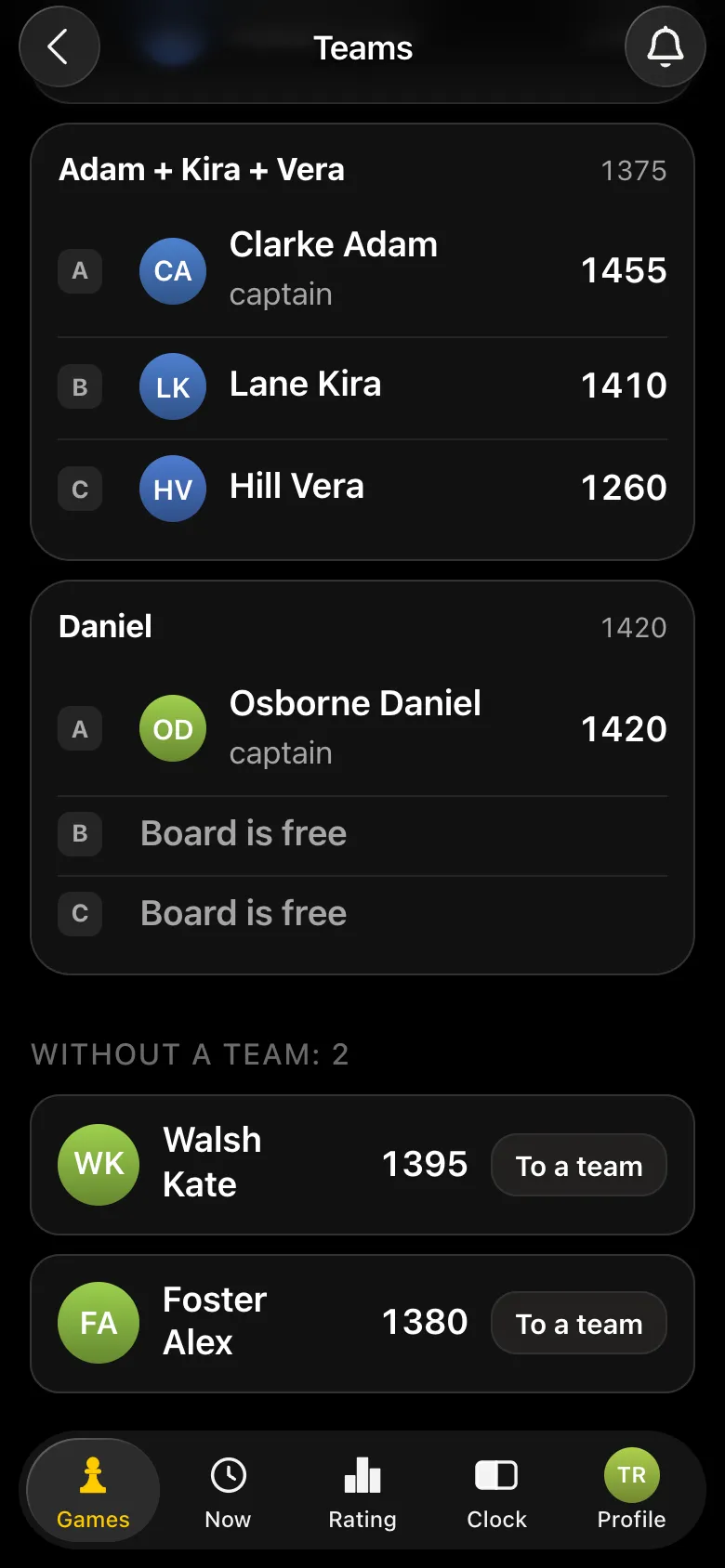
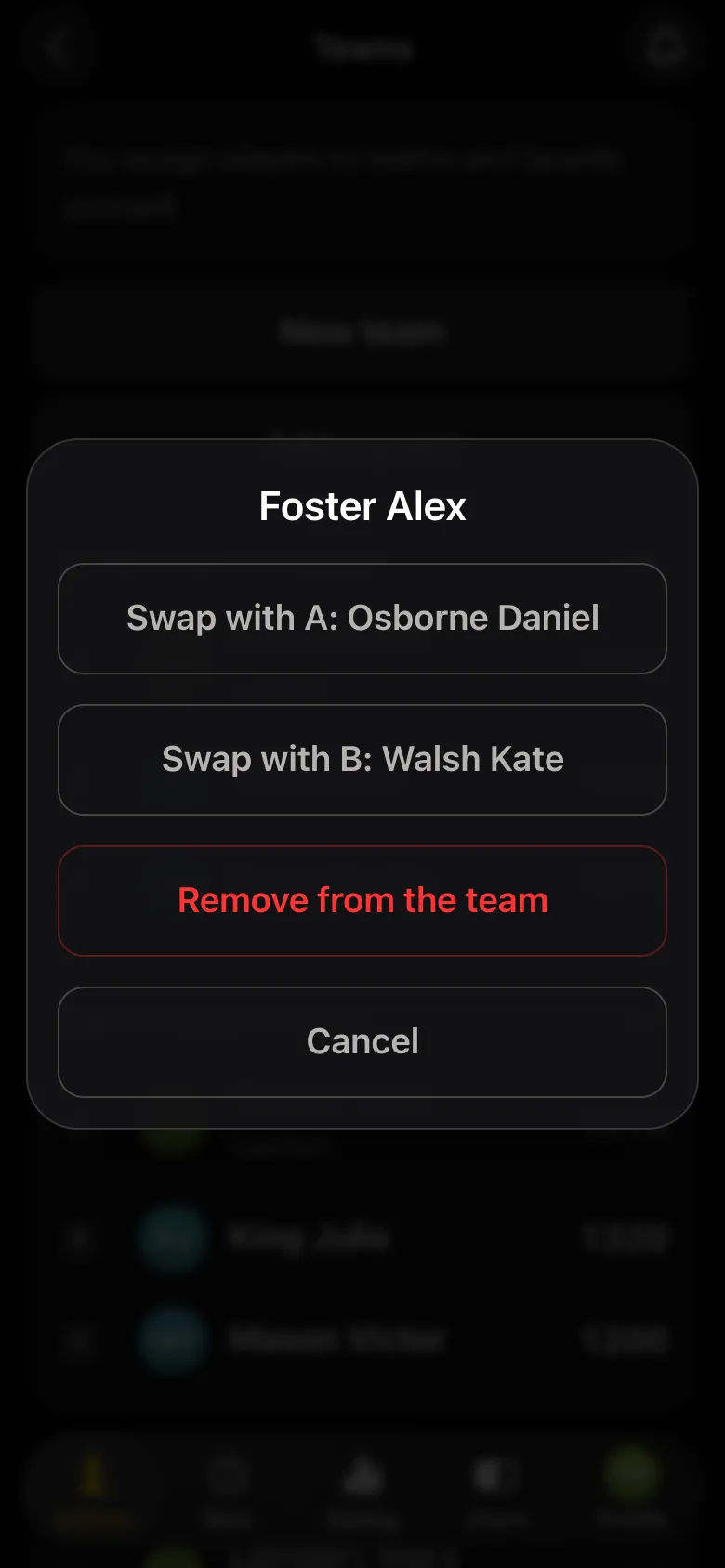
Board A is the captain. To change the captain or the board order, tap a player: "Swap with A", "Swap with B". The organiser can change boards whichever way the teams were formed, even if the players or the draw put them together. A player without Telegram can be entered as a guest with "Add a guest" and put on a free board like anyone else.
An incomplete team still plays: its empty board loses without play in every match. So before the start it is better to fill it with a guest or remove the team. At the start the line-ups are fixed, and after that players can no longer be moved between teams.
"Close registration" - "Start the tournament". The app pairs the teams for round one and seats the matches at adjacent tables: the first match at tables 1-3, the second at 4-6 and so on. On the Now tab every match has its own header: the names of the two teams and the score between them.
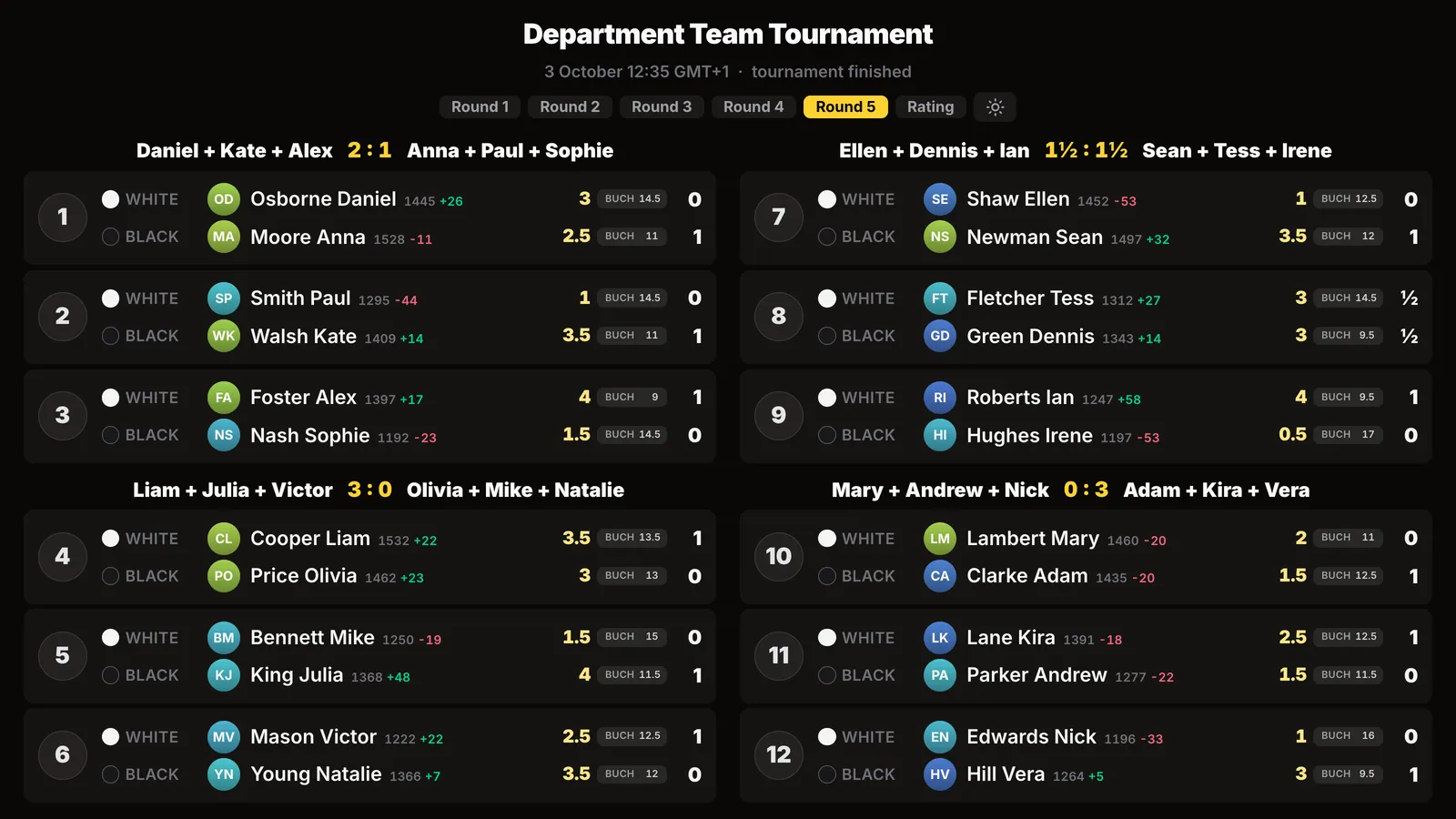
Inside a match the core rule of team chess applies: the captains sit at the match's first table, boards B at the second, boards C at the third. Colours alternate: in our example Ellen's team has White at table 4, Black at table 5 and White again at table 6.
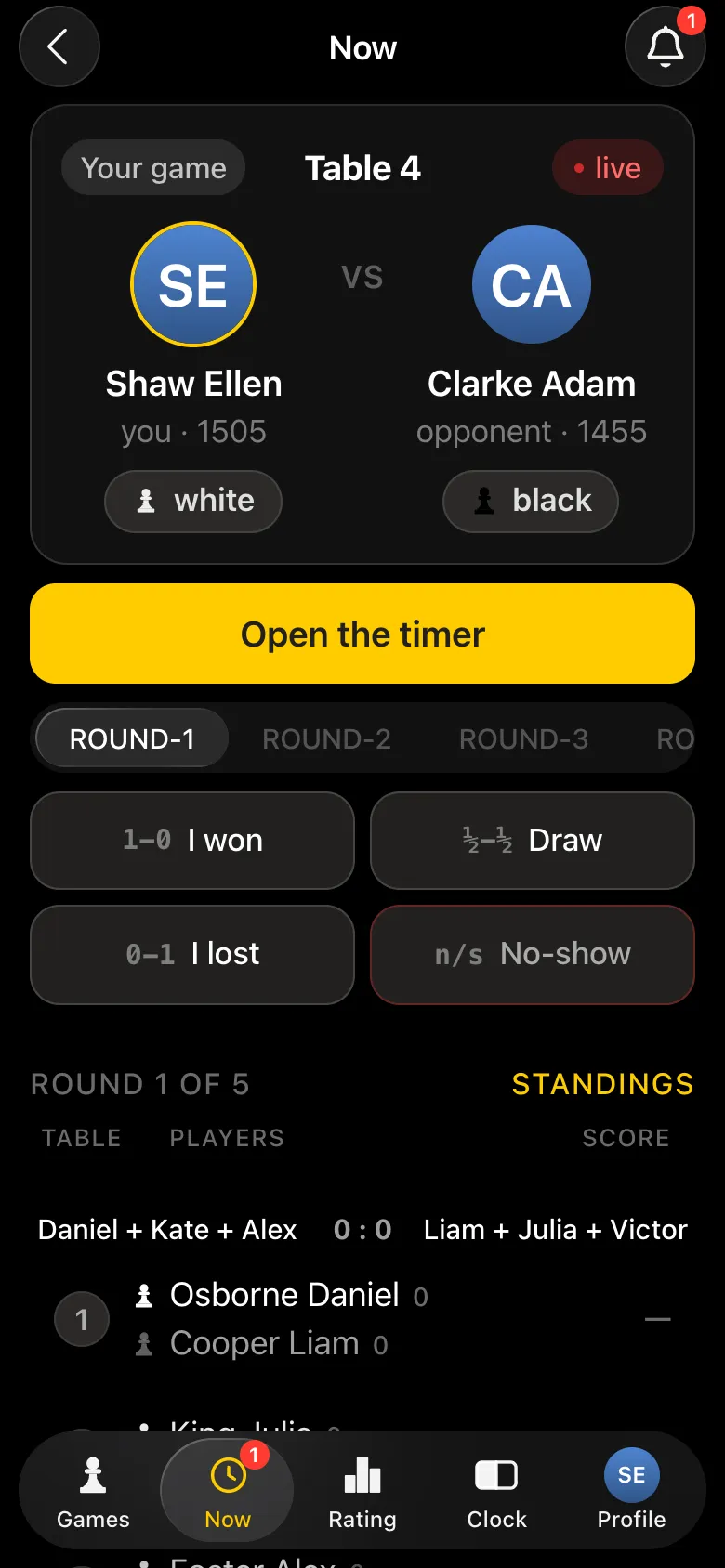
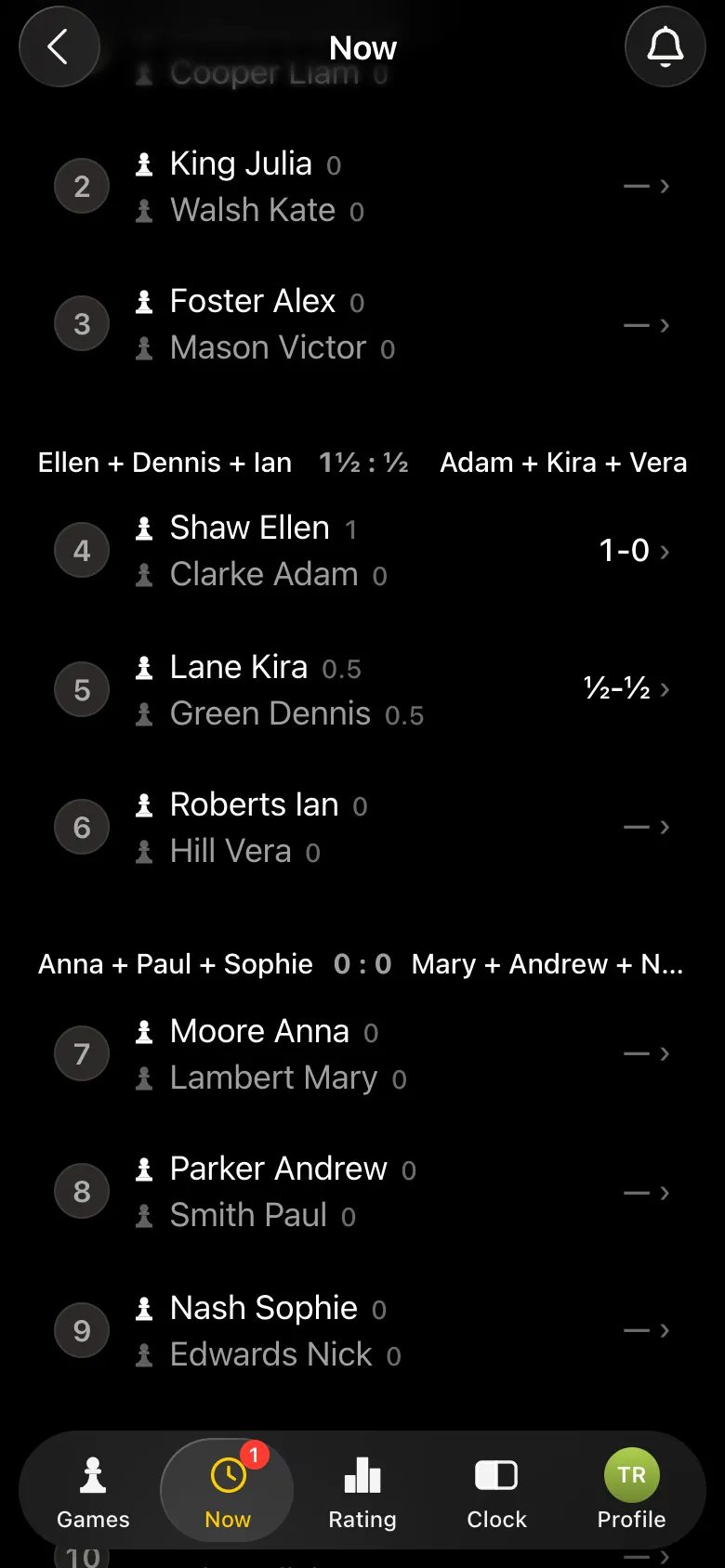
Every player sees their own game on the phone: table number, colour, opponent and an "Open the timer" button if there are not enough clocks. Team pairings are made by the same engine as the individual Swiss, bbpPairings: teams are paired by the main score, with no repeat pairings and with colours taken into account.
Each board reports its own result: when the game ends, one of the players taps "I won", "Draw", "I lost" or "No-show". The opponent sees the entry and has 15 seconds to dispute it; otherwise the result is accepted by itself. Reporting your own loss is accepted at once.
Nobody adds up the match score by hand: it is built from the boards. While the last game is still going, the match header already shows the running score - 1½ : ½ in the screenshot above, with the third board still playing.
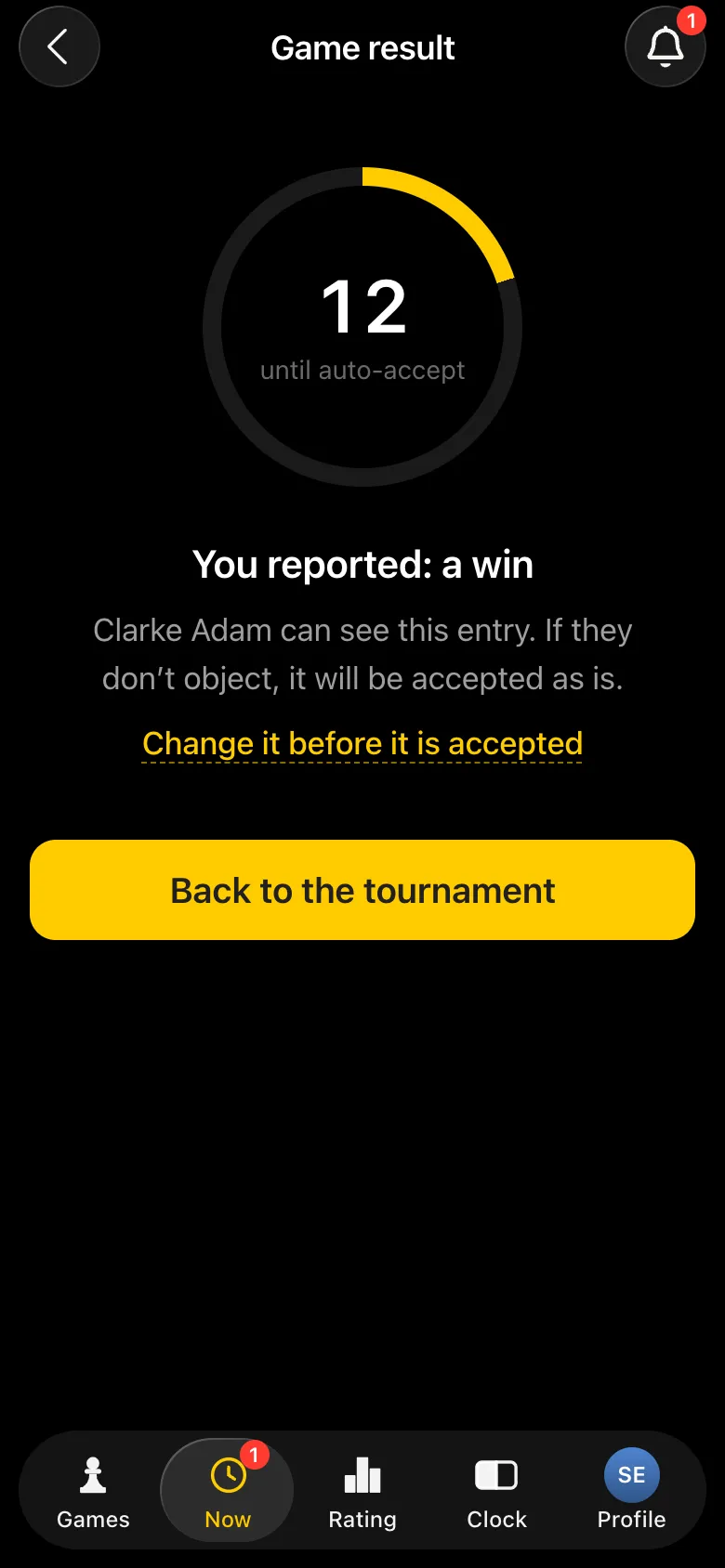
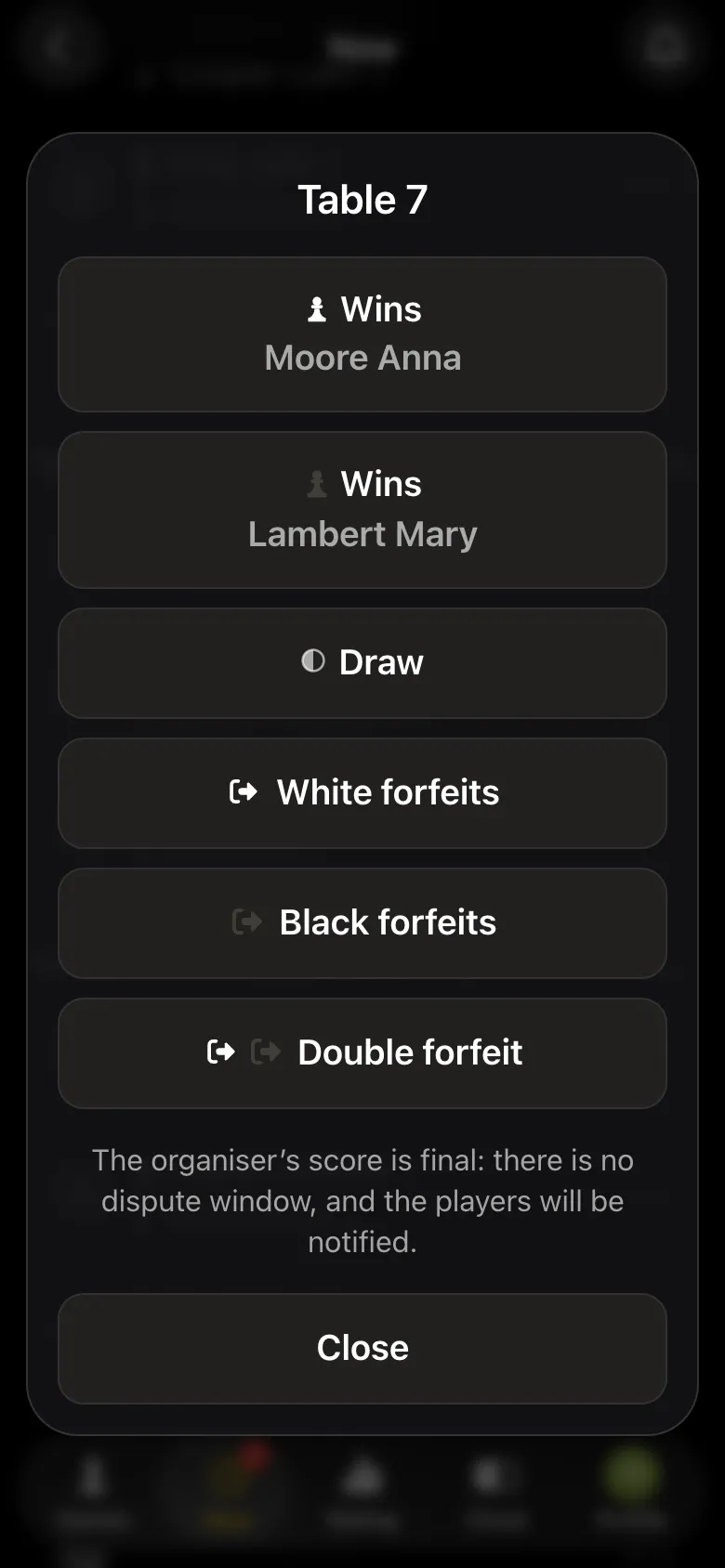
The organiser can set or correct the result on any board of any match: tap the table and pick the outcome. The organiser's score is final, with no dispute window. Once the last board of the last match is reported, the next round is announced by itself.
The tournament card has "Show the tournament on a screen". Open the link on the laptop connected to the projector or TV. Round pairings are shown as matches: a header "Team 1½ : ½ Team", the boards in order below it, and each player's rating with its change. The page updates by itself.
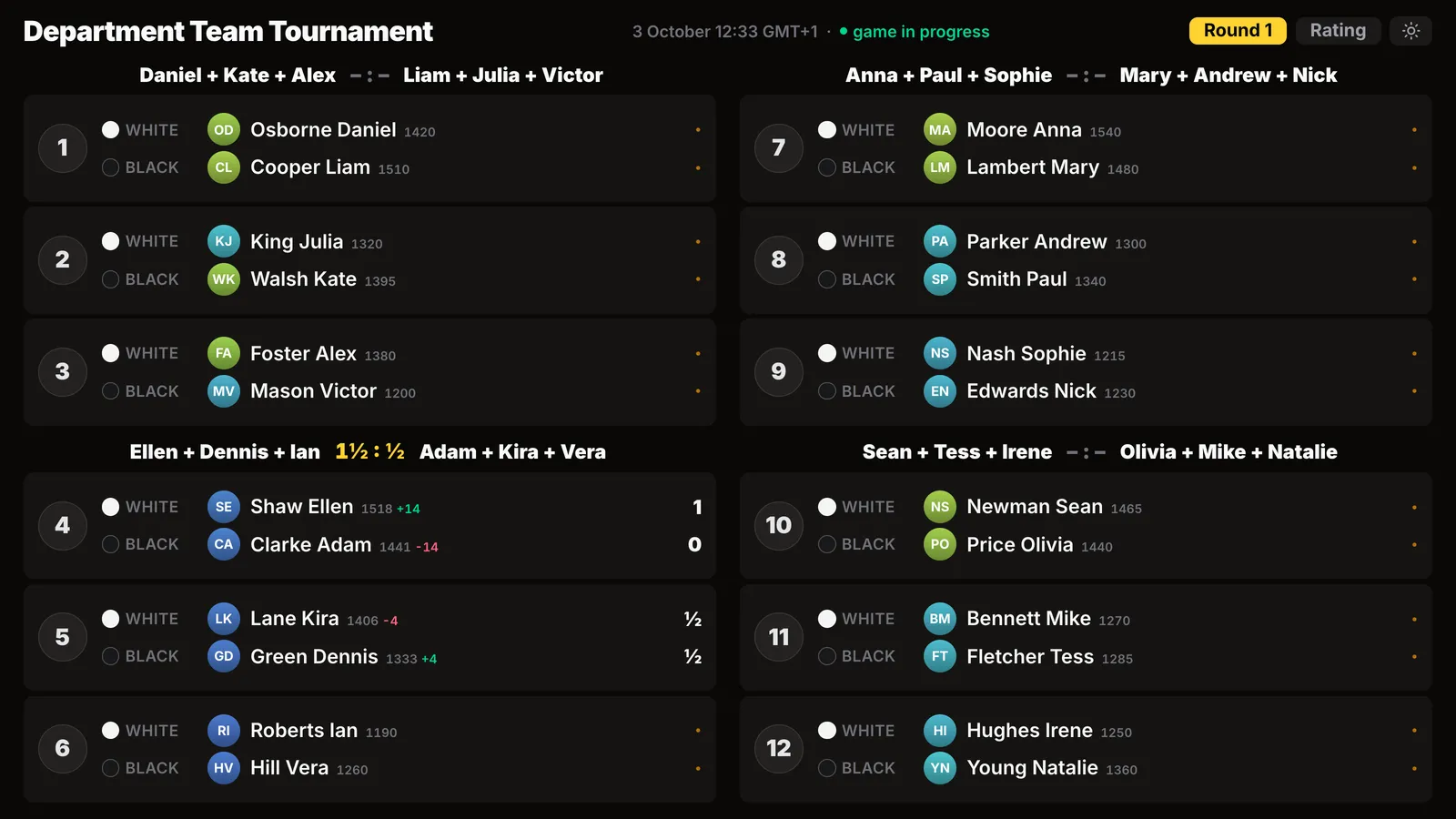
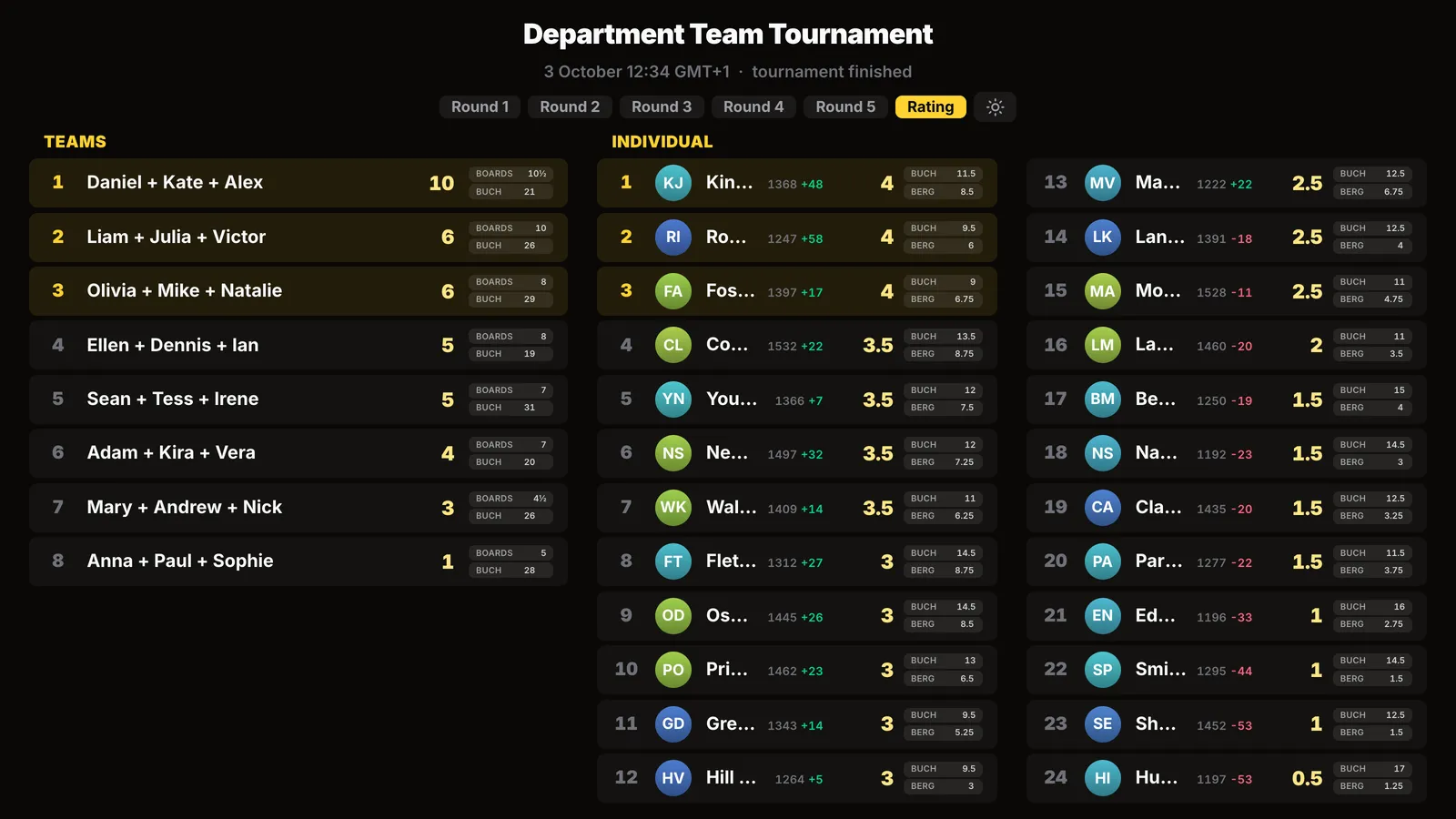
On the Rating tab of the same screen the team table is on the left and the individual standings on the right, with the prize places highlighted - a screen to keep on the projector during the prize giving.
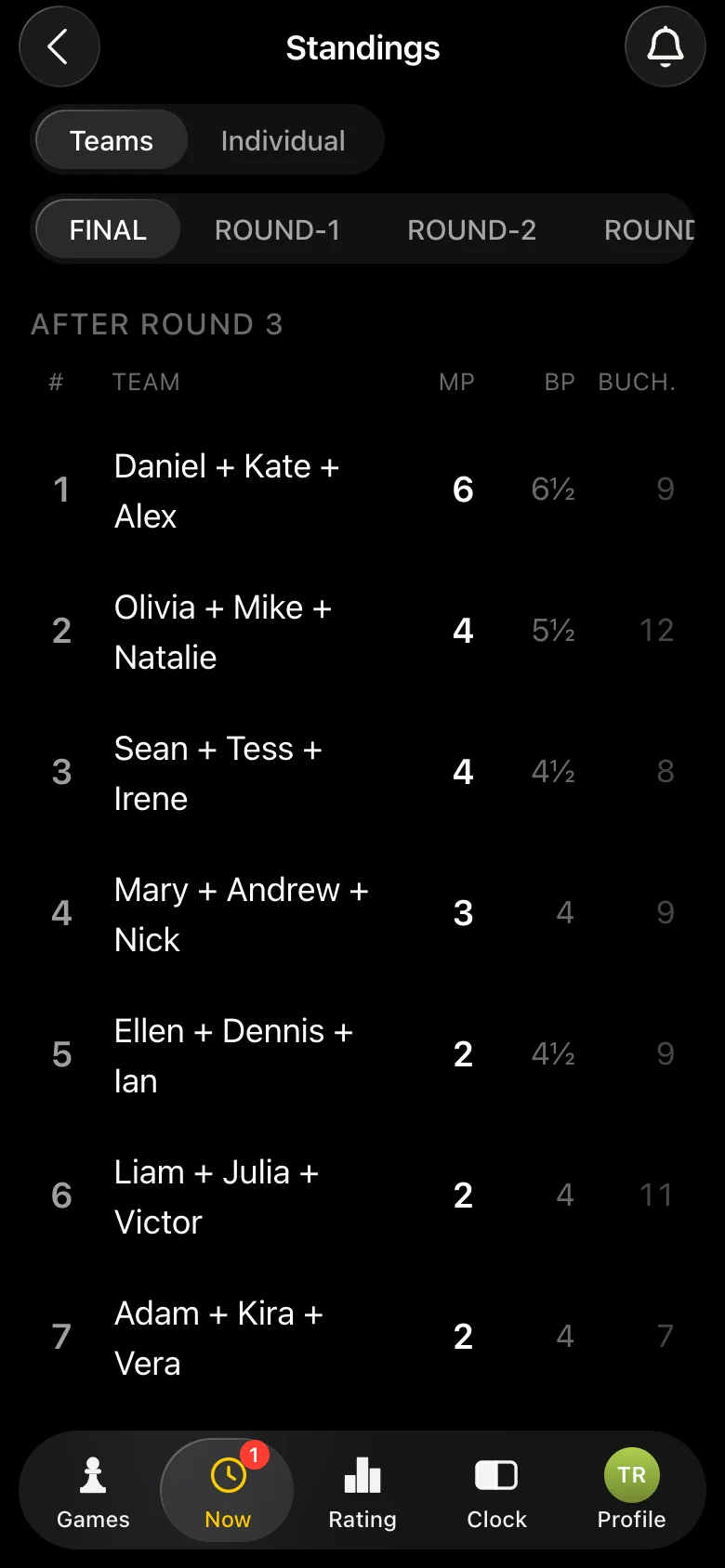
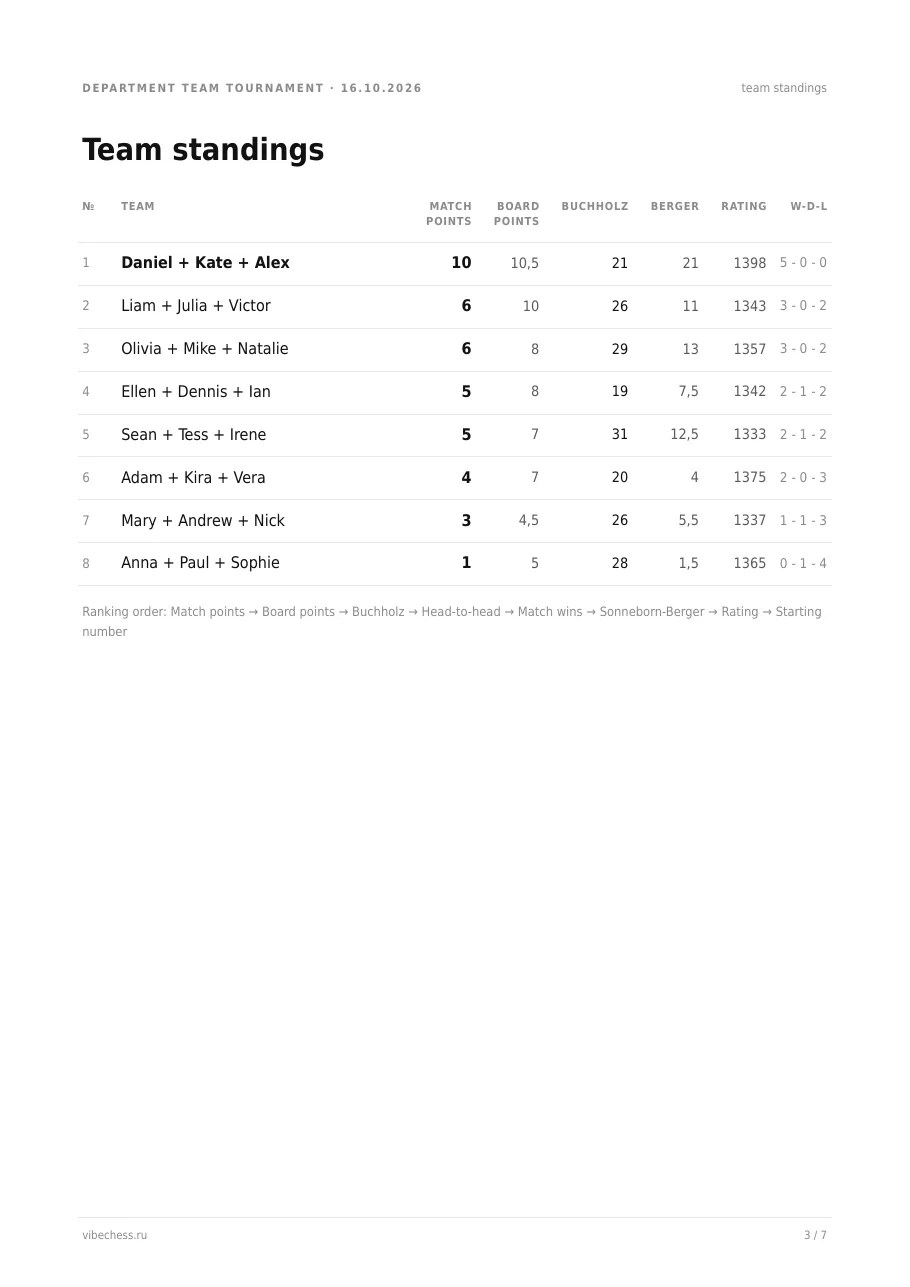
A team tournament's standings come in two views - the "Teams / Individual" switch above the round tabs. In the team table the columns follow the order of comparison: "MP" for match points, "BP" for board points, "Buch." for team Buchholz. Under the table is a "Ranking order" line: the chain the app uses to separate tied places.
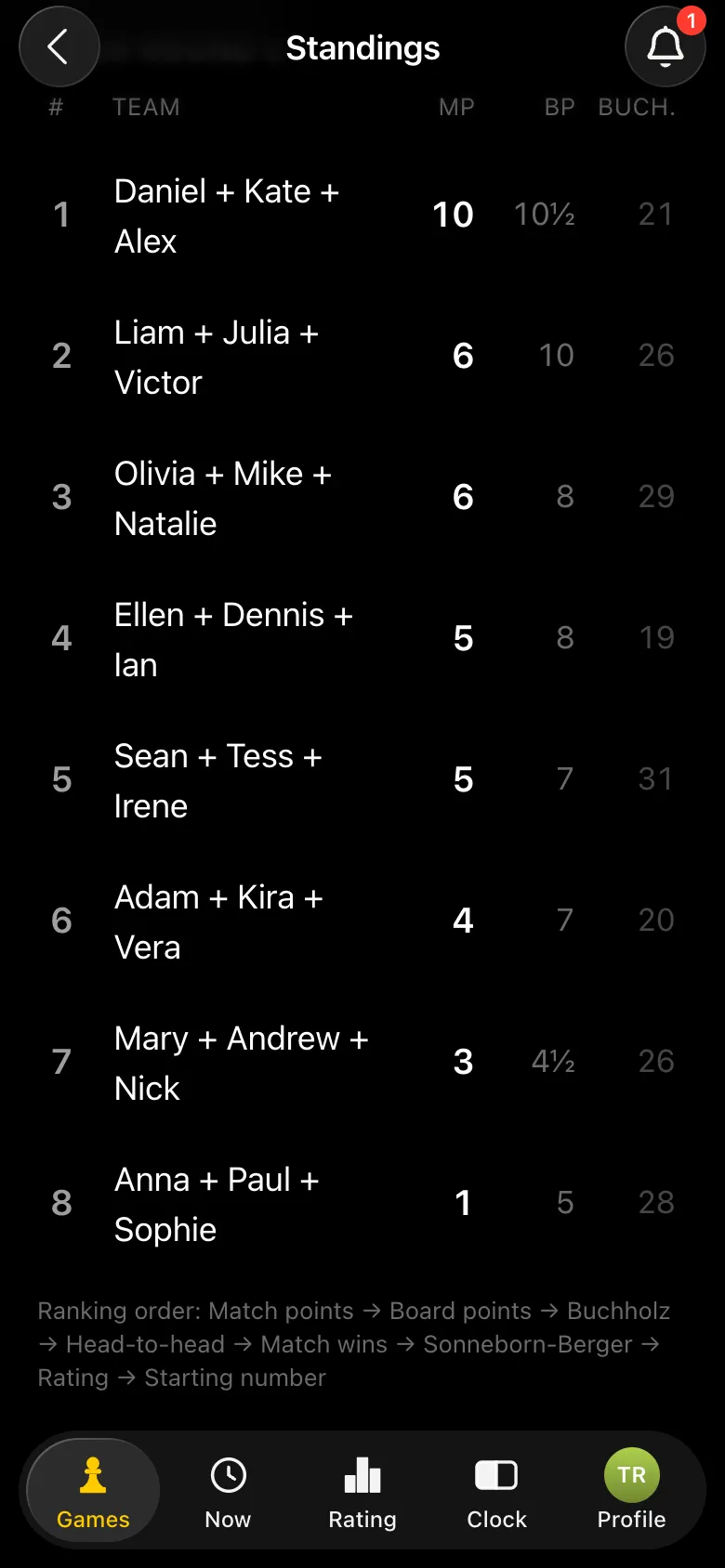
In our demo tournament "Daniel + Kate + Alex" won clearly with 10 match points. Second place was closer: "Liam + Julia + Victor" and "Olivia + Mike + Natalie" both finished on 6 match points. Board points settled it, 10 against 8 - helped by the 3 : 0 win of the first team over the second in the last round. Fourth and fifth were split the same way: 5 match points each, 8 board points against 7.
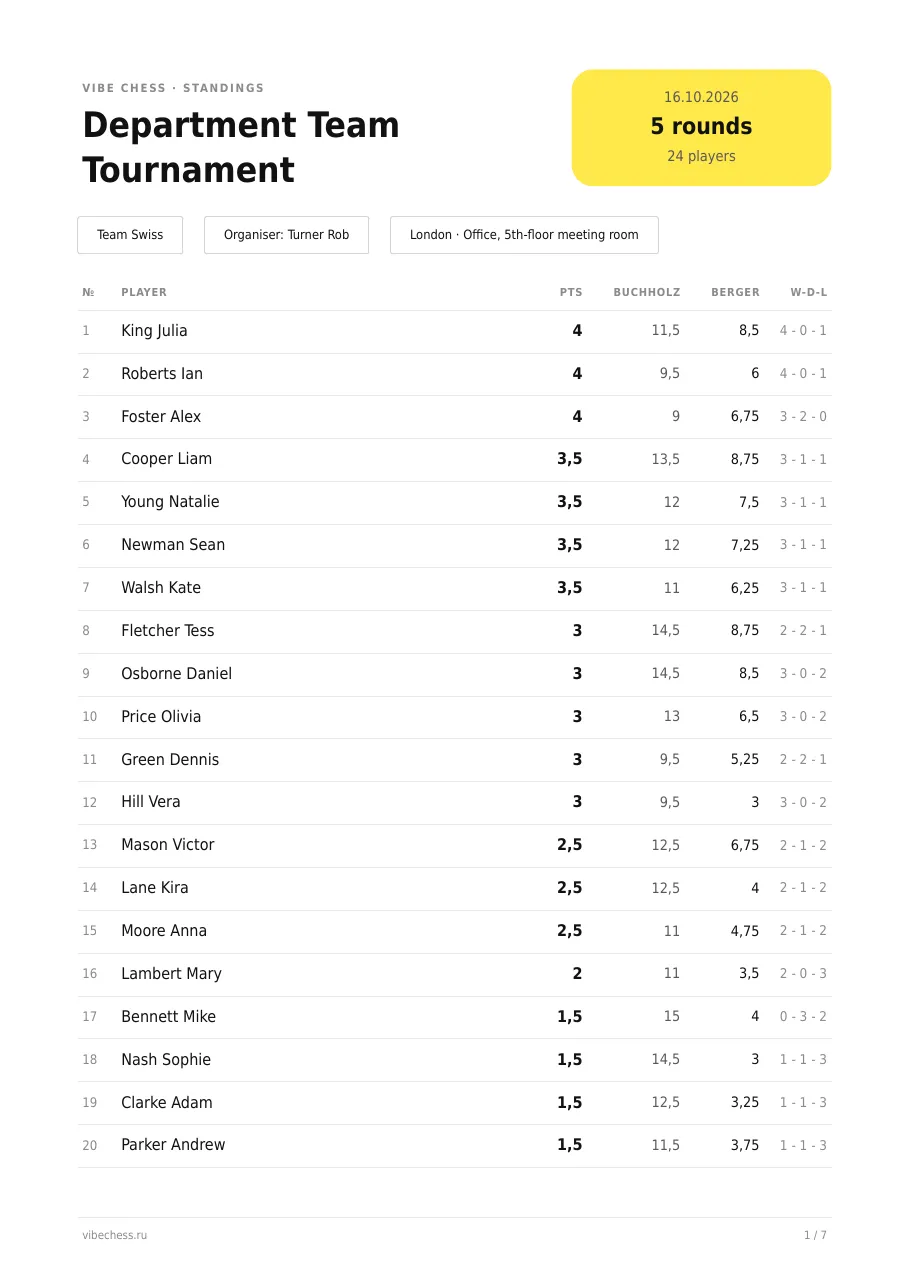
In the individual standings every player is in one list, whatever their team or board. Three players finished on 4 out of 5 - Julia King, Ian Roberts and Alex Foster - and their places were decided by Buchholz.
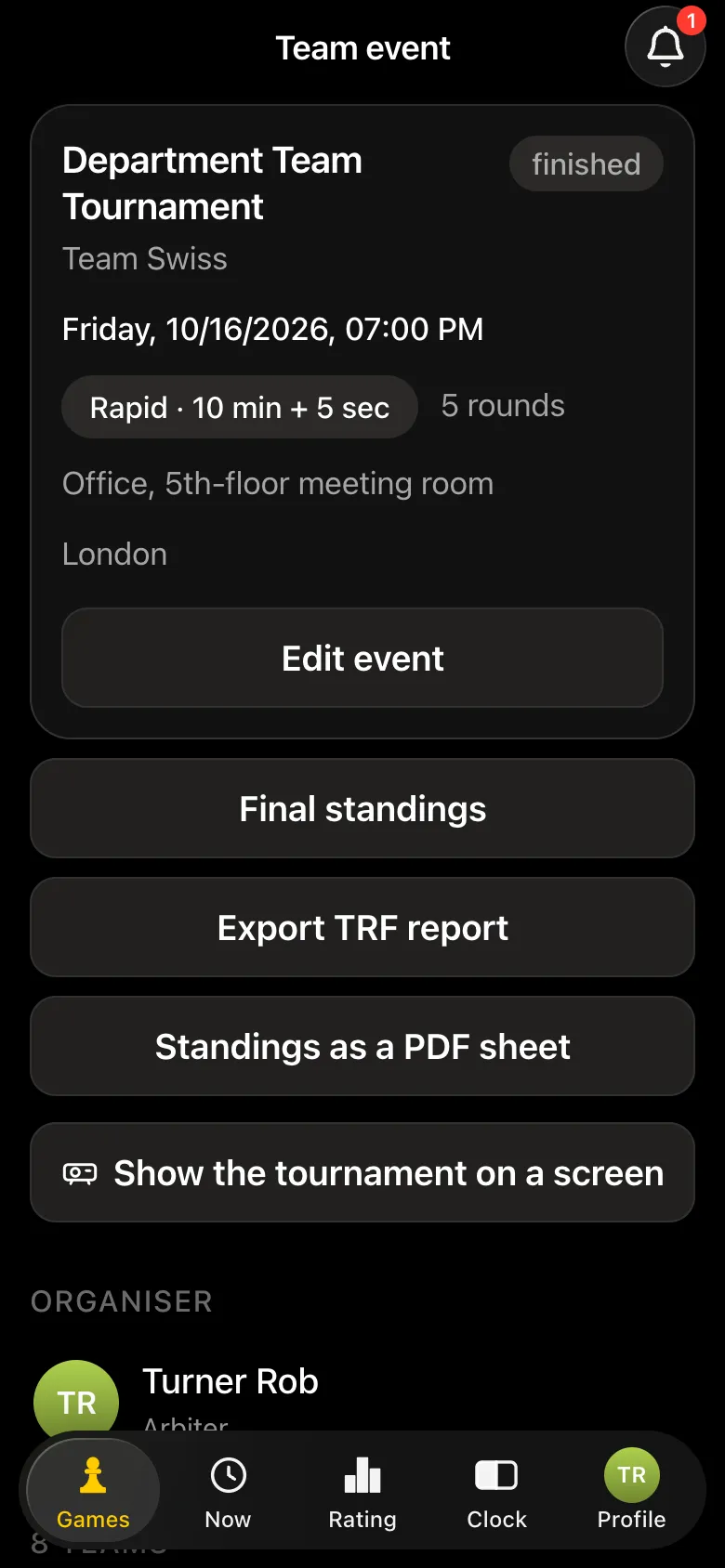
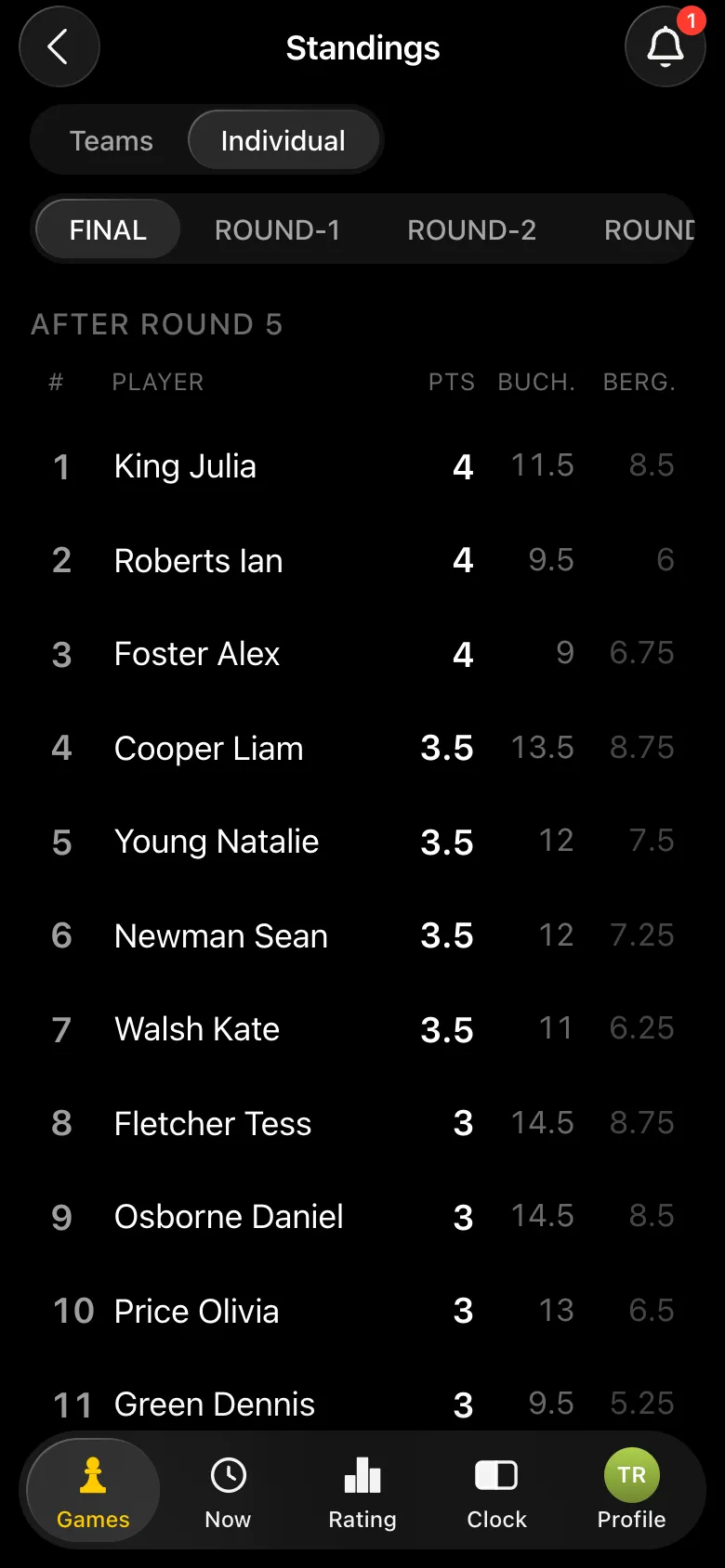
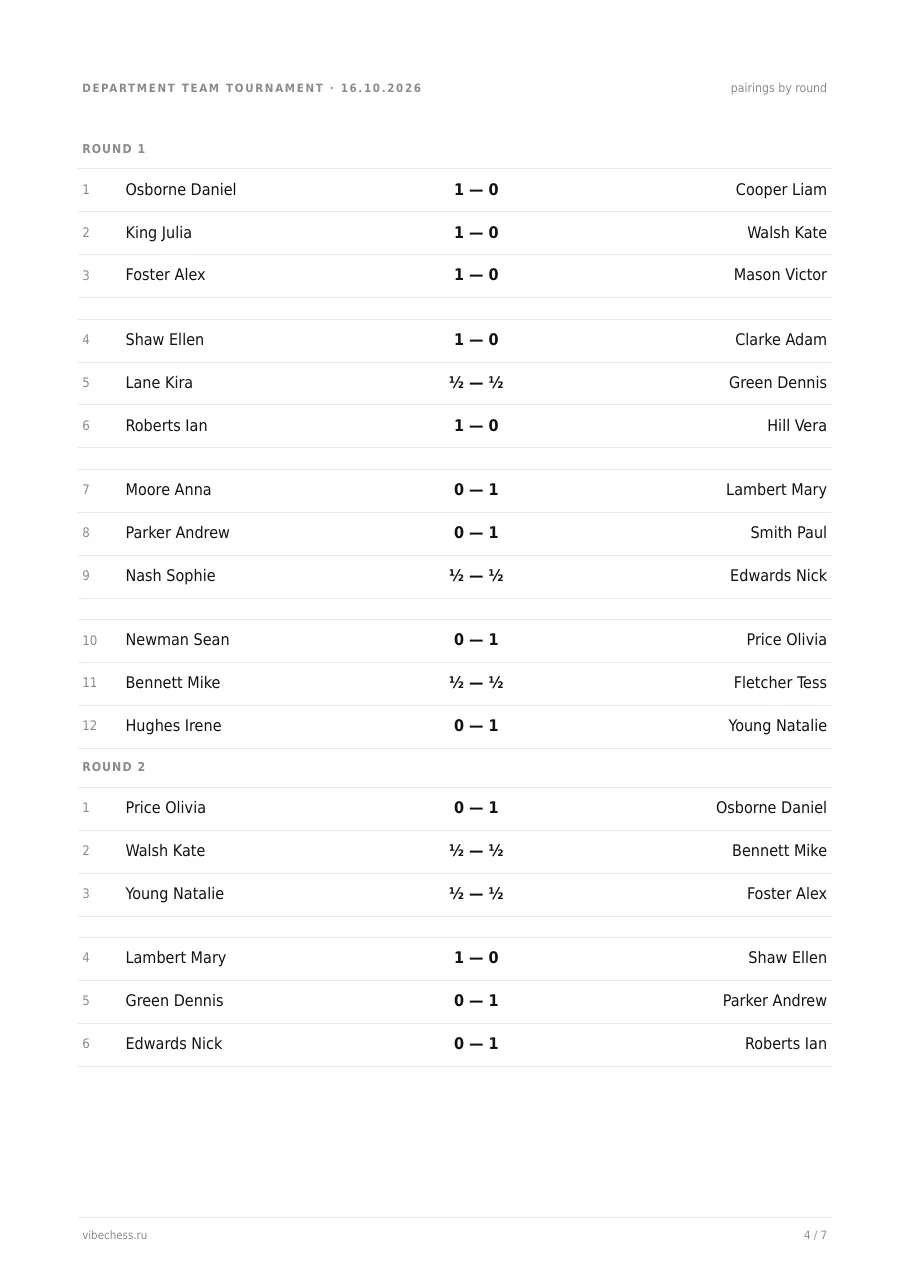
"Standings as a PDF sheet" sends an A4 document to the chat. The first pages are the individual standings, then comes a separate page with the team standings: place, team, match points, board points, Buchholz, Berger, average rating, and matches won, drawn and lost. After that, the pairings of every round, with the boards of each match grouped together. The sheet goes up on the notice board and into the report.
An event where teams play matches on several boards each round, and the team pairings follow the Swiss system - by points scored and with no repeat pairings. The match score is the sum of the games on the boards.
By board number: captains (board A) play captains, board B plays the opponent's board B, C plays C. Colours alternate along the boards: if a team has White on board one, it has Black on board two.
Match points are given for the match as a whole: 2 for a win, 1 for a draw, 0 for a loss. Board points are the total of all the team's games. The regulations say in advance which one is the main score; the other usually comes first among the tie-breaks.
As many as the regulations say. The Olympiad uses four boards and a reserve, club leagues up to six or eight boards. For a one-evening event two or three boards are most comfortable. In the Vibe Chess app a team has 2, 3 or 4 players.
Each board does: a player taps I won, Draw or I lost, and the opponent has 15 seconds to object. The organiser can enter the result for any table. The match score adds up from the boards automatically.
Three ways: the organiser assigns players, the players pick their own teammates (a captain invites them), or teams are drawn at random. Board A is the captain, and the organiser can change the board order before the start.
By default yes, towards the individual Vibe Chess rating. For a friendly event there is a Not rated switch: the games stay in history marked unrated, and players' ratings do not change.
Yes. Show the tournament on a screen displays matches as blocks with a score, plus the final team and individual tables. Standings as a PDF sheet sends a document with the individual standings, a separate team standings page and the pairings of every round.
Pairings are computed by bbpPairings, an open-source engine implementing the Dutch system by FIDE rules: score groups, floats on an odd field, colour alternation. Free to use.
The bot is constantly improved based on real tournaments. If you need a feature that isn't there yet, message the developers right inside the bot with the /support command. Many features appeared exactly because organizers asked for them, and useful ideas get added quickly.
Organising a team event with no app involved - team chess tournament. Rounds and pairings for teams - Swiss system for teams. A match between two teams - Scheveningen system. A tournament for employees - corporate tournament in the app, department against department - tournament between departments. The individual Swiss in the app - Swiss tournament in the app. A guide for players - how to take part in a tournament.

At the board since childhood: hazy about his rating, precise about every rook he has blundered. Counts an evening as a good one if the opponent stayed to talk afterwards instead of rushing off to check with an engine. Message →