Let's play a game for two: Daniel and Ethan, blitz 5+3. You need two phones - one for the clock, one for the camera. Everything below is real screens of the app.
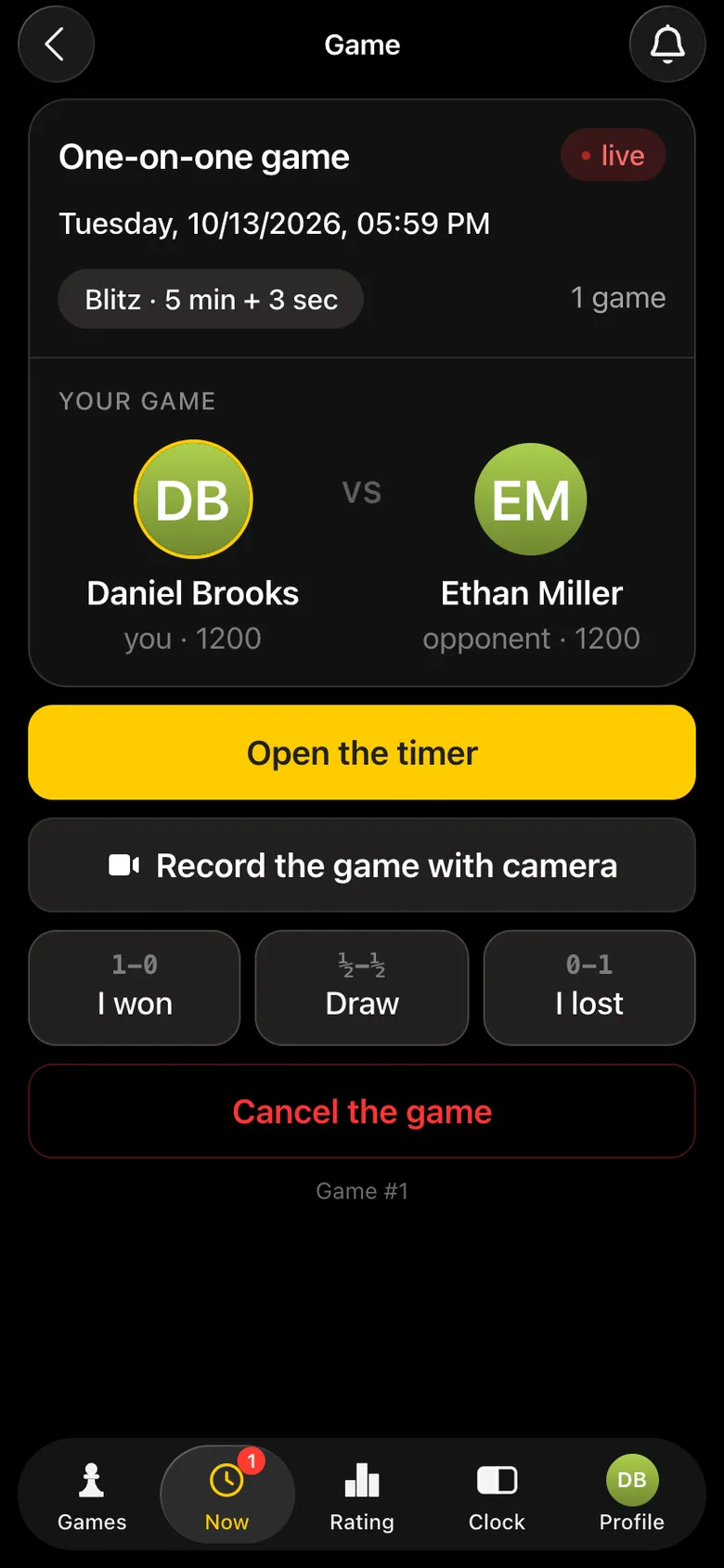
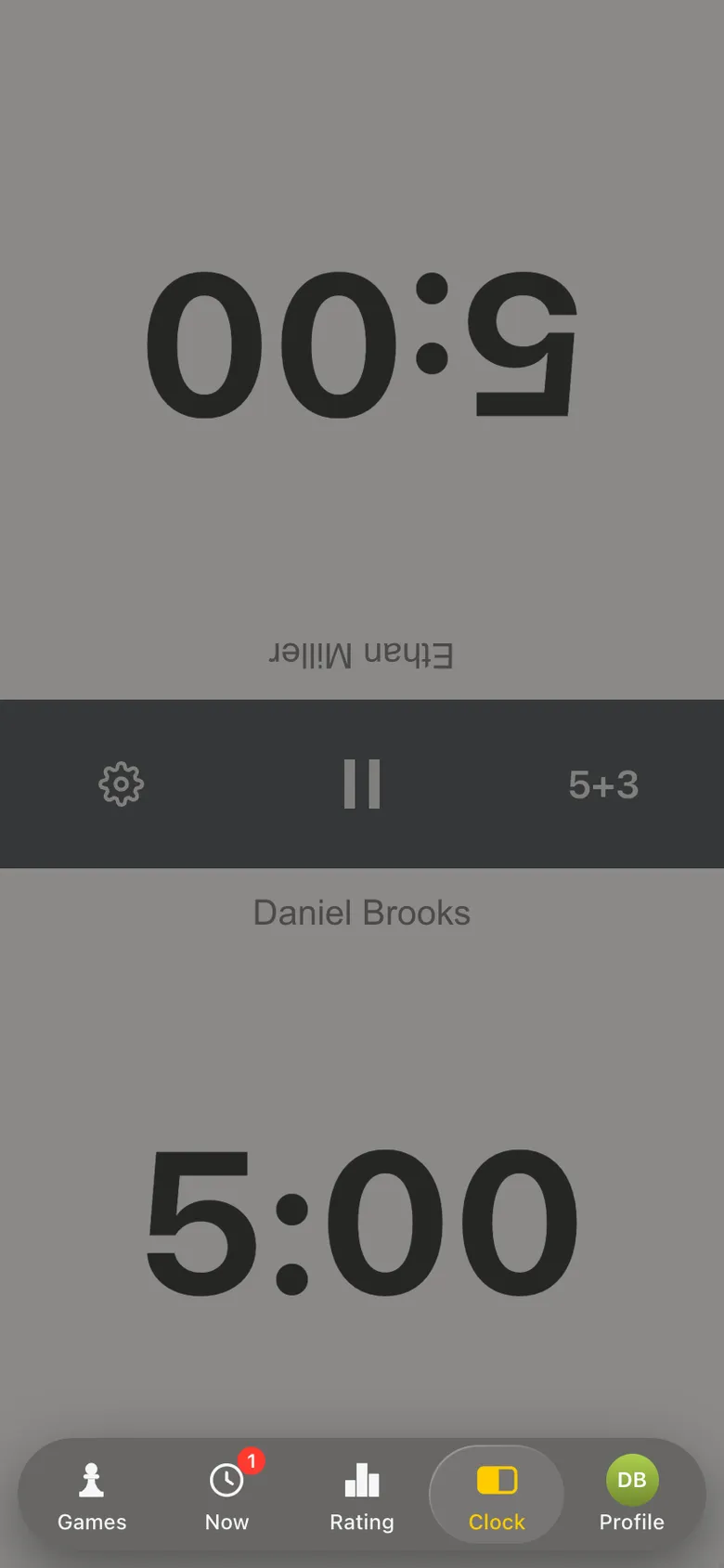
Daniel opens the game in his app and taps “Open the timer”. The phone with the clock goes next to the board, like an ordinary chess clock.
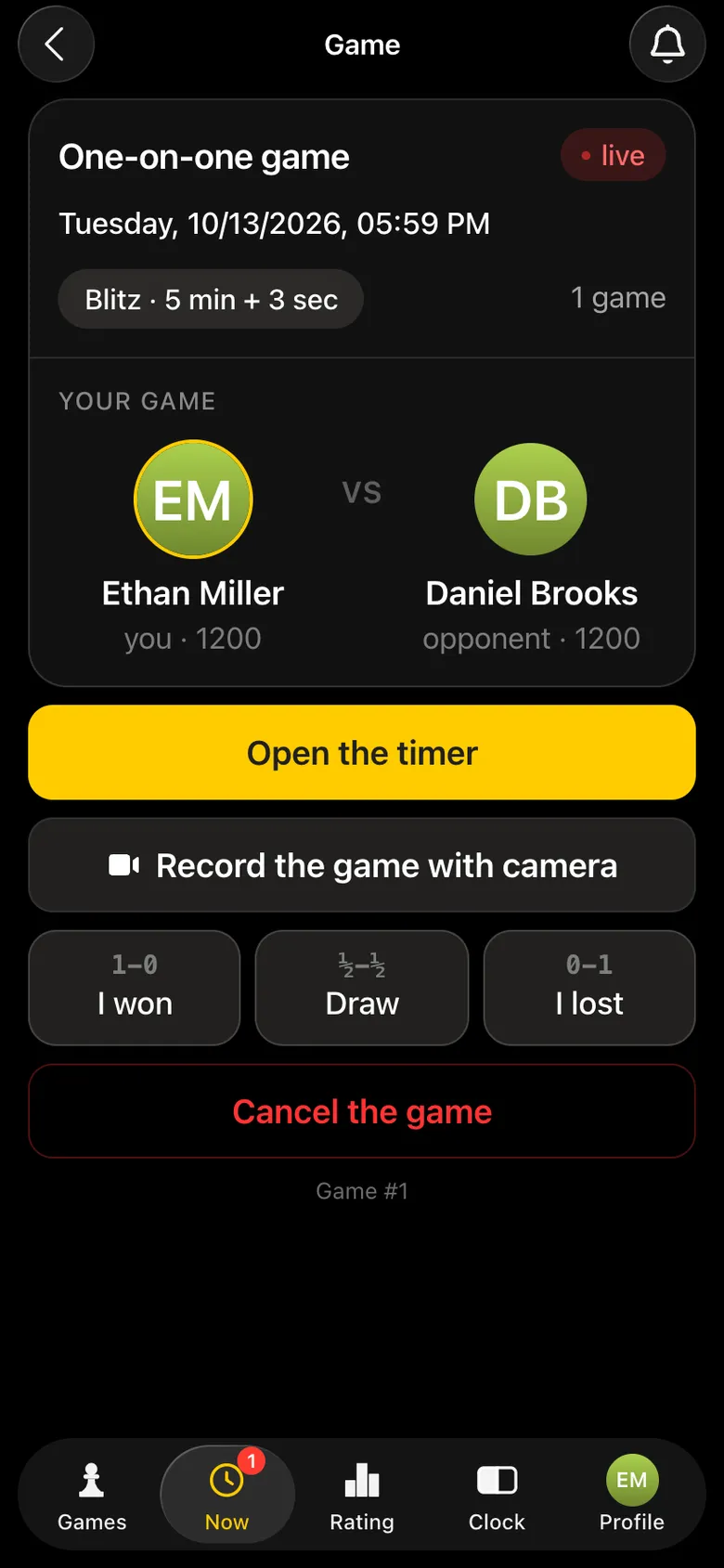
Ethan opens the same game on his phone and taps “Record the game with camera”. He puts the phone on a stand so that the whole board is in the frame.
The viewfinder opens straight away. In a couple of seconds a green frame with dots in the corners lies on the edges of the board, and the squares are marked with a grid. If the frame sits crooked, there are “Auto calibration” and “Calibrate manually”.
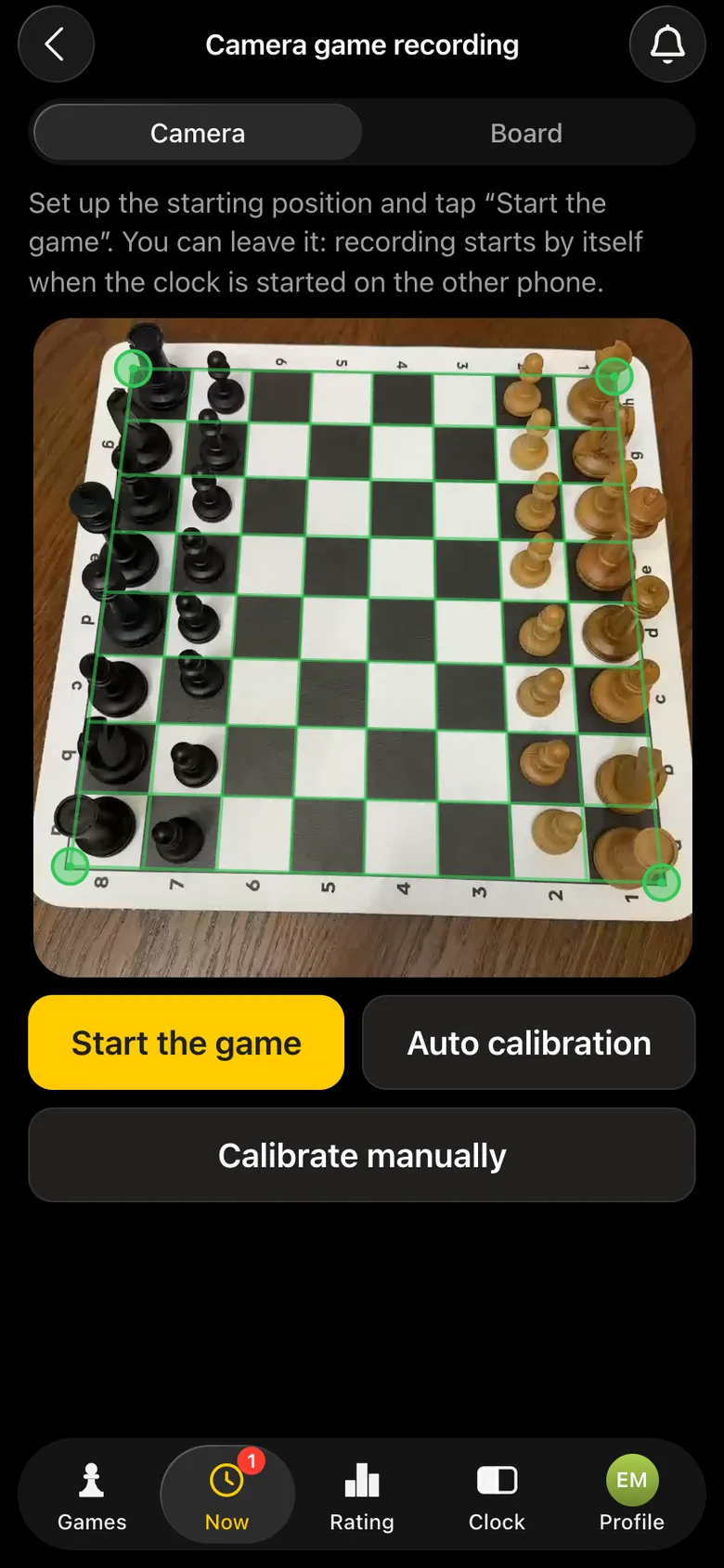
Ethan taps “Start the game” - or taps nothing: recording starts by itself as soon as Daniel starts the clock. From this moment every piece in the frame carries a label, and the labels move together with the pieces.
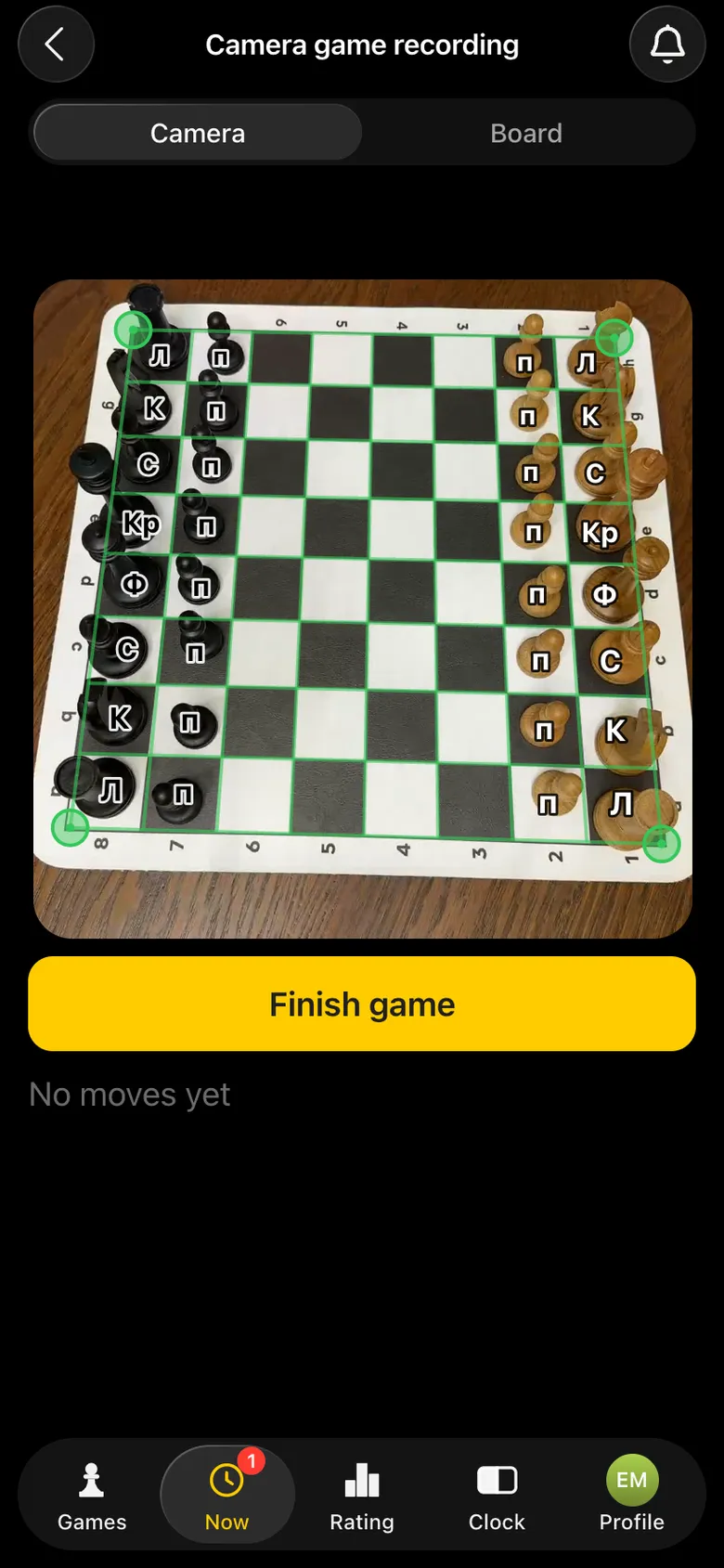
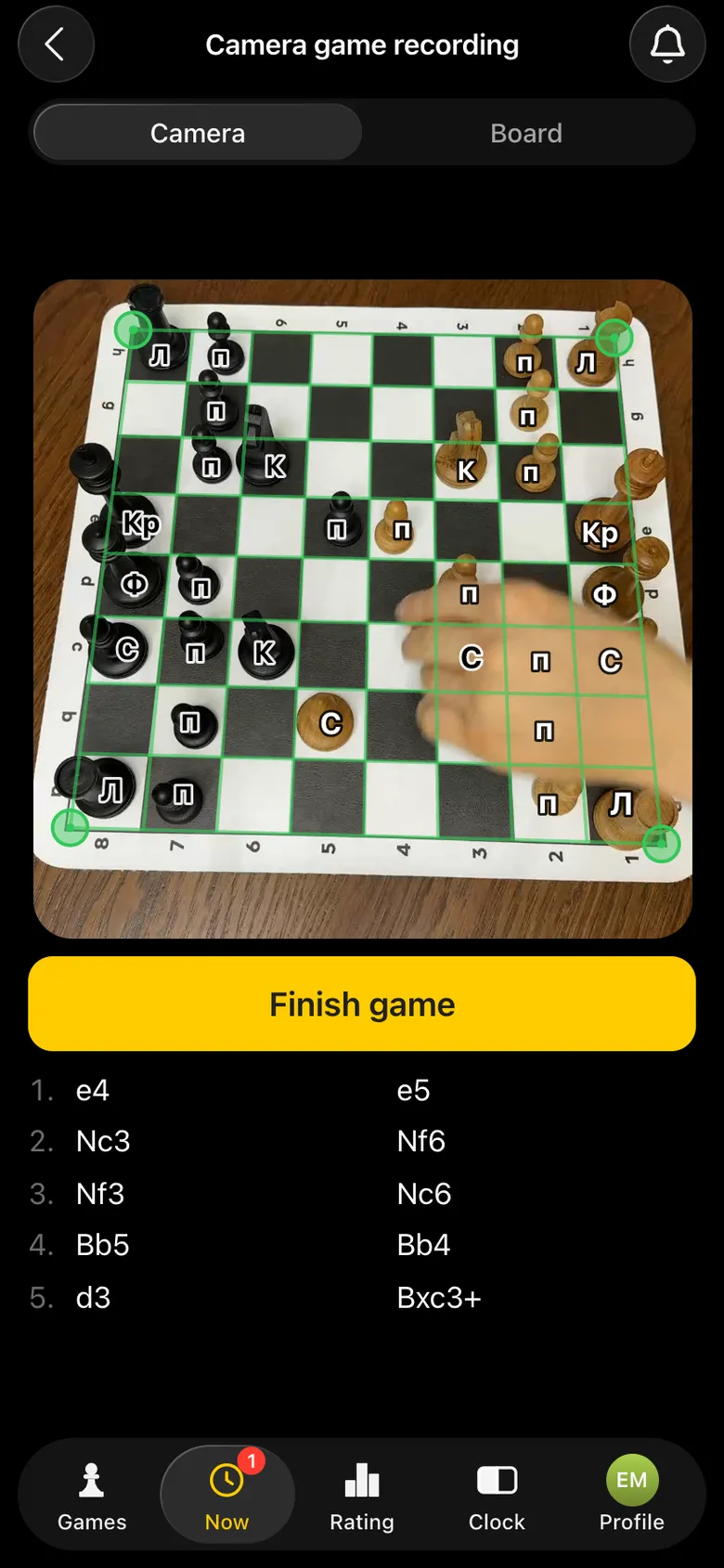
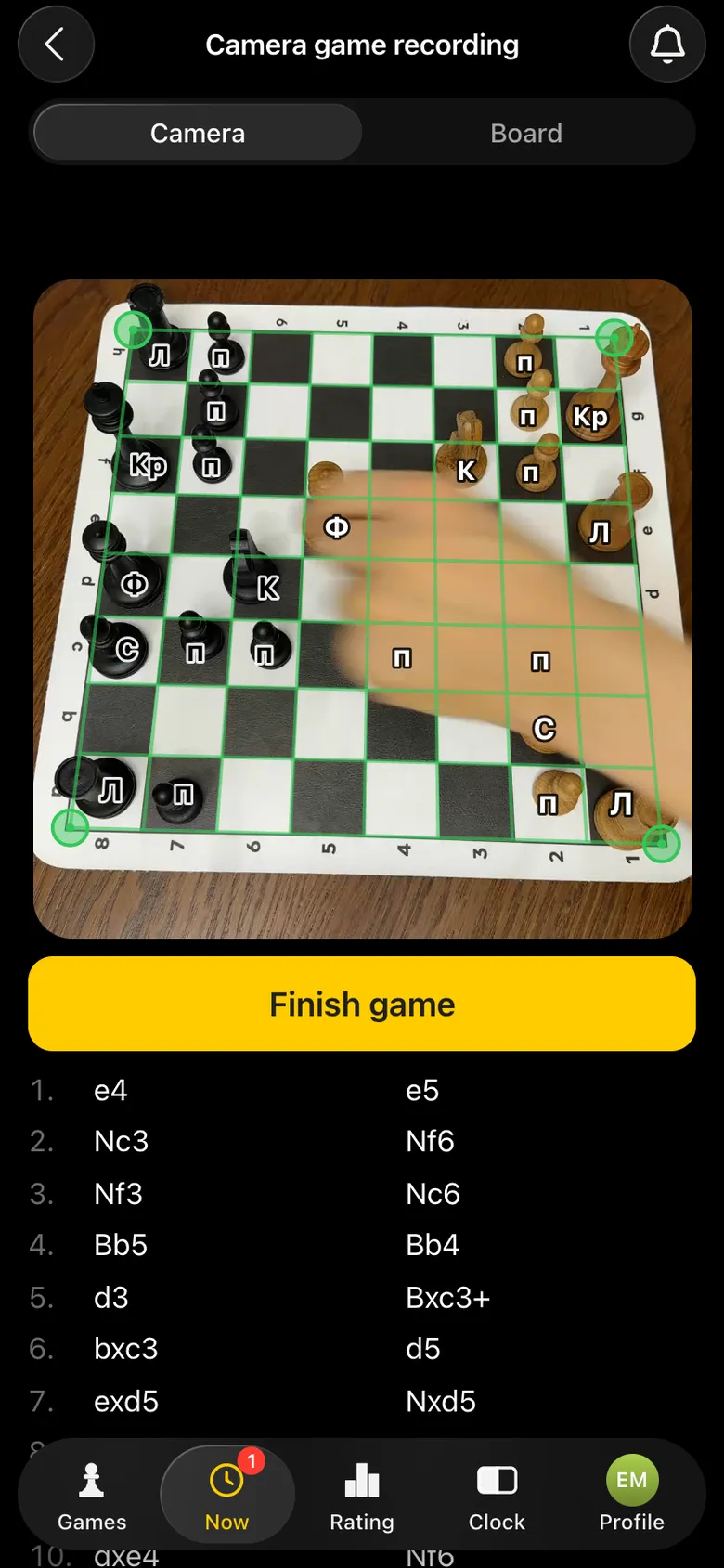
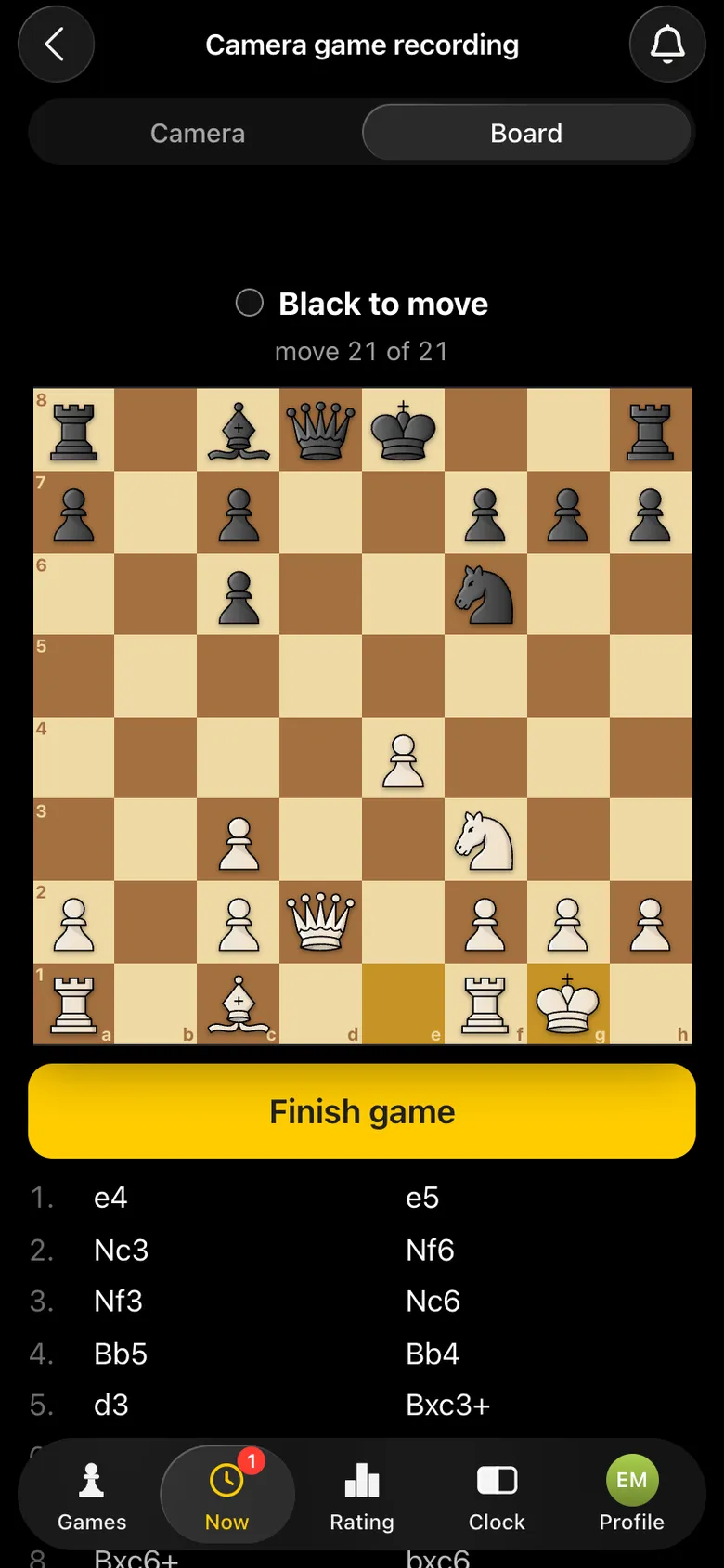
The “Board” tab shows the same game as an ordinary position: whose move it is, how many moves have been played, the last move highlighted. The game record is below. You don't need to watch the screen: the phone stands to the side, the players look at the board.
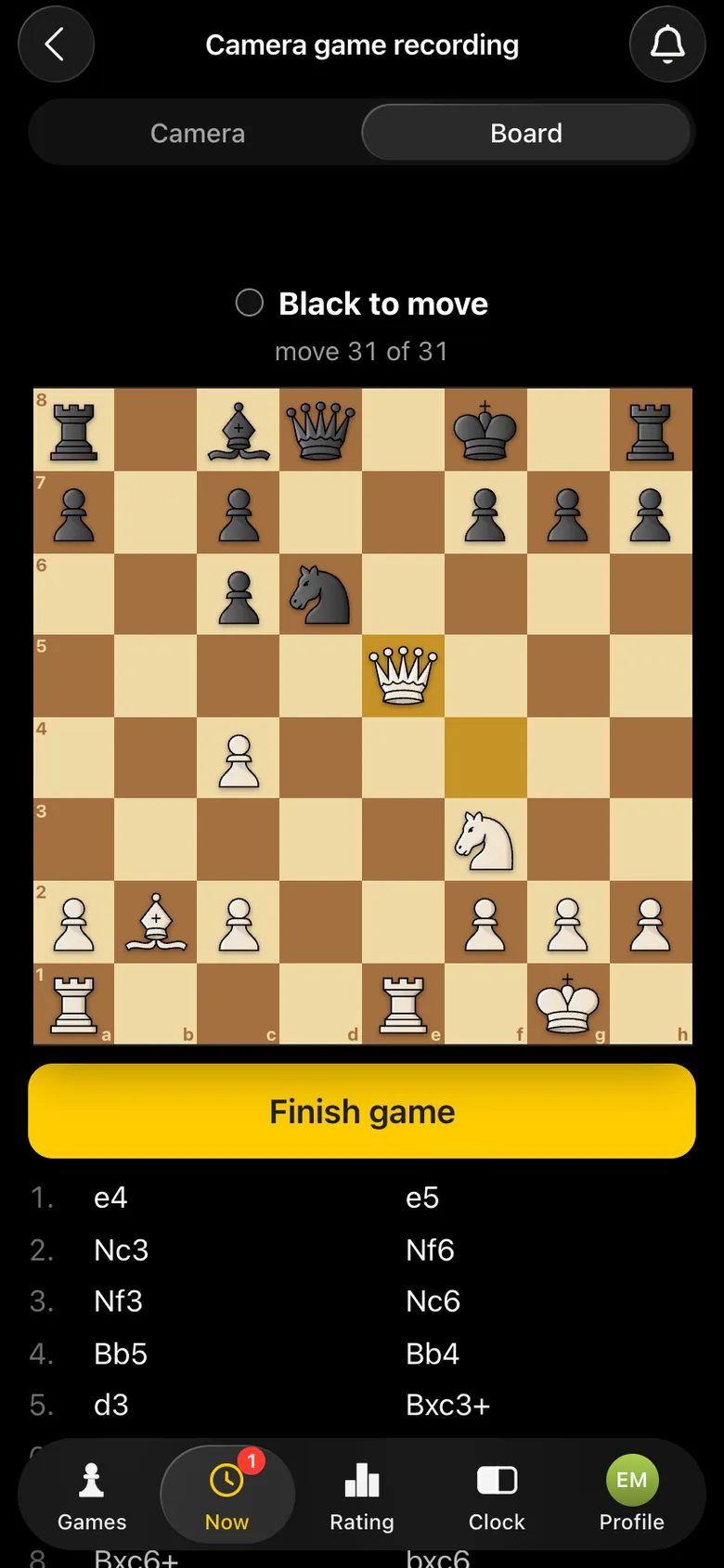
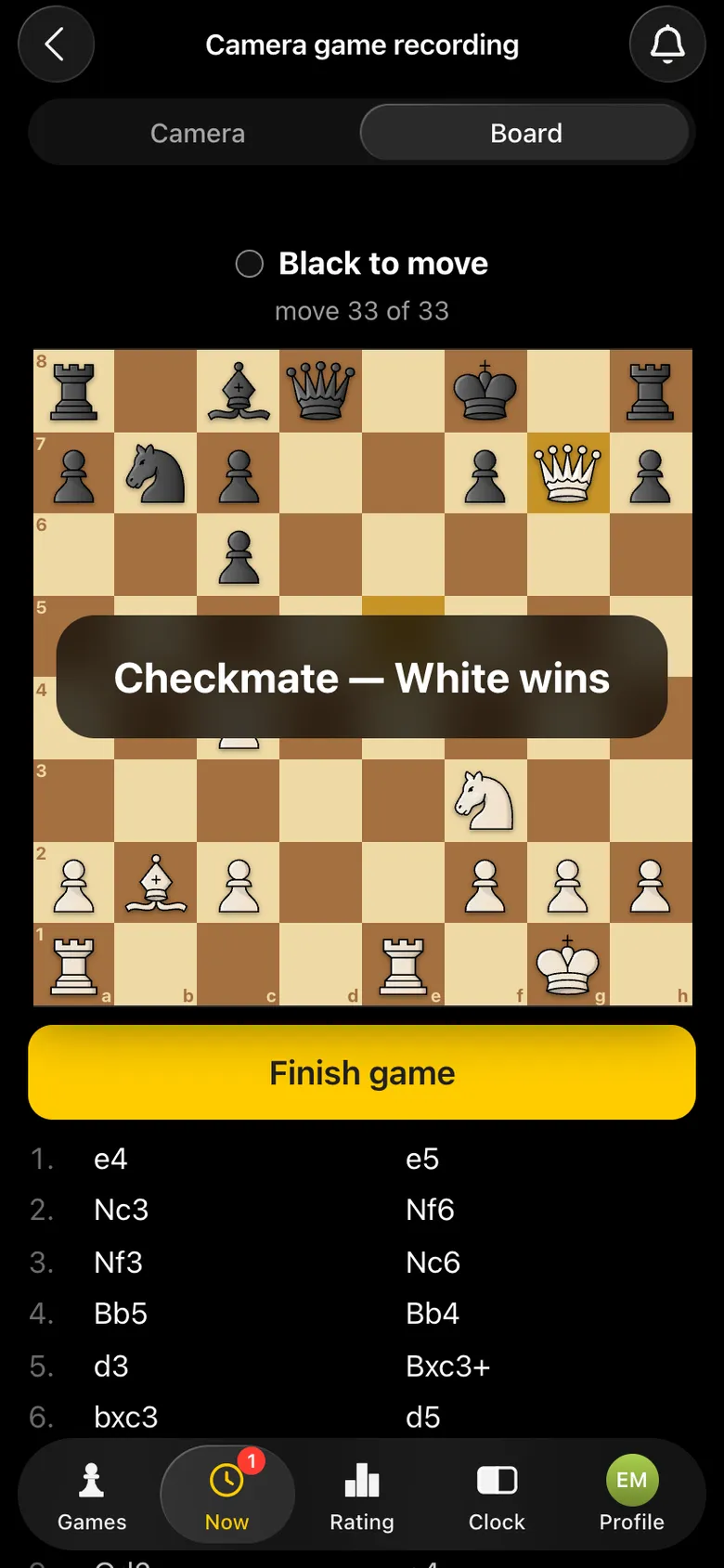
After the checkmate the app went back to the game screen by itself. The result is marked - and the game card holds all 33 moves: you can replay them on a board and analyse them with an engine.
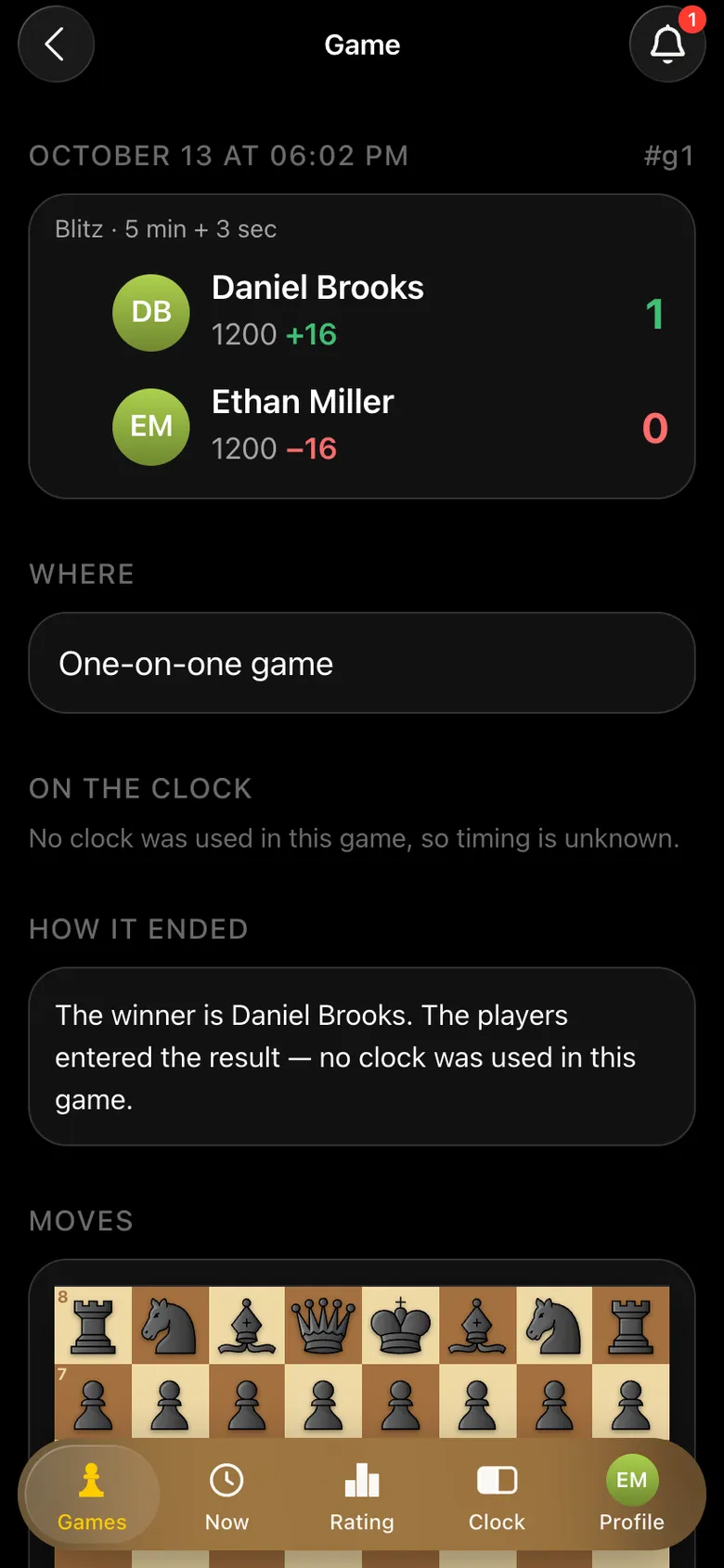
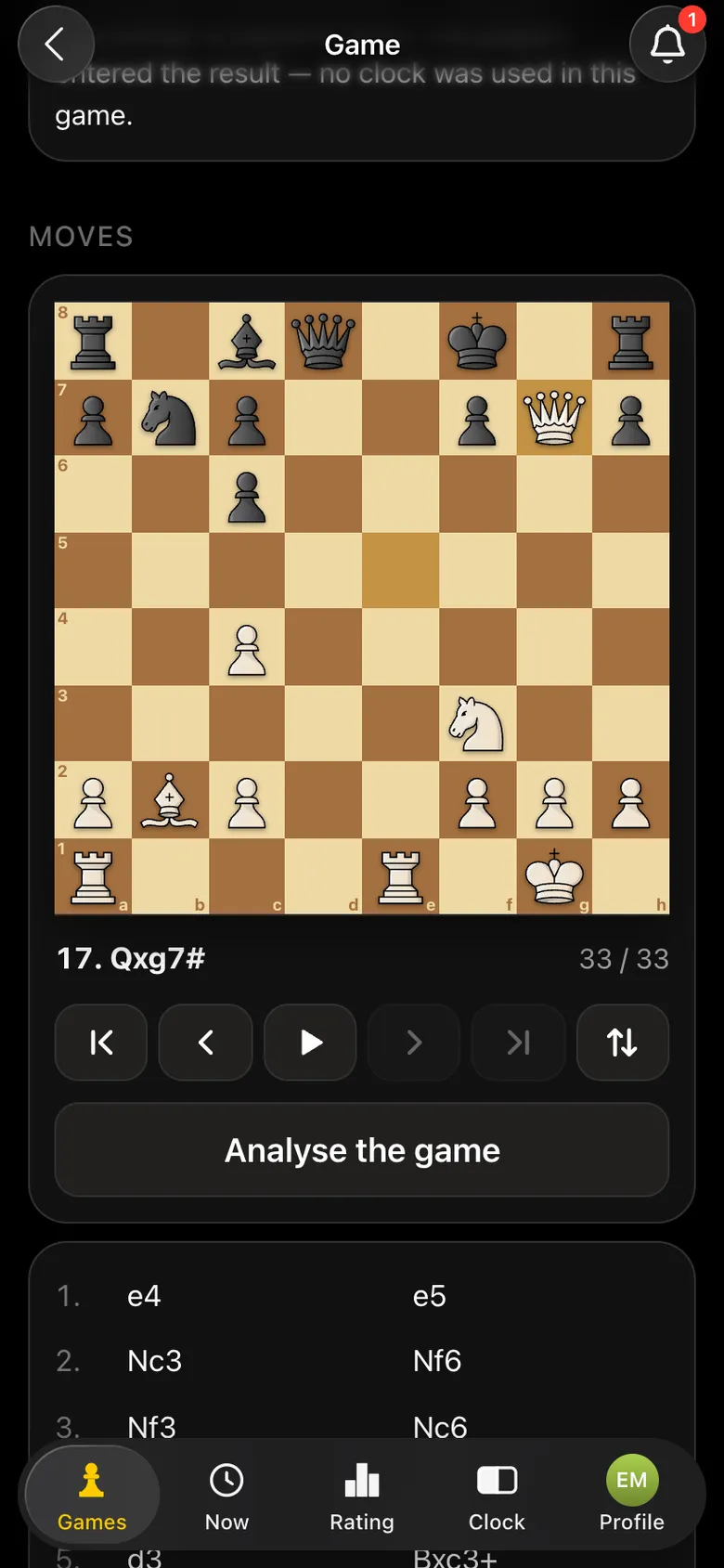
The app recorded this game in full by itself: 33 moves with castling, captures and checks, without a single correction.
Special moves are the hardest part of any automatic recording. In castling two pieces move at once; in en passant the pawn removed is not on the square where the capturing pawn lands. The app records these moves correctly and by itself.
We tested recognition on real games at different boards: wooden and vinyl, tournament and home sets. We filmed from above and from the side, from White's and Black's side, in daylight and evening light. In all these conditions the app reads the position of the pieces with high accuracy.
Recognition keeps improving: every game played with the camera makes it even more accurate.
The app does the rest. Step by step - how to record a game with the camera.
Some programs recognise a position from a single photo - say, a picture of a diagram in a book. They show one position. Camera recording in Vibe Chess follows a live game from start to finish: you end up not with a snapshot but with the whole game move by move, which you can replay and analyse with an engine - game analysis in the app.
Yes. Camera recording is available in tournaments of any system, at the club's casual meetups and in one-on-one games. Each board needs its own phone on a stand.
Yes. The Vibe Chess app recognises an ordinary chess board with the phone camera and records every move of the game. All you need is a phone stand and the whole board in the frame.
No. Ordinary pieces of any design and any board will do: wooden, vinyl, tournament or home.
Yes. Castling, en passant, pawn promotion, check, checkmate and stalemate are recorded by themselves, just like ordinary moves.
We tested it on dozens of games on different boards, in different light and at different angles - the position of the pieces is read with high accuracy. Every new game makes recognition even more accurate.
Recording in Vibe Chess is made for a live game: it follows play from the starting position and saves every move. The app does not recognise single snapshots.
No arbiter skills required. The app takes over the part that usually stops people from running tournaments at all: who plays whom in each round and who finishes first.
The bot is constantly improved based on real tournaments. If you need a feature that isn't there yet, message the developers right inside the bot with the /support command. Many features appeared exactly because organizers asked for them, and useful ideas get added quickly.
How to record a game step by step - recording a game with the camera. What to do with the recorded game - game analysis in the app. How electronic boards work - electronic chess boards. The rules of castling and en passant - castling and how the pawn moves.

At the board since childhood: hazy about his rating, precise about every rook he has blundered. Counts an evening as a good one if the opponent stayed to talk afterwards instead of rushing off to check with an engine. Message →