The right to appeal comes from Article 11.10 of the FIDE Laws: a player may appeal against any decision of the arbiter unless the tournament regulations say otherwise. So the organiser has two honest options:
FIDE has separate procedural rules for the appeals committee (section C.11, since 2023). They are written for FIDE events, but as a model they suit any tournament:
| What | How | Point |
|---|---|---|
| Composition | a chair and two members; optionally two reserves | 2.2, 2.3 |
| Whom to invite | ideally a titled player and an experienced arbiter | 2.1 |
| Independence | members from different federations; a member does not judge a dispute involving their own federation's player - a reserve steps in | 2.4, 3.8 |
| Who may appeal | only the affected party; a player under 18 - through a parent or head of delegation; in a team event - the captain | 3.1, 3.3 |
| When it is possible | only after the chief arbiter's decision | 3.7 |
| Deadline | in writing: one hour in classical, 15 minutes in rapid and blitz after the round or the incident | 3.4 |
| Fee | amount per the regulations; upheld - refunded; rejected - the committee may refund it | 3.6 |
| How it is heard | the chair requests written statements from the opponent and the arbiters | 3.9 |
| Next round | if no more than 3/4 of the rounds are played - on schedule, with the chief arbiter's result | 3.10 |
If the hearing delays the schedule, the next round does not wait: if no more than three quarters of the rounds have been played, it starts on schedule, with the chief arbiter's result for the disputed game. At the end of the tournament it is up to the chief arbiter whether to wait for the committee.
A protocol you can print and fill in by hand:
The committee's decisions are worth attaching to the arbiter's report - that is how it is done at FIDE events too. What else goes into the report - the arbiter's report after a tournament.
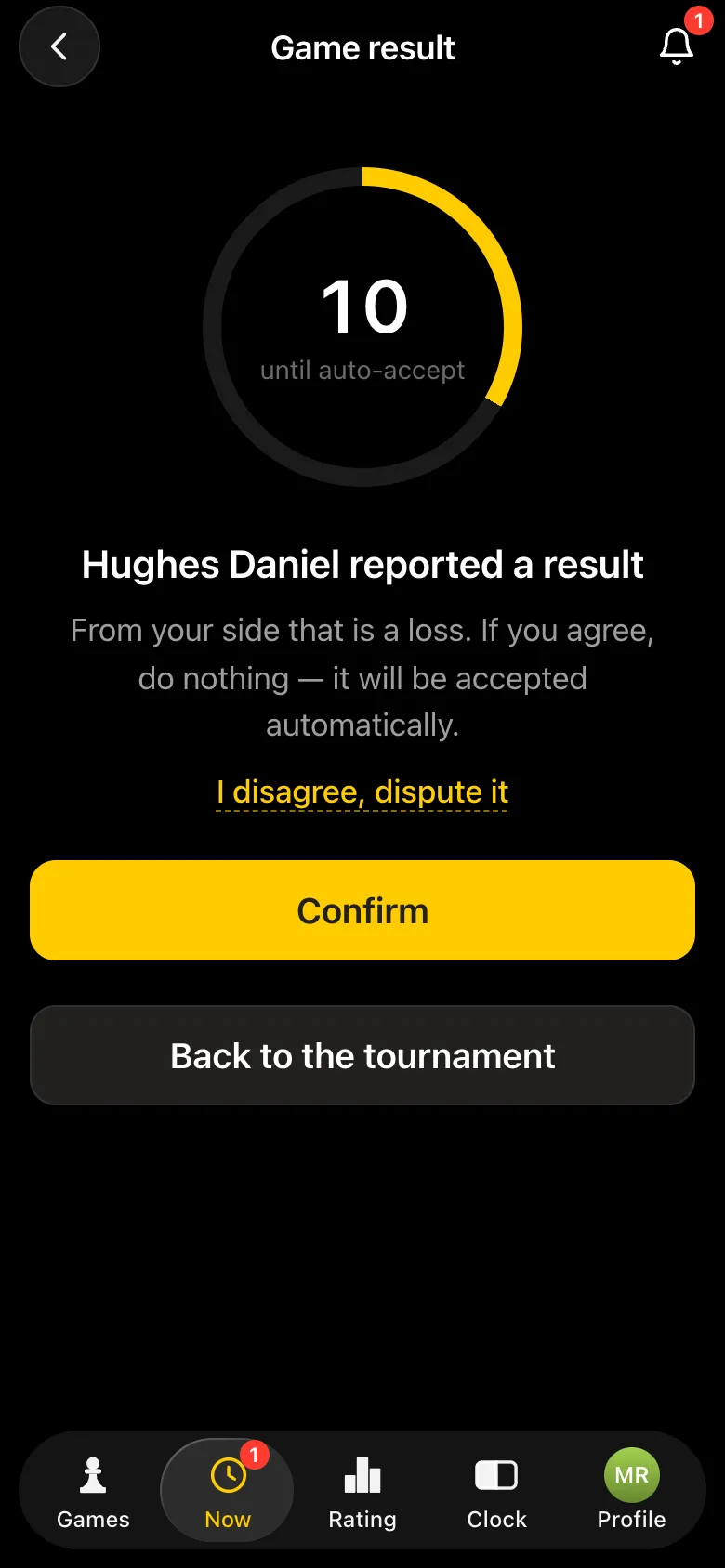
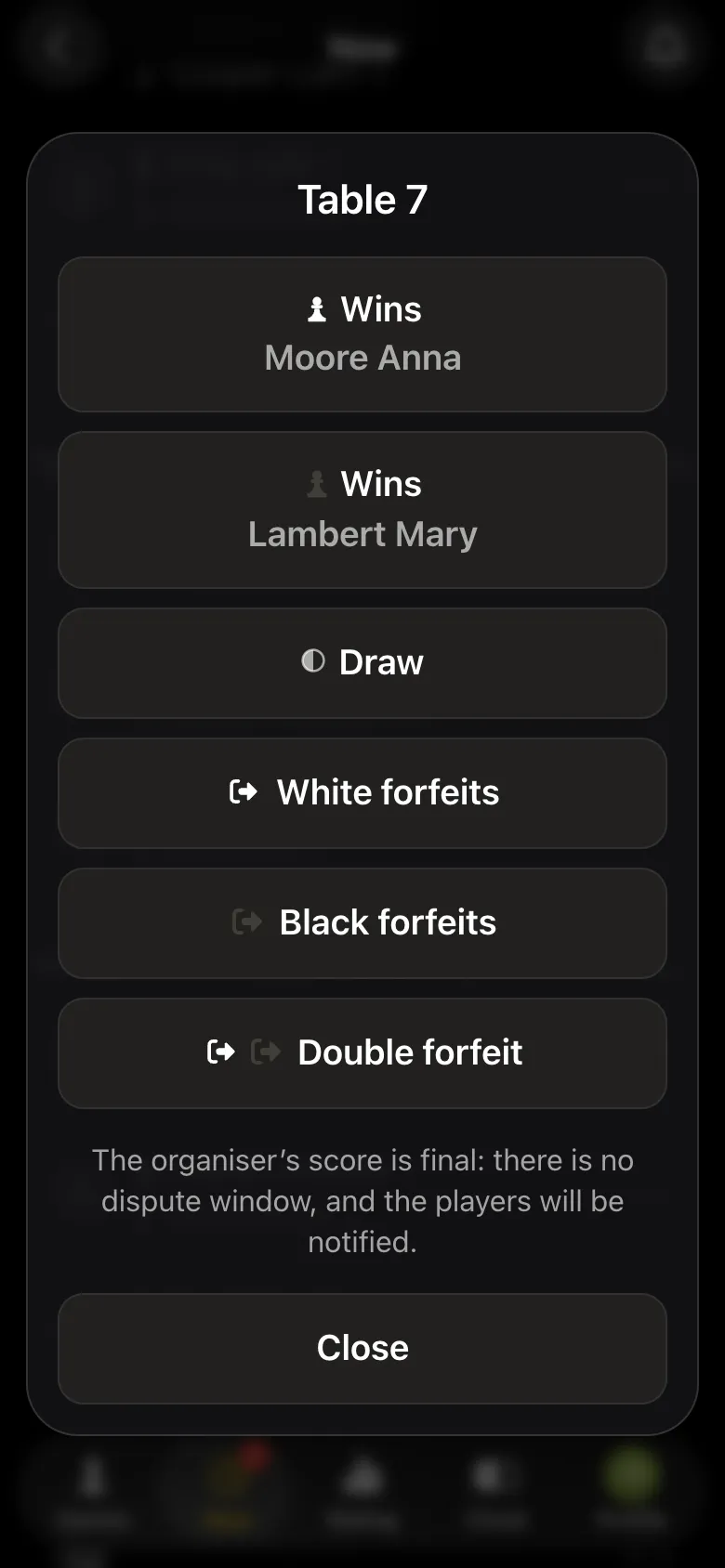
There is no appeals committee in the app. Disputes there go through two steps, which suits amateur tournaments:
Under the FIDE rules - a chair and two members, plus two optional reserves. For your own tournament the same works well: three people and two reserves.
The regulations set it. On the FIDE model - in writing within one hour after the round in classical and 15 minutes in rapid and blitz.
If the appeal is upheld - yes. If it is rejected - under the FIDE rules the committee may refund the fee at its discretion.
No. An appeal is possible only against the chief arbiter's decision: the chief arbiter settles the dispute first.
Under the FIDE rules a player under 18 lodges an appeal through a parent, guardian or head of delegation.
Usually not: if no more than three quarters of the rounds have been played, the round starts on schedule, and the disputed game goes into the pairing with the chief arbiter's result.
The Vibe Chess app opens from a link and needs no installation. Setting up a tournament takes a minute: pick the system, set the date, the venue and the time control - the app handles the rest.
for a large field: opponents are matched by score, you choose the number of rounds
for a small circle: everyone plays everyone, the round count follows from the field
no rounds, no pairings: players sign up and pick opponents at the table
The bot is constantly improved based on real tournaments. If you need a feature that isn't there yet, message the developers right inside the bot with the /support command. Many features appeared exactly because organizers asked for them, and useful ideas get added quickly.
More about arbiting: an appeal at a chess tournament, arbiting a chess tournament, how many arbiters a tournament needs and chess tournament regulations.

At the board since childhood: hazy about his rating, precise about every rook he has blundered. Counts an evening as a good one if the opponent stayed to talk afterwards instead of rushing off to check with an engine. Message →