An organisation here is any group of people that already exists without chess: a company, a department, a university, a school, a factory floor, a local club, a neighbourhood group chat. All that matters is that people have a reason to play for one another.
The whole scheme fits in three lines:
That gives you two events instead of one: two selections and a match. It isn't complexity for its own sake: the selection does half the work. It answers the question “who gets picked” without leaving it to the captain, and along the way it gives each organisation standings of its own, which it never had before.
The selection tournament is an ordinary Swiss of four or five rounds of blitz. An hour and a half, and the list is ready. Everyone who wants to can play, not only those considered strong: the point of a selection is that sometimes it gives an answer nobody expected, and that's the most valuable thing about it.
The final standings are the line-up. First place is board one, tenth place is board ten. Nothing else needs deciding, and that removes the most awkward conversation in any team: why is he on board one and I'm on board four? There's one answer for everyone: that's how the games went.
If the organisation has fewer than twenty people, four rounds are enough: the Swiss system sorts people by strength from round two, and by round four the top of the table has settled. More on how many rounds to choose in a separate guide.
From here on everything is shown on one match, from start to finish. The people and numbers in it are made up: this isn't a report of an evening that took place, it's an example built to show how the method works. Playing are “Project Office” (A from here on) and “Service Centre” (B), ten people from each.
Both selections followed the same regulations: five rounds of 5+3 blitz within each organisation. Here's what they produced.
Five rounds of blitz within the organisation. A player's place in the final standings is their board number; nobody picks the line-up separately.
| Board | Player | Selection points | Rating |
|---|---|---|---|
| 1 | Andrew Lewis | 4½ | 1720 |
| 2 | Marina Sobol | 4 | 1650 |
| 3 | Peter Gaines | 4 | 1610 |
| 4 | Dennis Carter | 3½ | 1540 |
| 5 | Olivia Reed | 3 | 1480 |
| 6 | Igor Shaw | 3 | 1430 |
| 7 | Natalie Boyd | 2½ | 1380 |
| 8 | Roman West | 2 | 1320 |
| 9 | Alice Curtis | 2 | 1265 |
| 10 | Tim Bass | 1½ | 1210 |
The same regulations and the same time control. Otherwise the two top tens couldn't be compared and a board number would mean nothing.
| Board | Player | Selection points | Rating |
|---|---|---|---|
| 1 | Sergei Pollock | 4½ | 1605 |
| 2 | Helen Grant | 4 | 1560 |
| 3 | Michael Thorpe | 3½ | 1525 |
| 4 | Vera Nash | 3½ | 1500 |
| 5 | Arthur Goss | 3 | 1470 |
| 6 | Julia Mercer | 3 | 1455 |
| 7 | Kirill Osborne | 2½ | 1440 |
| 8 | Daria Lobb | 2½ | 1410 |
| 9 | Anton Stroud | 2 | 1390 |
| 10 | Polly Kim | 1½ | 1360 |
The difference between the line-ups is visible straight away, and it isn't in the average rating, which is almost the same (1460.5 for A, 1471.5 for B). The difference is in the shape: A has a strong top and a weak tail, B has an even row with no stars and no weak spots.
This is the key chart of the article. The lines cross at about board six: above it A is stronger, below it B. And that's exactly why a match by boards gives a different result from the one a glance at the top names suggests.
Once you have both top tens, the pairings make themselves: first against first, second against second, tenth against tenth. There's no draw for pairings at all; the match is known in advance, and that's a strength in itself: each player knows their opponent before sitting down at the board.
There's no draw for pairings: the pairs are known in advance. The rating gap flips sign at board six: above it A is stronger, below it B.
| Board | Project Office (A) | Service Centre (B) | Gap | White |
|---|---|---|---|---|
| 1 | Andrew Lewis 1720 | Sergei Pollock 1605 | +115 to A | A |
| 2 | Marina Sobol 1650 | Helen Grant 1560 | +90 to A | B |
| 3 | Peter Gaines 1610 | Michael Thorpe 1525 | +85 to A | A |
| 4 | Dennis Carter 1540 | Vera Nash 1500 | +40 to A | B |
| 5 | Olivia Reed 1480 | Arthur Goss 1470 | +10 to A | A |
| 6 | Igor Shaw 1430 | Julia Mercer 1455 | +25 to B | B |
| 7 | Natalie Boyd 1380 | Kirill Osborne 1440 | +60 to B | A |
| 8 | Roman West 1320 | Daria Lobb 1410 | +90 to B | B |
| 9 | Alice Curtis 1265 | Anton Stroud 1390 | +125 to B | A |
| 10 | Tim Bass 1210 | Polly Kim 1360 | +150 to B | B |
Why this way and not at random? With random pairings, one organisation's strong player might land the other's weakest, and the match turns into a lottery of the draw. With pairings by number each board is an even fight, and the match is won by the organisation whose whole line-up is more even. One very strong player brings at most one point out of ten, and that isn't enough.
Ten boards is a convenient number, but not a required one. Use what the smaller organisation can field: six, eight, twelve. All that matters is that the number is the same on both sides, and even if you plan to split the colours equally.
The simplest and most common scoring is by games: a win gives one point, a draw half, a loss zero. The points from all ten boards are added up. Ten boards means ten points at stake, and you need 5½ to win the match.
A win is one point, a draw is half. Ten boards means ten points at stake, and you need 5½ to win.
| Board | Pairing | Score | Point to |
|---|---|---|---|
| 1 | Andrew Lewis - Sergei Pollock | 1 : 0 | A |
| 2 | Marina Sobol - Helen Grant | 1 : 0 | A |
| 3 | Peter Gaines - Michael Thorpe | ½ : ½ | shared |
| 4 | Dennis Carter - Vera Nash | 1 : 0 | A |
| 5 | Olivia Reed - Arthur Goss | ½ : ½ | shared |
| 6 | Igor Shaw - Julia Mercer | 0 : 1 | B |
| 7 | Natalie Boyd - Kirill Osborne | 0 : 1 | B |
| 8 | Roman West - Daria Lobb | 0 : 1 | B |
| 9 | Alice Curtis - Anton Stroud | 0 : 1 | B |
| 10 | Tim Bass - Polly Kim | 0 : 1 | B |
| Total | 4 : 6 | Service Centre wins |
The score is 4 : 6, and that's exactly the outcome the example was built for. A took three wins and two draws on the first five boards, where it's stronger. And lost the match, because its tail gave away five boards in a row.
A bar to the right is a point for A, to the left a point for B, grey is a draw. You can see the wins aren't mixed up but come in blocks: the top of the table goes to one organisation, the bottom to the other. That's almost always how it goes when the line-ups have different shapes, and it's the main lesson of the method: the match isn't decided by board one, but by the board where the gap in strength is largest.
The running score shows the same thing another way: after board five A leads 4 : 1 and looks like the winner. At board eight the score is level, and the last two games decide the match. That's why the organiser should announce the score not as it goes but in blocks: an early score is misleading, and a room that hears “4 : 1” treats the match as over.
The practical takeaway for a captain: if you have a choice of who to add to the top ten, don't take a second strong player, take the one who will hold board nine or ten. A point at the bottom is worth exactly as much as a point on board one, and it's easier to win there.
A 5:5 tie happens more often than you'd think, and the rule for it is announced before the start, not invented afterwards. Workable options, from simple to more involved: the win goes to the organisation that won on board one; or results are compared from the top down, board by board, until the first difference; or the top boards play an extra rapid game. Any of these works; the only thing that doesn't is having no agreement.
The second way of scoring is by match points: you need it when there are more than two organisations and matches are played in rounds. The difference between the two systems, and how they can produce different winners, is covered in the article on team scoring.
Five things, each of which will otherwise come up in the middle of the evening:
The app handles both heavy parts: the selection and recording the games. It's free, works in the browser and inside Telegram, and needs no club status, licence or arbiter qualification.
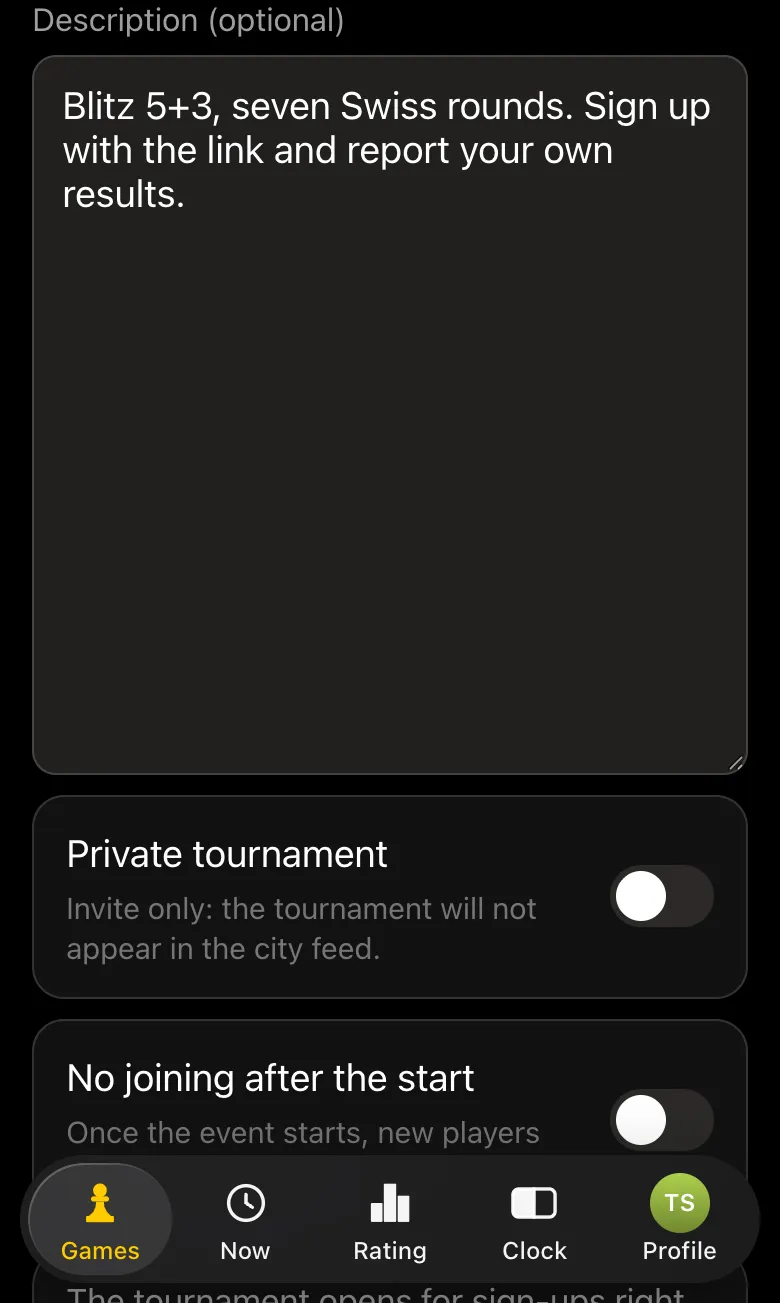
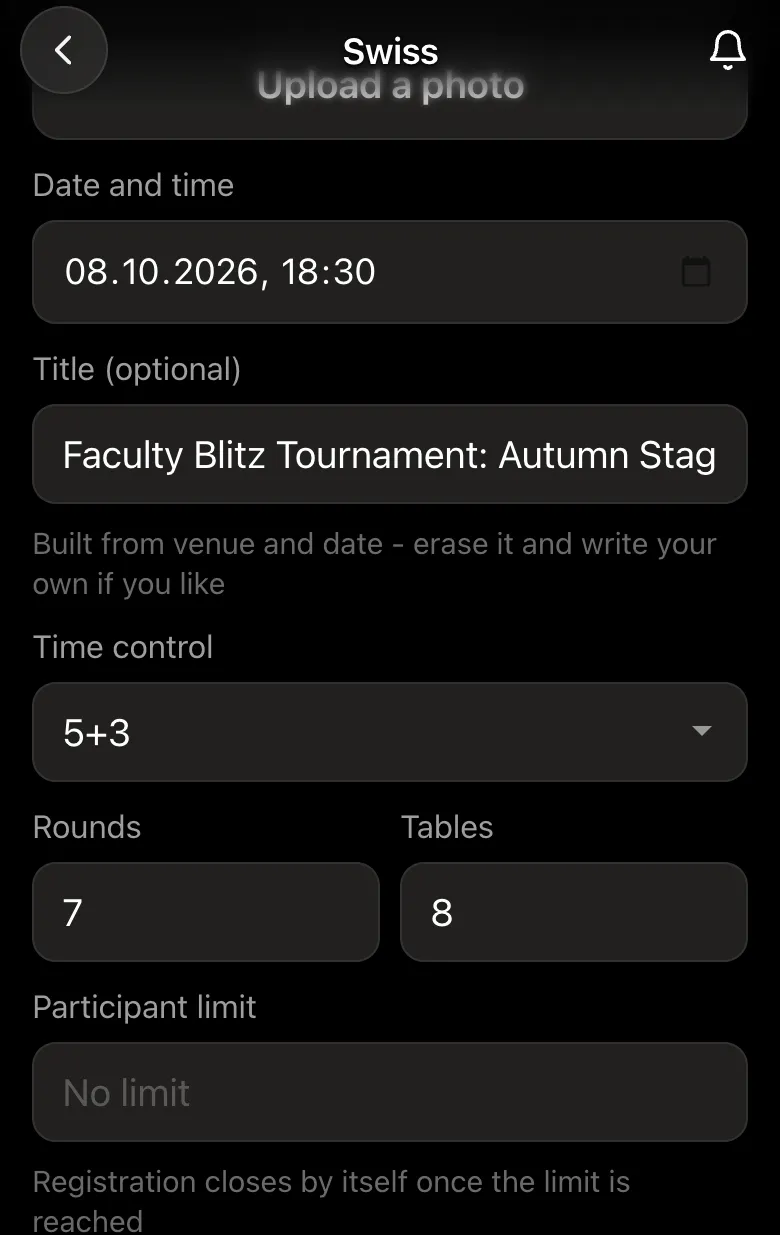
Selection.It's an ordinary tournament in the app: you create an event, send out a link or show a QR code, and people sign up themselves. Each round is paired by the same engine that runs rated tournaments, and it balances colours and avoids repeat opponents by itself.
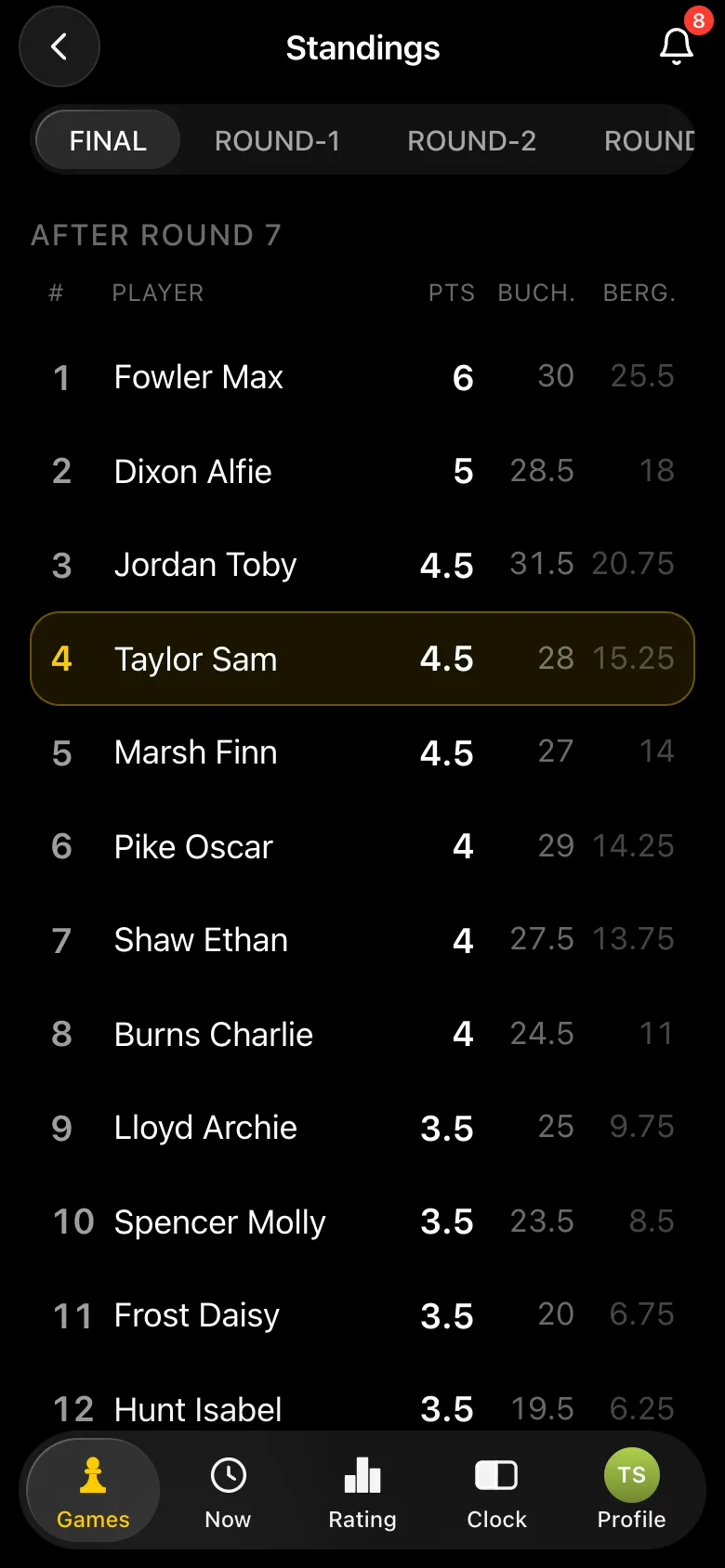
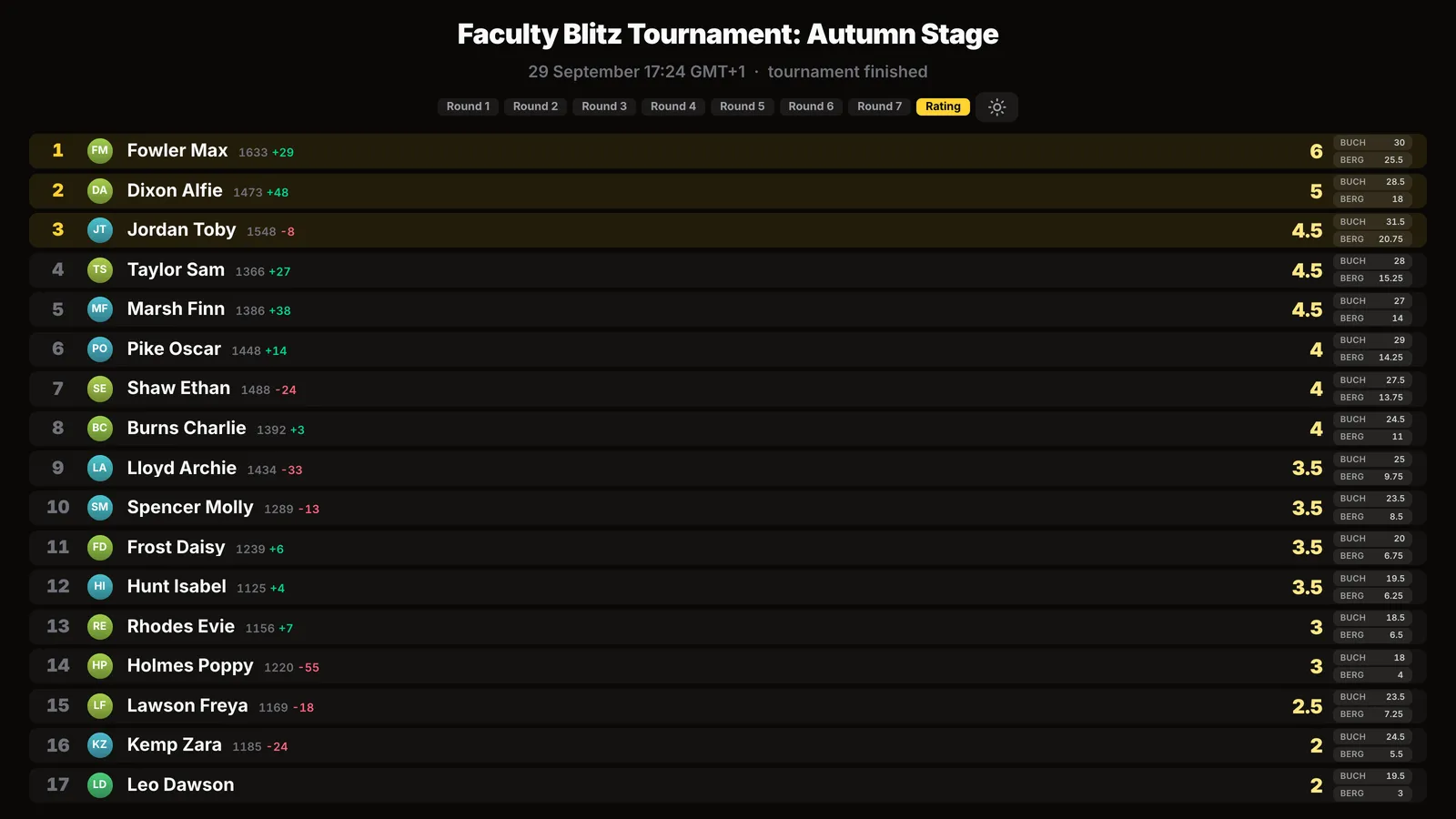
After the last round you have finished standings with the Buchholz score, that is, a list from strongest to weakest, and the top ten is taken straight from the top. Exactly the table shown above in the selection section, only with real people.
The match. There are two ways to go here, and the choice depends on the number of boards.
Up to four boards: the team format, and the score adds itself up. The app has a team Swiss: team size is set when you create the event (2, 3 or 4), a match takes up the right number of neighbouring tables, each board's result goes into the match score without the organiser lifting a finger, and there are two tables, team and individual.
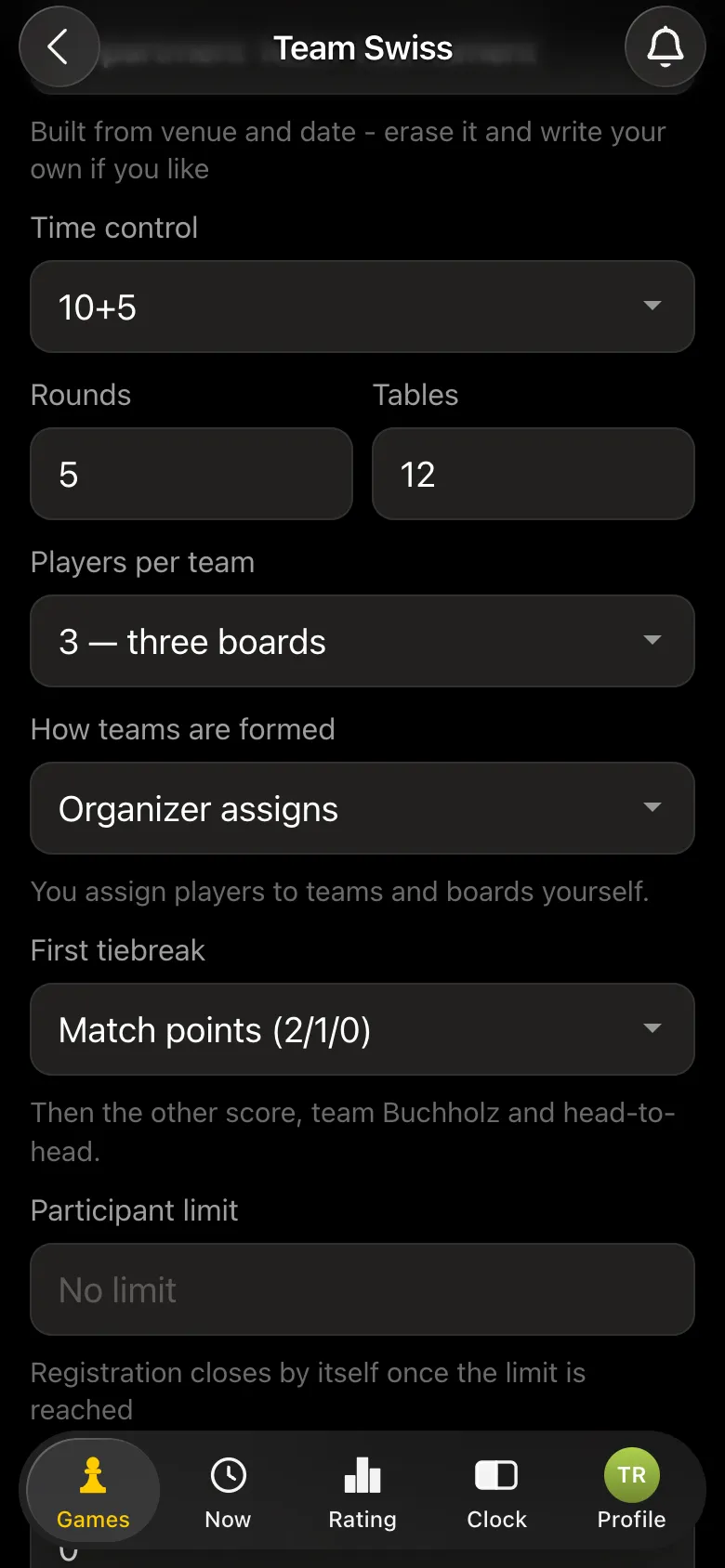
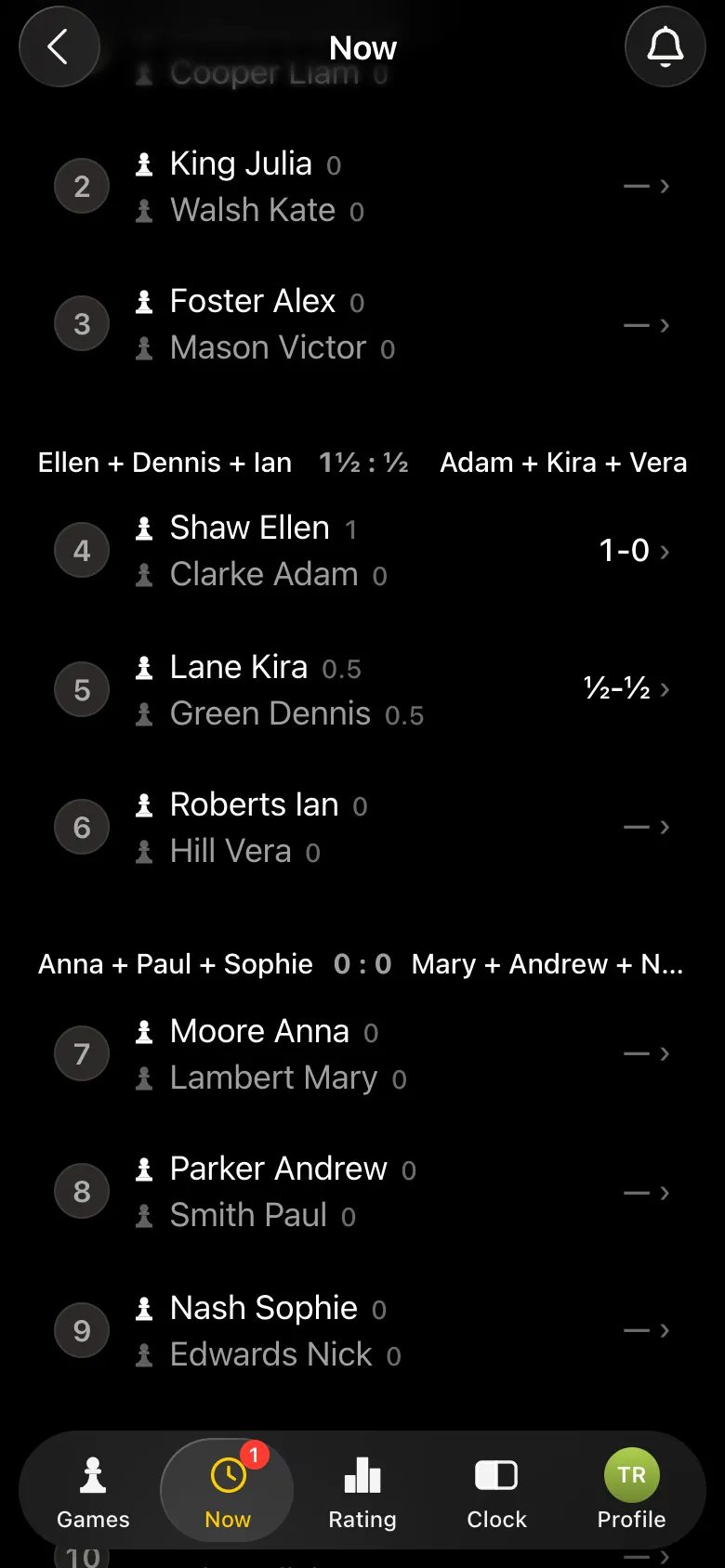
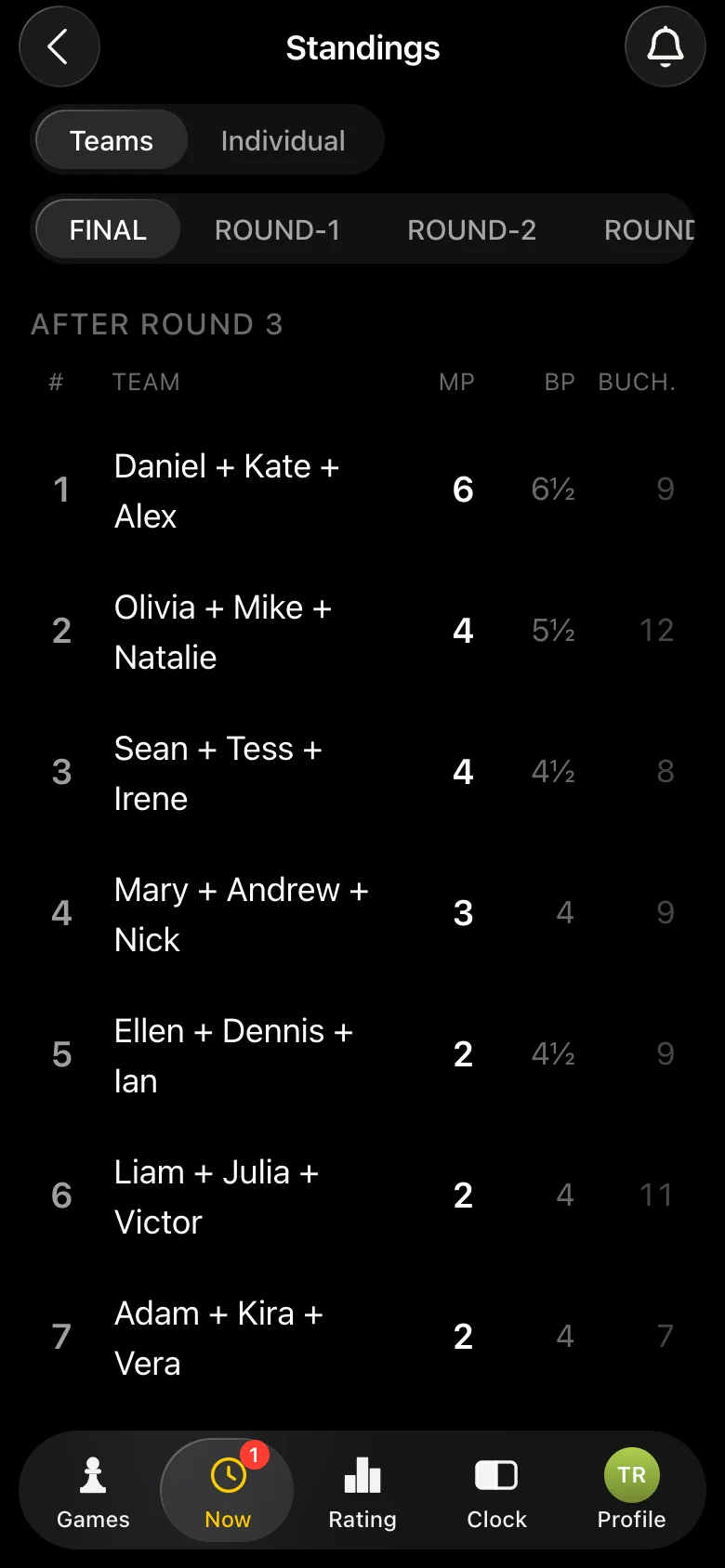
Ten boards: by hand for now, and that's an honest limit. The team format is built for teams of 2-4 people and a Swiss between many teams, not one match of two line-ups of ten. On ten boards each game is set up as an ordinary game between two players, played with a clock on a phone and recorded in both players' club rating, and the organiser adds up the ten numbers, which is one line in a notebook. The app gives you each game's result, each player's rating and the standings of both selections; the addition is up to you.
A workaround if you don't want to add it up: play the match on four boards instead of ten, and put the rest out as a second match between the next fours. Two matches instead of one, but the app scores both.
If the match isn't a one-off but a recurring thing, it makes sense to set up a league: it has its own rating sheet, and results of open tournaments in the city don't move it.
Running it yourselves is entirely doable, and most people do. You need one person willing to spend an evening on organising, enough boards for the number of pairs and a room where ten pairs can sit for two hours. The app is free and doesn't limit the number of players or tournaments.
It's worth bringing us in where there's no organiser in-house or the occasion needs to feel like an event: we bring boards and clocks, run both selections and the match, put the standings on the screen in the room, and take care of disputes and the prizegiving. It's our usual turnkey corporate tournament format, just with a match scheme instead of an individual one.
By the way, the second organisation doesn't have to find itself: an opponent can be found. We match companies and universities with each other, and there's a separate page about it.
For the match, as many as there are boards, usually ten. For the selection, the more the better: from twelve to fifteen people the standings start to mean something. If an organisation has exactly ten volunteers, a selection is still useful: it settles the board order.
You can, if the line-up is obvious and nobody has questions. But it's the selection that settles the argument about who plays on which board, and it often changes people's idea of who the strongest players are.
Two selections of an hour and a half each and a match of an hour and a half to two hours. Usually that's three separate evenings, but the selection and the match can be combined into one long day.
No. Use as many as the smaller organisation can field: six, eight, twelve. What matters is the same number on both sides. On four boards the app adds up the match score by itself.
A match by boards shows that more honestly than any other format: it's not one person who turns out weaker but the whole row. If the gap is known in advance, you play not for the win but for the score, and compare the next match with the previous one.
No, and the example above shows it: the organisation that won boards one, two and four lost the match 4:6, because it gave away five boards in a row at the bottom. A point on board one is worth the same as a point on board ten.
The rule is announced before the start. Most often the side that won on board one takes it; the second option is comparing results from the top down; the third is an extra rapid game between the top boards.
No. The pairings are known in advance, the app runs the clocks, and the organiser settles disputes. No arbiter qualification is needed for either the selection or the match.
Yes, each game is recorded in both players' club rating. The team format has a Not rated switch for a friendly match. If you need separate standings unrelated to city tournaments, you set up a league with its own rating sheet.
Up to four boards, yes: in the team format the match score adds itself up, and there's a team table. On ten boards the app gives you each game's result, and the organiser adds up the ten numbers.
The app is free: no paid tiers, no limit on the number of players or tournaments. You only pay if you bring us in to run the event.
The Vibe Chess app is built for an evening over the board, not for online play: it keeps the sign-up list, the pairings and the table while you deal with people and the venue. All of it free.
score groups, no rematches, no second bye
everyone plays everyone, the app works out the number of rounds
who is free and who is already at a board is shown under Now
The bot is constantly improved based on real tournaments. If you need a feature that isn't there yet, message the developers right inside the bot with the /support command. Many features appeared exactly because organizers asked for them, and useful ideas get added quickly.
Board order and two systems of team scoring: team tournament. The team Swiss in the app, with screenshots: here. A different match scheme, where everyone plays everyone: Scheveningen. A match inside one company: tournament between departments. What corporate chess is in general: here.

At the board since childhood: hazy about his rating, precise about every rook he has blundered. Counts an evening as a good one if the opponent stayed to talk afterwards instead of rushing off to check with an engine. Message →